ScienceFreePrintable

Cell Biology Fundamentals

A free science worksheet ready for your classroom. Open in Kuraplan to grab the print-ready PDF, customize it for your students, or generate a fresh version in seconds.
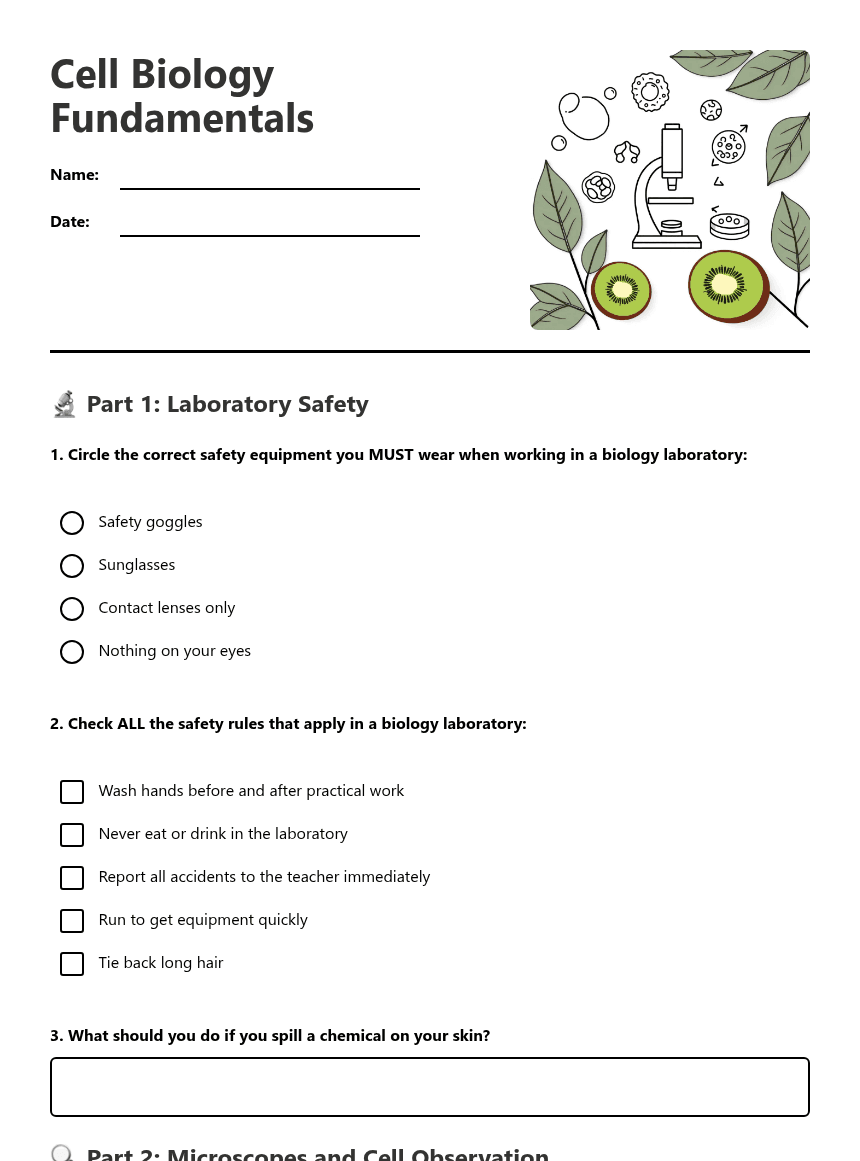
Cell Biology Fundamentals worksheet preview
Cell Biology Fundamentals

Cell Biology Fundamentals

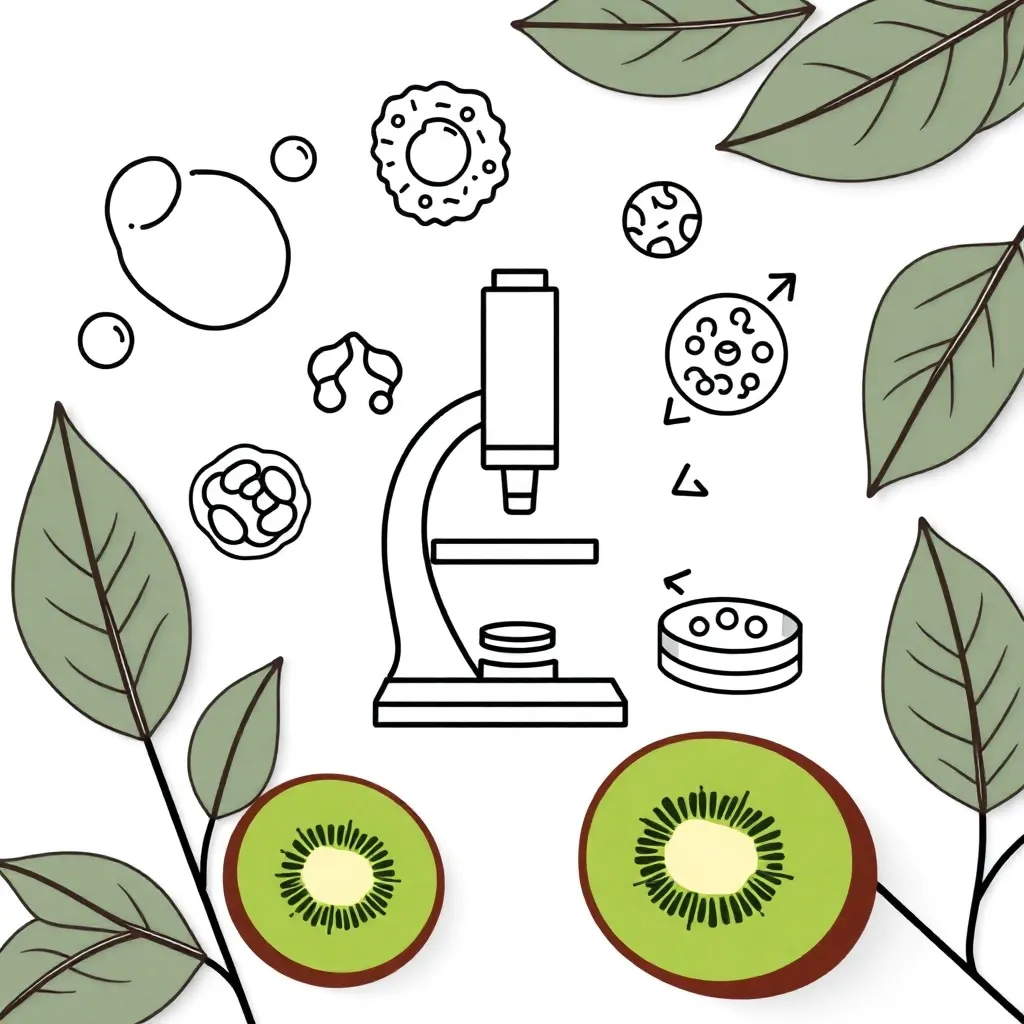
Cell biology illustration showing plant and animal cells

🔬 Part 1: Laboratory Safety

1. Circle the correct safety equipment you MUST wear when working in a biology laboratory:

Safety goggles

Sunglasses

Contact lenses only

Nothing on your eyes

2. Check ALL the safety rules that apply in a biology laboratory:

Wash hands before and after practical work

Never eat or drink in the laboratory

Report all accidents to the teacher immediately

Run to get equipment quickly

Tie back long hair

3. What should you do if you spill a chemical on your skin?

🔍 Part 2: Microscopes and Cell Observation

4. Fill in the blanks about microscope parts:

The ____________ lens is the one you look through, while the ____________ lens magnifies the specimen. To focus the image clearly, you adjust the ____________ knobs.

5. If the eyepiece lens has a magnification of ×10 and the objective lens has a magnification of ×40, what is the total magnification?
6. Draw what you might see when looking at plant cells under a microscope. Label at least 3 parts:

🌱 Part 3: Types of Cells

7. Match the cell type with its characteristics:
1. Prokaryotic cells
2. Eukaryotic cells
3. Plant cells
4. Animal cells
A. Have a cell wall and chloroplasts
B. No nucleus, DNA freely floating
C. Have a nucleus and membrane-bound organelles
D. Have centrioles and no cell wall
8. Which of the following is found in plant cells but NOT in animal cells?

Nucleus

Cell membrane

Chloroplasts

Mitochondria

🧬 Part 4: Cell Structure and Function

9. Complete the table by filling in the function of each organelle:

Cell membrane: ________________________

Nucleus: ________________________

Mitochondria: ________________________

Ribosomes: ________________________

Vacuole: ________________________

10. Explain why the nucleus is often called the "control centre" of the cell:

🦠 Part 5: Bacteria

11. Check ALL the characteristics that describe bacteria:

Single-celled organisms

Have a nucleus

Prokaryotic cells

Can reproduce rapidly

Always cause disease

12. Name two beneficial uses of bacteria:

💧 Part 6: Diffusion, Osmosis and Cell Transport

13. Define the following terms:

Diffusion: ________________________________________

Osmosis: ________________________________________

Active transport: ________________________________________

14. A red blood cell is placed in pure water. What will happen to the cell and why?

It will shrink because water moves out

It will swell and may burst because water moves in

Nothing will happen

It will change colour

15. Draw a diagram showing diffusion of particles from high concentration to low concentration:
16. Explain why active transport requires energy while diffusion does not:

🧪 Part 7: Introduction to Bioscience

17. What is bioscience? Give a brief definition:
18. List three careers that involve bioscience:

1. ________________________

2. ________________________

3. ________________________

19. How might studying cells help us understand human health and disease?

About This Worksheet

Free in Kuraplan

Sign up free, grab the PDF, and customize it for your class.

Print-Ready

Formatted for standard paper. Clean layout, easy to read.

AI-Generated

Created with Kuraplan's AI, designed for real classroom use.

For Teachers & Parents

Use in classrooms, for homework, tutoring, or homeschool.

Need a custom version of this worksheet?

Kuraplan's AI generates custom worksheets in seconds — differentiated for every learner, aligned to your curriculum.

Generate Custom Worksheets — Free
No credit card Curriculum-aligned Under 60 seconds