ScienceFreePrintable

Chemical Reactions Assessment Worksheet

A free science worksheet ready for your classroom. Open in Kuraplan to grab the print-ready PDF, customize it for your students, or generate a fresh version in seconds.
Chemical Reactions Assessment Worksheet worksheet preview
Name:Date:

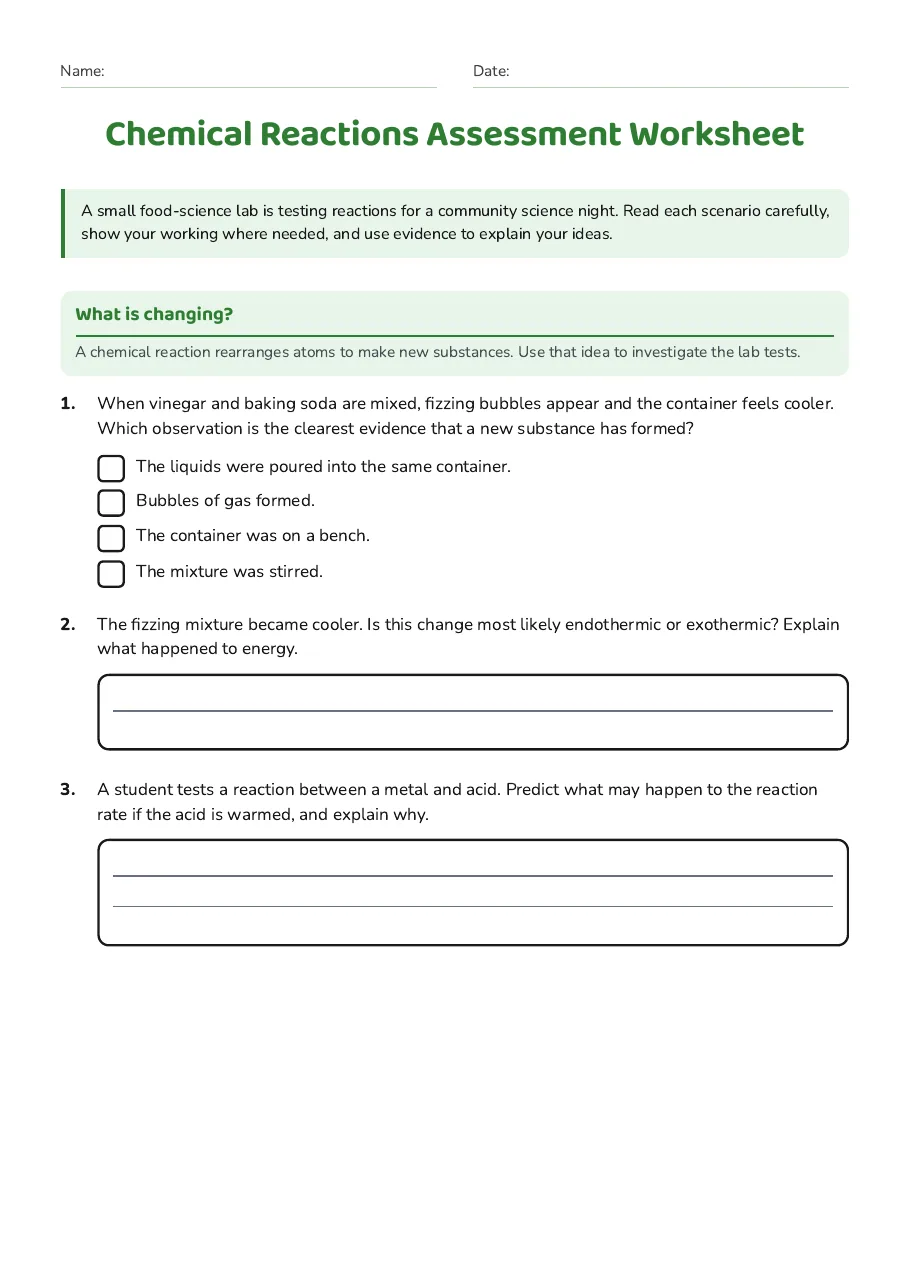
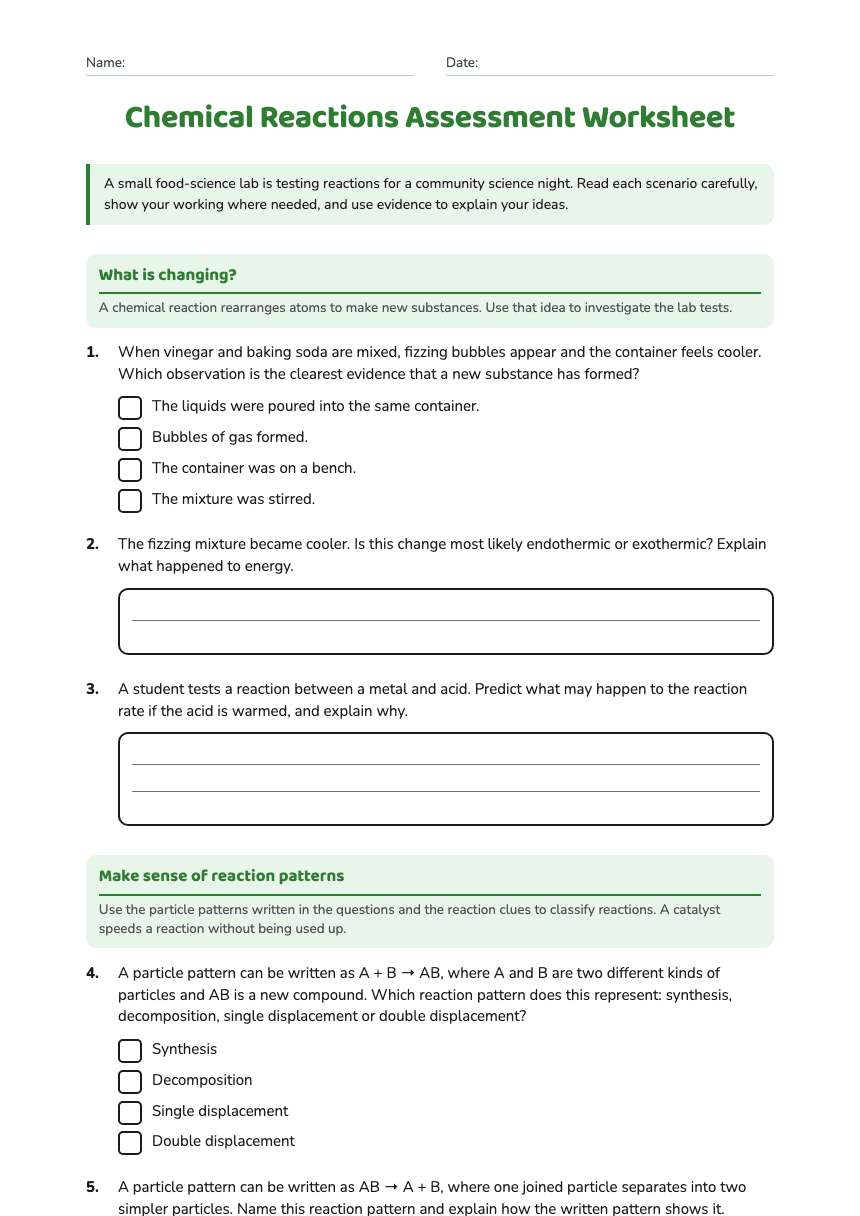
Chemical Reactions Assessment Worksheet

A small food-science lab is testing reactions for a community science night. Read each scenario carefully, show your working where needed, and use evidence to explain your ideas.

What is changing?

A chemical reaction rearranges atoms to make new substances. Use that idea to investigate the lab tests.

1.When vinegar and baking soda are mixed, fizzing bubbles appear and the container feels cooler. Which observation is the clearest evidence that a new substance has formed?
  • The liquids were poured into the same container.
  • Bubbles of gas formed.
  • The container was on a bench.
  • The mixture was stirred.
2.The fizzing mixture became cooler. Is this change most likely endothermic or exothermic? Explain what happened to energy.
3.A student tests a reaction between a metal and acid. Predict what may happen to the reaction rate if the acid is warmed, and explain why.

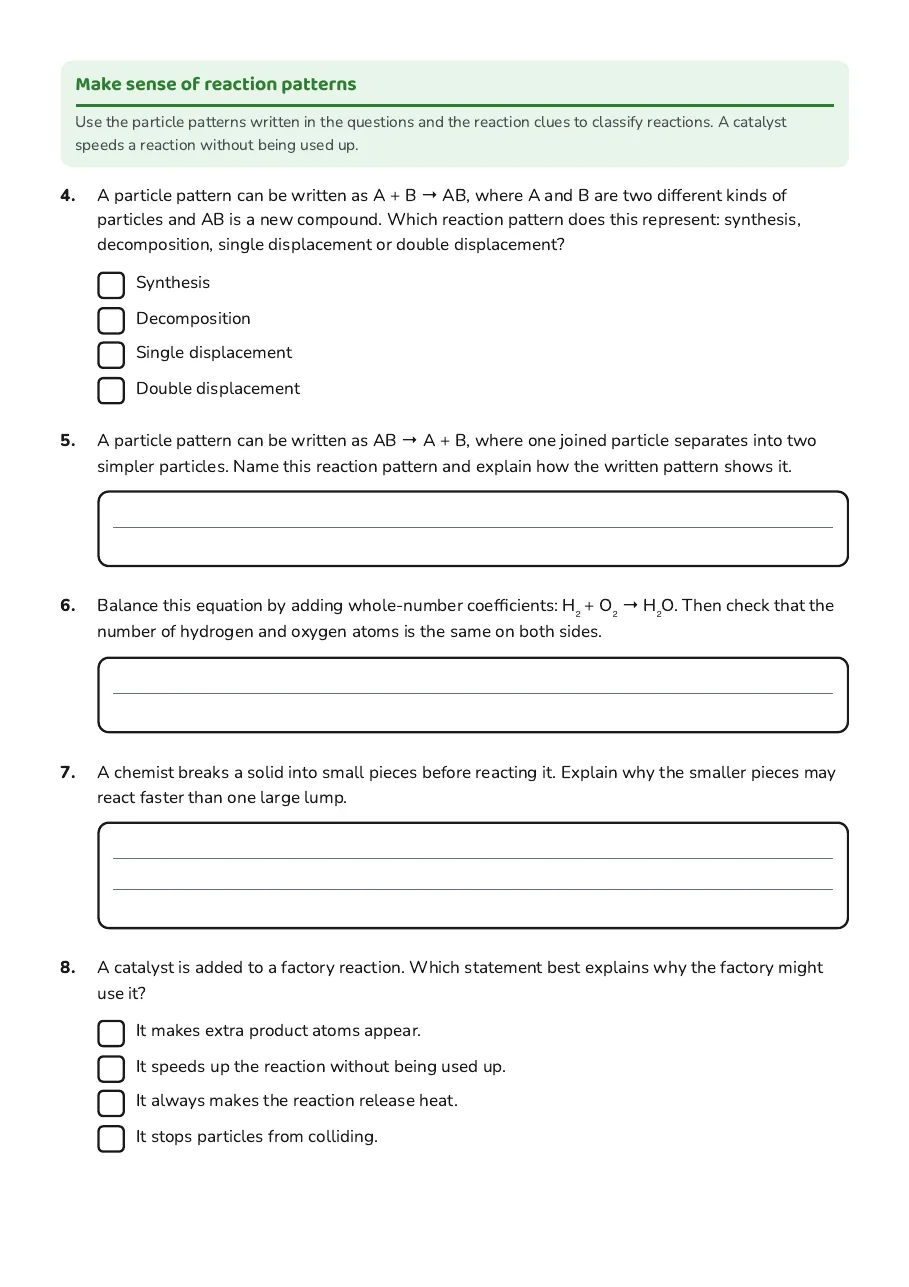
Make sense of reaction patterns

Use the particle patterns written in the questions and the reaction clues to classify reactions. A catalyst speeds a reaction without being used up.

4.A particle pattern can be written as A + B → AB, where A and B are two different kinds of particles and AB is a new compound. Which reaction pattern does this represent: synthesis, decomposition, single displacement or double displacement?
  • Synthesis
  • Decomposition
  • Single displacement
  • Double displacement
5.A particle pattern can be written as AB → A + B, where one joined particle separates into two simpler particles. Name this reaction pattern and explain how the written pattern shows it.
6.Balance this equation by adding whole-number coefficients: H₂ + O₂ → H₂O. Then check that the number of hydrogen and oxygen atoms is the same on both sides.
7.A chemist breaks a solid into small pieces before reacting it. Explain why the smaller pieces may react faster than one large lump.
8.A catalyst is added to a factory reaction. Which statement best explains why the factory might use it?
  • It makes extra product atoms appear.
  • It speeds up the reaction without being used up.
  • It always makes the reaction release heat.
  • It stops particles from colliding.
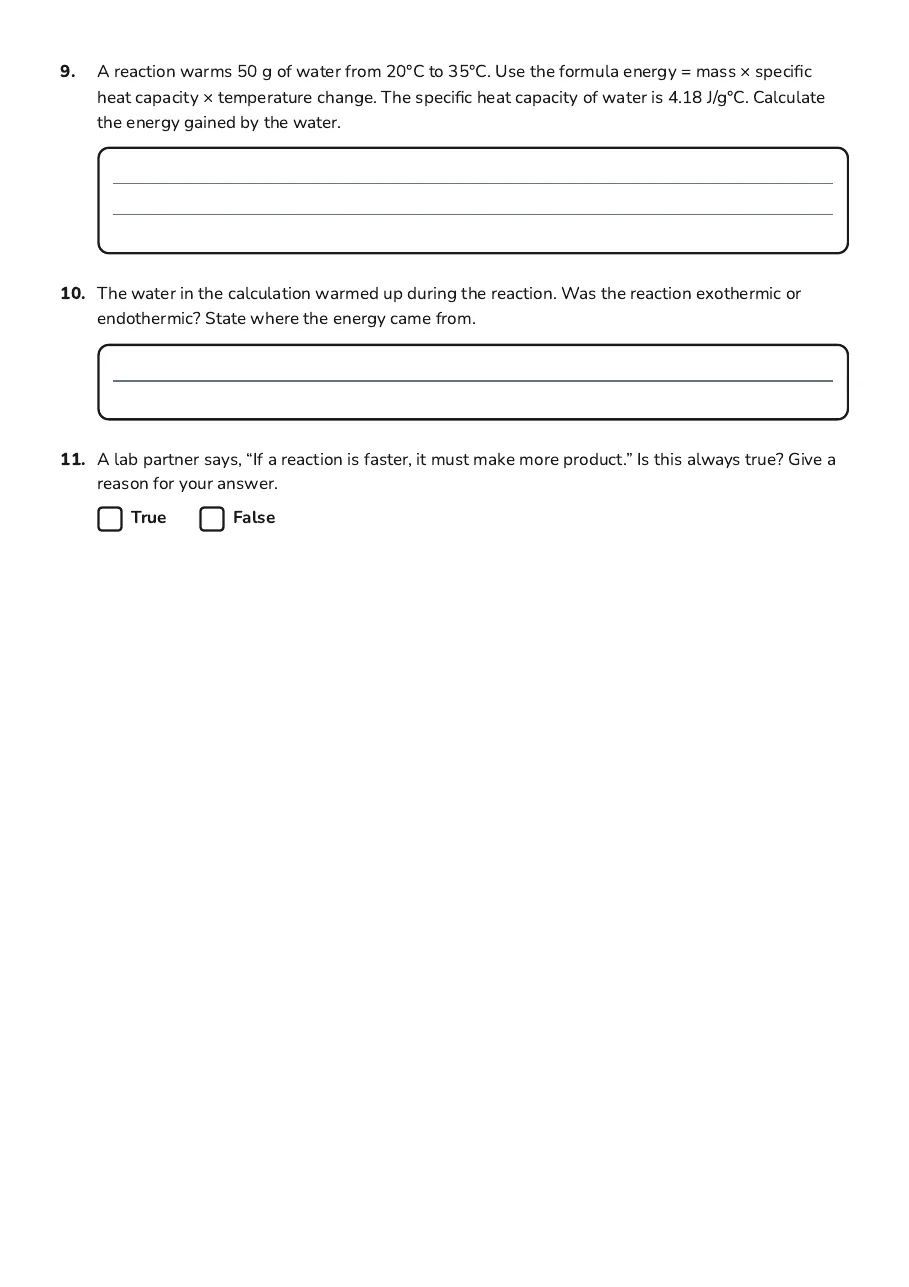
9.A reaction warms 50 g of water from 20°C to 35°C. Use the formula energy = mass × specific heat capacity × temperature change. The specific heat capacity of water is 4.18 J/g°C. Calculate the energy gained by the water.
10.The water in the calculation warmed up during the reaction. Was the reaction exothermic or endothermic? State where the energy came from.
11.A lab partner says, “If a reaction is faster, it must make more product.” Is this always true? Give a reason for your answer.
TrueFalse

3 printable pages

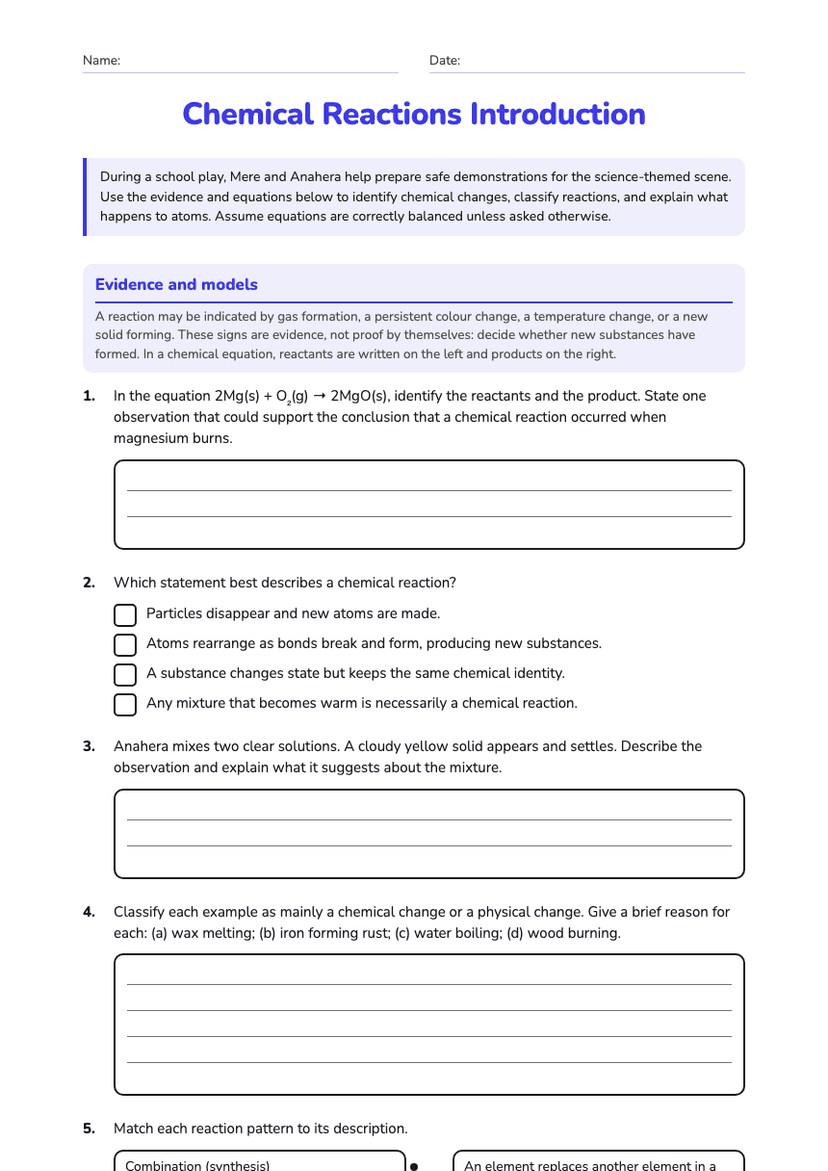
  • Chemical Reactions Assessment Worksheet, page 1 of 3: What is changing?

    Page 1

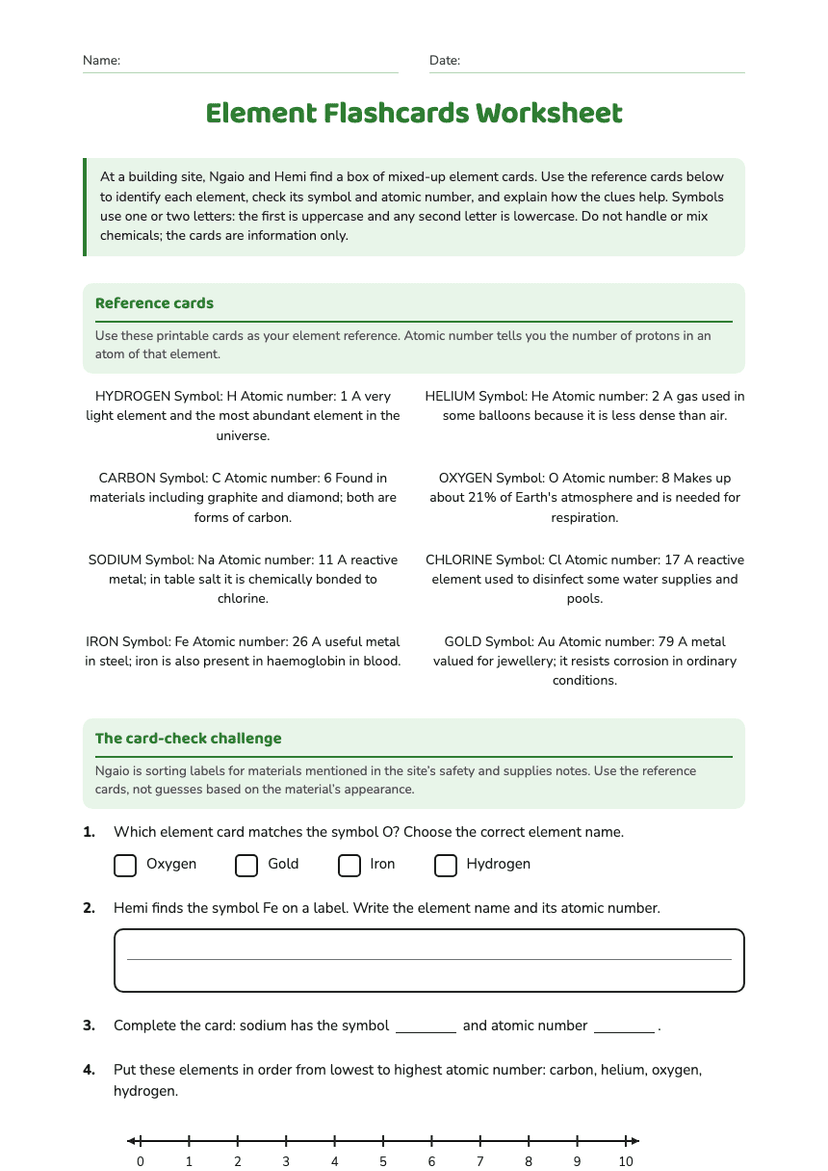
  • Chemical Reactions Assessment Worksheet, page 2 of 3: Make sense of reaction patterns

    Page 2

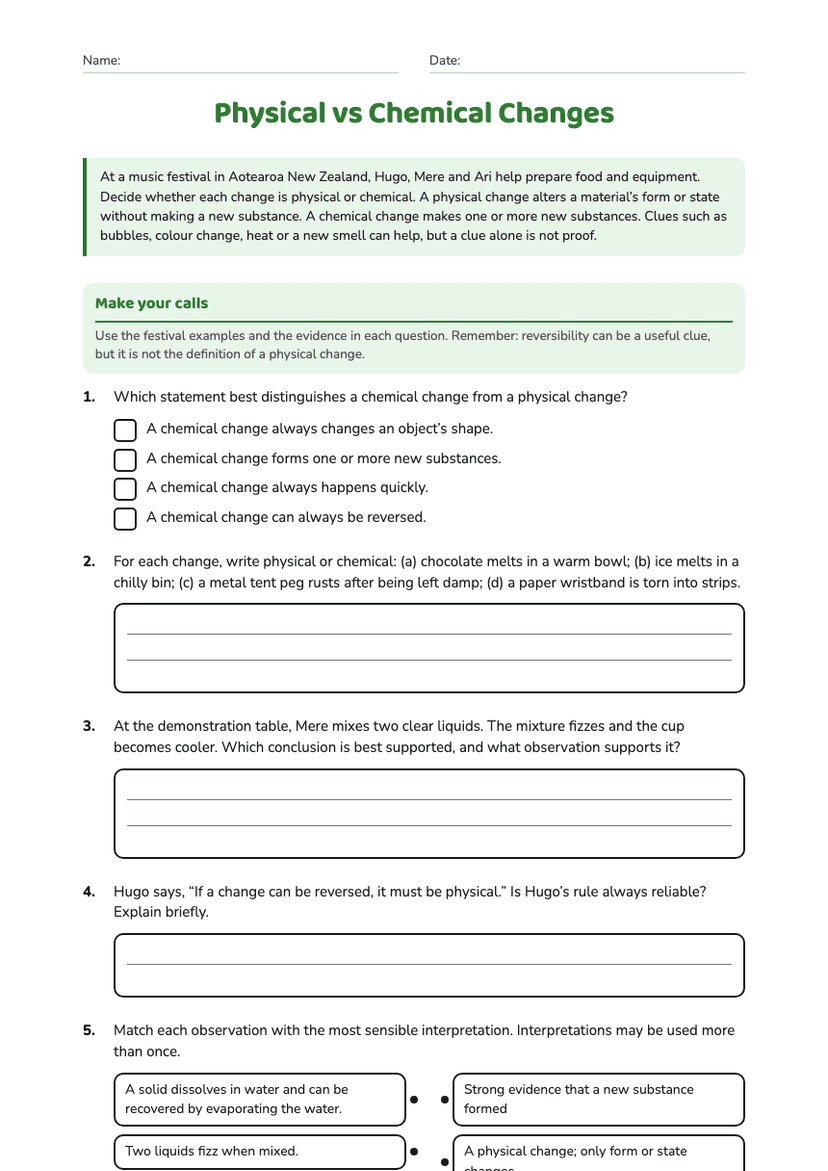
  • Chemical Reactions Assessment Worksheet, page 3 of 3: 9. A reaction warms 50 g of water from 20°C to 35°C. Use the formula energy = mass ×…

    Page 3

About This Worksheet

Free in Kuraplan

Sign up free, grab the PDF, and customize it for your class.

Print-Ready

Formatted for standard paper. Clean layout, easy to read.

AI-Generated

Created with Kuraplan's AI, designed for real classroom use.

For Teachers & Parents

Use in classrooms, for homework, tutoring, or homeschool.

Need a custom version of this worksheet?

Kuraplan's AI generates custom worksheets in seconds — differentiated for every learner, aligned to your curriculum.

Generate Custom Worksheets — Free
No credit card Curriculum-aligned Under 60 seconds