ScienceFreePrintable

DNA Mutations and Effects

A free science worksheet ready for your classroom. Open in Kuraplan to grab the print-ready PDF, customize it for your students, or generate a fresh version in seconds.
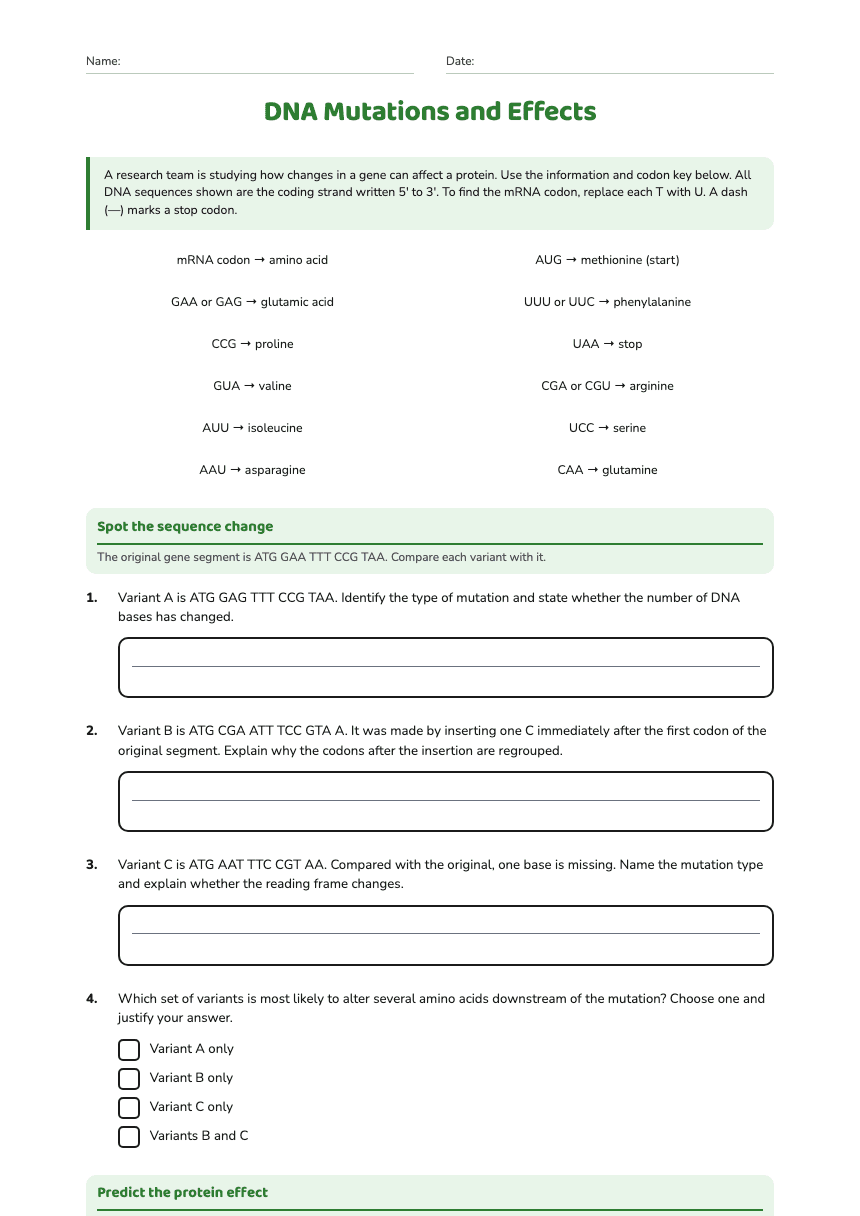
DNA Mutations and Effects worksheet preview
Name:Date:

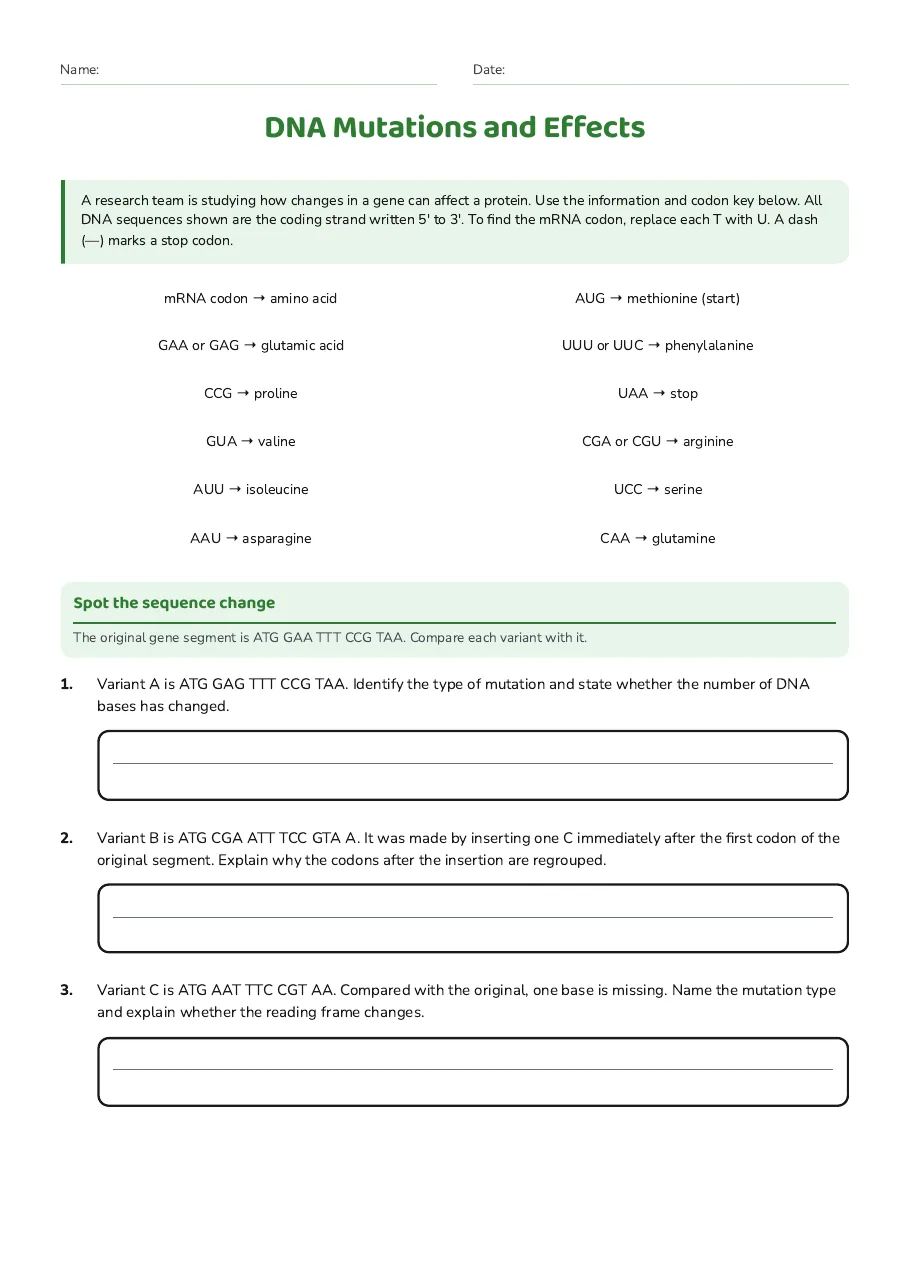
DNA Mutations and Effects

A research team is studying how changes in a gene can affect a protein. Use the information and codon key below. All DNA sequences shown are the coding strand written 5′ to 3′. To find the mRNA codon, replace each T with U. A dash (—) marks a stop codon.

mRNA codon → amino acid

AUG → methionine (start)

GAA or GAG → glutamic acid

UUU or UUC → phenylalanine

CCG → proline

UAA → stop

GUA → valine

CGA or CGU → arginine

AUU → isoleucine

UCC → serine

AAU → asparagine

CAA → glutamine

Spot the sequence change

The original gene segment is ATG GAA TTT CCG TAA. Compare each variant with it.

1.Variant A is ATG GAG TTT CCG TAA. Identify the type of mutation and state whether the number of DNA bases has changed.
2.Variant B is ATG CGA ATT TCC GTA A. It was made by inserting one C immediately after the first codon of the original segment. Explain why the codons after the insertion are regrouped.
3.Variant C is ATG AAT TTC CGT AA. Compared with the original, one base is missing. Name the mutation type and explain whether the reading frame changes.
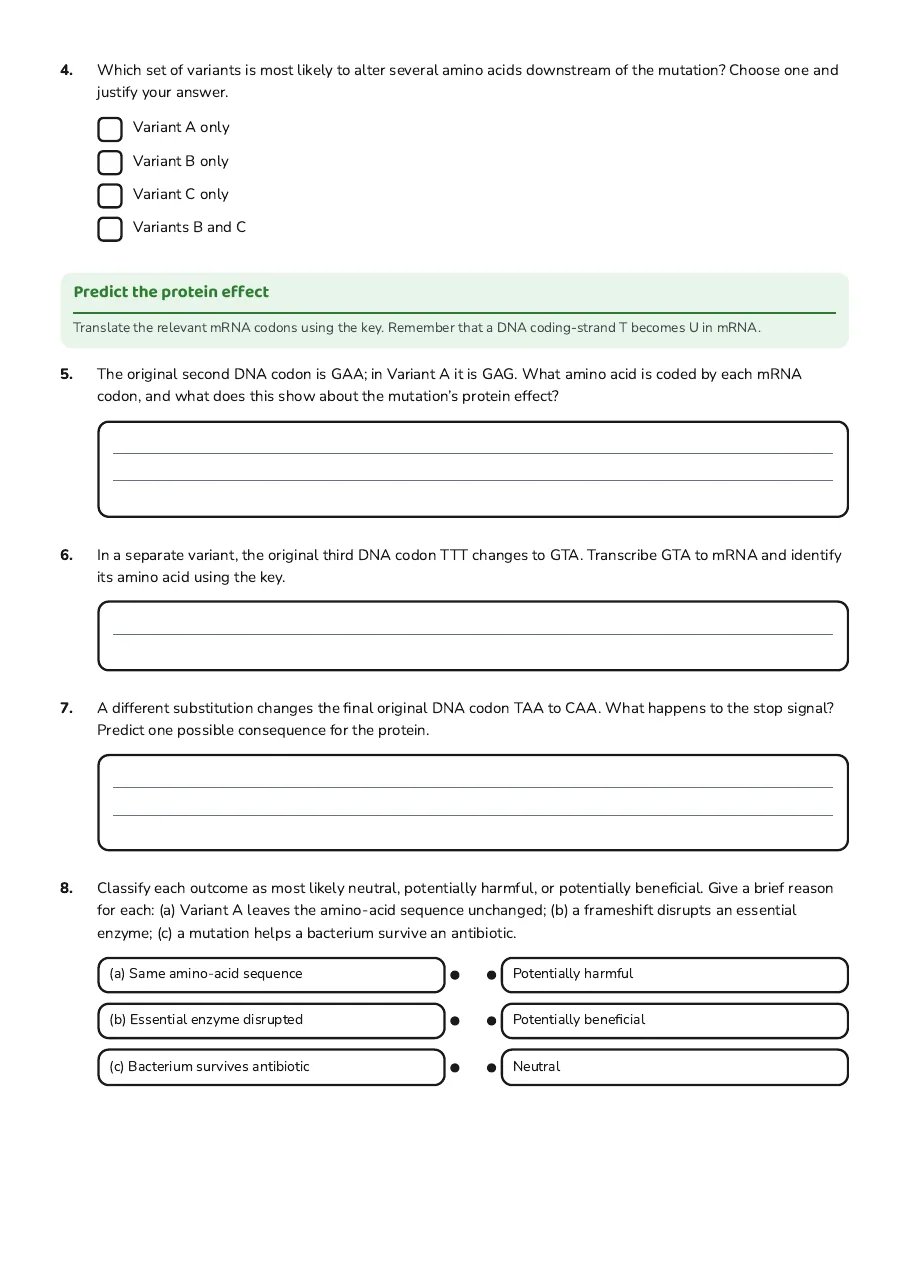
4.Which set of variants is most likely to alter several amino acids downstream of the mutation? Choose one and justify your answer.
  • Variant A only
  • Variant B only
  • Variant C only
  • Variants B and C

Predict the protein effect

Translate the relevant mRNA codons using the key. Remember that a DNA coding-strand T becomes U in mRNA.

5.The original second DNA codon is GAA; in Variant A it is GAG. What amino acid is coded by each mRNA codon, and what does this show about the mutation’s protein effect?
6.In a separate variant, the original third DNA codon TTT changes to GTA. Transcribe GTA to mRNA and identify its amino acid using the key.
7.A different substitution changes the final original DNA codon TAA to CAA. What happens to the stop signal? Predict one possible consequence for the protein.
8.Classify each outcome as most likely neutral, potentially harmful, or potentially beneficial. Give a brief reason for each: (a) Variant A leaves the amino-acid sequence unchanged; (b) a frameshift disrupts an essential enzyme; (c) a mutation helps a bacterium survive an antibiotic.
  • (a) Same amino-acid sequence
  • (b) Essential enzyme disrupted
  • (c) Bacterium survives antibiotic
  • Potentially harmful
  • Potentially beneficial
  • Neutral
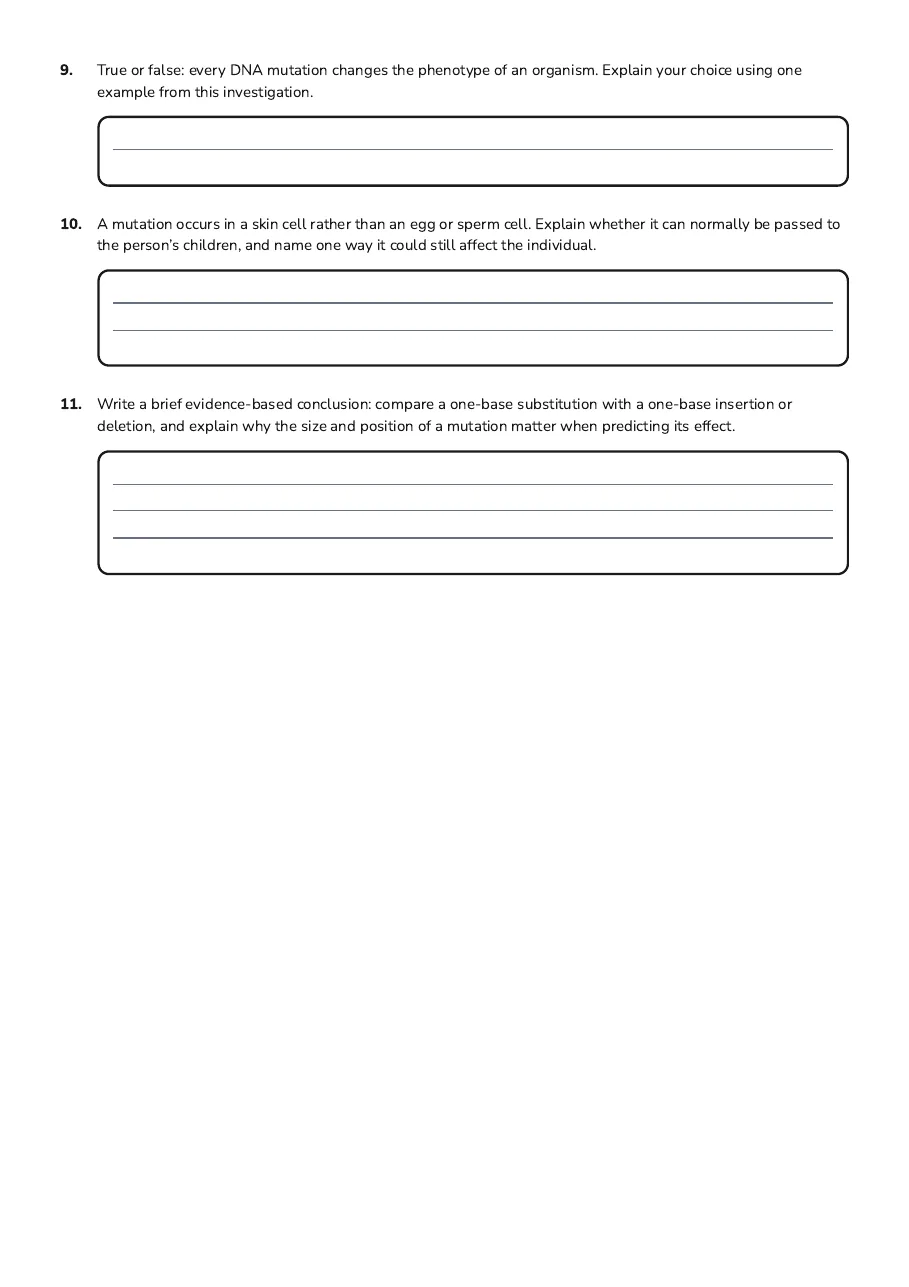
9.True or false: every DNA mutation changes the phenotype of an organism. Explain your choice using one example from this investigation.
10.A mutation occurs in a skin cell rather than an egg or sperm cell. Explain whether it can normally be passed to the person’s children, and name one way it could still affect the individual.
11.Write a brief evidence-based conclusion: compare a one-base substitution with a one-base insertion or deletion, and explain why the size and position of a mutation matter when predicting its effect.

3 printable pages

  • DNA Mutations and Effects, page 1 of 3: Spot the sequence change

    Page 1

  • DNA Mutations and Effects, page 2 of 3: Predict the protein effect

    Page 2

  • DNA Mutations and Effects, page 3 of 3: 9. True or false: every DNA mutation changes the phenotype of an organism. Explain your…

    Page 3

About This Worksheet

Free in Kuraplan

Sign up free, grab the PDF, and customize it for your class.

Print-Ready

Formatted for standard paper. Clean layout, easy to read.

AI-Generated

Created with Kuraplan's AI, designed for real classroom use.

For Teachers & Parents

Use in classrooms, for homework, tutoring, or homeschool.

Need a custom version of this worksheet?

Kuraplan's AI generates custom worksheets in seconds — differentiated for every learner, aligned to your curriculum.

Generate Custom Worksheets — Free
No credit card Curriculum-aligned Under 60 seconds