Earth, Moon and Sun Patterns
A free science worksheet ready for your classroom. Open in Kuraplan to grab the print-ready PDF, customize it for your students, or generate a fresh version in seconds.
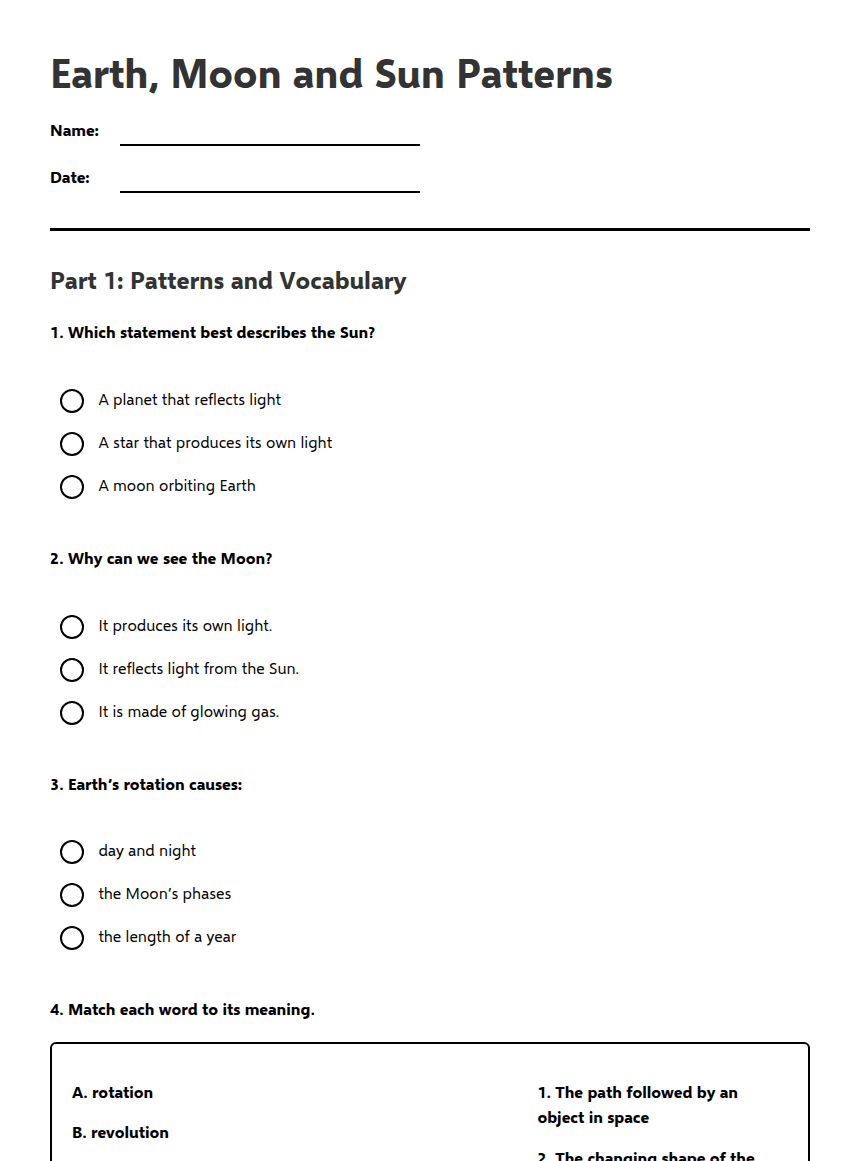
Earth, Moon and Sun Patterns
Part 1: Patterns and Vocabulary
Answers: A–____ B–____ C–____ D–____
Part 2: Explain and Apply
Teacher Answer Key
1. A star that produces its own light.
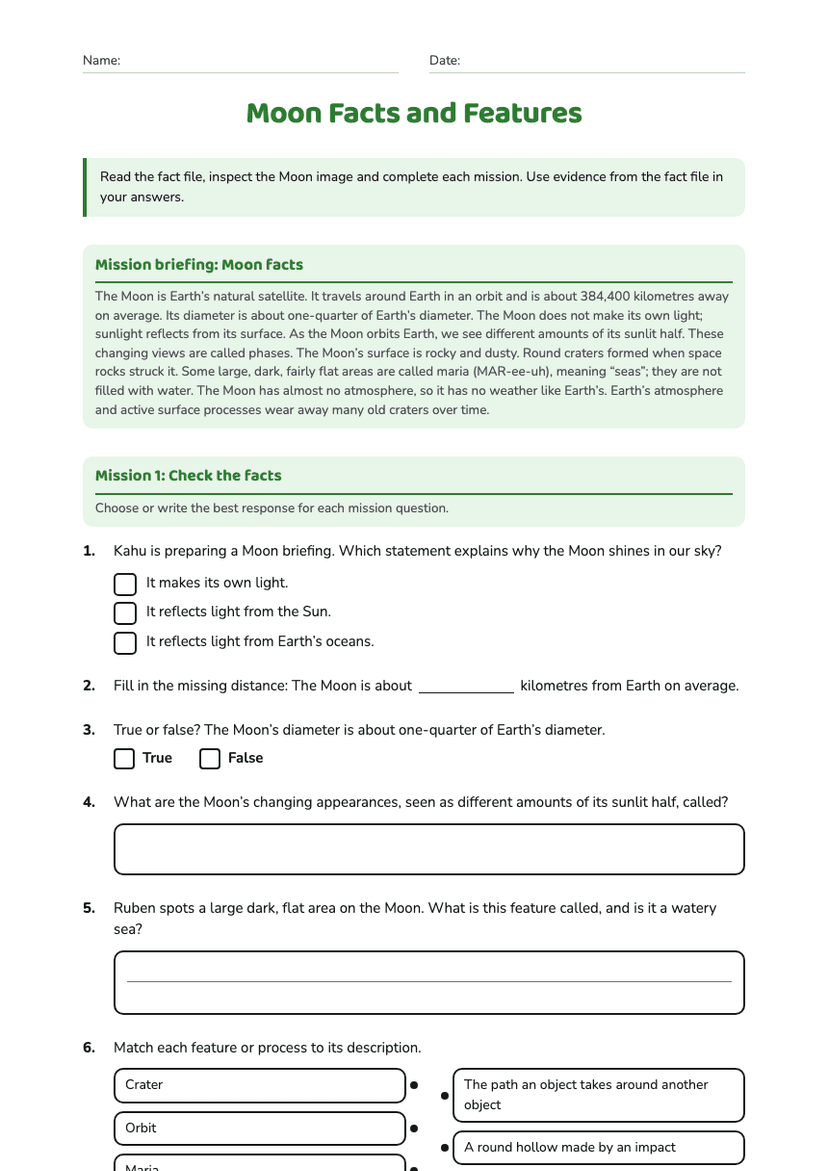
2. It reflects light from the Sun.
3. Day and night.
4. A–3, B–4, C–1, D–2.
5. Diagram should show the Sun at the centre, Earth orbiting the Sun, and the Moon orbiting Earth. Arrows should show movement.
6. Earth rotates on its axis. The side facing the Sun has day; the side facing away has night.
7. Earth takes about 365 days to complete one orbit around the Sun. This cycle is one year.
8. The Moon does not make its own light. As it orbits Earth, we see different amounts of its sunlit half.
9. False. Moon phases are mainly caused by the changing positions of the Sun, Earth and Moon, not Earth’s shadow. Earth’s shadow causes a lunar eclipse.
10. There would no longer be a normal repeating day-and-night cycle caused by rotation. Earth would still have a year because it continued orbiting the Sun.
About This Worksheet
Free in Kuraplan
Sign up free, grab the PDF, and customize it for your class.
Print-Ready
Formatted for standard paper. Clean layout, easy to read.
AI-Generated
Created with Kuraplan's AI, designed for real classroom use.
For Teachers & Parents
Use in classrooms, for homework, tutoring, or homeschool.
Need a custom version of this worksheet?
Kuraplan's AI generates custom worksheets in seconds — differentiated for every learner, aligned to your curriculum.
Generate Custom Worksheets — Free