ScienceFreePrintable

Floating and Sinking Exploration

A free science worksheet ready for your classroom. Open in Kuraplan to grab the print-ready PDF, customize it for your students, or generate a fresh version in seconds.
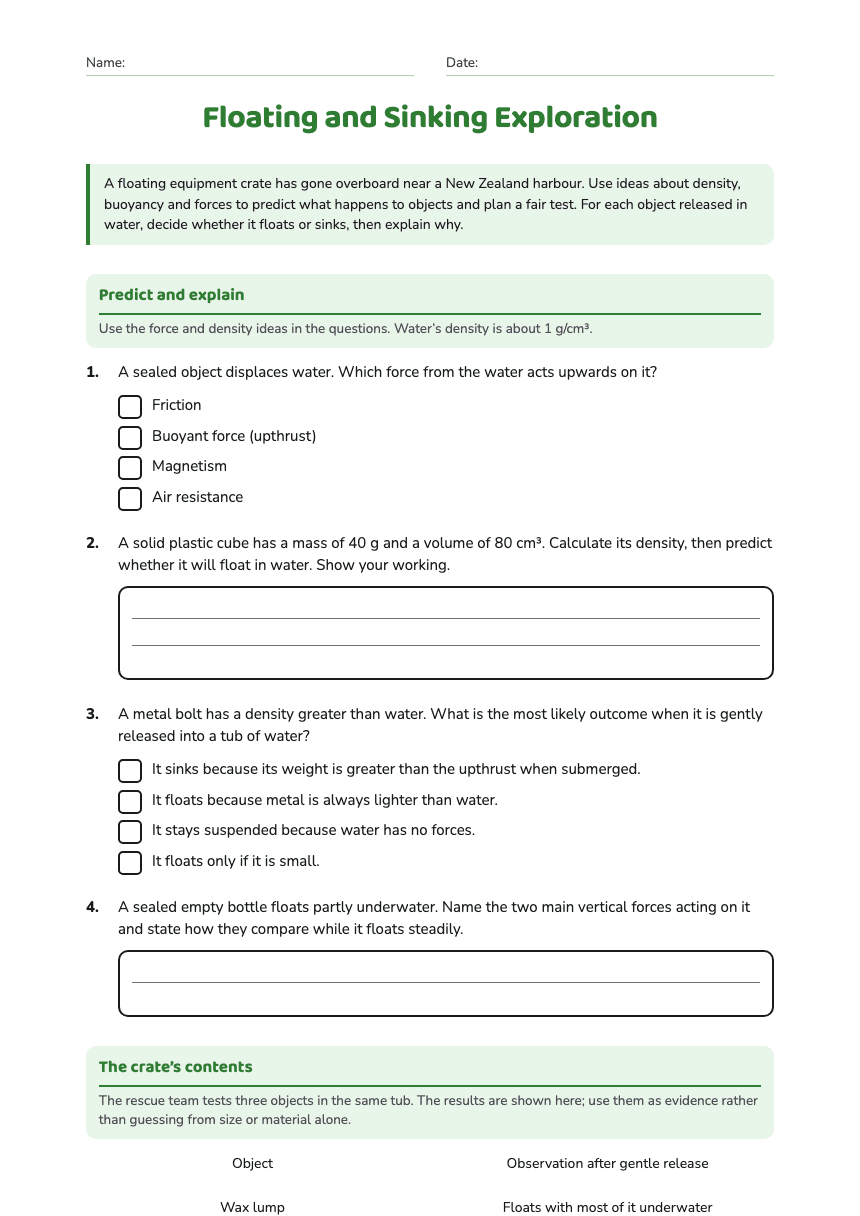
Floating and Sinking Exploration worksheet preview
Name:Date:

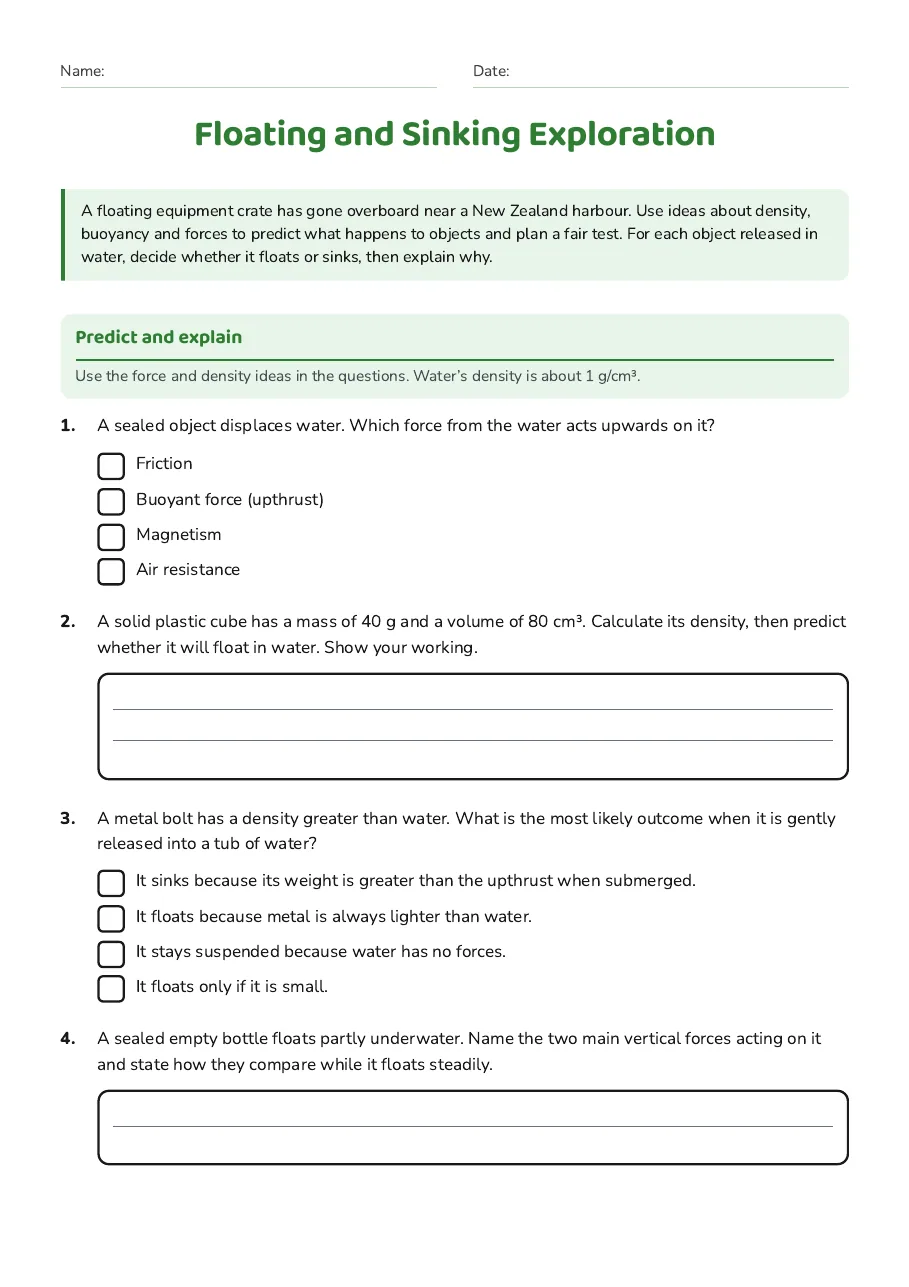
Floating and Sinking Exploration

A floating equipment crate has gone overboard near a New Zealand harbour. Use ideas about density, buoyancy and forces to predict what happens to objects and plan a fair test. For each object released in water, decide whether it floats or sinks, then explain why.

Predict and explain

Use the force and density ideas in the questions. Water’s density is about 1 g/cm³.

1.A sealed object displaces water. Which force from the water acts upwards on it?
  • Friction
  • Buoyant force (upthrust)
  • Magnetism
  • Air resistance
2.A solid plastic cube has a mass of 40 g and a volume of 80 cm³. Calculate its density, then predict whether it will float in water. Show your working.
3.A metal bolt has a density greater than water. What is the most likely outcome when it is gently released into a tub of water?
  • It sinks because its weight is greater than the upthrust when submerged.
  • It floats because metal is always lighter than water.
  • It stays suspended because water has no forces.
  • It floats only if it is small.
4.A sealed empty bottle floats partly underwater. Name the two main vertical forces acting on it and state how they compare while it floats steadily.

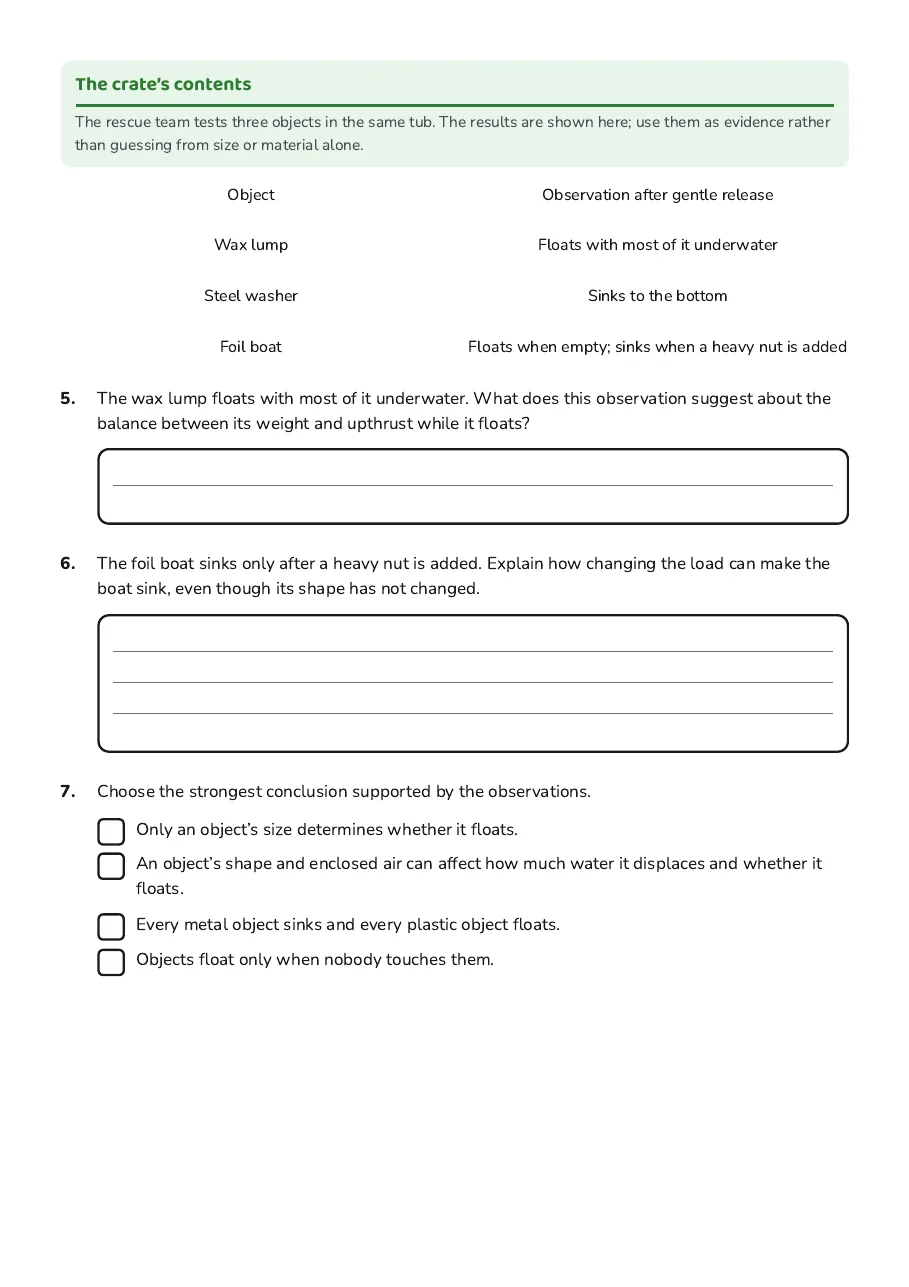
The crate’s contents

The rescue team tests three objects in the same tub. The results are shown here; use them as evidence rather than guessing from size or material alone.

Object

Observation after gentle release

Wax lump

Floats with most of it underwater

Steel washer

Sinks to the bottom

Foil boat

Floats when empty; sinks when a heavy nut is added

5.The wax lump floats with most of it underwater. What does this observation suggest about the balance between its weight and upthrust while it floats?
6.The foil boat sinks only after a heavy nut is added. Explain how changing the load can make the boat sink, even though its shape has not changed.
7.Choose the strongest conclusion supported by the observations.
  • Only an object’s size determines whether it floats.
  • An object’s shape and enclosed air can affect how much water it displaces and whether it floats.
  • Every metal object sinks and every plastic object floats.
  • Objects float only when nobody touches them.

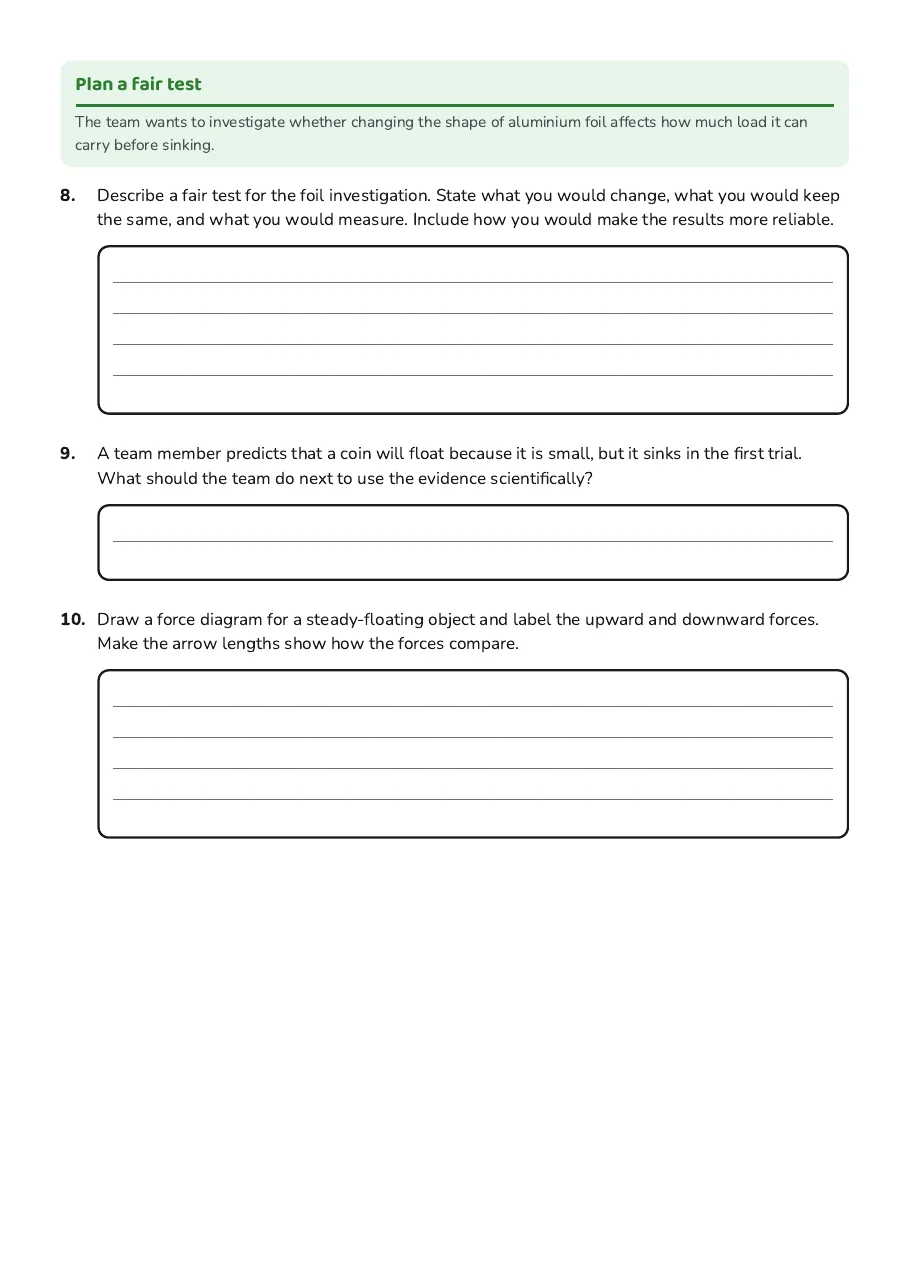
Plan a fair test

The team wants to investigate whether changing the shape of aluminium foil affects how much load it can carry before sinking.

8.Describe a fair test for the foil investigation. State what you would change, what you would keep the same, and what you would measure. Include how you would make the results more reliable.
9.A team member predicts that a coin will float because it is small, but it sinks in the first trial. What should the team do next to use the evidence scientifically?
10.Draw a force diagram for a steady-floating object and label the upward and downward forces. Make the arrow lengths show how the forces compare.

3 printable pages

  • Floating and Sinking Exploration, page 1 of 3: Predict and explain

    Page 1

  • Floating and Sinking Exploration, page 2 of 3: The crate’s contents

    Page 2

  • Floating and Sinking Exploration, page 3 of 3: Plan a fair test

    Page 3

About This Worksheet

Free in Kuraplan

Sign up free, grab the PDF, and customize it for your class.

Print-Ready

Formatted for standard paper. Clean layout, easy to read.

AI-Generated

Created with Kuraplan's AI, designed for real classroom use.

For Teachers & Parents

Use in classrooms, for homework, tutoring, or homeschool.

Need a custom version of this worksheet?

Kuraplan's AI generates custom worksheets in seconds — differentiated for every learner, aligned to your curriculum.

Generate Custom Worksheets — Free
No credit card Curriculum-aligned Under 60 seconds