ScienceFreePrintable
Force Summation in Volleyball
A free science worksheet ready for your classroom. Open in Kuraplan to grab the print-ready PDF, customize it for your students, or generate a fresh version in seconds.
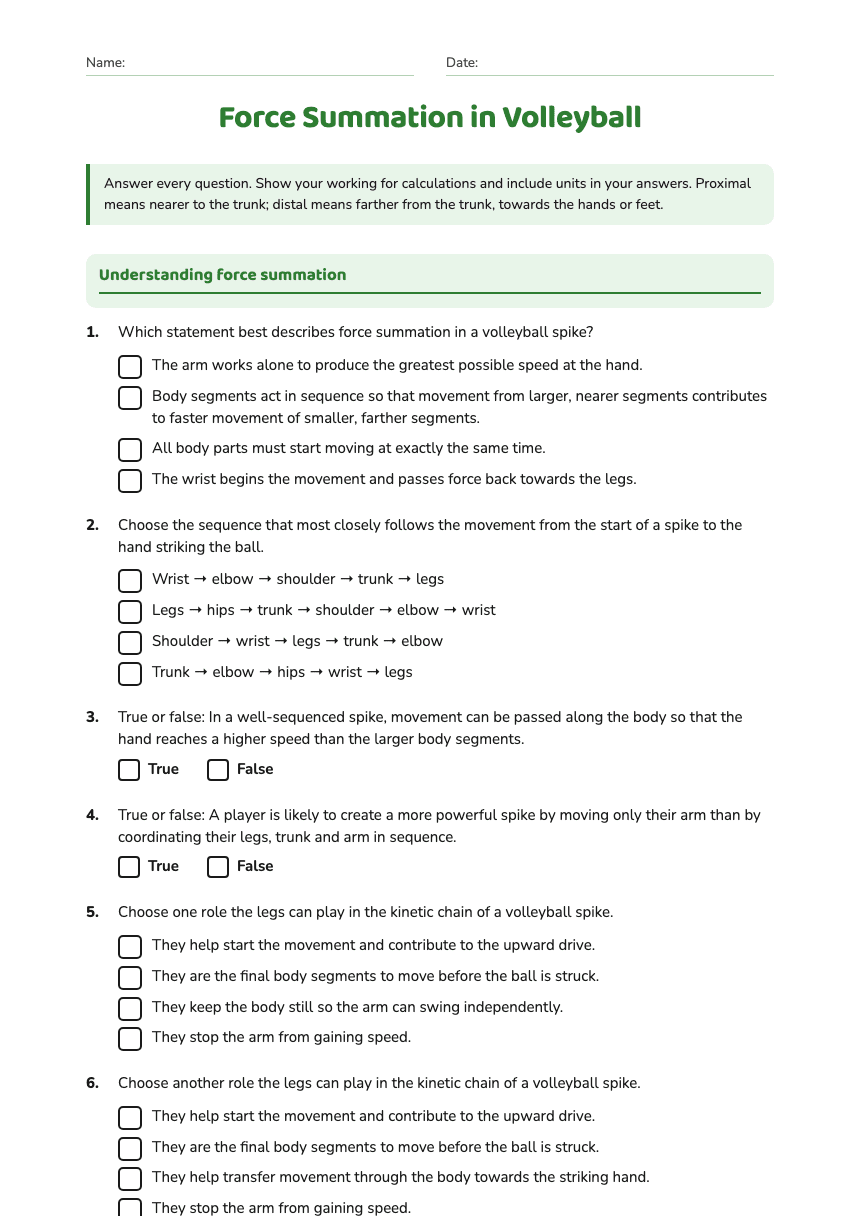
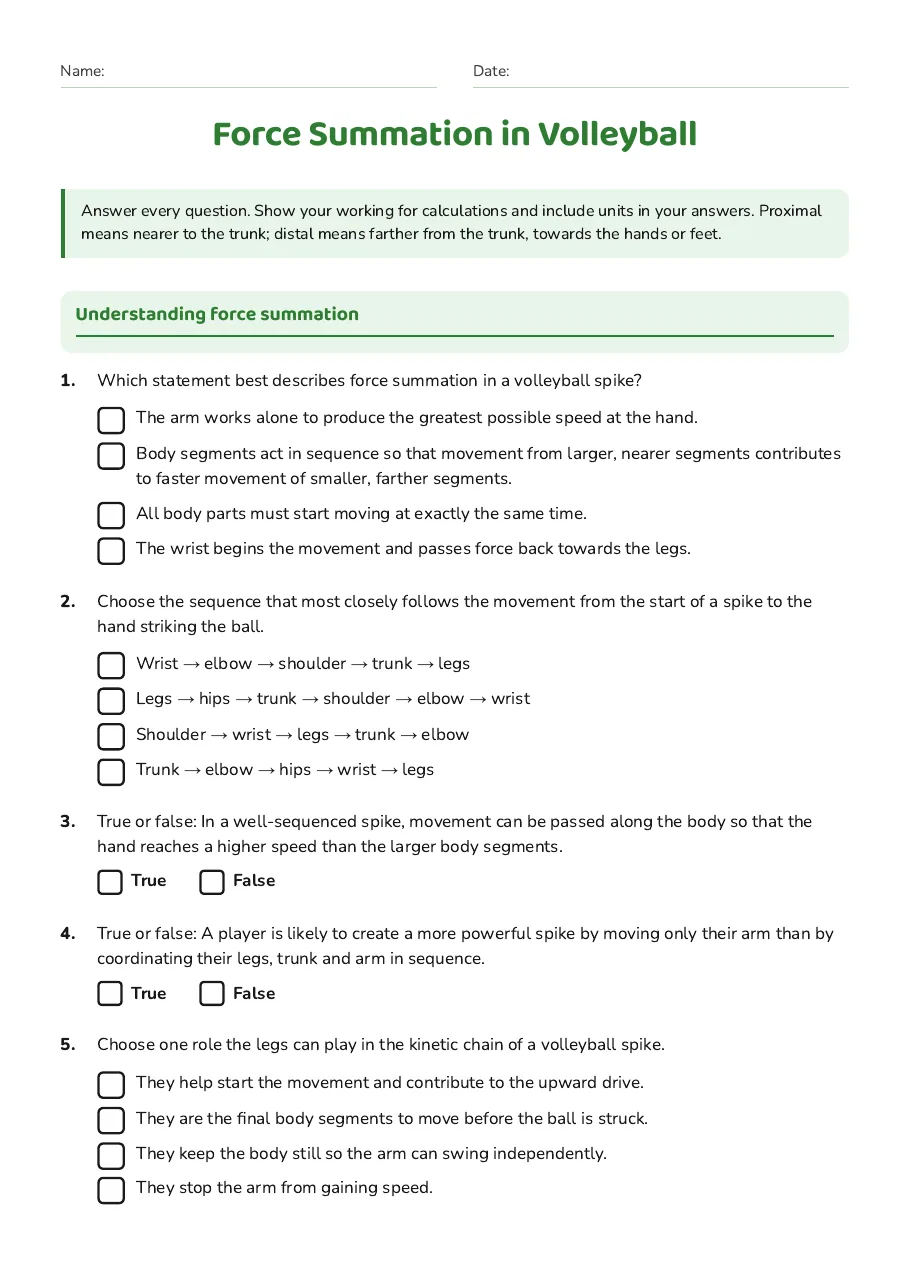
Name:Date:
Force Summation in Volleyball
Answer every question. Show your working for calculations and include units in your answers. Proximal means nearer to the trunk; distal means farther from the trunk, towards the hands or feet.
Understanding force summation
1.Which statement best describes force summation in a volleyball spike?
- The arm works alone to produce the greatest possible speed at the hand.
- Body segments act in sequence so that movement from larger, nearer segments contributes to faster movement of smaller, farther segments.
- All body parts must start moving at exactly the same time.
- The wrist begins the movement and passes force back towards the legs.
2.Choose the sequence that most closely follows the movement from the start of a spike to the hand striking the ball.
- Wrist → elbow → shoulder → trunk → legs
- Legs → hips → trunk → shoulder → elbow → wrist
- Shoulder → wrist → legs → trunk → elbow
- Trunk → elbow → hips → wrist → legs
3.True or false: In a well-sequenced spike, movement can be passed along the body so that the hand reaches a higher speed than the larger body segments.
TrueFalse
4.True or false: A player is likely to create a more powerful spike by moving only their arm than by coordinating their legs, trunk and arm in sequence.
TrueFalse
5.Choose one role the legs can play in the kinetic chain of a volleyball spike.
- They help start the movement and contribute to the upward drive.
- They are the final body segments to move before the ball is struck.
- They keep the body still so the arm can swing independently.
- They stop the arm from gaining speed.
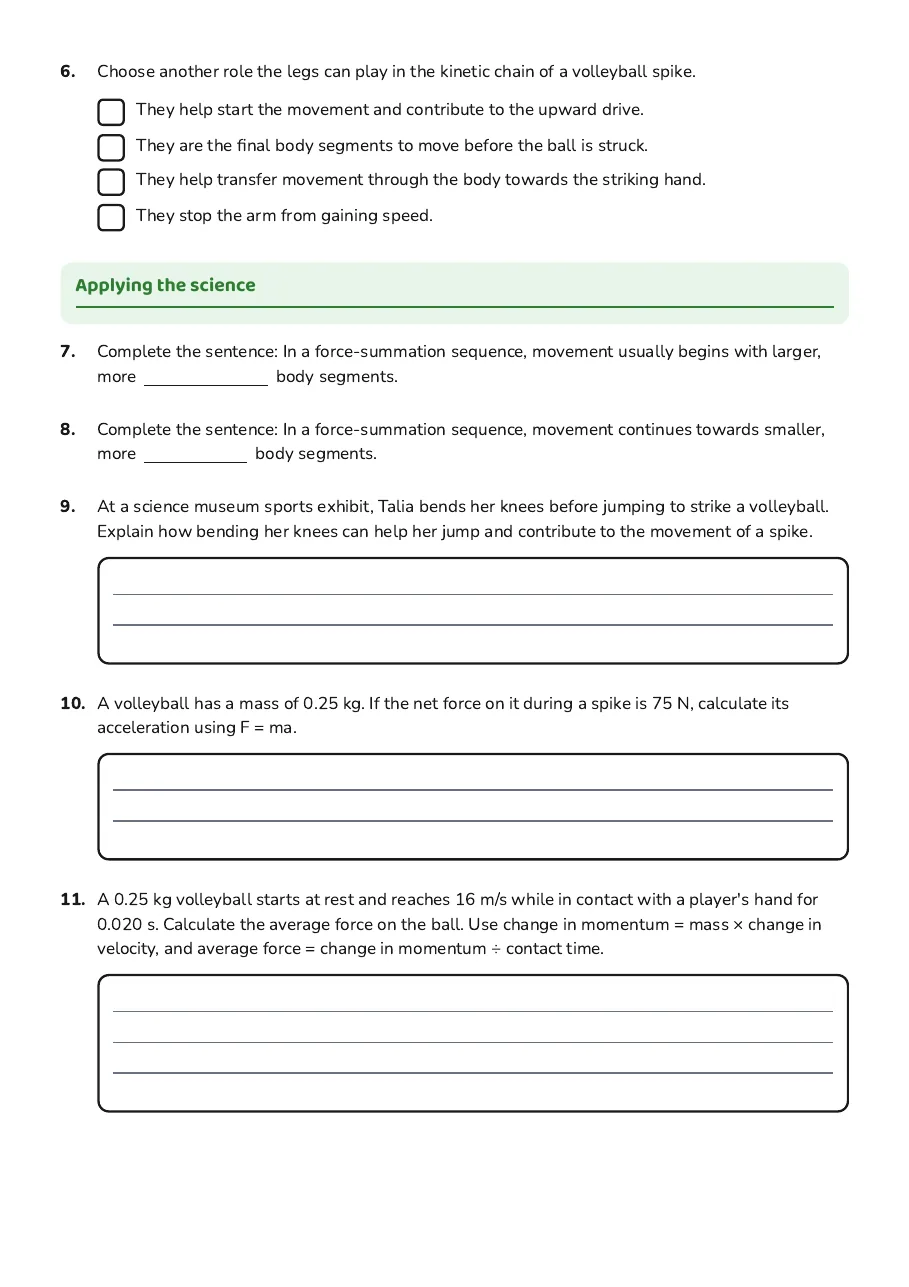
6.Choose another role the legs can play in the kinetic chain of a volleyball spike.
- They help start the movement and contribute to the upward drive.
- They are the final body segments to move before the ball is struck.
- They help transfer movement through the body towards the striking hand.
- They stop the arm from gaining speed.
Applying the science
7.Complete the sentence: In a force-summation sequence, movement usually begins with larger, more body segments.
8.Complete the sentence: In a force-summation sequence, movement continues towards smaller, more body segments.
9.At a science museum sports exhibit, Talia bends her knees before jumping to strike a volleyball. Explain how bending her knees can help her jump and contribute to the movement of a spike.
10.A volleyball has a mass of 0.25 kg. If the net force on it during a spike is 75 N, calculate its acceleration using F = ma.
11.A 0.25 kg volleyball starts at rest and reaches 16 m/s while in contact with a player's hand for 0.020 s. Calculate the average force on the ball. Use change in momentum = mass × change in velocity, and average force = change in momentum ÷ contact time.
12.Hemi is practising a volleyball serve at a science museum activity. Write one coaching cue that would remind him to use his body segments in sequence rather than swinging with only his arm.
3 printable pages
Page 1
Page 2

Page 3
About This Worksheet
Free in Kuraplan
Sign up free, grab the PDF, and customize it for your class.
Print-Ready
Formatted for standard paper. Clean layout, easy to read.
AI-Generated
Created with Kuraplan's AI, designed for real classroom use.
For Teachers & Parents
Use in classrooms, for homework, tutoring, or homeschool.
Need a custom version of this worksheet?
Kuraplan's AI generates custom worksheets in seconds — differentiated for every learner, aligned to your curriculum.
Generate Custom Worksheets — Free No credit card Curriculum-aligned Under 60 seconds