ScienceFreePrintable
Forces and Motion Revision
A free science worksheet ready for your classroom. Open in Kuraplan to grab the print-ready PDF, customize it for your students, or generate a fresh version in seconds.
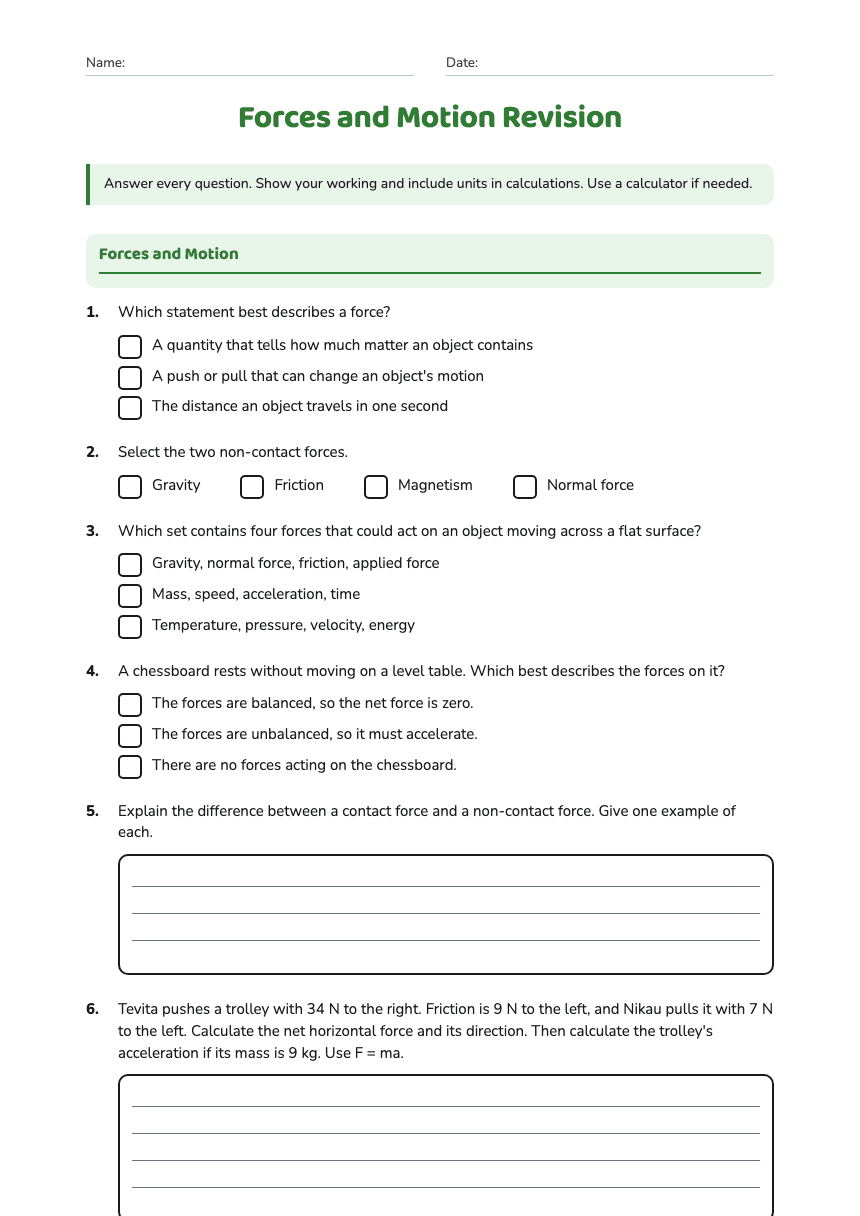
Name:Date:
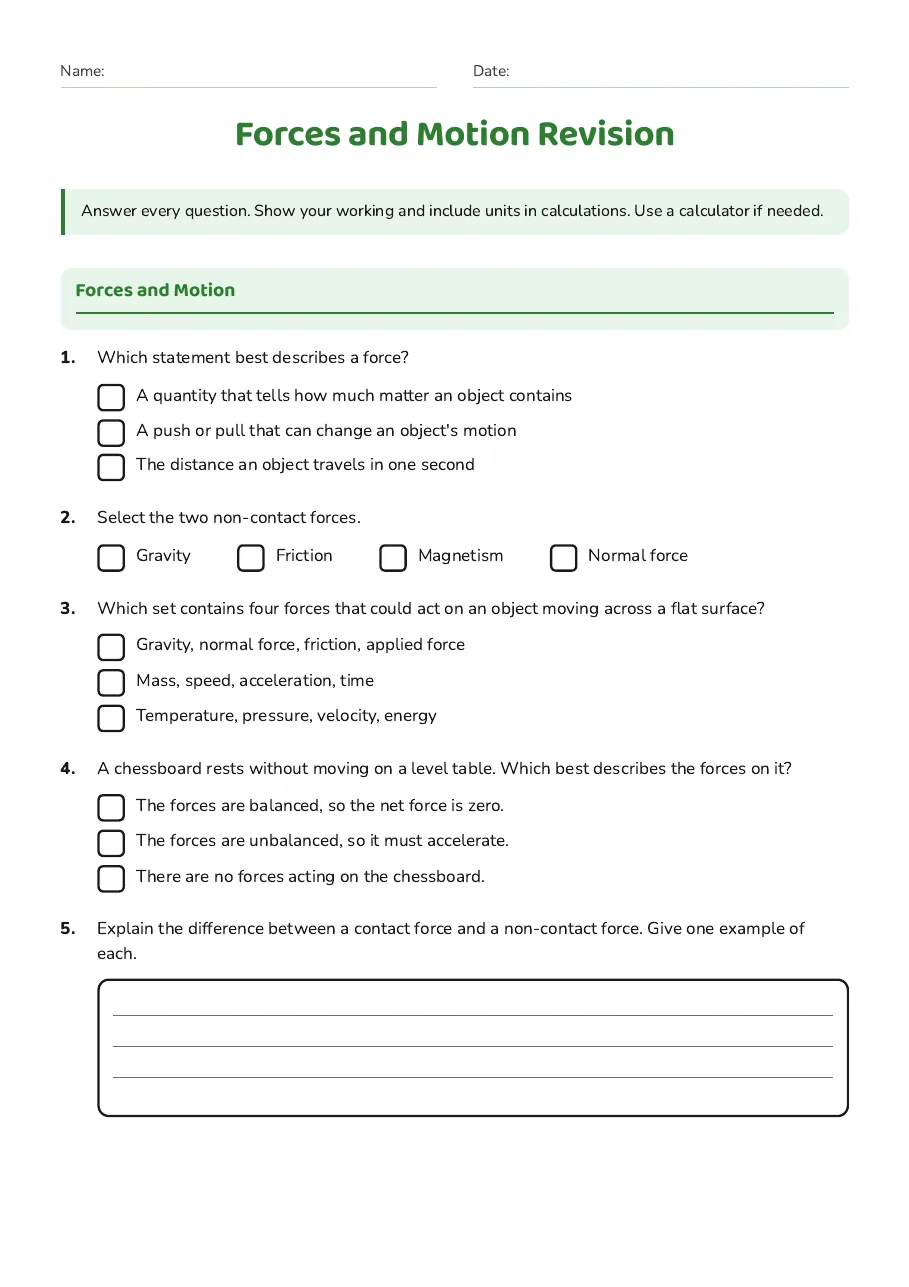
Forces and Motion Revision
Answer every question. Show your working and include units in calculations. Use a calculator if needed.
Forces and Motion
1.Which statement best describes a force?
- A quantity that tells how much matter an object contains
- A push or pull that can change an object's motion
- The distance an object travels in one second
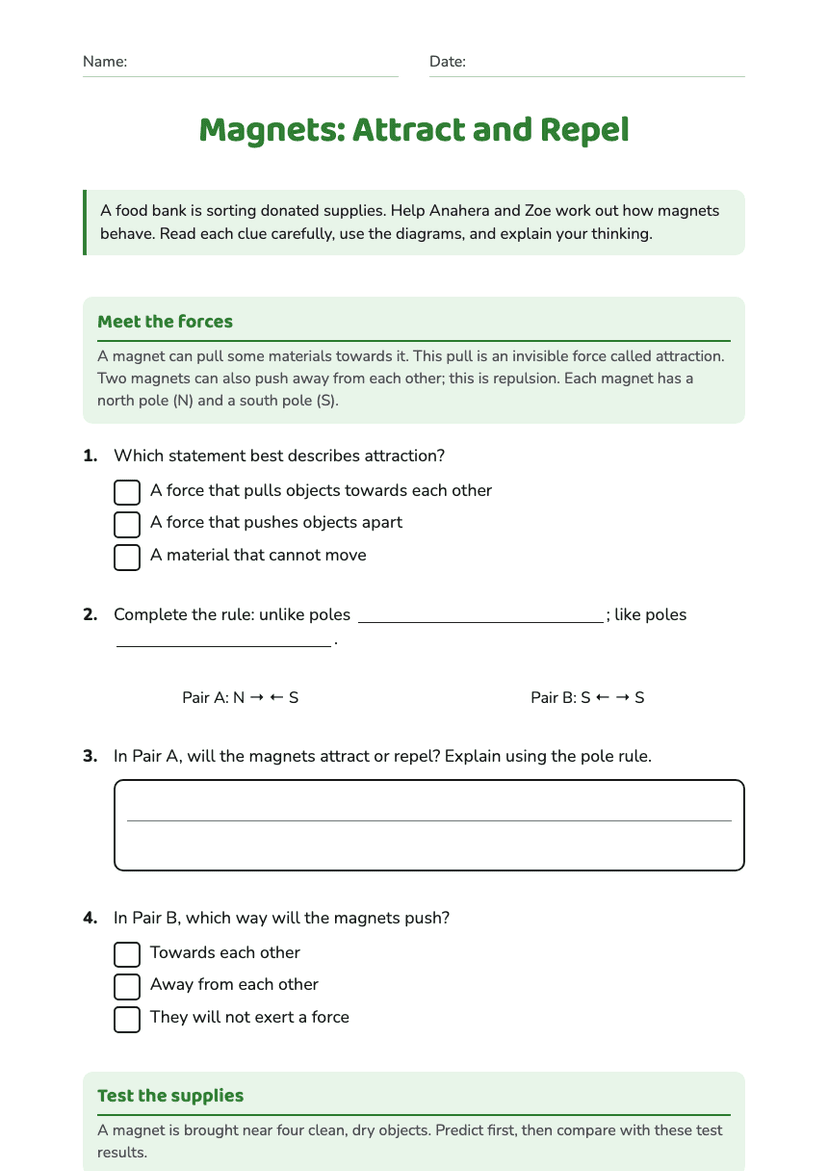
2.Select the two non-contact forces.
- Gravity
- Friction
- Magnetism
- Normal force
3.Which set contains four forces that could act on an object moving across a flat surface?
- Gravity, normal force, friction, applied force
- Mass, speed, acceleration, time
- Temperature, pressure, velocity, energy
4.A chessboard rests without moving on a level table. Which best describes the forces on it?
- The forces are balanced, so the net force is zero.
- The forces are unbalanced, so it must accelerate.
- There are no forces acting on the chessboard.
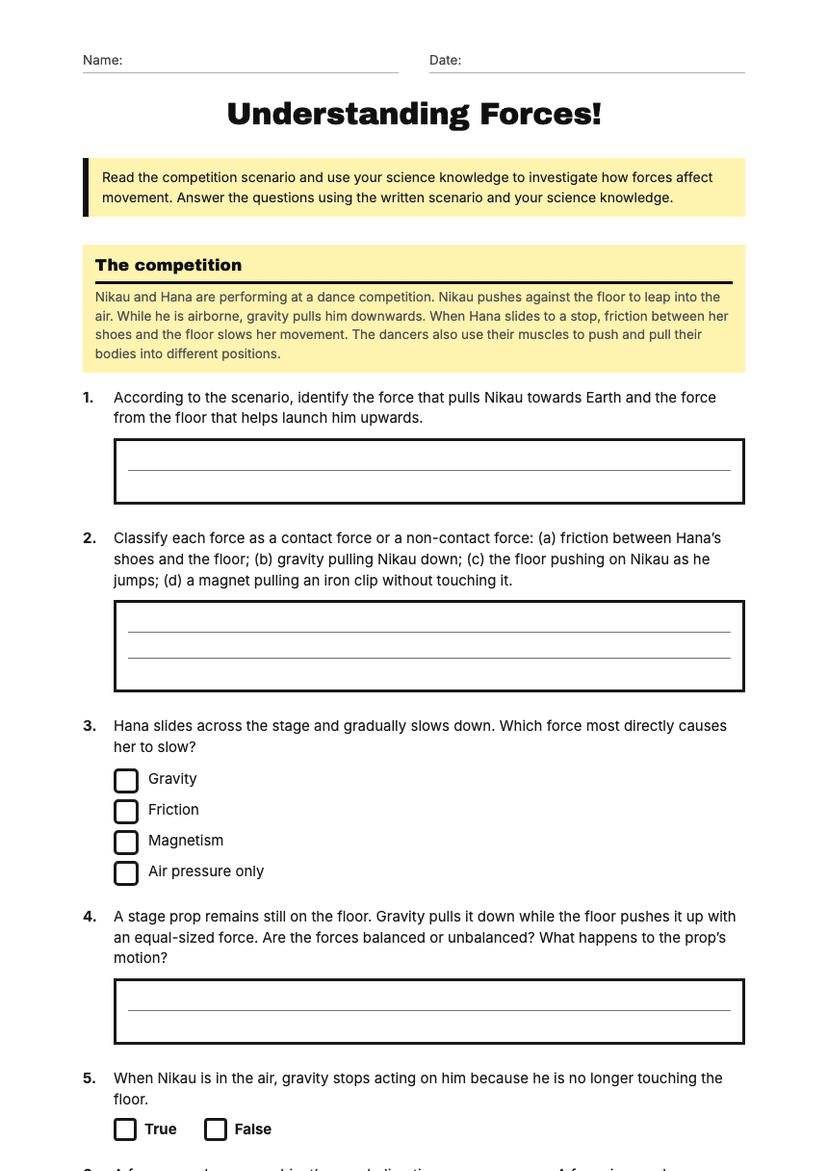
5.Explain the difference between a contact force and a non-contact force. Give one example of each.
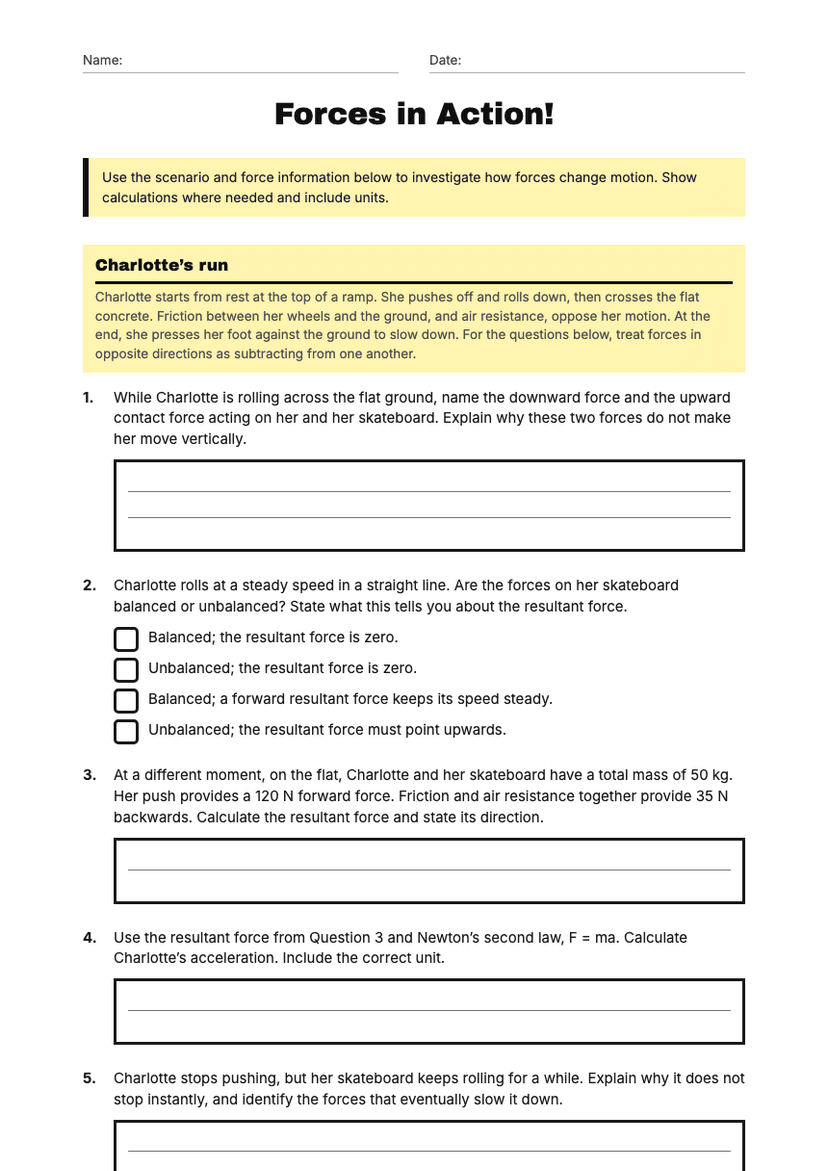
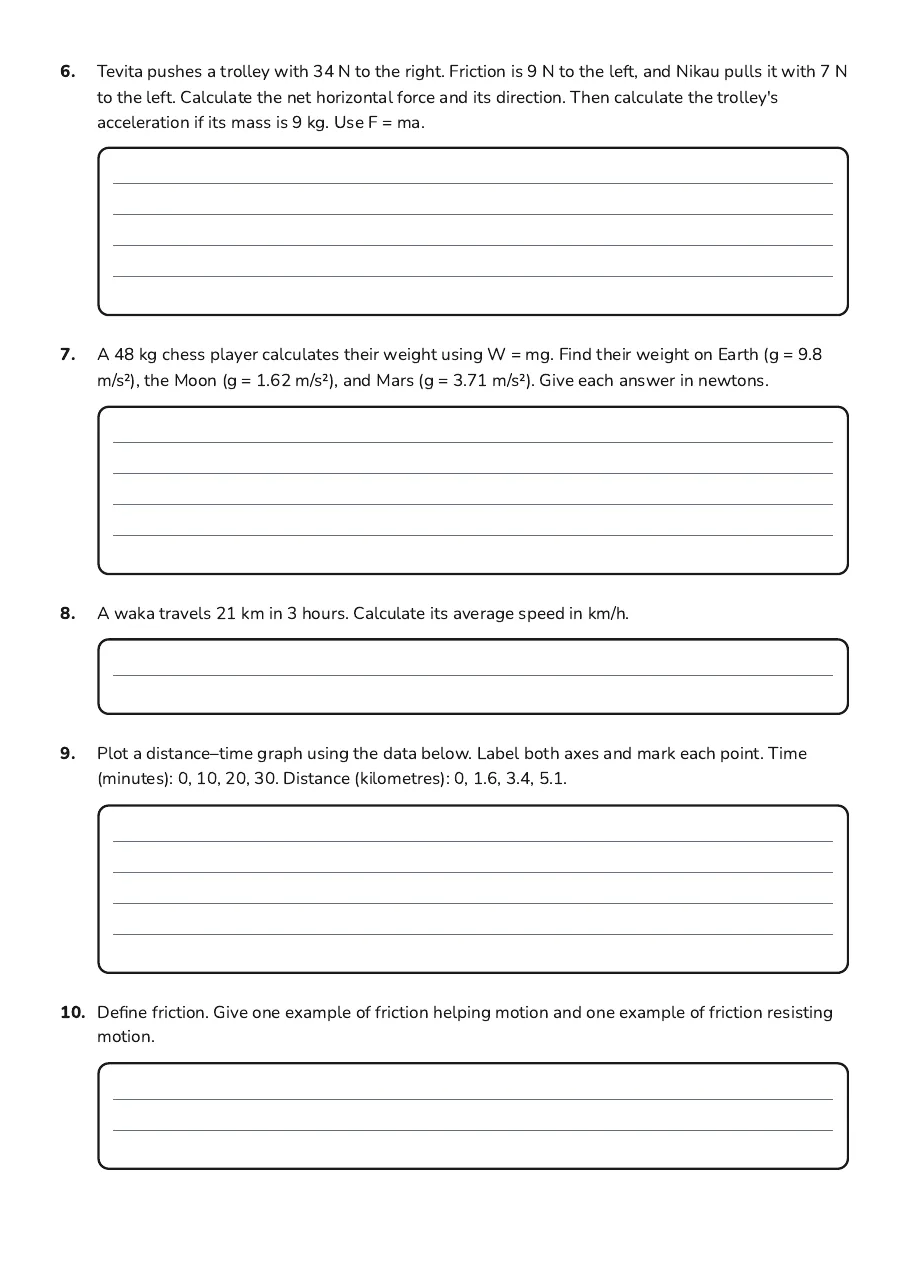
6.Tevita pushes a trolley with 34 N to the right. Friction is 9 N to the left, and Nikau pulls it with 7 N to the left. Calculate the net horizontal force and its direction. Then calculate the trolley's acceleration if its mass is 9 kg. Use F = ma.
7.A 48 kg chess player calculates their weight using W = mg. Find their weight on Earth (g = 9.8 m/s²), the Moon (g = 1.62 m/s²), and Mars (g = 3.71 m/s²). Give each answer in newtons.
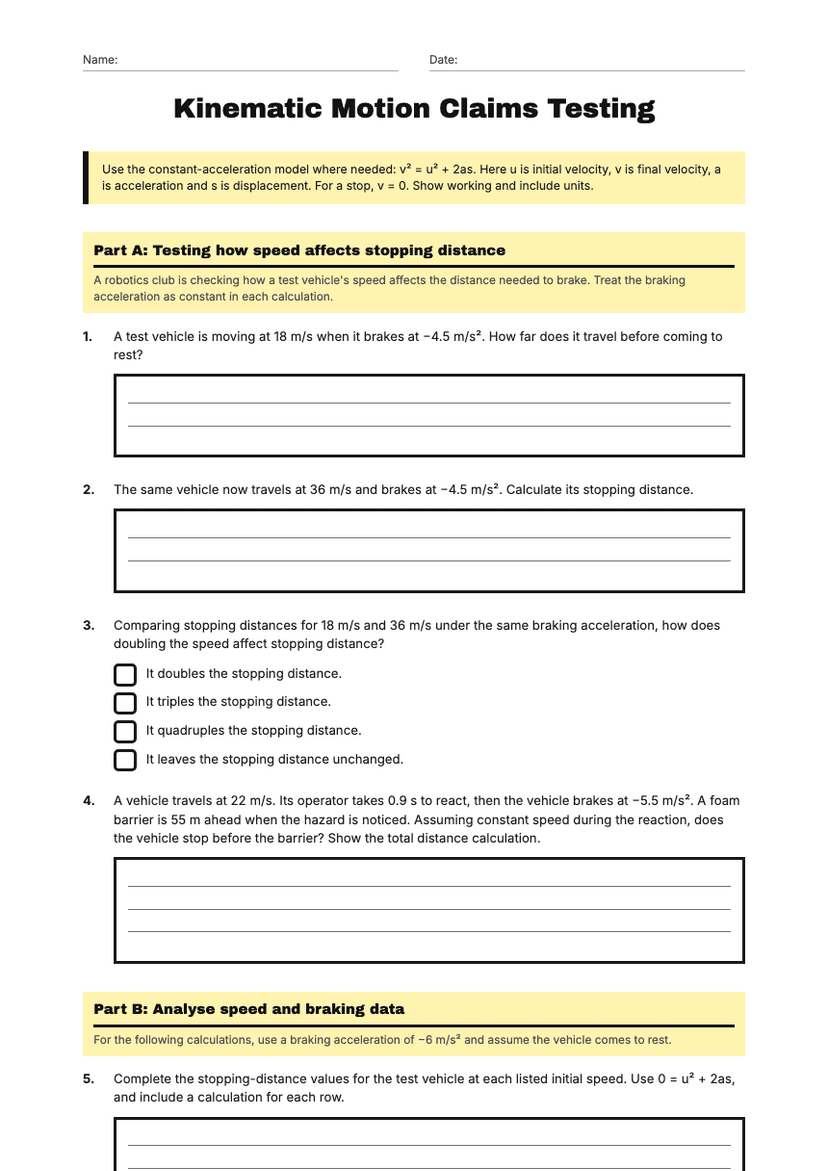
8.A waka travels 21 km in 3 hours. Calculate its average speed in km/h.
9.Plot a distance–time graph using the data below. Label both axes and mark each point. Time (minutes): 0, 10, 20, 30. Distance (kilometres): 0, 1.6, 3.4, 5.1.
10.Define friction. Give one example of friction helping motion and one example of friction resisting motion.
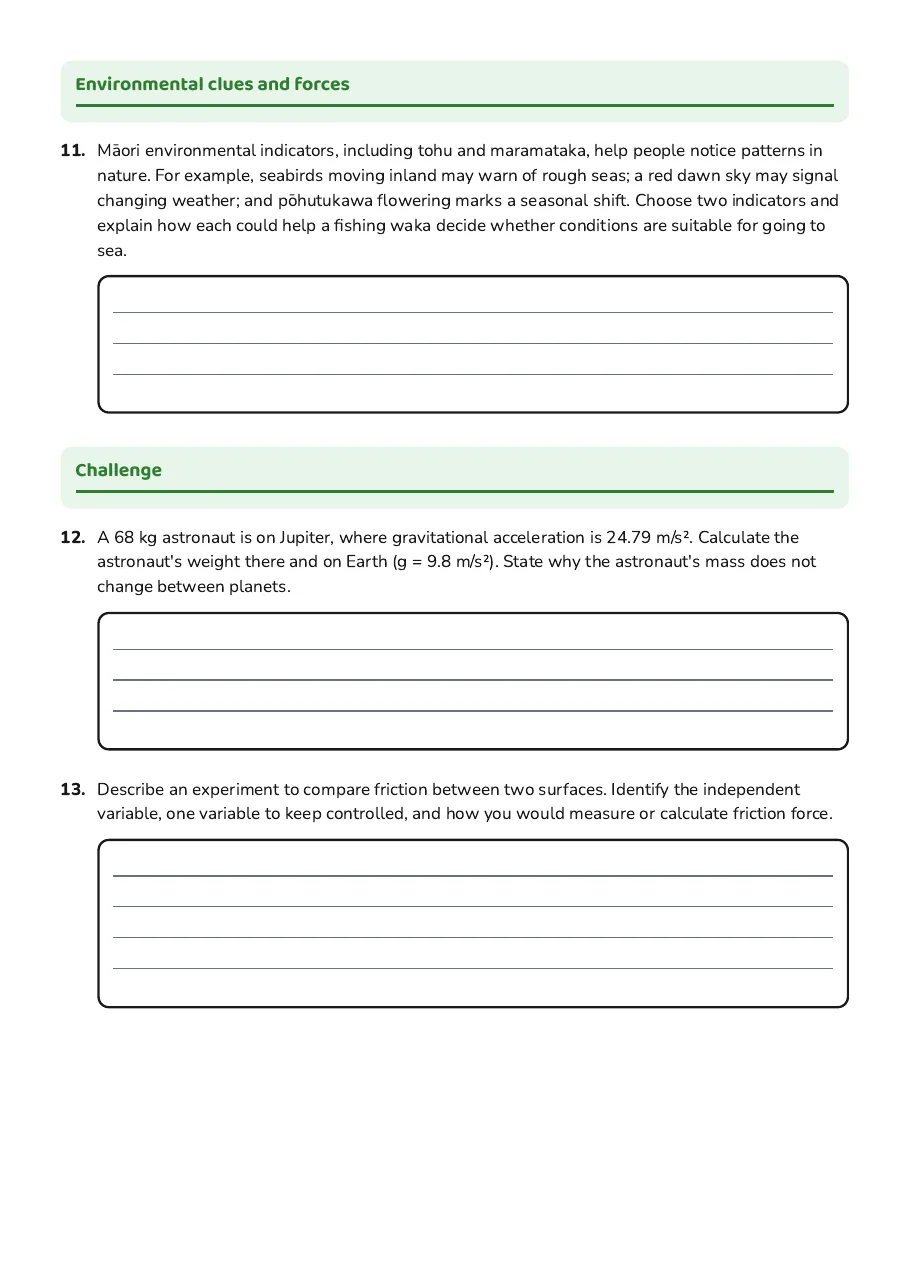
Environmental clues and forces
11.Māori environmental indicators, including tohu and maramataka, help people notice patterns in nature. For example, seabirds moving inland may warn of rough seas; a red dawn sky may signal changing weather; and pōhutukawa flowering marks a seasonal shift. Choose two indicators and explain how each could help a fishing waka decide whether conditions are suitable for going to sea.
Challenge
12.A 68 kg astronaut is on Jupiter, where gravitational acceleration is 24.79 m/s². Calculate the astronaut's weight there and on Earth (g = 9.8 m/s²). State why the astronaut's mass does not change between planets.
13.Describe an experiment to compare friction between two surfaces. Identify the independent variable, one variable to keep controlled, and how you would measure or calculate friction force.
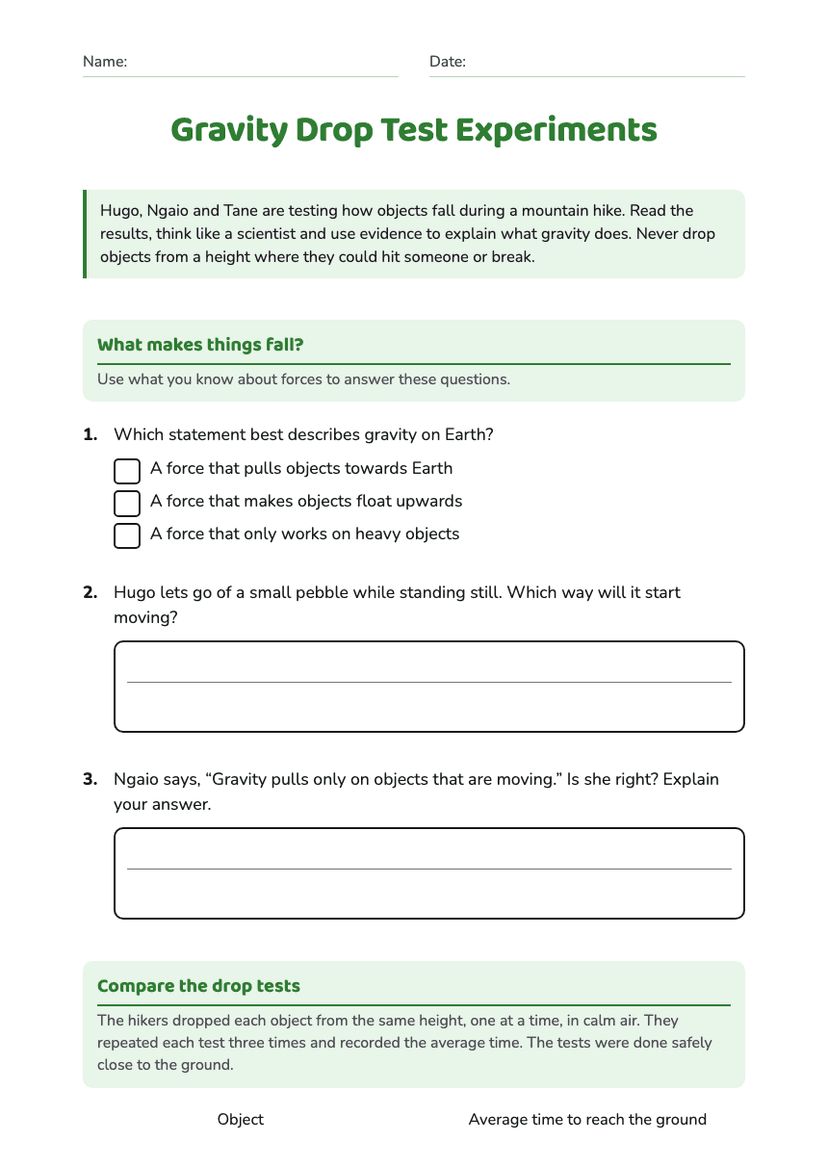
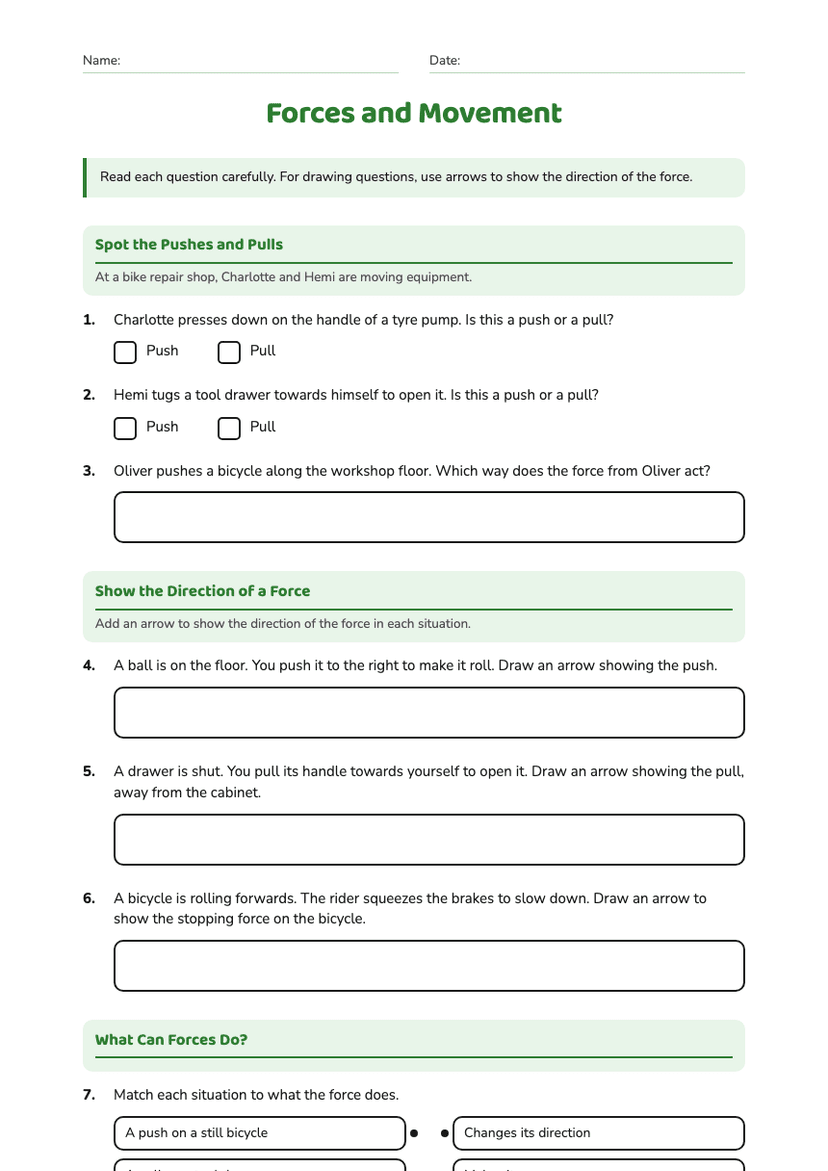
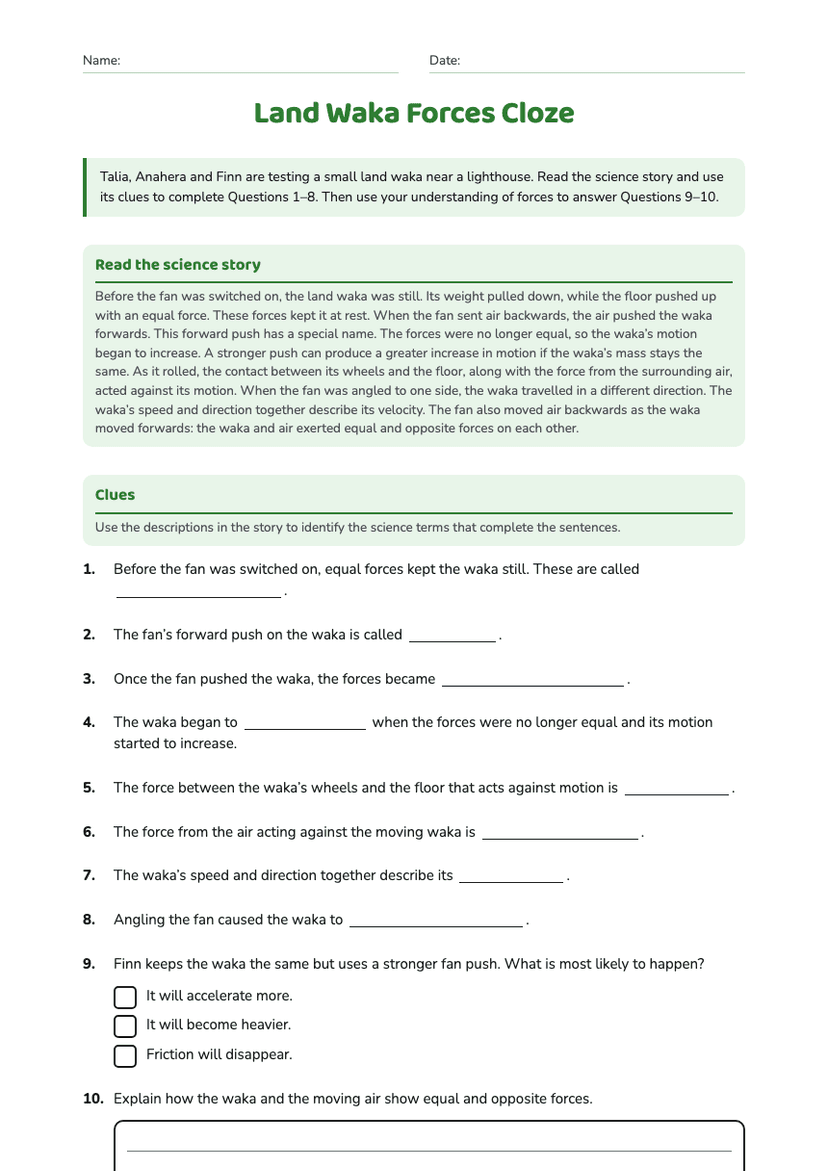
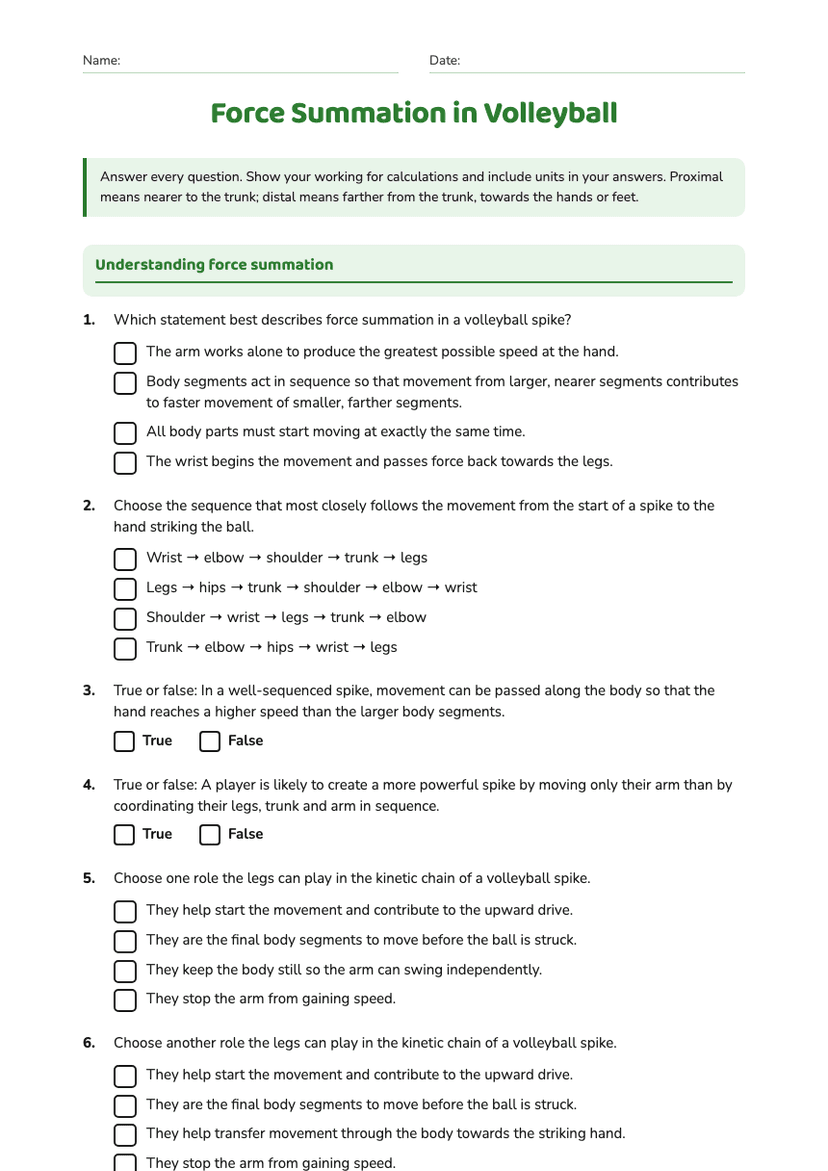
3 printable pages
Page 1
Page 2
Page 3
About This Worksheet
Free in Kuraplan
Sign up free, grab the PDF, and customize it for your class.
Print-Ready
Formatted for standard paper. Clean layout, easy to read.
AI-Generated
Created with Kuraplan's AI, designed for real classroom use.
For Teachers & Parents
Use in classrooms, for homework, tutoring, or homeschool.
Need a custom version of this worksheet?
Kuraplan's AI generates custom worksheets in seconds — differentiated for every learner, aligned to your curriculum.
Generate Custom Worksheets — Free No credit card Curriculum-aligned Under 60 seconds