Genetics Vocabulary and Inheritance
A free science worksheet ready for your classroom. Open in Kuraplan to grab the print-ready PDF, customize it for your students, or generate a fresh version in seconds.
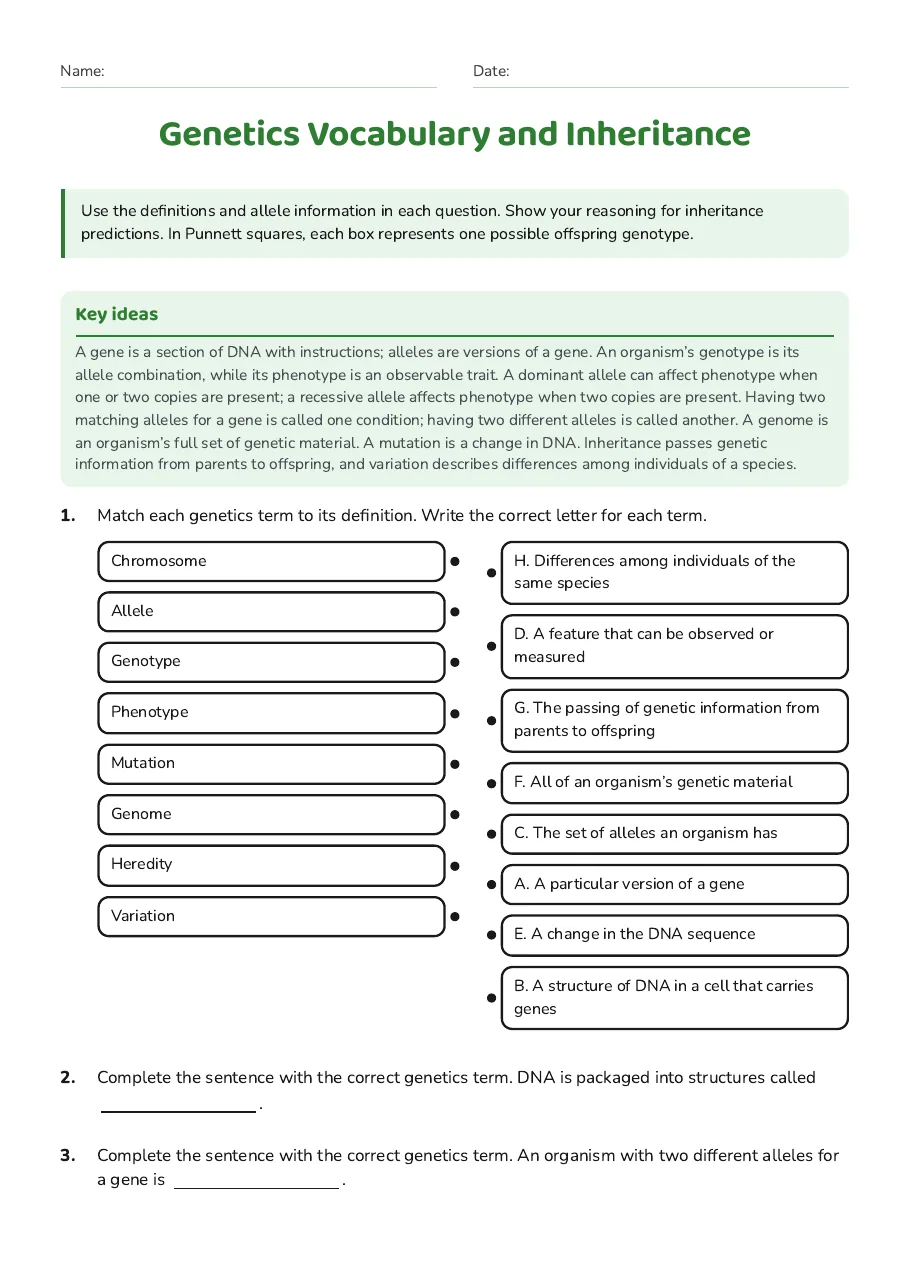
Important Terms in Genetics
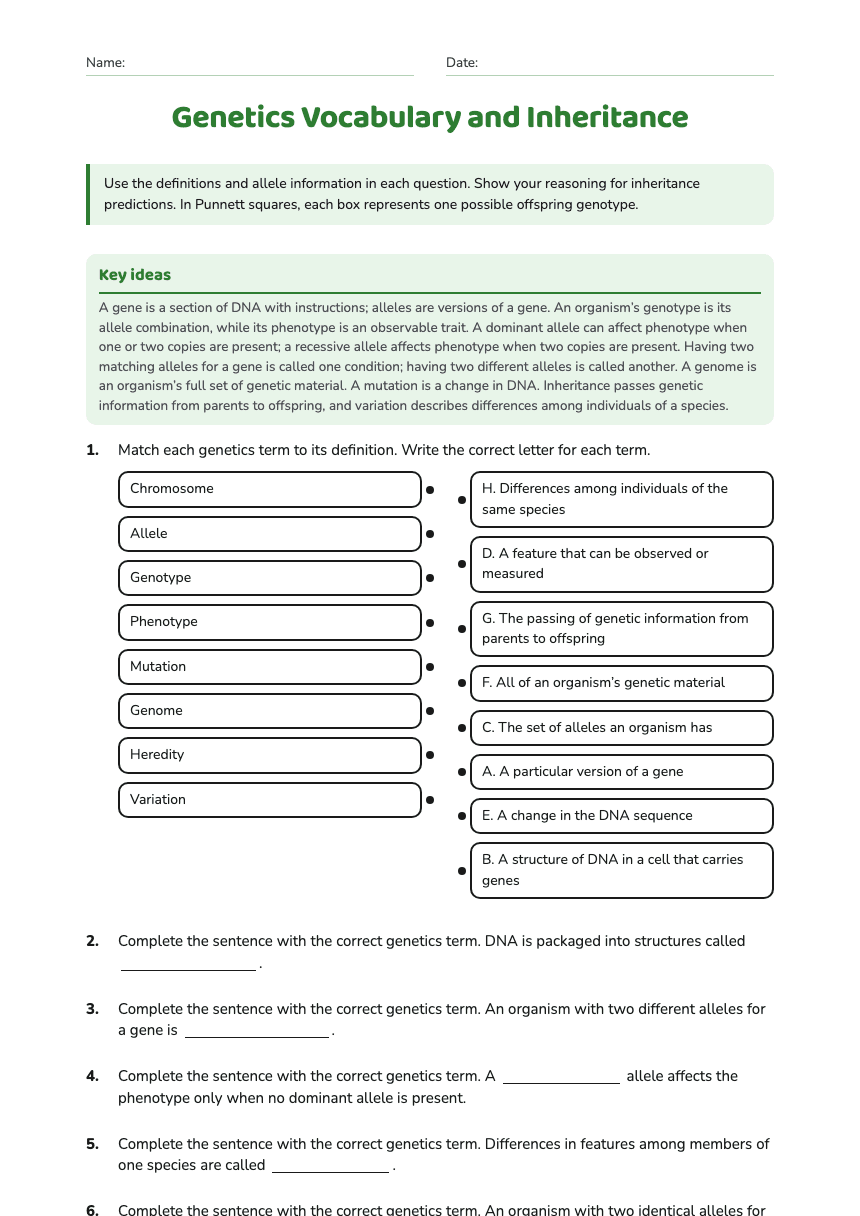
Part 1: Vocabulary
Learning focus: We are learning how genetic information is stored, inherited and expressed, and how inheritance creates variation.
Success criteria: I can define key genetics terms, use genotype and phenotype correctly, and complete a simple Punnett square.
Dyslexia-friendly options: Read each term aloud, use a ruler or coloured overlay to track lines, and ask for a partner or teacher to clarify unfamiliar words.
Glossary
Genetics: The study of genes, inheritance and variation.
Heredity or inheritance: The passing of genetic information from parents to offspring.
Variation: Differences in characteristics between individuals of the same species.
DNA: The molecule that stores genetic information.
Gene: A section of DNA that contains instructions for a characteristic or protein.
Allele: A different version of a gene.
Chromosome: A long, coiled structure of DNA found in a cell nucleus.
Genome: All the genetic material of an organism.
Genotype: The allele combination an organism has, such as Bb.
Phenotype: An observable characteristic, such as brown eyes.
Dominant allele: An allele expressed when at least one copy is present.
Recessive allele: An allele expressed only when two copies are present.
Homozygous: Having two identical alleles, such as BB or bb.
Heterozygous: Having two different alleles, such as Bb.
Mutation: A change in the DNA sequence.
Punnett square: A diagram used to predict possible offspring genotypes and phenotypes.
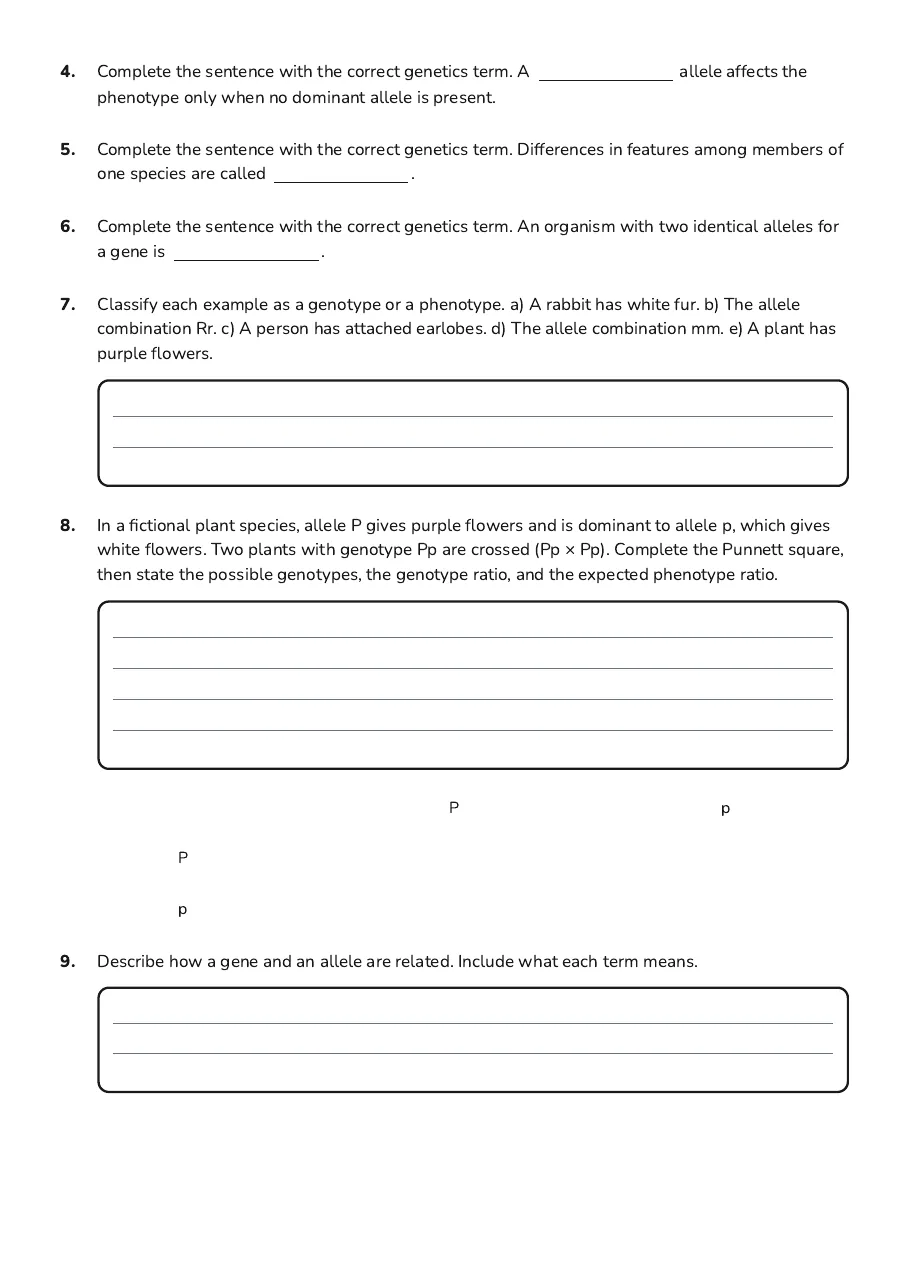
a) DNA is organised into structures called ____________.
b) An organism with two different alleles is ____________.
c) A ____________ allele is masked when a dominant allele is present.
d) Differences between individuals are called ____________.
Part 2: Applying Inheritance
a) Tall plant: ____________________
b) Tt: ____________________
c) Blue eyes: ____________________
d) aa: ____________________
In pea plants, T is the dominant allele for tall plants and t is the recessive allele for short plants. Cross two heterozygous plants: Tt × Tt.
Write one parent’s alleles across the top and the other parent’s alleles down the side. Then complete the four offspring genotypes.
Possible genotypes: ______________________________
Expected phenotype ratio: __________ tall : __________ short
Differentiation: Use the glossary and allele cards or ask a partner to read questions aloud. For an added challenge, calculate the expected percentage of each genotype in question 4 and explain why real offspring numbers may differ from predictions.
Teacher Answer Key
1. Matching: 1-D, 2-E, 3-C, 4-B, 5-A.
2. Fill in the blanks: a) chromosomes; b) heterozygous; c) recessive; d) variation.
3. Classification: a) phenotype; b) genotype; c) phenotype; d) genotype.
4. Punnett square:
Top alleles: T, t. Side alleles: T, t. Offspring genotypes: TT, Tt, Tt, tt. Genotype ratio: 1 TT : 2 Tt : 1 tt. Phenotype ratio: 3 tall : 1 short.
5. Expected response: A gene is a section of DNA containing instructions for a characteristic or protein. An allele is a particular version of that gene.
6. Expected response: A person with one dominant and one recessive allele is heterozygous. The dominant allele is expressed, so the recessive phenotype is not shown, although the recessive allele is still present.
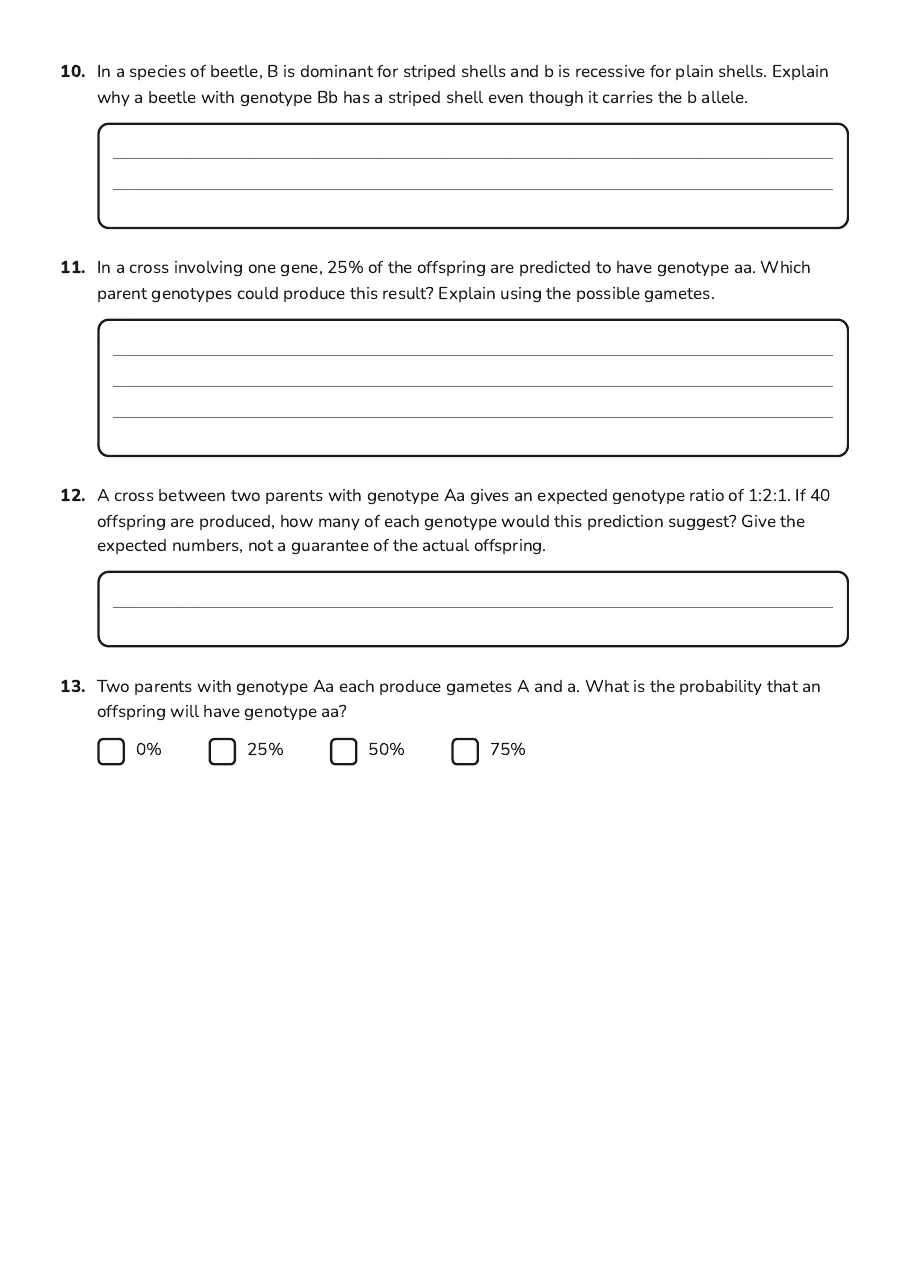
7. Expected response: The parents must both be heterozygous: Aa × Aa. This cross gives a 1 in 4, or 25%, chance of aa offspring.
Curriculum connection: This worksheet supports NZ Te Mātaiaho Science, Biological Science: genetic inheritance and variation, reference NZ-TMA-SCIENCE-Y0-10-biological-science-020-DOC113.
About This Worksheet
Free in Kuraplan
Sign up free, grab the PDF, and customize it for your class.
Print-Ready
Formatted for standard paper. Clean layout, easy to read.
AI-Generated
Created with Kuraplan's AI, designed for real classroom use.
For Teachers & Parents
Use in classrooms, for homework, tutoring, or homeschool.
Need a custom version of this worksheet?
Kuraplan's AI generates custom worksheets in seconds — differentiated for every learner, aligned to your curriculum.
Generate Custom Worksheets — FreeMore Science Worksheets
Danforth: Authority and Conscience
Free
Natural Resources Science
Free
Natural Resources Science
Free
Vitamins, Minerals, and Protein Science
Free
Exploring Science Materials
Free
Waka Buoyancy Science Worksheet
Free
Science Skills Made Simple
Free