ScienceFreePrintable

Human Respiratory System Worksheet

A free science worksheet ready for your classroom. Open in Kuraplan to grab the print-ready PDF, customize it for your students, or generate a fresh version in seconds.
Human Respiratory System Worksheet worksheet preview
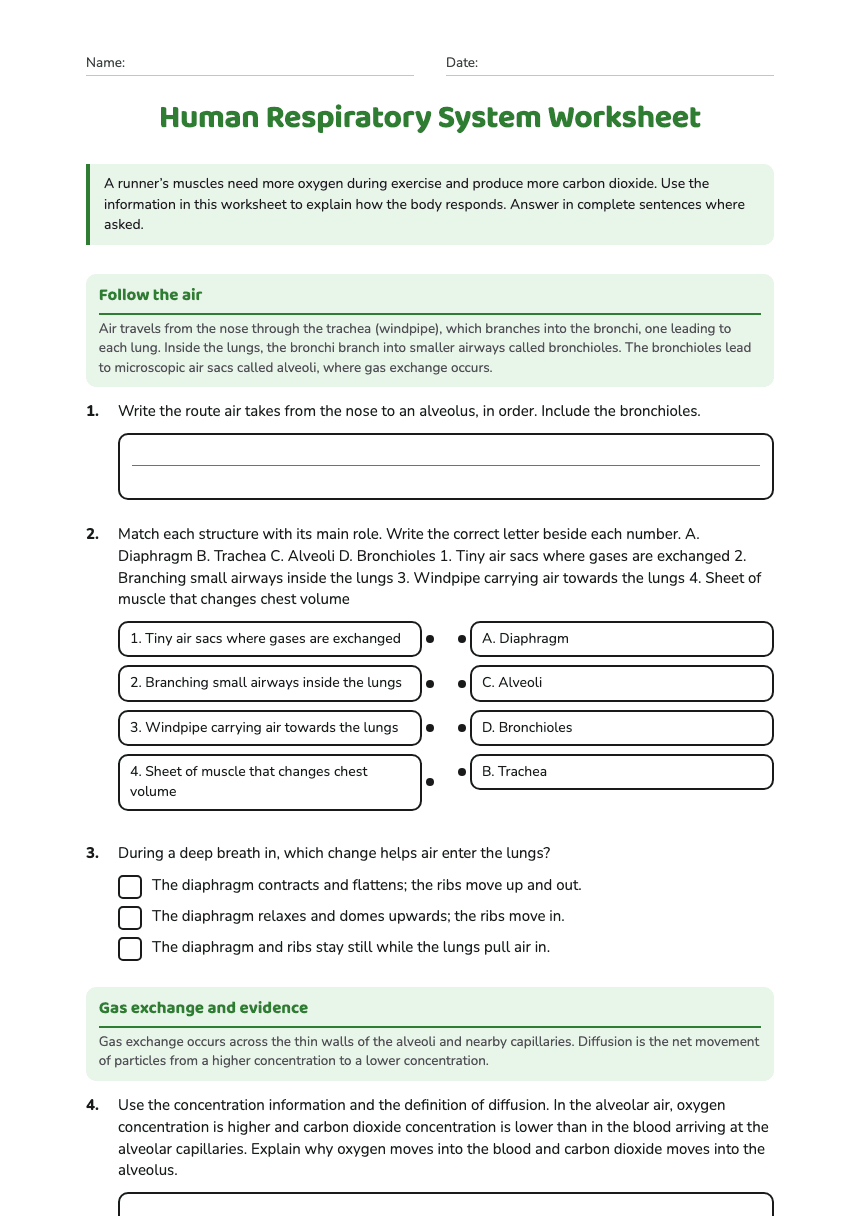
Name:Date:

Human Respiratory System Worksheet

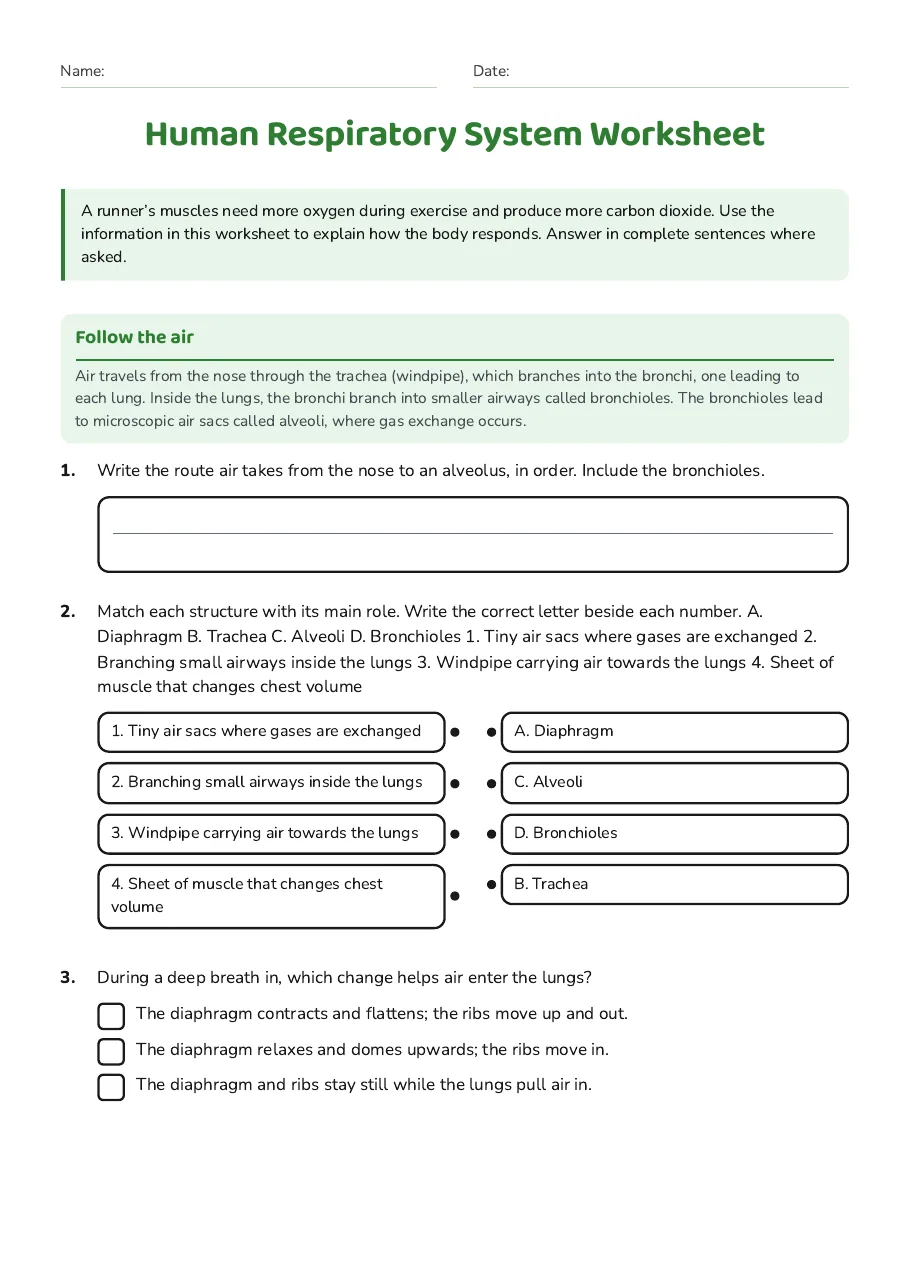
A runner’s muscles need more oxygen during exercise and produce more carbon dioxide. Use the information in this worksheet to explain how the body responds. Answer in complete sentences where asked.

Follow the air

Air travels from the nose through the trachea (windpipe), which branches into the bronchi, one leading to each lung. Inside the lungs, the bronchi branch into smaller airways called bronchioles. The bronchioles lead to microscopic air sacs called alveoli, where gas exchange occurs.

1.Write the route air takes from the nose to an alveolus, in order. Include the bronchioles.
2.Match each structure with its main role. Write the correct letter beside each number. A. Diaphragm B. Trachea C. Alveoli D. Bronchioles 1. Tiny air sacs where gases are exchanged 2. Branching small airways inside the lungs 3. Windpipe carrying air towards the lungs 4. Sheet of muscle that changes chest volume
  • 1. Tiny air sacs where gases are exchanged
  • 2. Branching small airways inside the lungs
  • 3. Windpipe carrying air towards the lungs
  • 4. Sheet of muscle that changes chest volume
  • A. Diaphragm
  • C. Alveoli
  • D. Bronchioles
  • B. Trachea
3.During a deep breath in, which change helps air enter the lungs?
  • The diaphragm contracts and flattens; the ribs move up and out.
  • The diaphragm relaxes and domes upwards; the ribs move in.
  • The diaphragm and ribs stay still while the lungs pull air in.

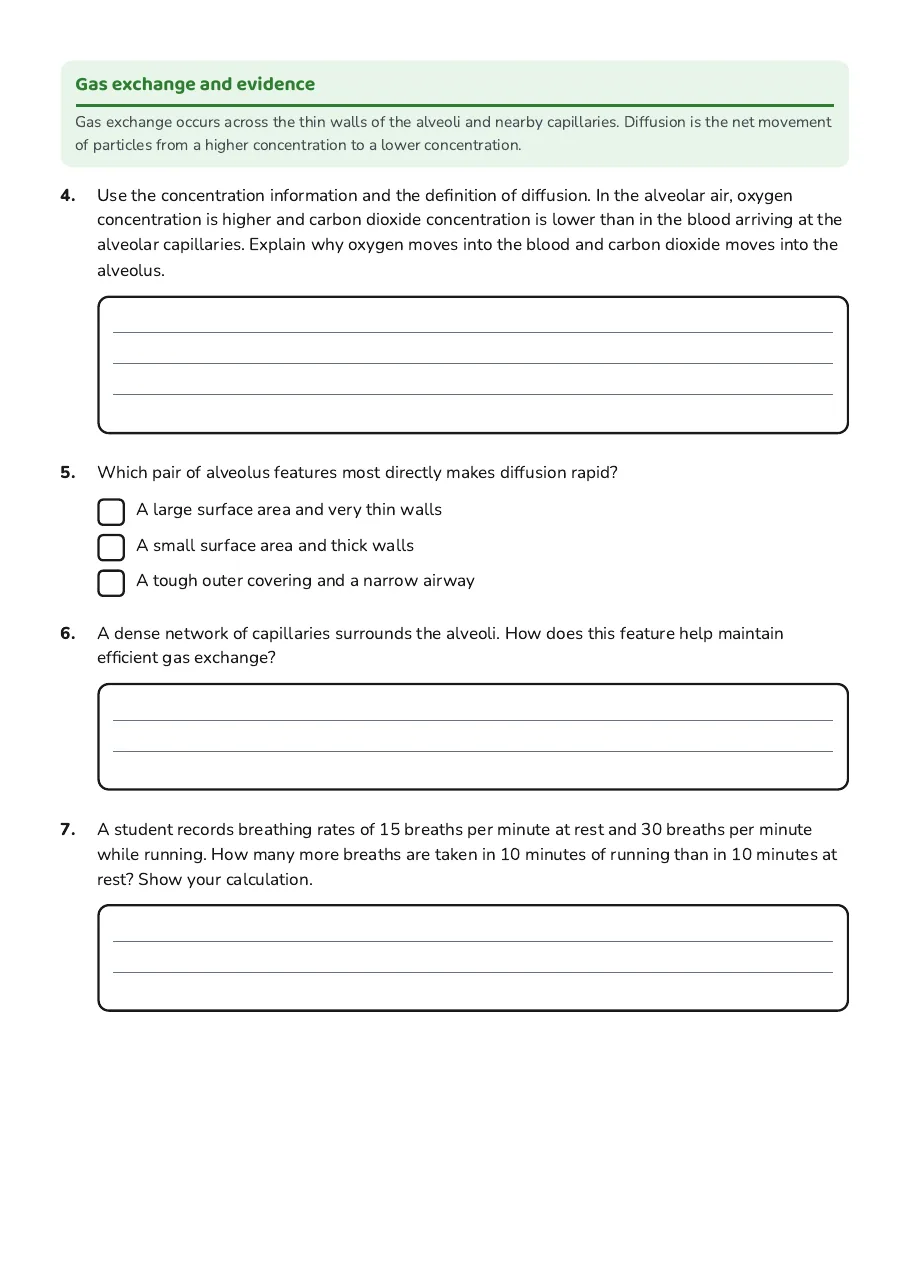
Gas exchange and evidence

Gas exchange occurs across the thin walls of the alveoli and nearby capillaries. Diffusion is the net movement of particles from a higher concentration to a lower concentration.

4.Use the concentration information and the definition of diffusion. In the alveolar air, oxygen concentration is higher and carbon dioxide concentration is lower than in the blood arriving at the alveolar capillaries. Explain why oxygen moves into the blood and carbon dioxide moves into the alveolus.
5.Which pair of alveolus features most directly makes diffusion rapid?
  • A large surface area and very thin walls
  • A small surface area and thick walls
  • A tough outer covering and a narrow airway
6.A dense network of capillaries surrounds the alveoli. How does this feature help maintain efficient gas exchange?
7.A student records breathing rates of 15 breaths per minute at rest and 30 breaths per minute while running. How many more breaths are taken in 10 minutes of running than in 10 minutes at rest? Show your calculation.
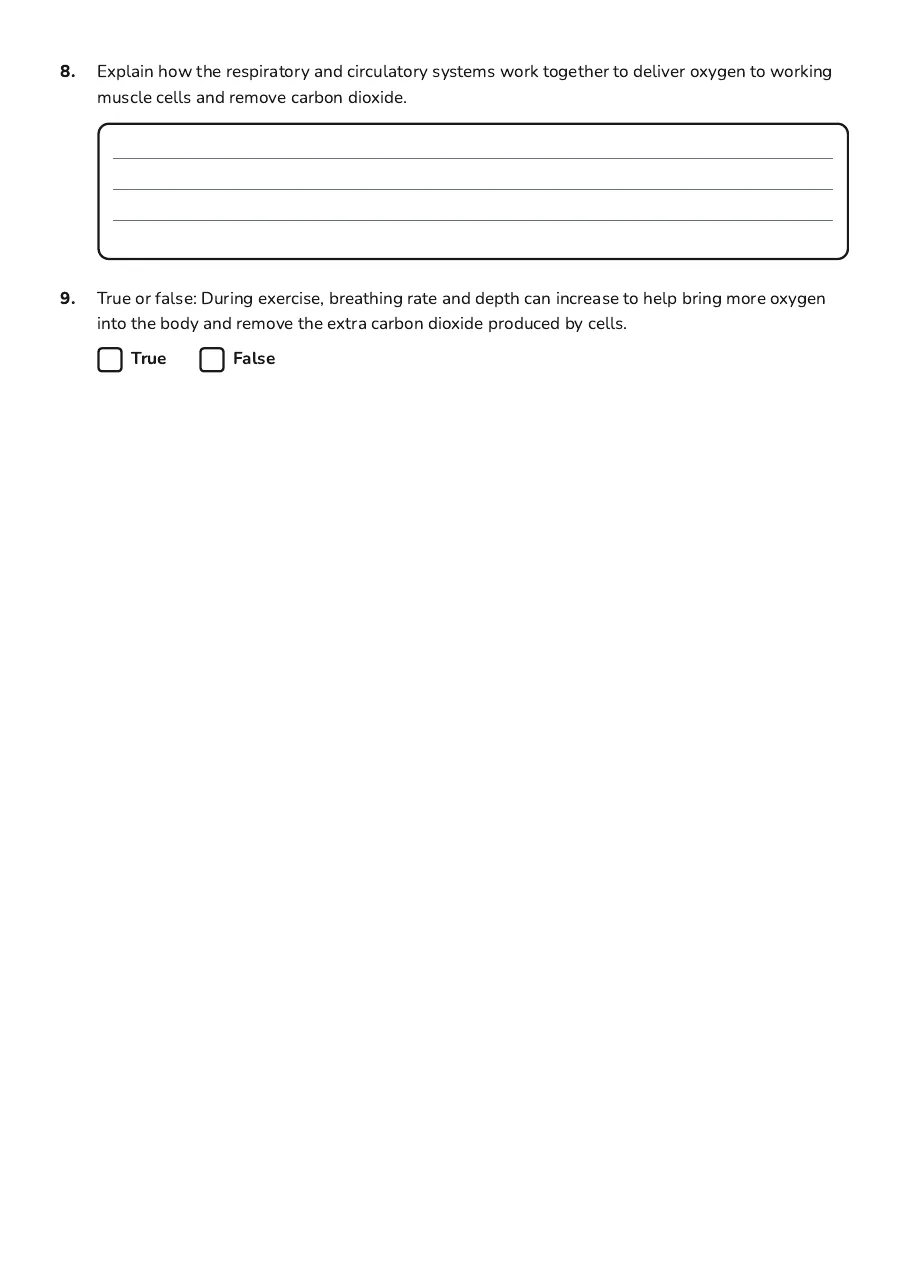
8.Explain how the respiratory and circulatory systems work together to deliver oxygen to working muscle cells and remove carbon dioxide.
9.True or false: During exercise, breathing rate and depth can increase to help bring more oxygen into the body and remove the extra carbon dioxide produced by cells.
TrueFalse

3 printable pages

  • Human Respiratory System Worksheet, page 1 of 3: Follow the air

    Page 1

  • Human Respiratory System Worksheet, page 2 of 3: Gas exchange and evidence

    Page 2

  • Human Respiratory System Worksheet, page 3 of 3: 8. Explain how the respiratory and circulatory systems work together to deliver oxygen to…

    Page 3

About This Worksheet

Free in Kuraplan

Sign up free, grab the PDF, and customize it for your class.

Print-Ready

Formatted for standard paper. Clean layout, easy to read.

AI-Generated

Created with Kuraplan's AI, designed for real classroom use.

For Teachers & Parents

Use in classrooms, for homework, tutoring, or homeschool.

Need a custom version of this worksheet?

Kuraplan's AI generates custom worksheets in seconds — differentiated for every learner, aligned to your curriculum.

Generate Custom Worksheets — Free
No credit card Curriculum-aligned Under 60 seconds