Kahungunu Ki Tai Reading Booklet
A free english worksheet ready for your classroom. Open in Kuraplan to grab the print-ready PDF, customize it for your students, or generate a fresh version in seconds.
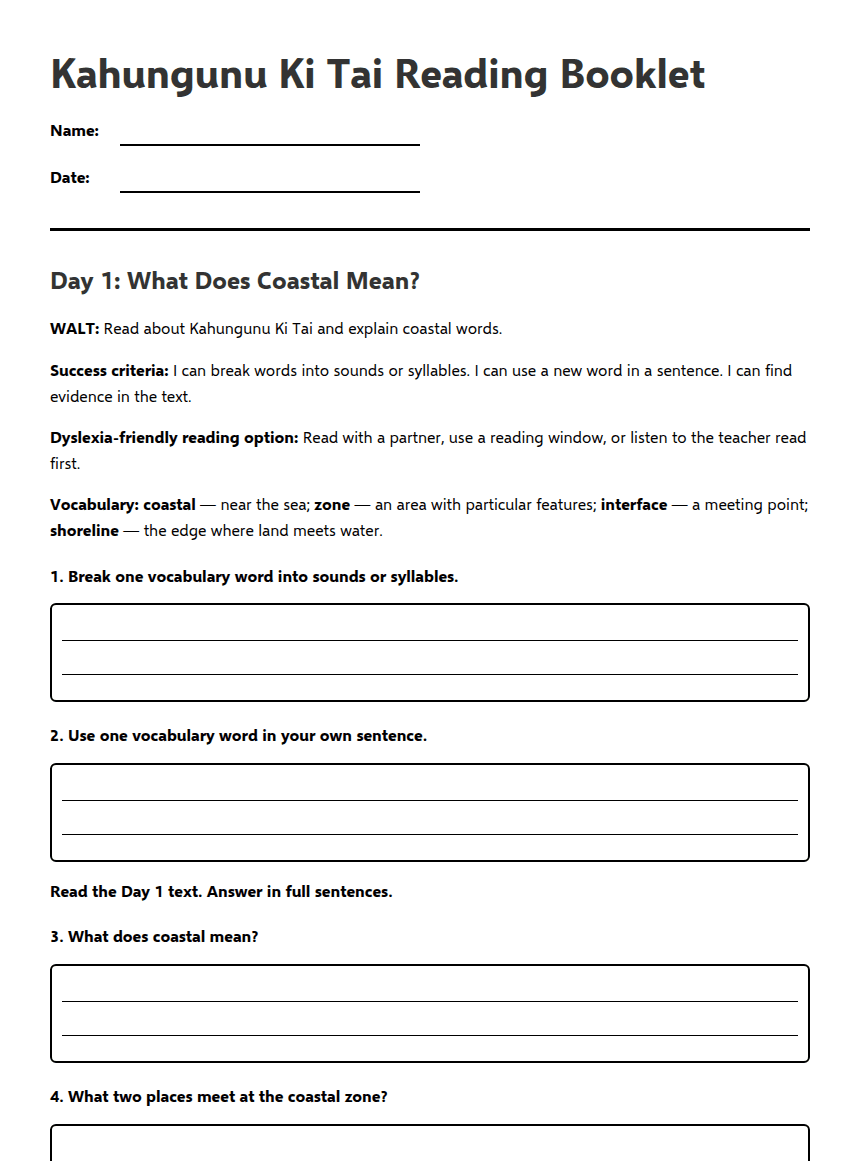
Kahungunu Ki Tai Reading Booklet
Day 1: What Does Coastal Mean?
WALT: Read about Kahungunu Ki Tai and explain coastal words.
Success criteria: I can break words into sounds or syllables. I can use a new word in a sentence. I can find evidence in the text.
Dyslexia-friendly reading option: Read with a partner, use a reading window, or listen to the teacher read first.
Vocabulary: coastal — near the sea; zone — an area with particular features; interface — a meeting point; shoreline — the edge where land meets water.
Read the Day 1 text. Answer in full sentences.
Evidence: Underline evidence in the text or copy one phrase that supports an answer.
Extension: Explain how a beach, rocky shore, harbour or estuary is different from another coastal place.
Day 2: A Changing Environment
WALT: Explain how coastal environments change.
Success criteria: I can define a new word. I can identify natural and human changes. I can use evidence.
Dyslexia-friendly reading option: Echo-read each sentence and track the words with a finger or ruler.
Vocabulary: environment — the living and non-living world around us; region — a particular area; habitat — a place where plants and animals live; dynamic — always changing.
Read the Day 2 text. Answer in full sentences.
Evidence: Underline or copy a phrase from the text that supports one answer.
Extension: Explain one cause-and-effect link in a changing coastal environment.
Day 3: Waves and Wind
WALT: Explain how wind can make waves.
Success criteria: I can read science words accurately. I can describe a process. I can support an idea with evidence.
Dyslexia-friendly reading option: Say each word slowly, tap its syllables, and reread difficult sentences.
Vocabulary: wave — a moving rise and fall of water; wind — moving air; energy — the ability to make something move or change; friction — rubbing that slows or pushes movement.
Read the Day 3 text. Answer in full sentences.
Evidence: Underline or copy the phrase that explains how wind makes waves.
Extension: Explain how stronger wind might affect the size or movement of waves.
Day 4: Tides and Gravity
WALT: Explain how gravity helps create tides.
Success criteria: I can explain a science idea in my own words. I can compare waves and tides. I can use text evidence.
Dyslexia-friendly reading option: Read the passage in short phrases, then echo-read it with a partner.
Vocabulary: tide — the regular rise and fall of sea level; gravity — a force that pulls objects together; fluid — a substance that can flow; tug — to pull strongly.
Read the Day 4 text. Answer in full sentences.
Evidence: Underline or copy a phrase that explains the Moon’s or Sun’s pull.
Extension: Compare the cause of a wave with the cause of a tide.
Day 5: High, Low and Intertidal
WALT: Describe what happens between high tide and low tide.
Success criteria: I can explain intertidal. I can describe changing conditions. I can use evidence from the text.
Dyslexia-friendly reading option: Cover some lines, read one line at a time, and reread for meaning.
Vocabulary: high tide — when water reaches its highest level; low tide — when water reaches its lowest level; intertidal — the area between high and low tide; exposed — uncovered or visible.
Read the Day 5 text. Answer in full sentences.
Evidence: Underline or copy a phrase showing that the shore can be underwater and exposed.
Extension: Explain one way an intertidal animal might cope with change.
Day 6: King Tides and Evidence
WALT: Explain what king tides show us.
Success criteria: I can explain a new term. I can connect evidence to an idea. I can answer using the text.
Dyslexia-friendly reading option: Listen first, highlight key words, and discuss answers before writing.
Vocabulary: alignment — objects arranged in a line or position; king tide — an unusually high natural tide; flooding — water covering normally dry land; sea-level rise — a long-term increase in ocean height.
Read the Day 6 text. Answer in full sentences.
Evidence: Underline or copy a phrase explaining how a king tide forms.
Extension: Suggest one measurement scientists could make during a king tide.
Day 7: Caring for Coastal Waters
WALT: Explain how communities can protect coastal waters.
Success criteria: I can explain a problem. I can suggest a solution. I can support my answer with evidence.
Dyslexia-friendly reading option: Rehearse your answer orally with a partner before writing it.
Vocabulary: conservation — protecting and caring for nature; pollution — harmful waste in the environment; marine debris — rubbish in the ocean; community — people living or working together.
Read the Day 7 text. Answer in full sentences.
Evidence: Underline or copy a phrase that supports a protective action.
Extension: Write an evidence-based recommendation for protecting Kahungunu Ki Tai.
Day 8: Synthesising Ideas
WALT: Summarise how natural forces and people affect Kahungunu Ki Tai.
Success criteria: I can connect ideas from the whole text. I can include evidence. I can describe a protective action.
Dyslexia-friendly reading option: Reread selected sentences, use a reading window, and plan ideas aloud before writing.
Vocabulary: impact — an effect or change; erosion — wearing away by wind or water; evidence — information that supports an idea; responsibility — a duty to care or act.
Reread the text. Answer in full sentences.
Evidence: Underline or copy two phrases from the text that support your ideas.
Summary: Write two or three sentences. Include one natural force, one human impact and one protective action.
Extension: Write a recommendation explaining why your protective action matters.
About This Worksheet
Free in Kuraplan
Sign up free, grab the PDF, and customize it for your class.
Print-Ready
Formatted for standard paper. Clean layout, easy to read.
AI-Generated
Created with Kuraplan's AI, designed for real classroom use.
For Teachers & Parents
Use in classrooms, for homework, tutoring, or homeschool.
Need a custom version of this worksheet?
Kuraplan's AI generates custom worksheets in seconds — differentiated for every learner, aligned to your curriculum.
Generate Custom Worksheets — Free