ScienceFreePrintable
Living Things Classification
A free science worksheet ready for your classroom. Open in Kuraplan to grab the print-ready PDF, customize it for your students, or generate a fresh version in seconds.
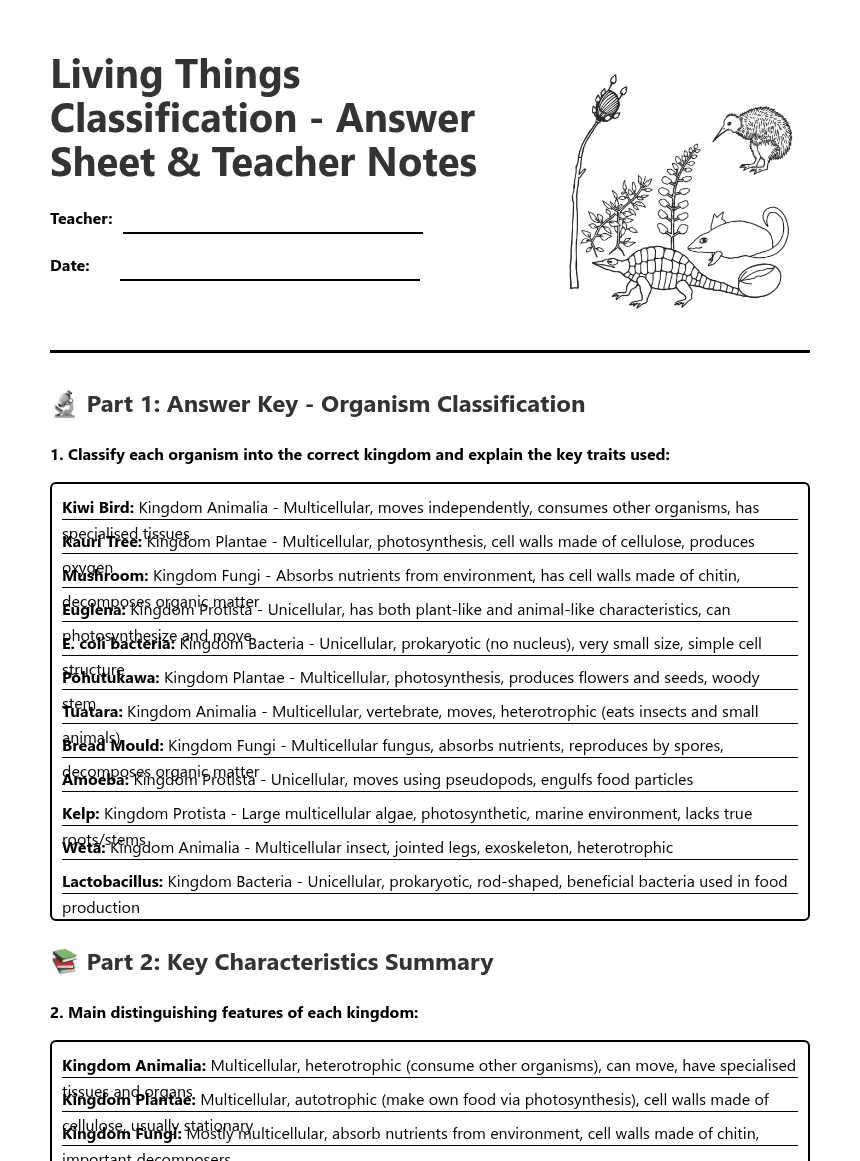
Living Things Classification - Answer Sheet & Teacher Notes
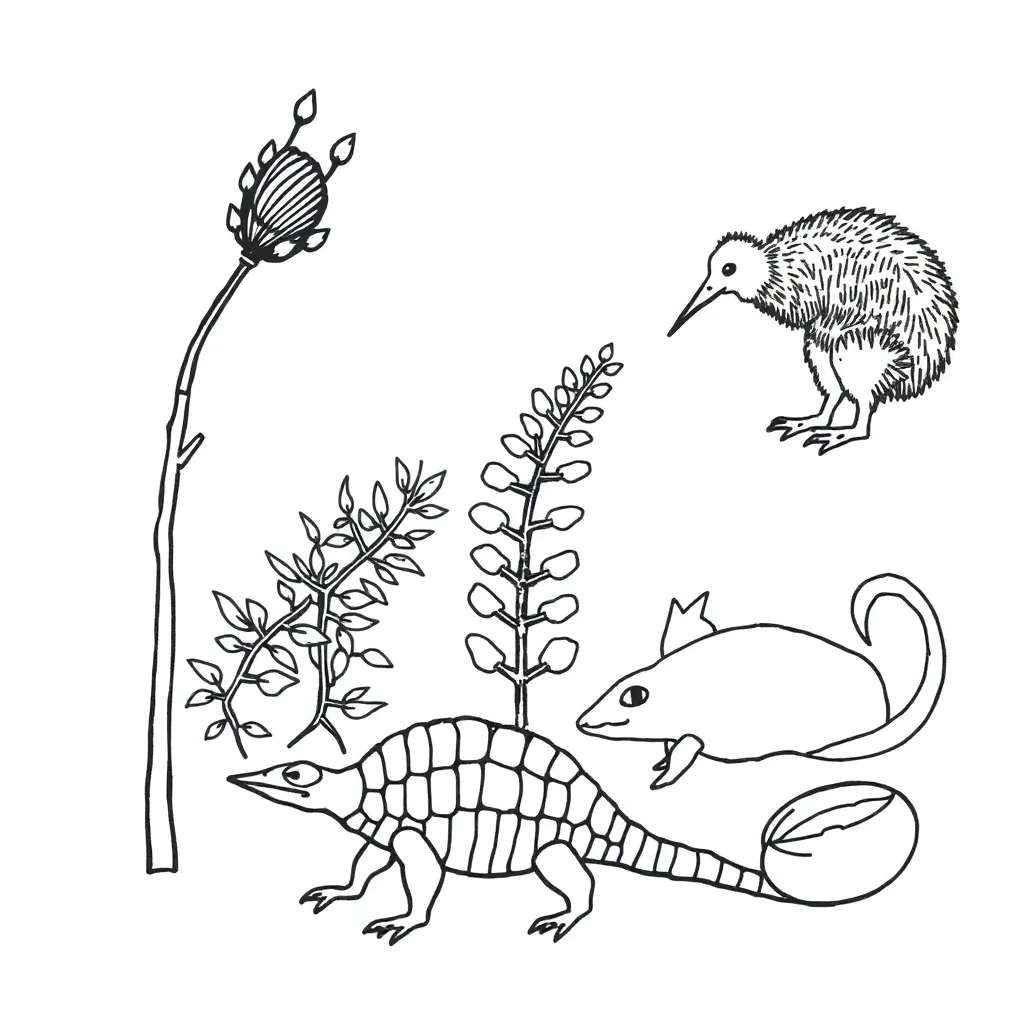
🔬 Part 1: Answer Key - Organism Classification
1. Classify each organism into the correct kingdom and explain the key traits used:
Kiwi Bird: Kingdom Animalia - Multicellular, moves independently, consumes other organisms, has specialised tissues
Kauri Tree: Kingdom Plantae - Multicellular, photosynthesis, cell walls made of cellulose, produces oxygen
Mushroom: Kingdom Fungi - Absorbs nutrients from environment, has cell walls made of chitin, decomposes organic matter
Euglena: Kingdom Protista - Unicellular, has both plant-like and animal-like characteristics, can photosynthesize and move
E. coli bacteria: Kingdom Bacteria - Unicellular, prokaryotic (no nucleus), very small size, simple cell structure
Pōhutukawa: Kingdom Plantae - Multicellular, photosynthesis, produces flowers and seeds, woody stem
Tuatara: Kingdom Animalia - Multicellular, vertebrate, moves, heterotrophic (eats insects and small animals)
Bread Mould: Kingdom Fungi - Multicellular fungus, absorbs nutrients, reproduces by spores, decomposes organic matter
Amoeba: Kingdom Protista - Unicellular, moves using pseudopods, engulfs food particles
Kelp: Kingdom Protista - Large multicellular algae, photosynthetic, marine environment, lacks true roots/stems
Wētā: Kingdom Animalia - Multicellular insect, jointed legs, exoskeleton, heterotrophic
Lactobacillus: Kingdom Bacteria - Unicellular, prokaryotic, rod-shaped, beneficial bacteria used in food production
📚 Part 2: Key Characteristics Summary
2. Main distinguishing features of each kingdom:
Kingdom Animalia: Multicellular, heterotrophic (consume other organisms), can move, have specialised tissues and organs
Kingdom Plantae: Multicellular, autotrophic (make own food via photosynthesis), cell walls made of cellulose, usually stationary
Kingdom Fungi: Mostly multicellular, absorb nutrients from environment, cell walls made of chitin, important decomposers
Kingdom Protista: Mostly unicellular, diverse group with mixed characteristics, includes algae, protozoa, and slime moulds
Kingdom Bacteria: Unicellular, prokaryotic (no membrane-bound nucleus), very small, found everywhere on Earth
🎯 Part 3: Teacher Discussion Points
3. Key discussion questions to guide student learning:
• Why might some organisms be difficult to classify? (e.g., Euglena has both plant and animal characteristics)
• How do scientists decide when to create new kingdoms or reclassify organisms?
• What tools help scientists classify very small organisms like bacteria?
• How does classification help us understand biodiversity in New Zealand?
• What role do native NZ species play in their ecosystems?
⚠️ Part 4: Common Student Misconceptions
4. Watch out for these common errors:
Misconception: All small organisms are bacteria
Correction: Many protists are also microscopic but have different cell structures
Misconception: Fungi are plants because they don't move
Correction: Fungi absorb nutrients rather than photosynthesise, and have different cell wall composition
Misconception: All algae are plants
Correction: Most algae belong to Kingdom Protista, though they photosynthesise like plants
Misconception: Classification never changes
Correction: Scientific classification evolves as we discover new evidence and better understand relationships
🌿 Part 5: New Zealand Curriculum Connections
5. Curriculum alignment and extension activities:
Level 4 Achievement Objective: Recognise common features of living things and explore diversity and classification
Key Competencies developed:
• Thinking: Analysing characteristics and making classification decisions
• Using language: Communicating scientific reasoning and terminology
• Participating and contributing: Working collaboratively in group activities
Extension activities:
• Research endemic NZ species and their classification
• Create a dichotomous key for local organisms
• Explore Māori traditional knowledge of native species classification
• Investigate how DNA analysis has changed modern classification
📝 Part 6: Assessment Rubric
6. Student performance indicators:
Excellent (A): Correctly classifies all organisms with detailed, accurate explanations of distinguishing characteristics
Good (B): Correctly classifies most organisms with generally accurate explanations, minor errors in detail
Satisfactory (C): Correctly classifies some organisms with basic explanations, shows understanding of main concepts
Needs Support (D): Limited correct classifications, requires additional support to understand basic classification principles
About This Worksheet
Free in Kuraplan
Sign up free, grab the PDF, and customize it for your class.
Print-Ready
Formatted for standard paper. Clean layout, easy to read.
AI-Generated
Created with Kuraplan's AI, designed for real classroom use.
For Teachers & Parents
Use in classrooms, for homework, tutoring, or homeschool.
Need a custom version of this worksheet?
Kuraplan's AI generates custom worksheets in seconds — differentiated for every learner, aligned to your curriculum.
Generate Custom Worksheets — Free No credit card Curriculum-aligned Under 60 seconds
More Science Worksheets
Year 12
Meiosis and Genetic Variation
Free
Year 11
Microbe–Factor–Process Research
Free
Year 12
DNA Mutations and Effects
Free
Year 12
Cellular Respiration Revision
Free
Year 12
Photosynthesis and Chloroplasts Revision
Free
Year 11
Photosynthesis and Chloroplasts
Free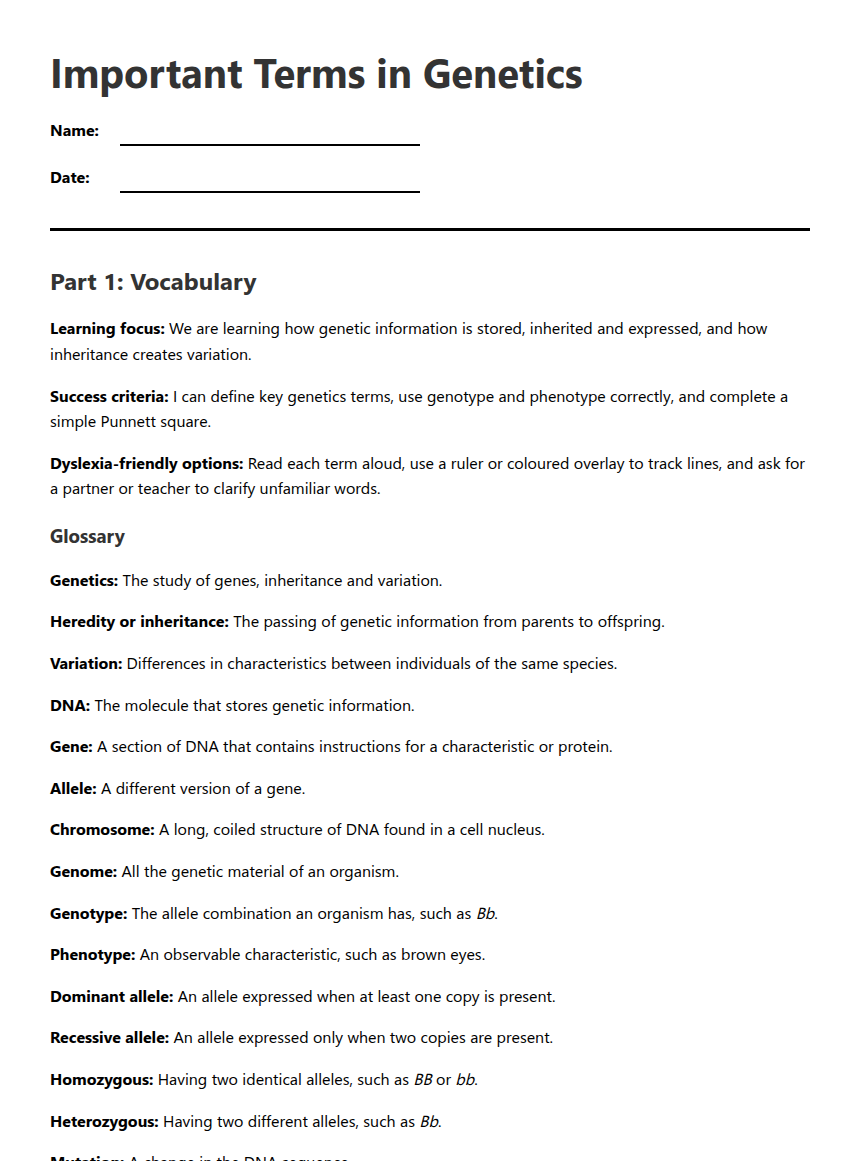
Year 10
Genetics Vocabulary and Inheritance
Free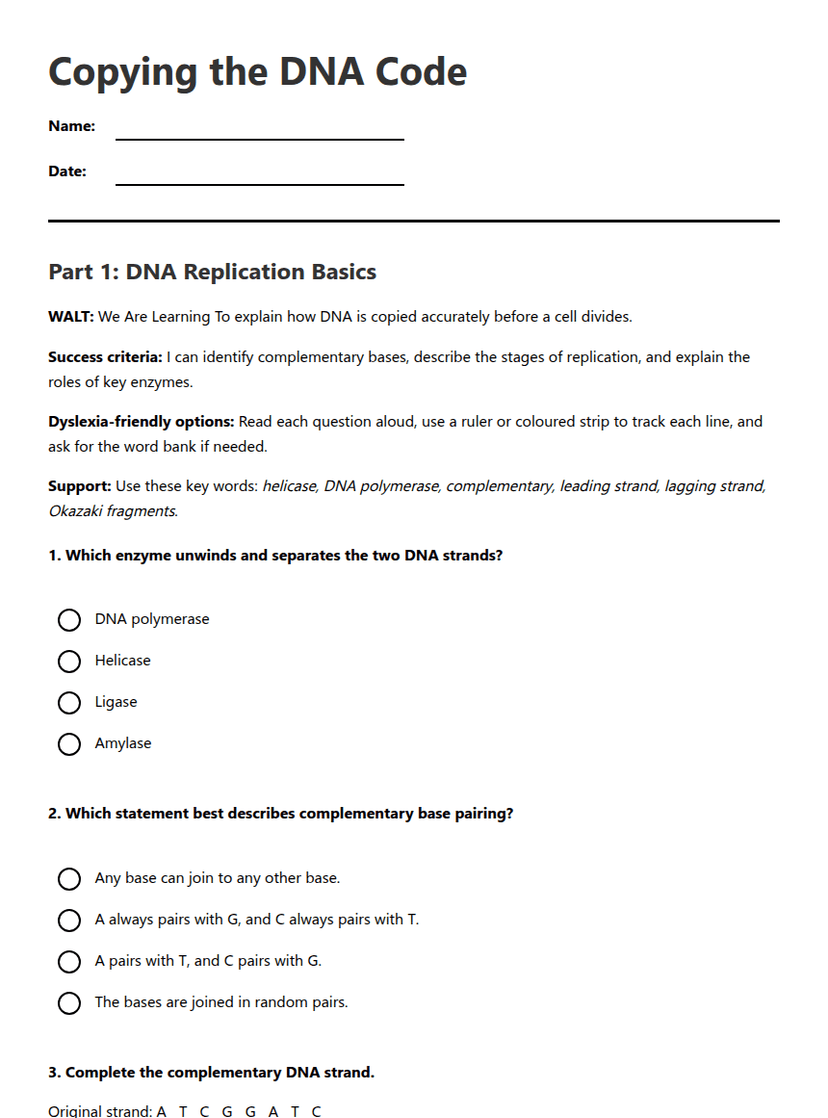
Year 10