ScienceFreePrintable

Magnetic Fields and Charges

A free science worksheet ready for your classroom. Open in Kuraplan to grab the print-ready PDF, customize it for your students, or generate a fresh version in seconds.
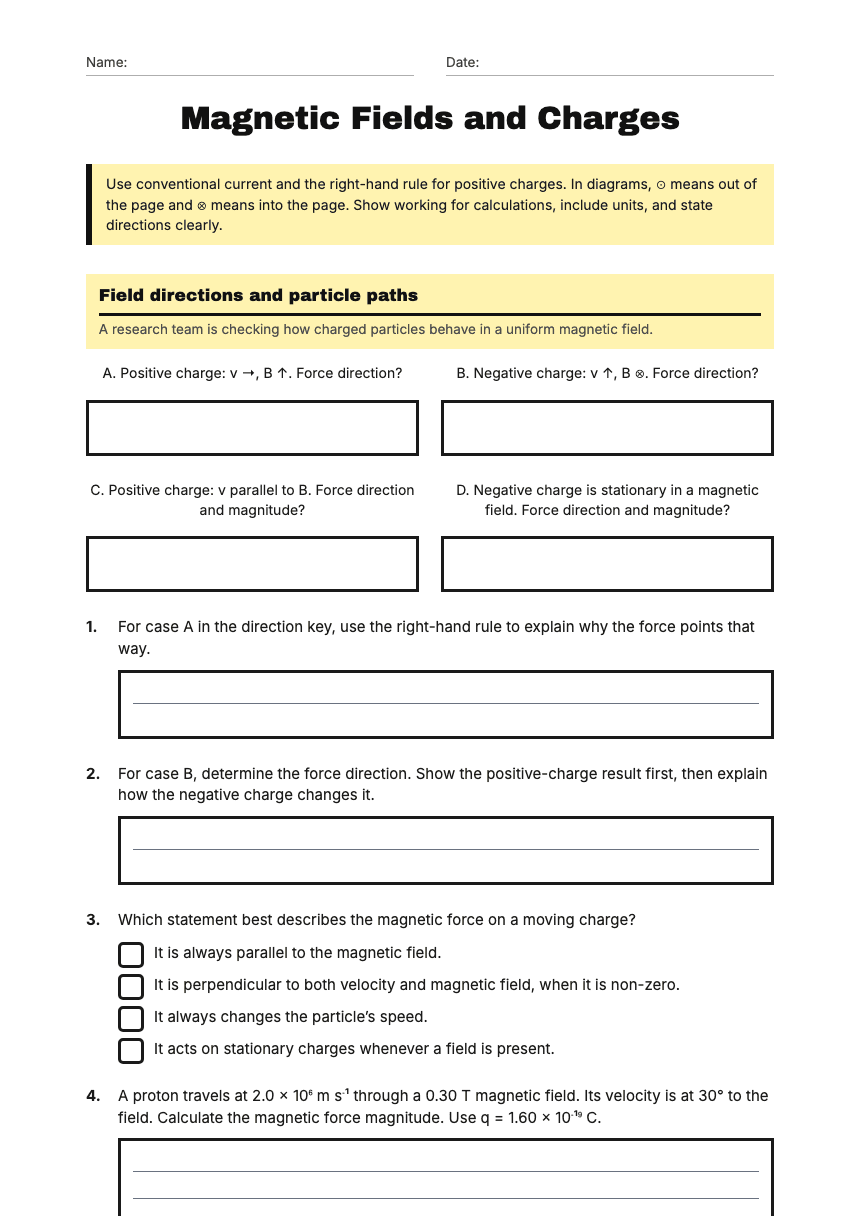
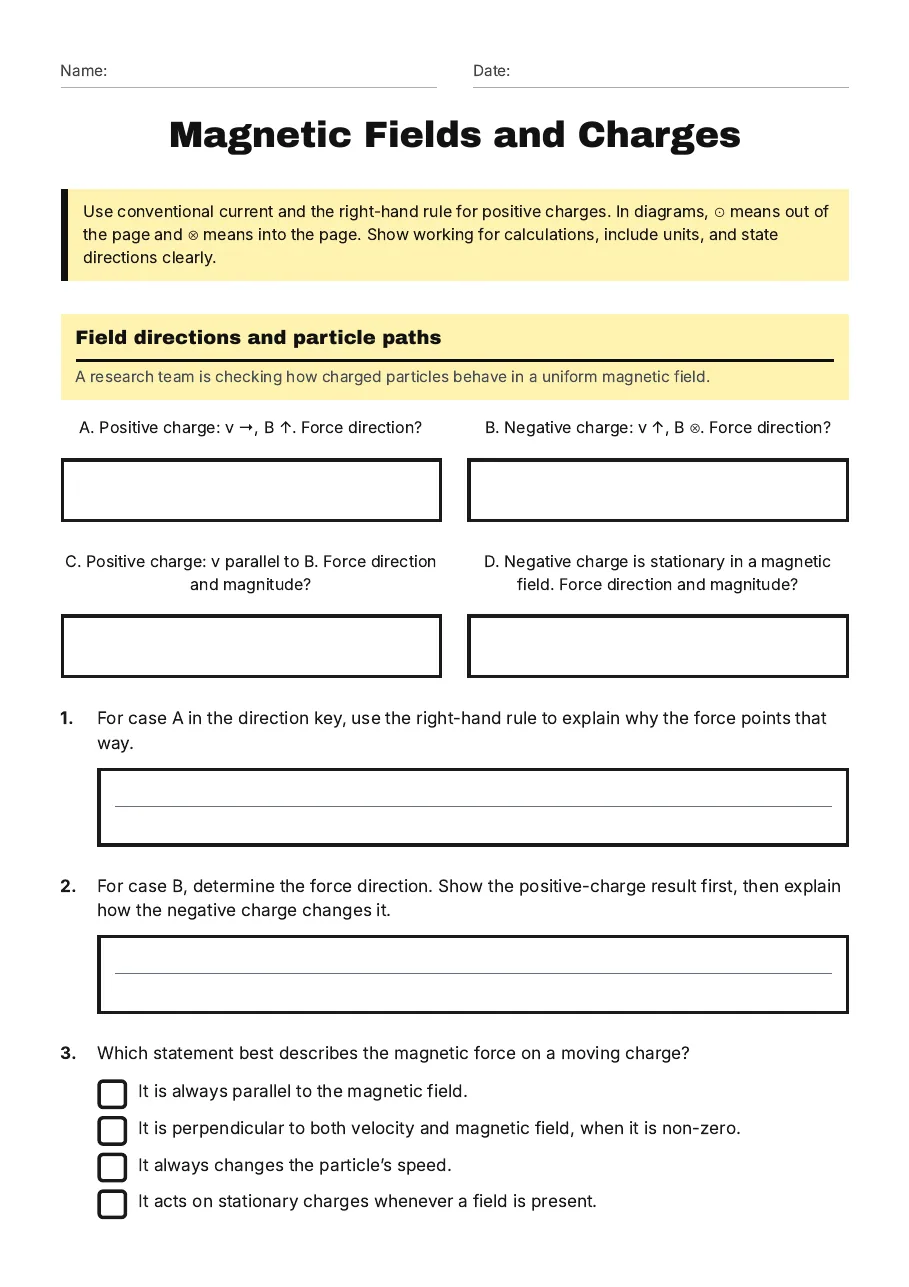
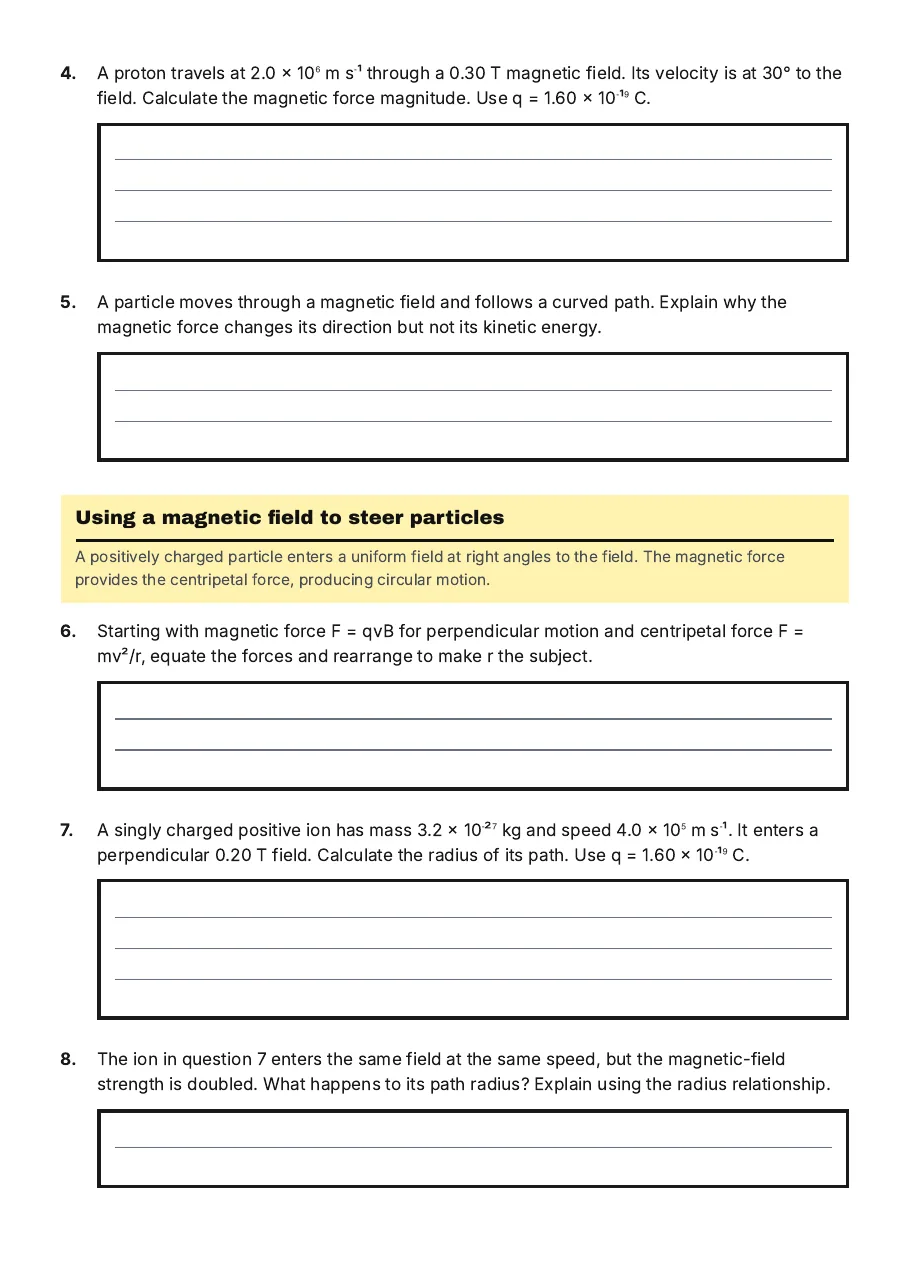
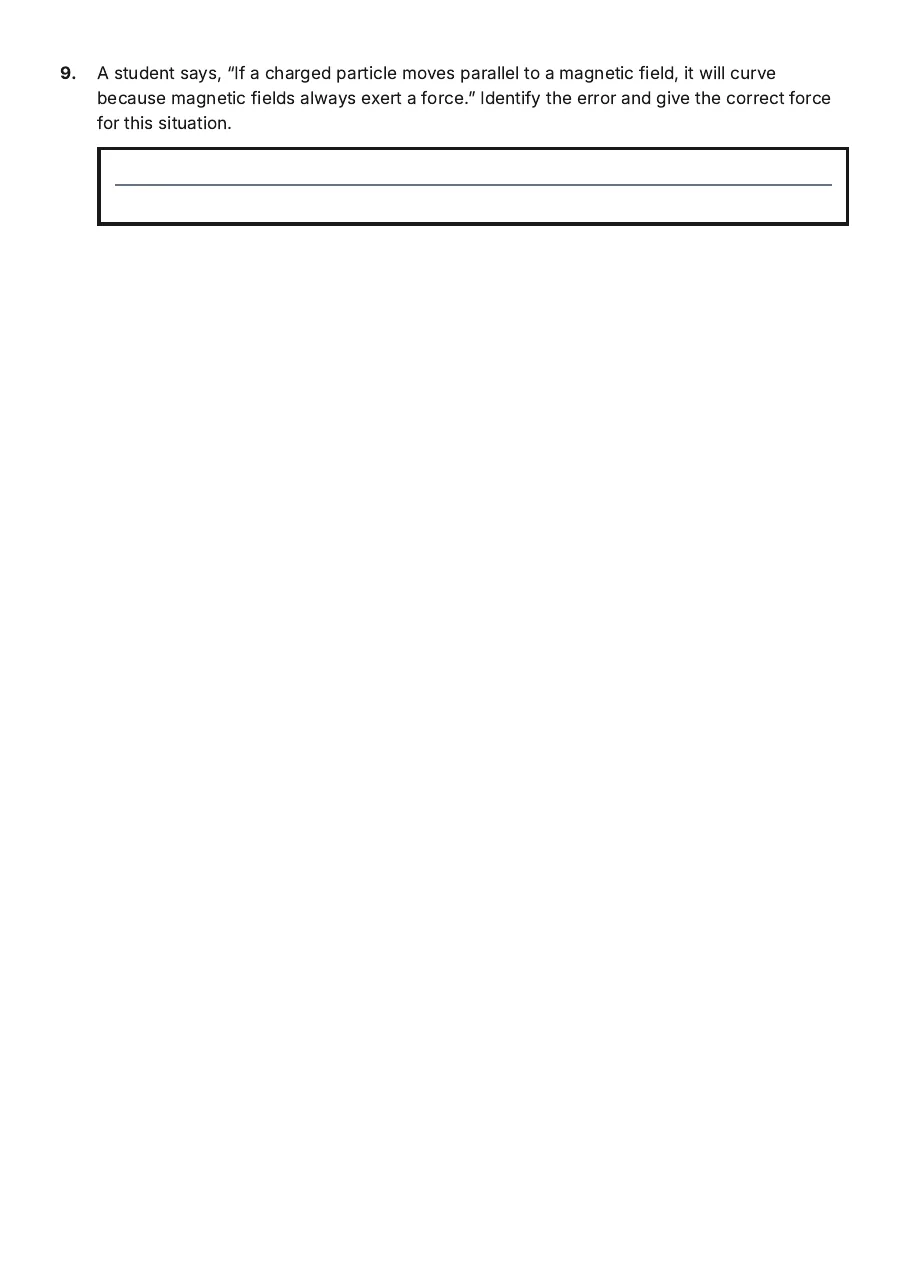
Magnetic Fields and Charges worksheet preview

Magnetic Fields and Charges

WALT & Success Criteria

WALT: We are learning to determine the direction and magnitude of the magnetic force on moving charges and to use the right-hand rule correctly.

Success criteria: I can (1) apply F = qvB sinθ for magnitudes, (2) use the right-hand rule (and reverse for negative charges) to state direction, and (3) explain why magnetic forces do no work.

Differentiation: Provide a step-by-step right-hand rule diagram for students who need more support; give numeric prompts for calculation questions.

Extension: Derive the radius r = mv/(qB) for a charged particle in uniform B and calculate a numerical example.

Dyslexia-friendly reading options: Use a ruler or finger to track each line; read questions aloud and underline key words (velocity, field direction, positive/negative).

📚 Part 1: Multiple Choice & Concept Check

1. A positive charge moves to the right (→). The magnetic field points upward (↑). What is the direction of the magnetic force on the charge?

Into the page (↓)

Out of the page (↑)

Downwards

Left

2. Which statement is true about the magnetic force on a moving charge?

The force is always parallel to the velocity vector.

The force is perpendicular to both velocity and magnetic field.

The force always does work on the charge.

The force depends only on the electric potential.

3. A negative charge moves to the right in a magnetic field that points upward. Which best describes the force direction?

Out of the page

Into the page

Upwards

Downwards

4. Check all statements that are correct about magnetic forces:

Magnitude is F = qvB sinθ.

Reversing velocity reverses the force direction.

Magnetic forces can change the kinetic energy of a charged particle.

A stationary charge in a magnetic field experiences a magnetic force.

✏️ Part 2: Short Answers & Worked Problems

5. Calculate the magnitude of the magnetic force on a proton (q = 1.60×10⁻¹⁹ C) moving at 3.0×10⁶ m/s perpendicular to a uniform magnetic field of 0.25 T. Show your working and give the answer in newtons (N).
6. Electrons travel upward into a region where the magnetic field points into the page. State the direction of the magnetic force on the electrons and briefly explain using the right-hand rule (or its modification for negative charges).
7. Explain in one or two sentences why a magnetic force on a charged particle does no work on that particle.
8. Draw: Sketch the magnetic field lines around a bar magnet and indicate with an arrow the force on a positive charge moving from left to right near the north pole. Label the north (N) and south (S) ends.

🔑 TEACHER ANSWER KEY

1. Answer: Into the page (↓)

Explanation: Using the right-hand rule: fingers point right (velocity), curl upward (magnetic field), thumb points into the page (force direction).

2. Answer: The force is perpendicular to both velocity and magnetic field.

Explanation: The magnetic force F = q(v × B) is always perpendicular to both v and B vectors due to the cross product.

3. Answer: Into the page

Explanation: Use right-hand rule for positive charge (gives out of page), then reverse for negative charge = into the page.

4. Correct statements (check these):

✓ Magnitude is F = qvB sinθ.

✓ Reversing velocity reverses the force direction.

✗ Magnetic forces can change the kinetic energy of a charged particle. (FALSE - magnetic forces do no work)

✗ A stationary charge in a magnetic field experiences a magnetic force. (FALSE - v = 0, so F = 0)

5. Answer: 1.2 × 10⁻¹³ N

Working:

F = qvB sinθ

F = (1.60×10⁻¹⁹ C)(3.0×10⁶ m/s)(0.25 T)(sin 90°)

F = (1.60×10⁻¹⁹)(3.0×10⁶)(0.25)(1)

F = 1.2 × 10⁻¹³ N

6. Answer: Force direction is to the left

Explanation: Using right-hand rule: fingers point up (velocity), curl into page (B-field), thumb points right. Since electrons are negative, reverse this direction = force points left. Alternative: Use left-hand rule directly for negative charges.

7. Answer:

Magnetic force is always perpendicular to velocity, so F·v = 0. Since work = F·d = F·v·t, no work is done. The magnetic force cannot change the kinetic energy of the particle, only its direction of motion.

8. Drawing should show:

• Bar magnet with N and S labeled

• Curved field lines from N to S (outside magnet)

• Positive charge near north pole with rightward velocity arrow

• Force arrow on charge pointing away from magnet (using F = q(v × B))

Accept: Clear field line patterns, correct force direction based on right-hand rule application

About This Worksheet

Free in Kuraplan

Sign up free, grab the PDF, and customize it for your class.

Print-Ready

Formatted for standard paper. Clean layout, easy to read.

AI-Generated

Created with Kuraplan's AI, designed for real classroom use.

For Teachers & Parents

Use in classrooms, for homework, tutoring, or homeschool.

Need a custom version of this worksheet?

Kuraplan's AI generates custom worksheets in seconds — differentiated for every learner, aligned to your curriculum.

Generate Custom Worksheets — Free
No credit card Curriculum-aligned Under 60 seconds