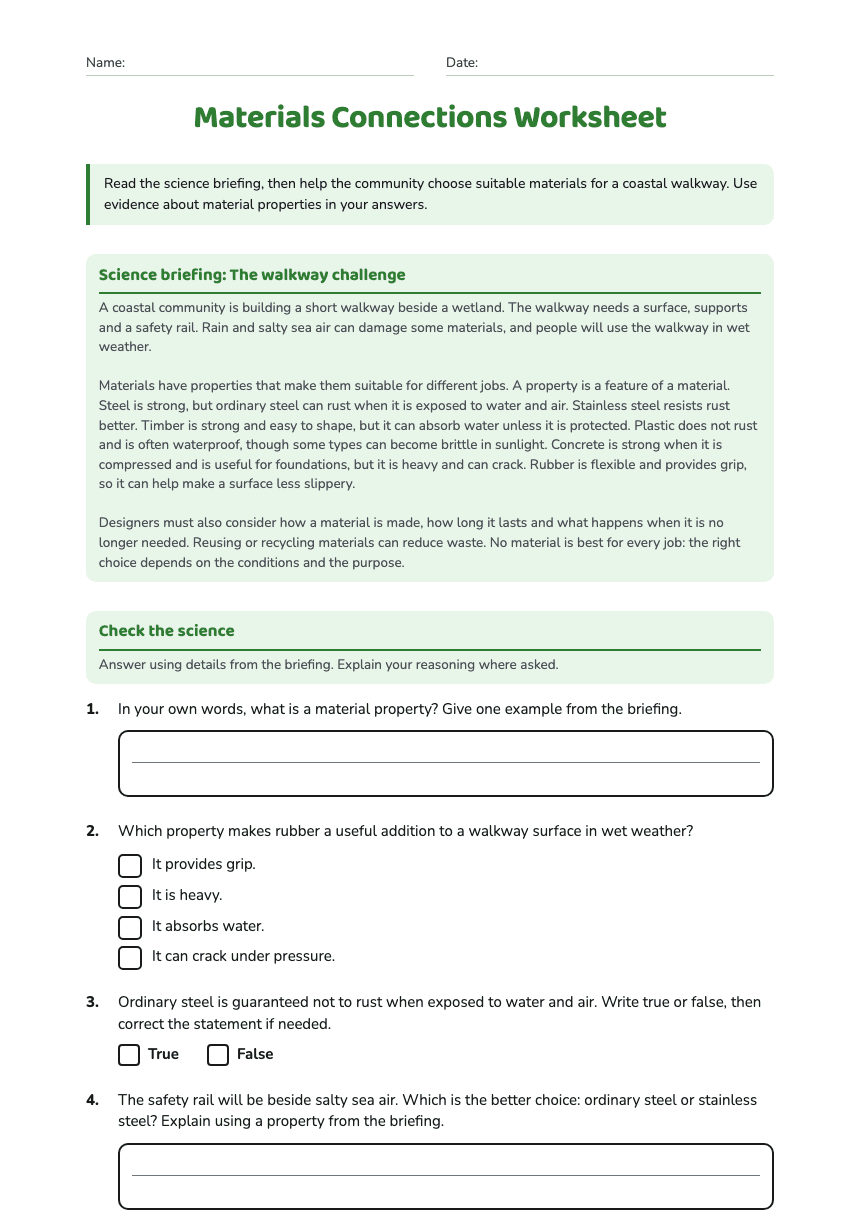
Materials Connections Worksheet
A free science worksheet ready for your classroom. Open in Kuraplan to grab the print-ready PDF, customize it for your students, or generate a fresh version in seconds.
Materials Connections Worksheet
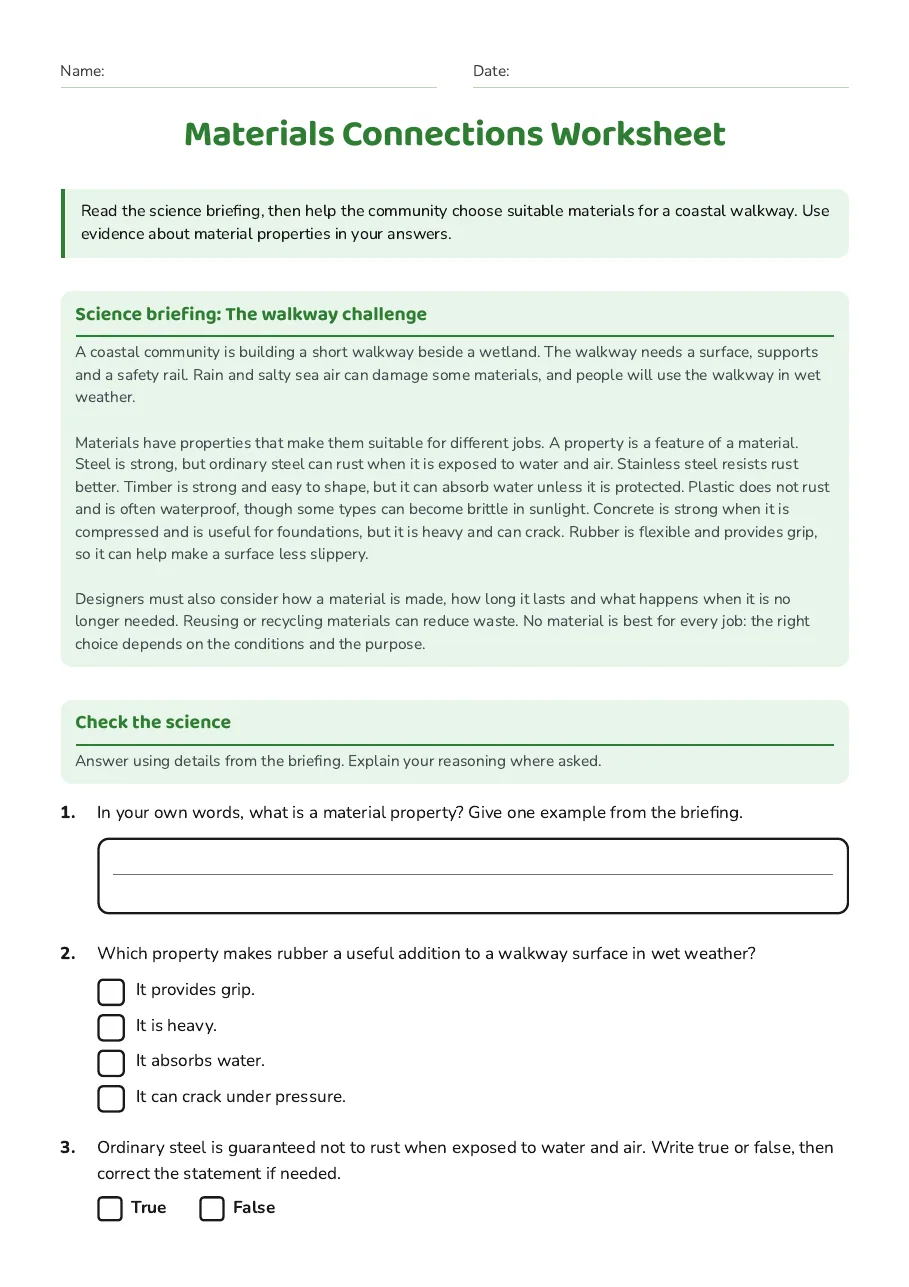
Science briefing: The walkway challenge
A coastal community is building a short walkway beside a wetland. The walkway needs a surface, supports and a safety rail. Rain and salty sea air can damage some materials, and people will use the walkway in wet weather. Materials have properties that make them suitable for different jobs. A property is a feature of a material. Steel is strong, but ordinary steel can rust when it is exposed to water and air. Stainless steel resists rust better. Timber is strong and easy to shape, but it can absorb water unless it is protected. Plastic does not rust and is often waterproof, though some types can become brittle in sunlight. Concrete is strong when it is compressed and is useful for foundations, but it is heavy and can crack. Rubber is flexible and provides grip, so it can help make a surface less slippery. Designers must also consider how a material is made, how long it lasts and what happens when it is no longer needed. Reusing or recycling materials can reduce waste. No material is best for every job: the right choice depends on the conditions and the purpose.
Check the science
Answer using details from the briefing. Explain your reasoning where asked.
- It provides grip.
- It is heavy.
- It absorbs water.
- It can crack under pressure.
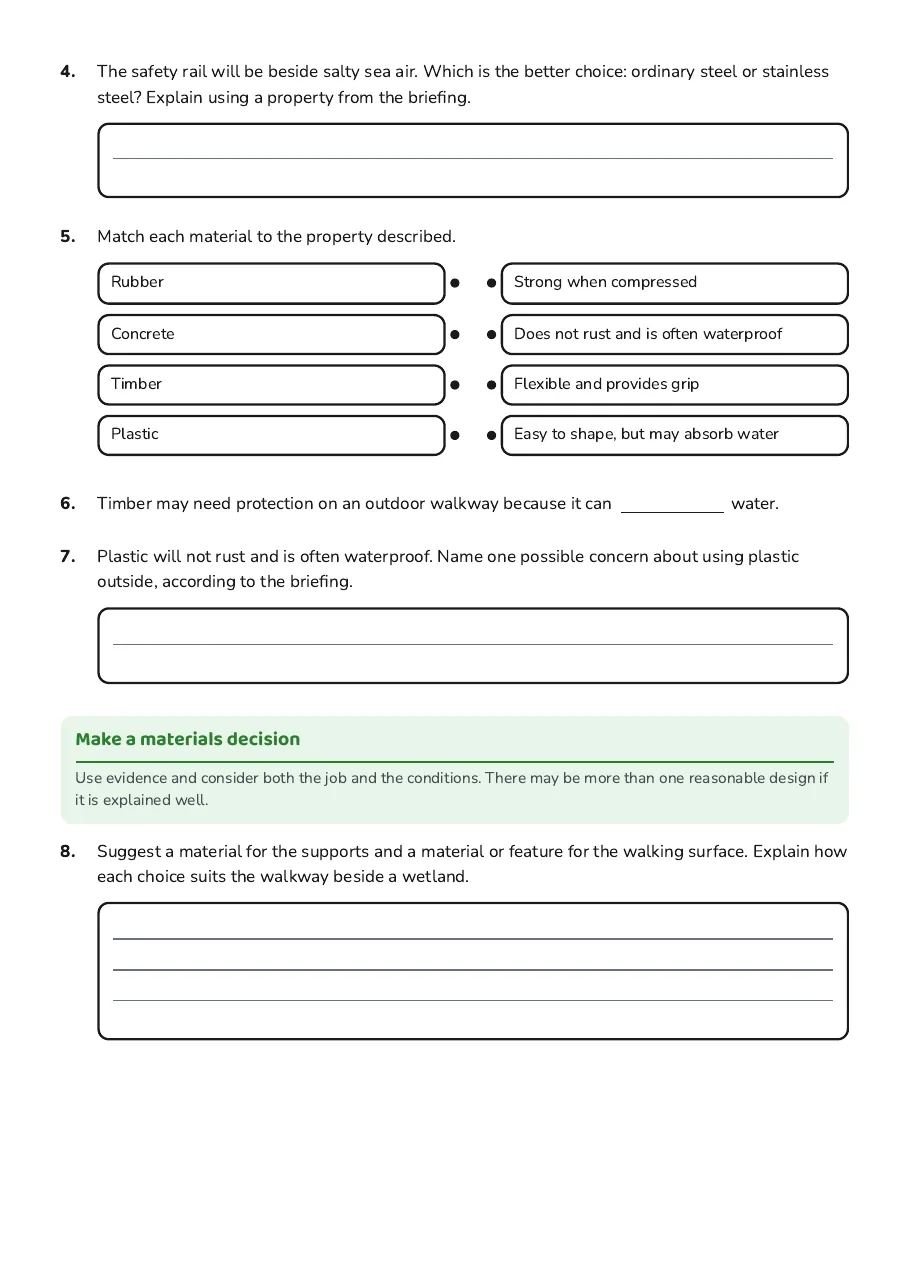
- Rubber
- Concrete
- Timber
- Plastic
- Strong when compressed
- Does not rust and is often waterproof
- Flexible and provides grip
- Easy to shape, but may absorb water
Make a materials decision
Use evidence and consider both the job and the conditions. There may be more than one reasonable design if it is explained well.
3 printable pages
Page 1
Page 2
Page 3
About This Worksheet
Free in Kuraplan
Sign up free, grab the PDF, and customize it for your class.
Print-Ready
Formatted for standard paper. Clean layout, easy to read.
AI-Generated
Created with Kuraplan's AI, designed for real classroom use.
For Teachers & Parents
Use in classrooms, for homework, tutoring, or homeschool.
Need a custom version of this worksheet?
Kuraplan's AI generates custom worksheets in seconds — differentiated for every learner, aligned to your curriculum.
Generate Custom Worksheets — Free