Microbe–Factor–Process Research
A free science worksheet ready for your classroom. Open in Kuraplan to grab the print-ready PDF, customize it for your students, or generate a fresh version in seconds.
Microbe–Factor–Process Research
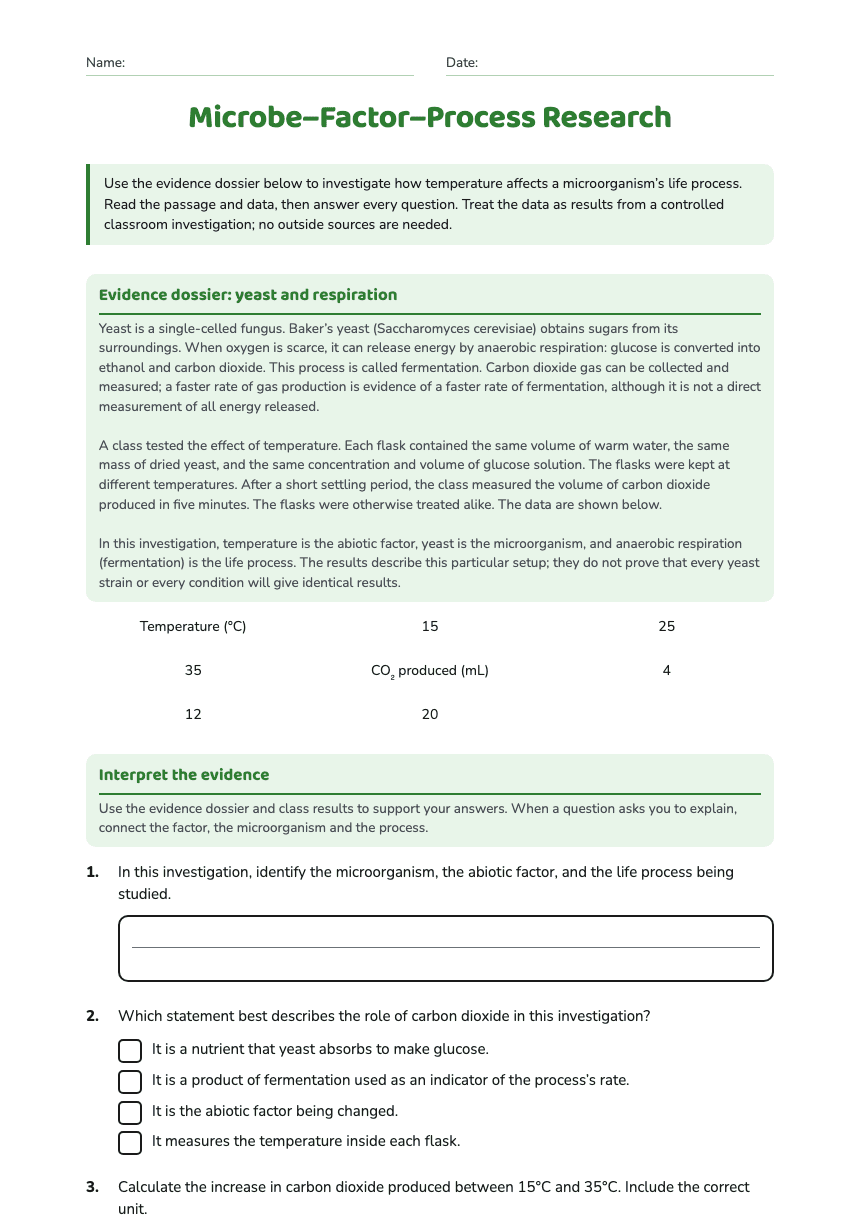
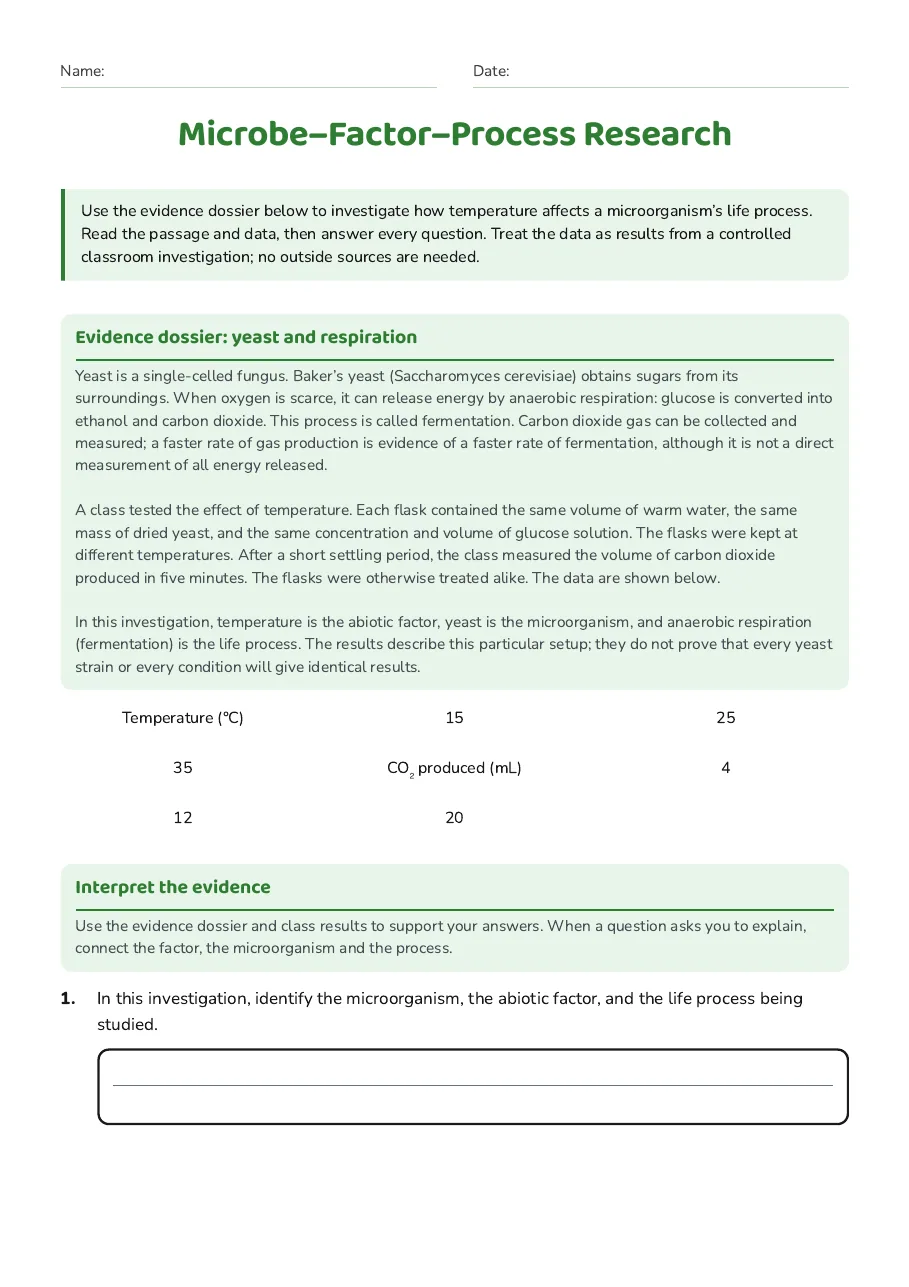
Evidence dossier: yeast and respiration
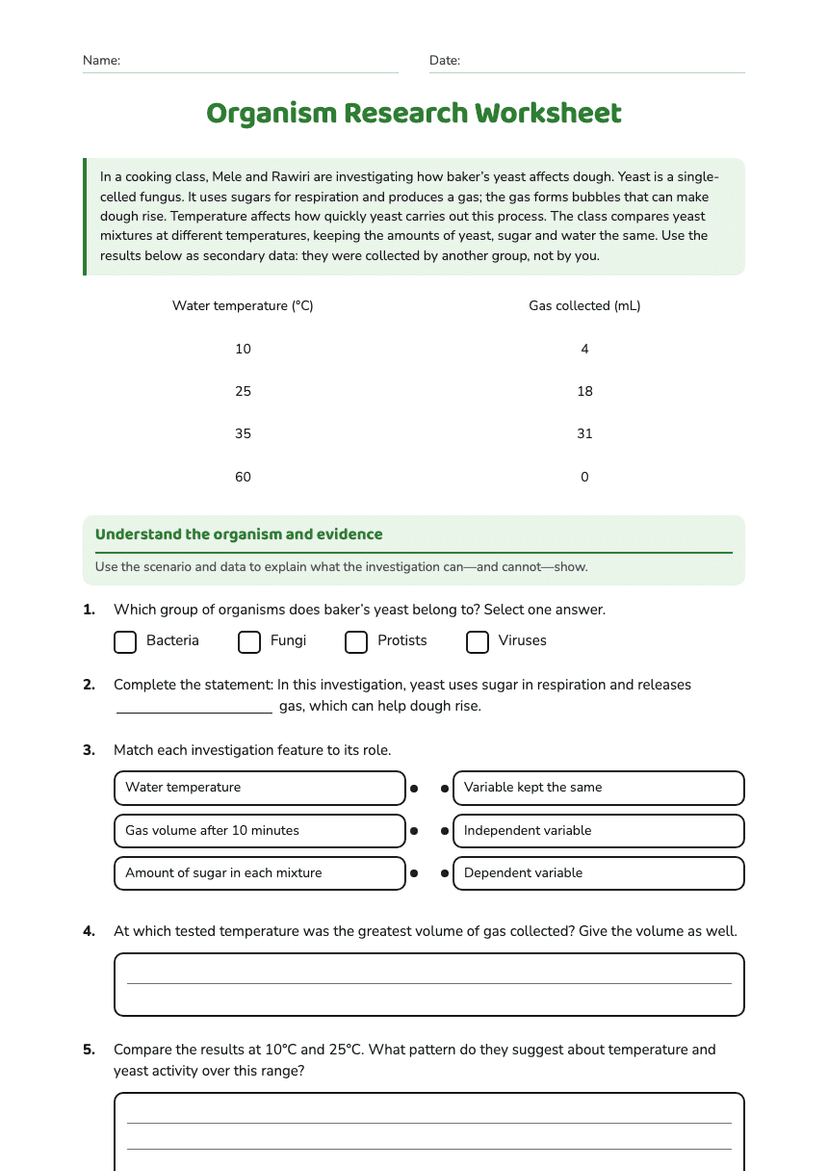
Yeast is a single-celled fungus. Baker’s yeast (Saccharomyces cerevisiae) obtains sugars from its surroundings. When oxygen is scarce, it can release energy by anaerobic respiration: glucose is converted into ethanol and carbon dioxide. This process is called fermentation. Carbon dioxide gas can be collected and measured; a faster rate of gas production is evidence of a faster rate of fermentation, although it is not a direct measurement of all energy released. A class tested the effect of temperature. Each flask contained the same volume of warm water, the same mass of dried yeast, and the same concentration and volume of glucose solution. The flasks were kept at different temperatures. After a short settling period, the class measured the volume of carbon dioxide produced in five minutes. The flasks were otherwise treated alike. The data are shown below. In this investigation, temperature is the abiotic factor, yeast is the microorganism, and anaerobic respiration (fermentation) is the life process. The results describe this particular setup; they do not prove that every yeast strain or every condition will give identical results.
Temperature (°C)
15
25
35
CO₂ produced (mL)
4
12
20
Interpret the evidence
Use the evidence dossier and class results to support your answers. When a question asks you to explain, connect the factor, the microorganism and the process.
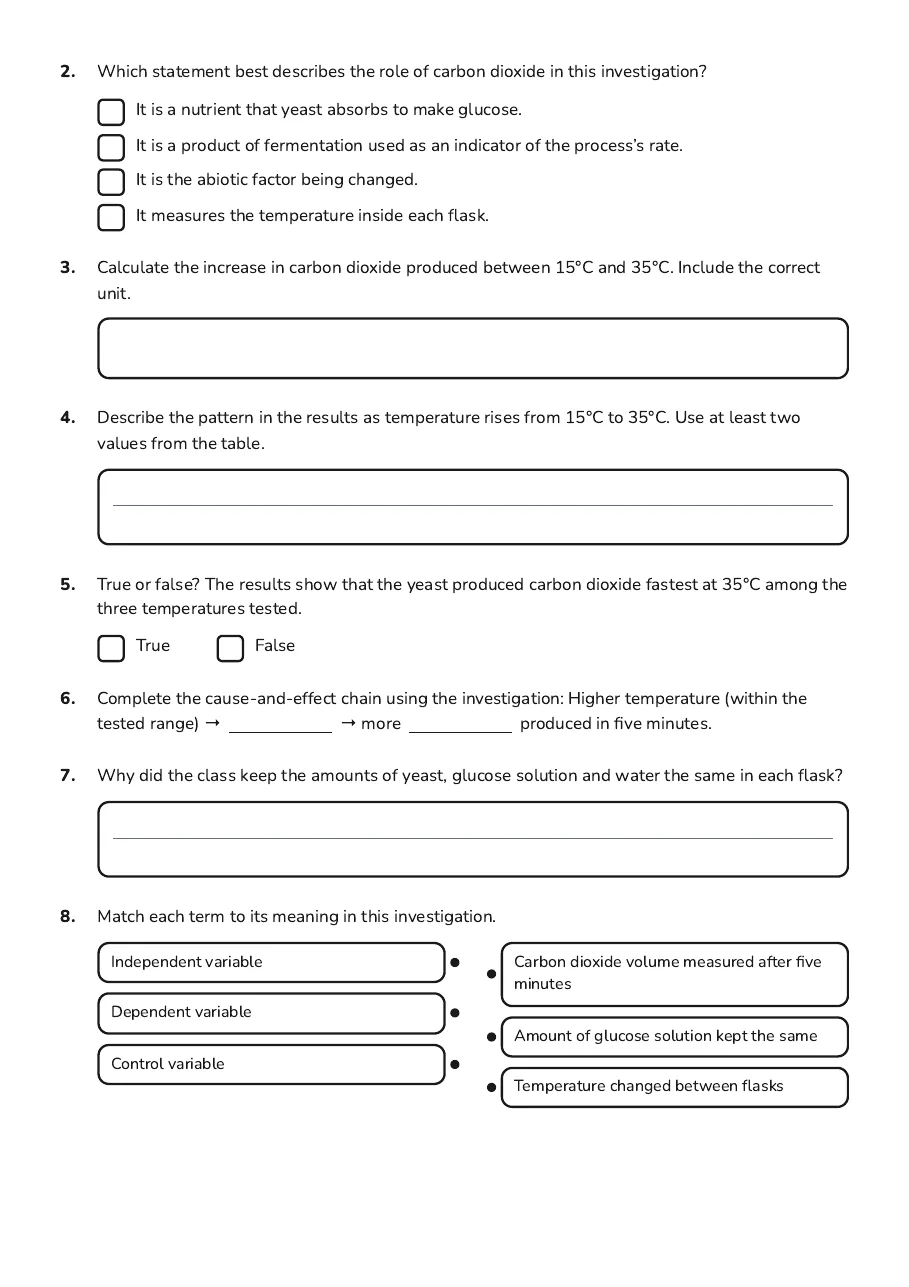
- It is a nutrient that yeast absorbs to make glucose.
- It is a product of fermentation used as an indicator of the process’s rate.
- It is the abiotic factor being changed.
- It measures the temperature inside each flask.
- True
- False
- Independent variable
- Dependent variable
- Control variable
- Carbon dioxide volume measured after five minutes
- Amount of glucose solution kept the same
- Temperature changed between flasks
3 printable pages
Page 1
Page 2
Page 3
About This Worksheet
Free in Kuraplan
Sign up free, grab the PDF, and customize it for your class.
Print-Ready
Formatted for standard paper. Clean layout, easy to read.
AI-Generated
Created with Kuraplan's AI, designed for real classroom use.
For Teachers & Parents
Use in classrooms, for homework, tutoring, or homeschool.
Need a custom version of this worksheet?
Kuraplan's AI generates custom worksheets in seconds — differentiated for every learner, aligned to your curriculum.
Generate Custom Worksheets — Free