ScienceFreePrintable

Papatūānuku: Layers and Movement

A free science worksheet ready for your classroom. Open in Kuraplan to grab the print-ready PDF, customize it for your students, or generate a fresh version in seconds.
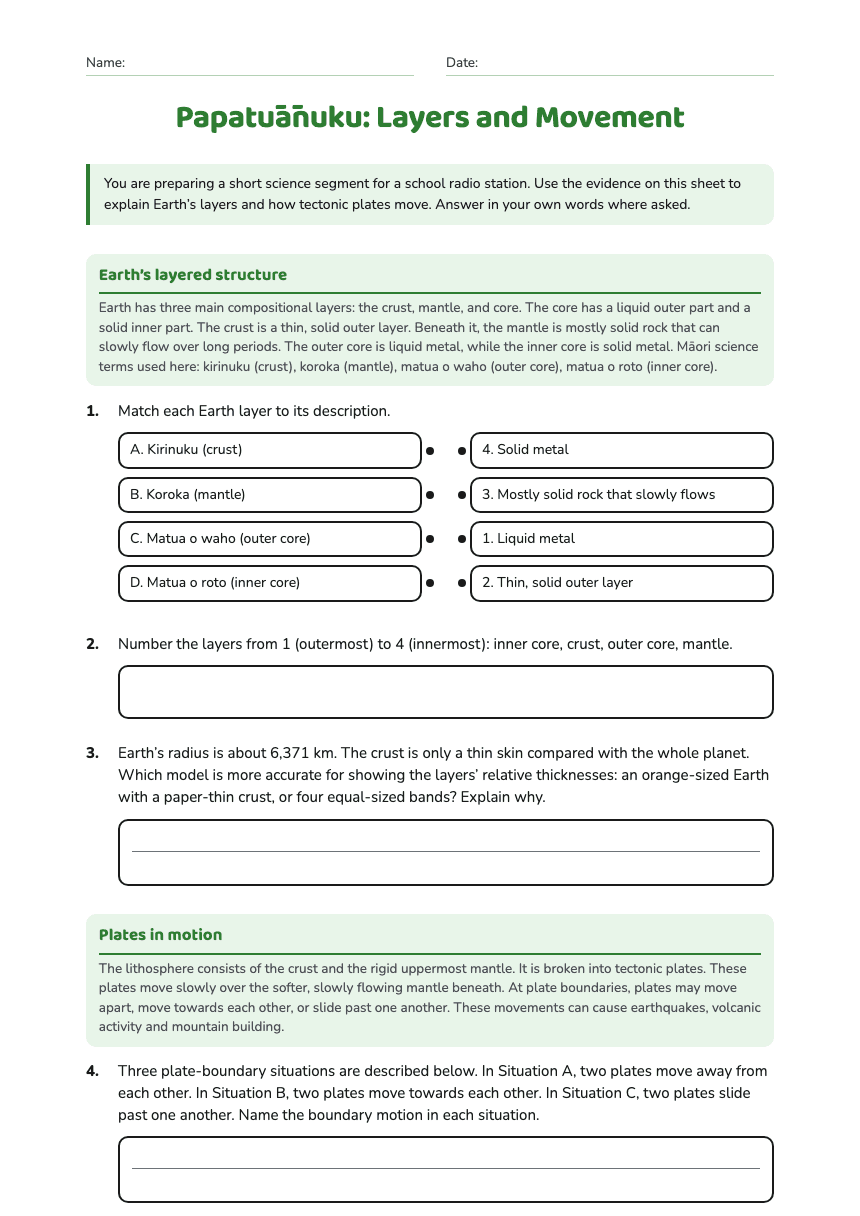
Papatūānuku: Layers and Movement worksheet preview
Name:Date:

Papatūānuku: Layers and Movement

You are preparing a short science segment for a school radio station. Use the evidence on this sheet to explain Earth’s layers and how tectonic plates move. Answer in your own words where asked.

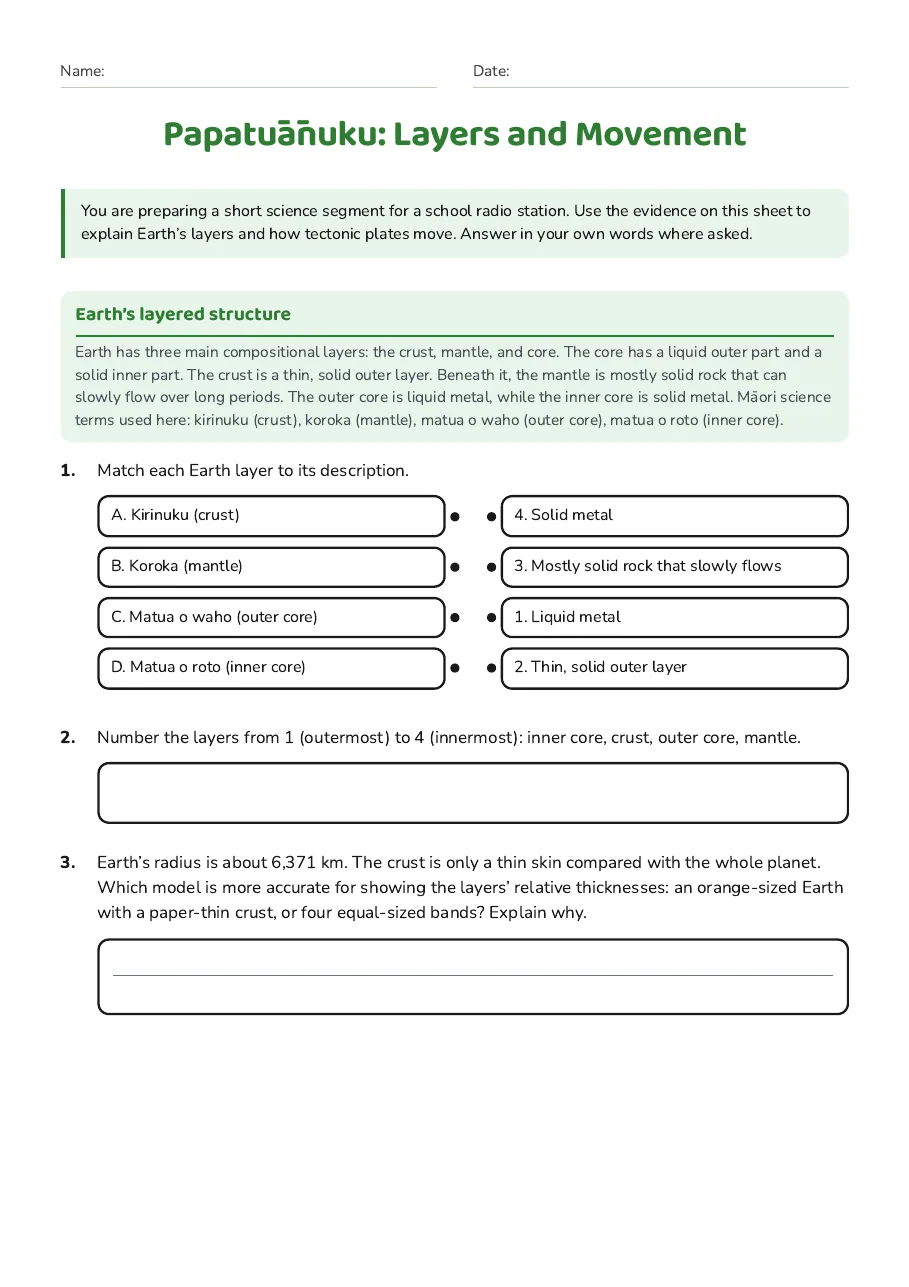
Earth’s layered structure

Earth has three main compositional layers: the crust, mantle, and core. The core has a liquid outer part and a solid inner part. The crust is a thin, solid outer layer. Beneath it, the mantle is mostly solid rock that can slowly flow over long periods. The outer core is liquid metal, while the inner core is solid metal. Māori science terms used here: kirinuku (crust), koroka (mantle), matua o waho (outer core), matua o roto (inner core).

1.Match each Earth layer to its description.
  • A. Kirinuku (crust)
  • B. Koroka (mantle)
  • C. Matua o waho (outer core)
  • D. Matua o roto (inner core)
  • 4. Solid metal
  • 3. Mostly solid rock that slowly flows
  • 1. Liquid metal
  • 2. Thin, solid outer layer
2.Number the layers from 1 (outermost) to 4 (innermost): inner core, crust, outer core, mantle.
3.Earth’s radius is about 6,371 km. The crust is only a thin skin compared with the whole planet. Which model is more accurate for showing the layers’ relative thicknesses: an orange-sized Earth with a paper-thin crust, or four equal-sized bands? Explain why.

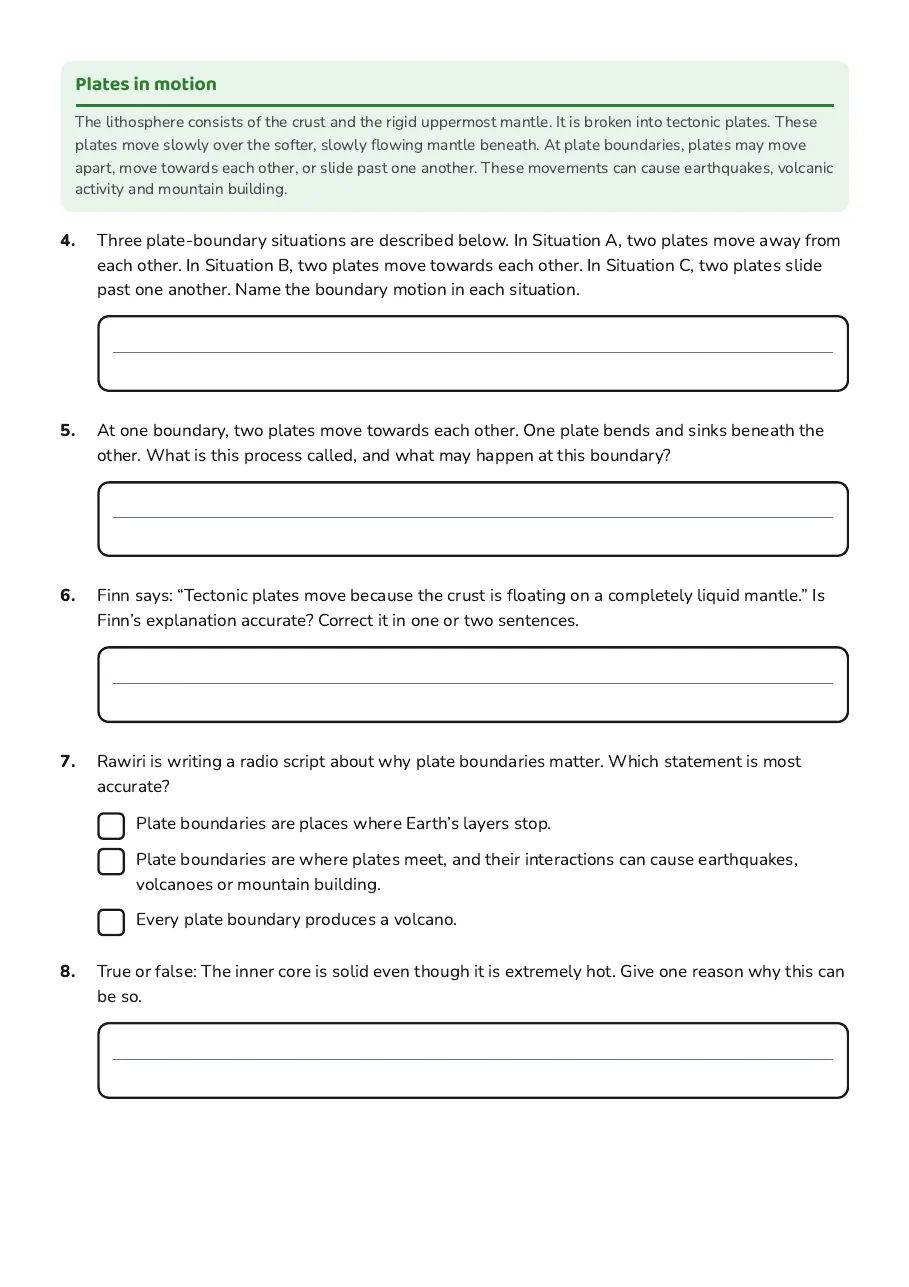
Plates in motion

The lithosphere consists of the crust and the rigid uppermost mantle. It is broken into tectonic plates. These plates move slowly over the softer, slowly flowing mantle beneath. At plate boundaries, plates may move apart, move towards each other, or slide past one another. These movements can cause earthquakes, volcanic activity and mountain building.

4.Three plate-boundary situations are described below. In Situation A, two plates move away from each other. In Situation B, two plates move towards each other. In Situation C, two plates slide past one another. Name the boundary motion in each situation.
5.At one boundary, two plates move towards each other. One plate bends and sinks beneath the other. What is this process called, and what may happen at this boundary?
6.Finn says: “Tectonic plates move because the crust is floating on a completely liquid mantle.” Is Finn’s explanation accurate? Correct it in one or two sentences.
7.Rawiri is writing a radio script about why plate boundaries matter. Which statement is most accurate?
  • Plate boundaries are places where Earth’s layers stop.
  • Plate boundaries are where plates meet, and their interactions can cause earthquakes, volcanoes or mountain building.
  • Every plate boundary produces a volcano.
8.True or false: The inner core is solid even though it is extremely hot. Give one reason why this can be so.
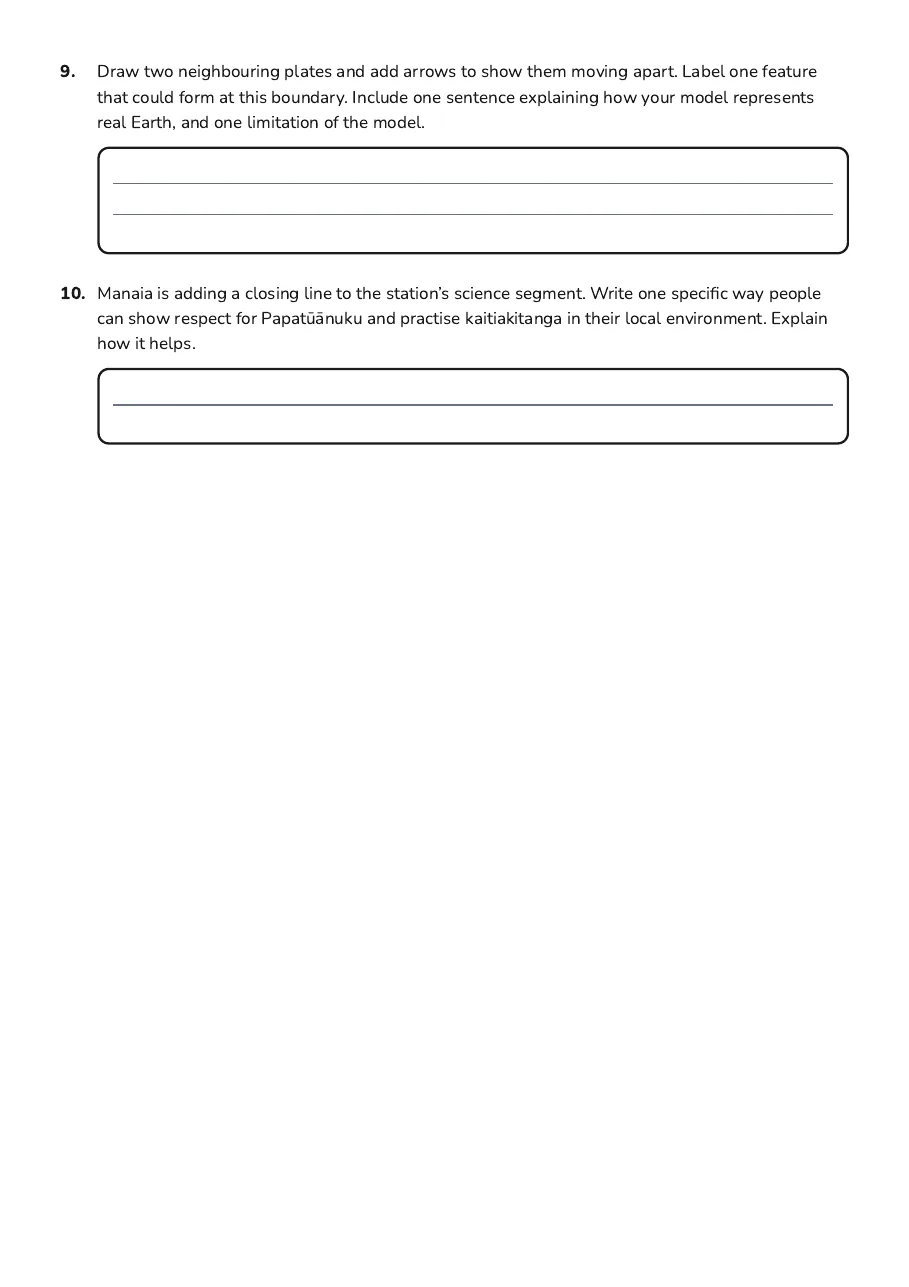
9.Draw two neighbouring plates and add arrows to show them moving apart. Label one feature that could form at this boundary. Include one sentence explaining how your model represents real Earth, and one limitation of the model.
10.Manaia is adding a closing line to the station’s science segment. Write one specific way people can show respect for Papatūānuku and practise kaitiakitanga in their local environment. Explain how it helps.

3 printable pages

  • Papatūānuku: Layers and Movement, page 1 of 3: Earth’s layered structure

    Page 1

  • Papatūānuku: Layers and Movement, page 2 of 3: Plates in motion

    Page 2

  • Papatūānuku: Layers and Movement, page 3 of 3: 9. Draw two neighbouring plates and add arrows to show them moving apart. Label one…

    Page 3

About This Worksheet

Free in Kuraplan

Sign up free, grab the PDF, and customize it for your class.

Print-Ready

Formatted for standard paper. Clean layout, easy to read.

AI-Generated

Created with Kuraplan's AI, designed for real classroom use.

For Teachers & Parents

Use in classrooms, for homework, tutoring, or homeschool.

Need a custom version of this worksheet?

Kuraplan's AI generates custom worksheets in seconds — differentiated for every learner, aligned to your curriculum.

Generate Custom Worksheets — Free
No credit card Curriculum-aligned Under 60 seconds