PEFreePrintable

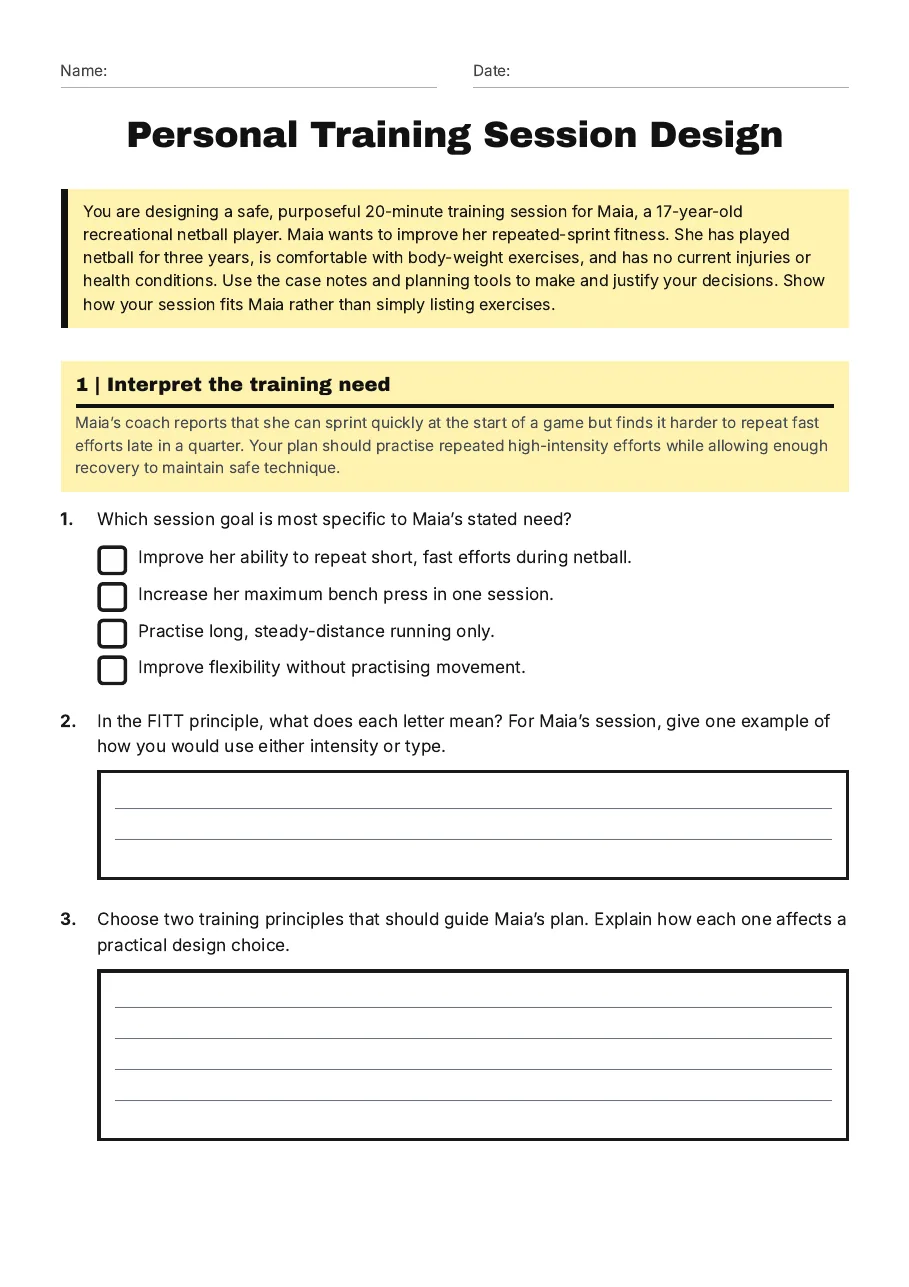
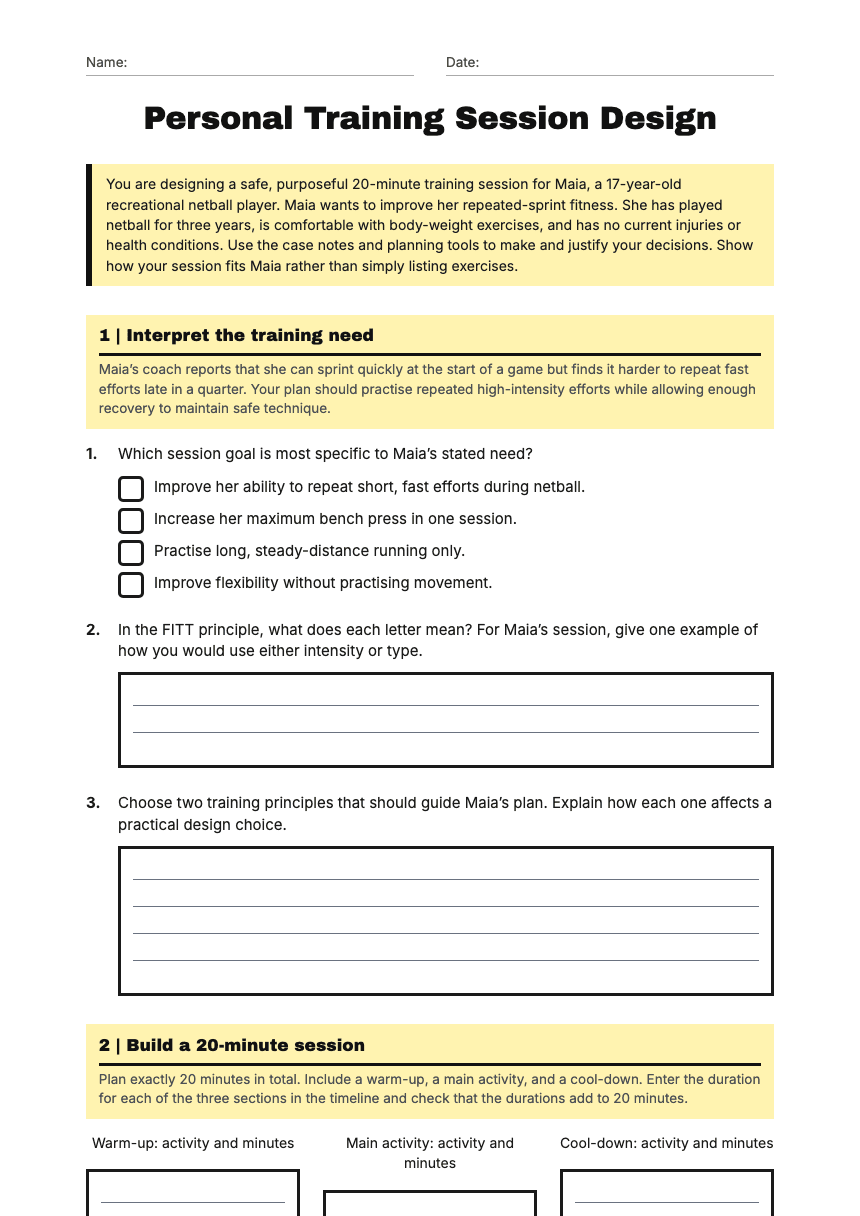
Personal Training Session Design

A free pe worksheet ready for your classroom. Open in Kuraplan to grab the print-ready PDF, customize it for your students, or generate a fresh version in seconds.
Personal Training Session Design worksheet preview

Personal Training Session Design

Worksheet illustration

Part 1: Analyse the Training Need

This worksheet supports NCEA Physical Education AS91329 and AS91789. Use evidence from the participant’s needs, goals and training principles to make safe, purposeful decisions.

1. Define each part of the FITT principle.

Frequency: ________________________________________________

Intensity: _________________________________________________

Time: _____________________________________________________

Type: _____________________________________________________

2. Explain two training principles that should guide this session. Choose from specificity, overload, progression, reversibility, variety, recovery or individuality.
3. Complete a needs analysis for your participant.

Goal and activity: __________________________________________

Current fitness, skill or experience: ___________________________

Strengths and areas to improve: ________________________________

Safety considerations or limitations: ___________________________

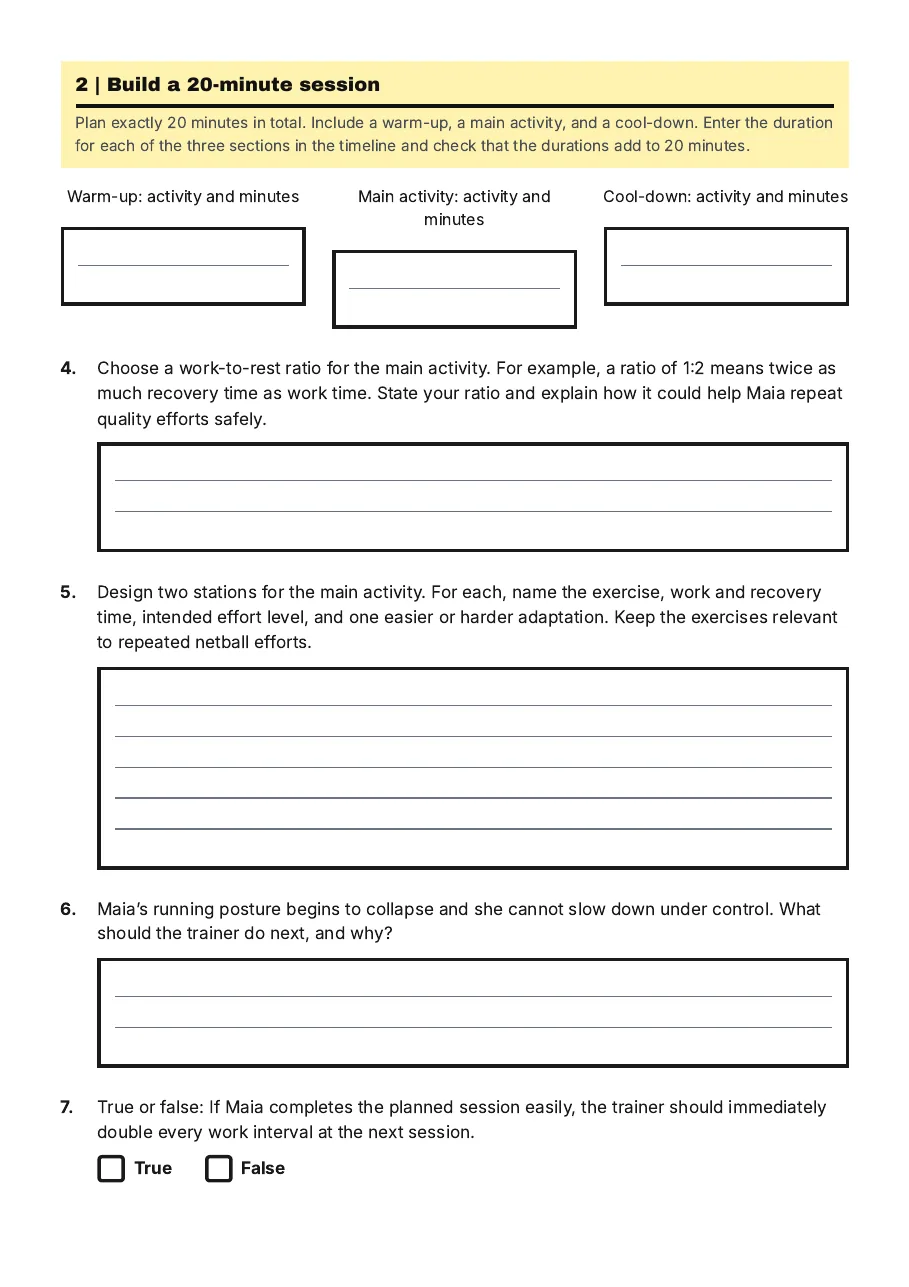
Part 2: Design a Safe 20-Minute Circuit

Design a circuit that lasts exactly 20 minutes. Include a suitable warm-up and cool-down within the session. State the work-to-rest ratio, intensity, target muscles or energy systems, and one adaptation for each exercise.

4. Session overview

Participant goal: ____________________________________________

Warm-up: __________________ minutes    Cool-down: __________________ minutes

Number of stations and rounds: ________________________________

Work/rest ratio: __________________    Overall intensity: __________________

5. Station 1: Exercise, work/rest, intensity, target muscles or energy system, and adaptation.
6. Station 2: Exercise, work/rest, intensity, target muscles or energy system, and adaptation.
7. Station 3: Exercise, work/rest, intensity, target muscles or energy system, and adaptation.
8. Station 4: Exercise, work/rest, intensity, target muscles or energy system, and adaptation.
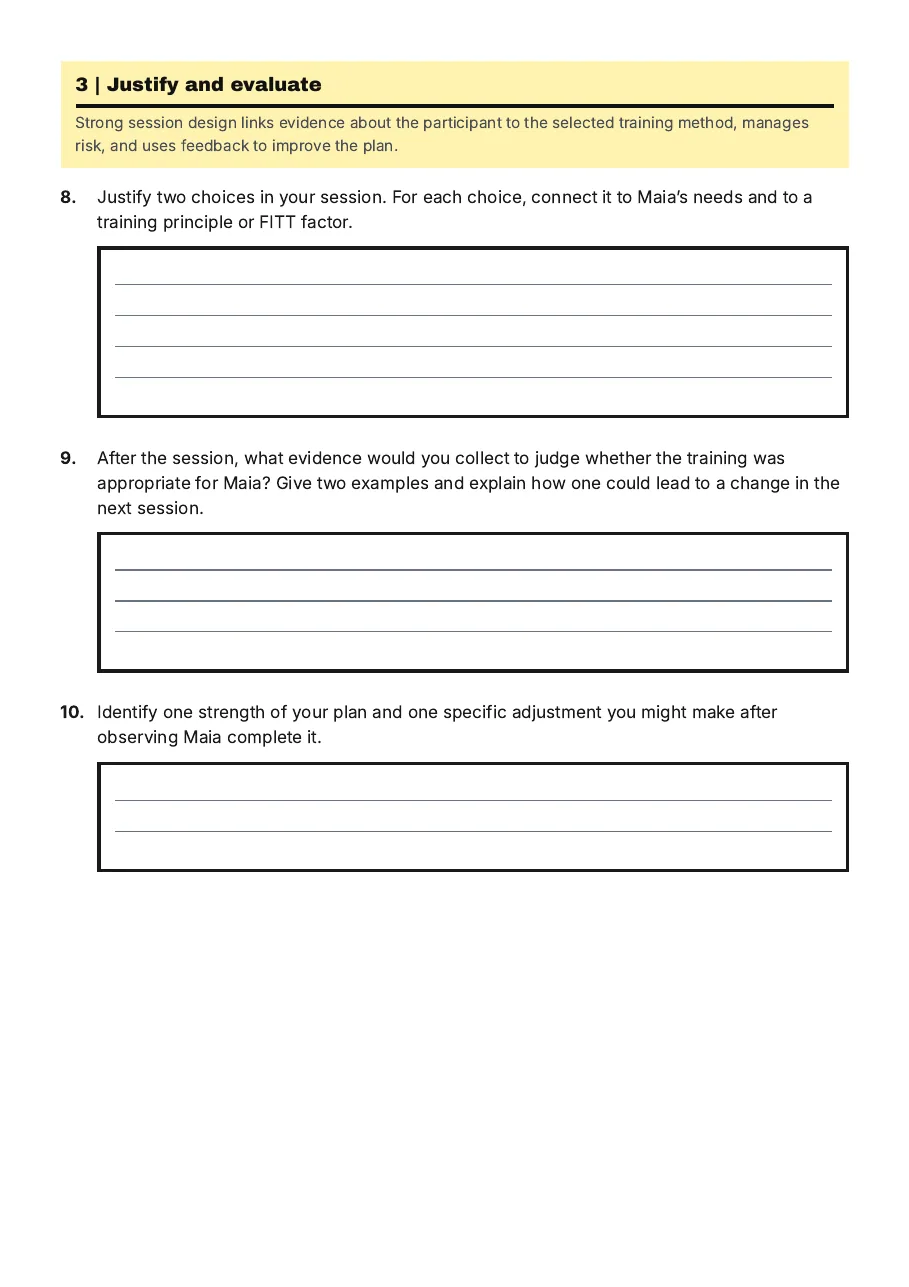
9. Justify two design choices. Explain how they meet the participant’s needs and apply FITT or a training principle.

Part 3: Evaluate and Exit Ticket

10. Self-assess your session design by ticking the statements you can support.

The session has a clear, participant-centred goal.

The timing adds up to exactly 20 minutes.

Exercises are safe and technically appropriate.

Intensity and recovery are suitable.

Adaptations are provided for different abilities.

11. What is one strength of your plan and one change you would make after observing the participant?
12. Exit ticket: What is one important idea you learned about designing or evaluating a training session?

Teacher Answer Guide: Indicative Responses

FITT: Frequency is how often training occurs; intensity is how hard the participant works; time is the duration or volume; type is the exercise or training method selected.

Training principles: Responses may include specificity to match the activity goal, overload to challenge the body appropriately, progression to increase demands gradually, recovery to allow adaptation, individuality to suit the participant, variety to maintain engagement, and reversibility to explain the loss of fitness when training stops.

Needs analysis: Look for a clear goal, relevant current ability, identified strengths and limitations, and realistic safety considerations such as technique, injuries, health conditions, equipment and supervision.

Circuit design: Indicative plans should total 20 minutes, include warm-up and cool-down, use suitable work and rest periods, identify a realistic intensity, target relevant muscles or energy systems, and include practical progressions or regressions.

Justification and evaluation: Strong responses link choices to the participant’s needs, FITT and training principles. Evaluation should identify evidence-based strengths and a specific improvement, such as changing exercise difficulty, work time, recovery or technique cues.

About This Worksheet

Free in Kuraplan

Sign up free, grab the PDF, and customize it for your class.

Print-Ready

Formatted for standard paper. Clean layout, easy to read.

AI-Generated

Created with Kuraplan's AI, designed for real classroom use.

For Teachers & Parents

Use in classrooms, for homework, tutoring, or homeschool.

Need a custom version of this worksheet?

Kuraplan's AI generates custom worksheets in seconds — differentiated for every learner, aligned to your curriculum.

Generate Custom Worksheets — Free
No credit card Curriculum-aligned Under 60 seconds

Explore more free resources