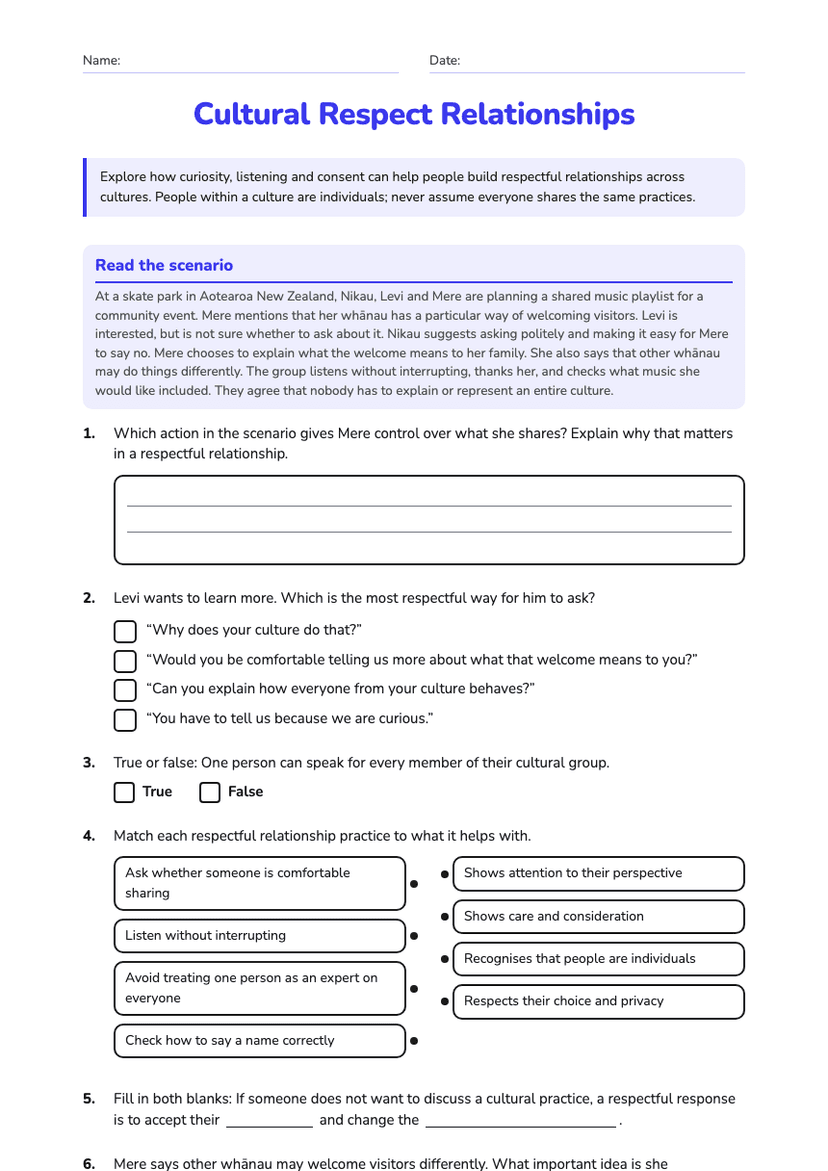
Consent: Communication and Respect
A free health worksheet ready for your classroom. Open in Kuraplan to grab the print-ready PDF, customize it for your students, or generate a fresh version in seconds.

Consent: Communication, Choice and Respect
Part 1: Learning About Consent
Learning intentions: I can explain key consent principles, recognise respectful communication, identify pressure or coercion, and describe ways to seek help.
Class discussion expectations: Use respectful language, listen without interrupting, avoid sharing personal experiences, do not pressure anyone to answer, and speak about situations rather than individuals. You may choose to pass or ask for support.
Key vocabulary: Consent means a clear and freely made agreement. Boundary means a limit a person communicates about what feels safe or comfortable. Coercion means pressuring, threatening or manipulating someone. Capacity means being able to understand, choose and communicate a decision.
A. Freely given B. Informed C. Specific D. Reversible E. Capacity
_____ The person understands what they are agreeing to.
_____ A person can change their mind at any time.
_____ The agreement is about a particular activity or situation.
_____ The person is able to understand, choose and communicate.
_____ The choice is made without pressure, threats or manipulation.
a) Someone can withdraw consent after initially agreeing. ________________________________
b) If a person is asleep, unconscious or too affected by alcohol or drugs to understand, they can give consent. ________________________________
c) Consent to share one photo means consent to share every photo. ________________________________
d) Respecting a boundary includes accepting “no”, “not now” or uncertainty. ________________________________
Part 2: Communication, Choice and Help-Seeking
Curriculum connection: This worksheet supports Te Mātaiaho Health and Physical Education Years 0–10, including navigating relationships and making informed decisions. Descriptor: NZ-TMA-HEALTHANDP-Y0-10-health-and-physical-educ-004-DOC114.
Official source: https://newzealandcurriculum.tahurangi.education.govt.nz/new-zealand-curriculum-online/nzc---health-and-pe-phases-1-4-years-0-10/5637293829
— PAGE BREAK —
Teacher Answer Key — Keep Separate
1. A clear, freely given and informed agreement.
2. In order: B, D, C, E, A.
3.
a) True.
b) False. A person needs capacity to give consent; someone who is asleep, unconscious or too affected by alcohol or drugs cannot give informed consent.
c) False. Consent is specific; agreement to one image does not mean agreement to all images or sharing platforms.
d) True.
4. Acceptable responses: Riley should not post or forward the photo until Sam gives a clear agreement. Riley could ask, “Would you like me to leave you out?” or suggest checking with everyone shown. “I’m not sure” is not a clear yes.
5. Acceptable responses: This is pressure or emotional coercion. A respectful response could be, “No is an answer. I will not keep asking,” or “You do not have to do anything to prove you trust me.”
6. Acceptable responses: “Are you comfortable with this?” “Would you like to continue?” “Is it okay if I…?” “What is your boundary?”
7. Acceptable responses: “Did the person agree to this exact message, image or video being shared?” “Who else might see it?” “Could sharing it embarrass or harm someone?” “Can I check with the person first?”
8. Acceptable responses: A trusted friend or adult, parent or caregiver, school counsellor, dean, teacher, health professional, Youthline, or another appropriate support service. Students should be encouraged to seek immediate adult help if someone is in danger.
9. Acceptable responses: Responses may include listening, honesty, kindness, privacy, equal decision-making, respecting boundaries, accepting “no”, checking in, and supporting each person’s choices.
About This Worksheet
Free in Kuraplan
Sign up free, grab the PDF, and customize it for your class.
Print-Ready
Formatted for standard paper. Clean layout, easy to read.
AI-Generated
Created with Kuraplan's AI, designed for real classroom use.
For Teachers & Parents
Use in classrooms, for homework, tutoring, or homeschool.
Need a custom version of this worksheet?
Kuraplan's AI generates custom worksheets in seconds — differentiated for every learner, aligned to your curriculum.
Generate Custom Worksheets — FreeMore Health Worksheets
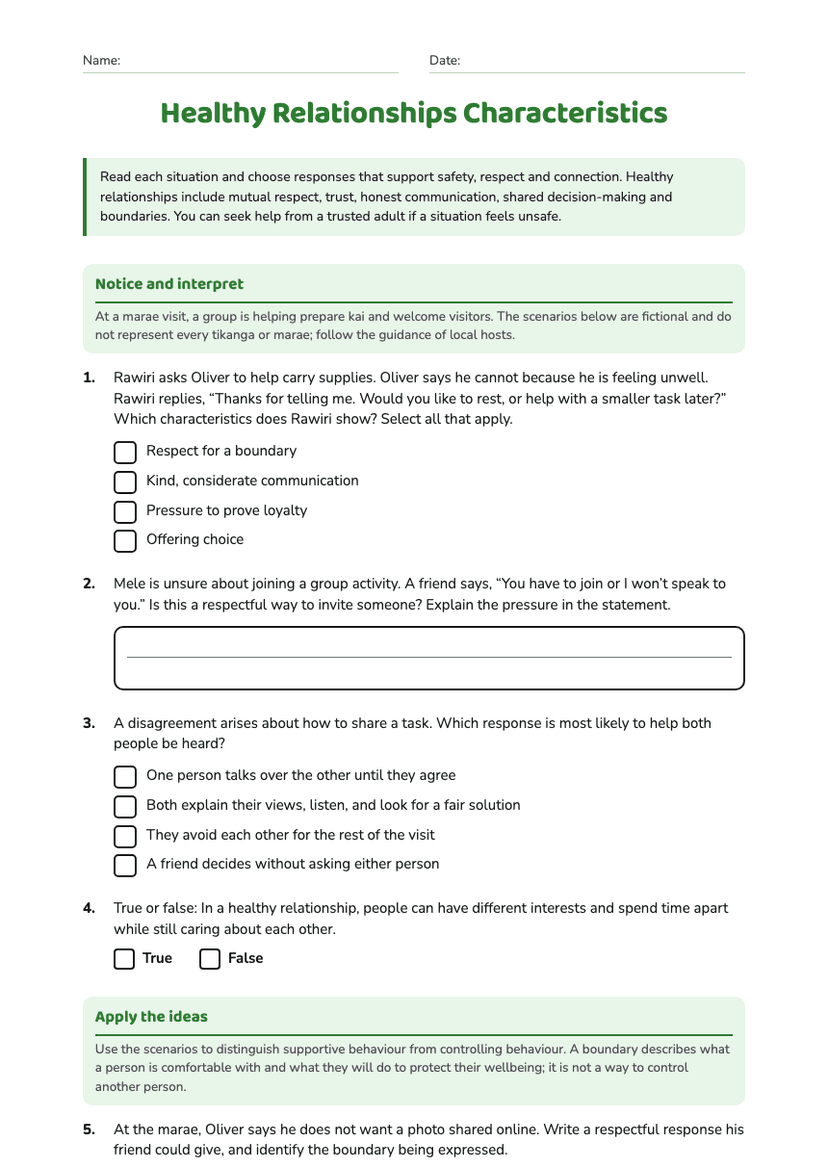
Healthy Relationships Characteristics
Free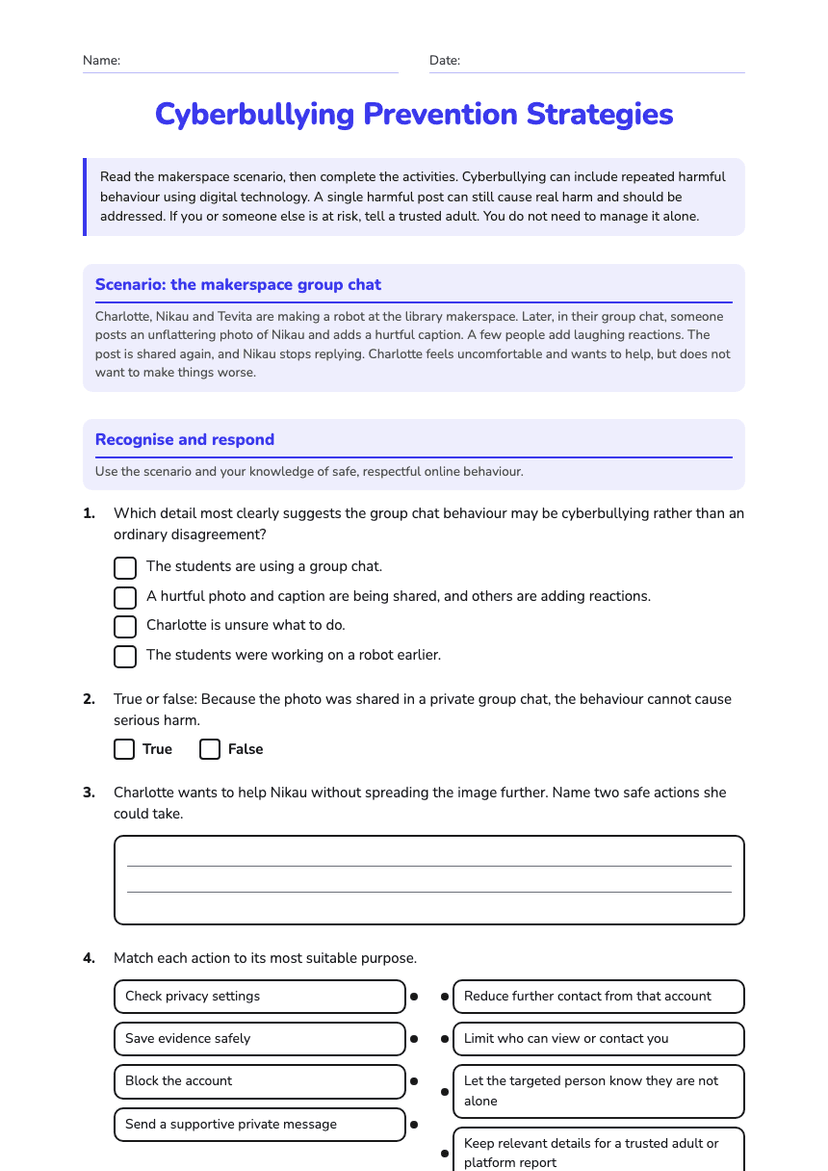
Cyberbullying Prevention Strategies
Free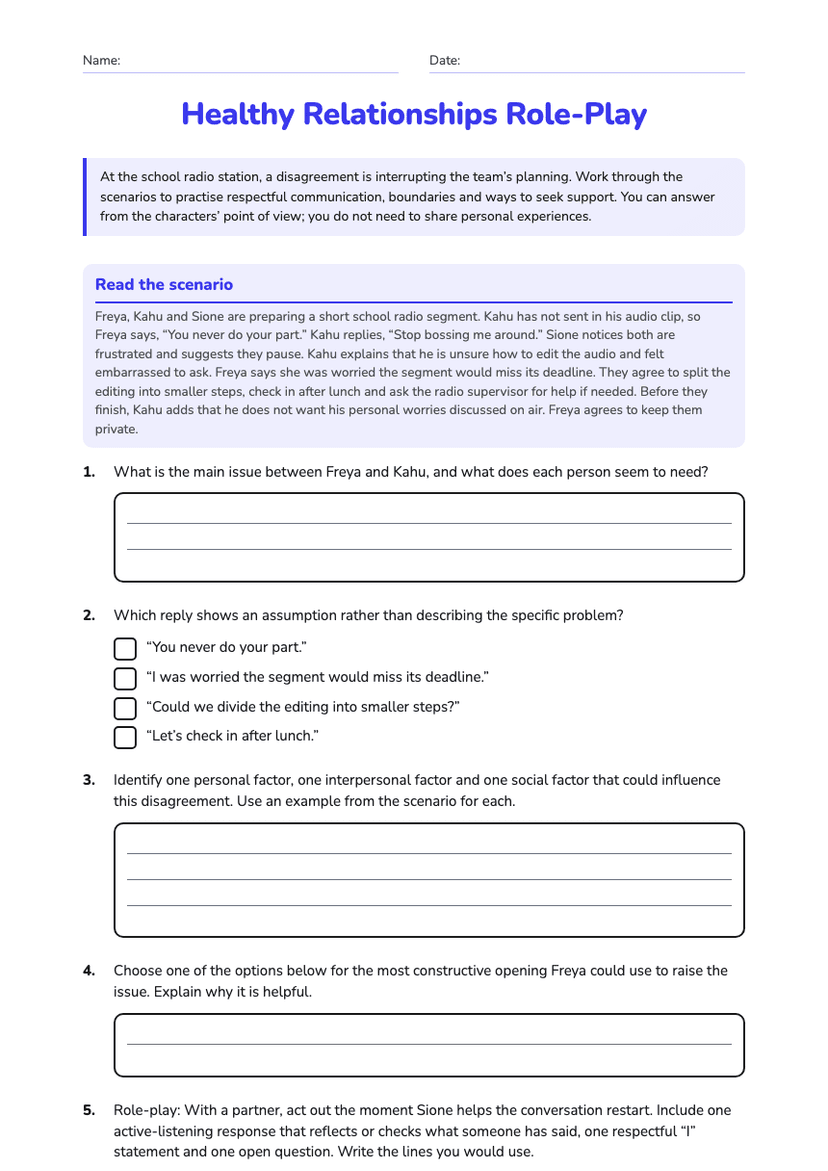
Healthy Relationships Role-Play
Free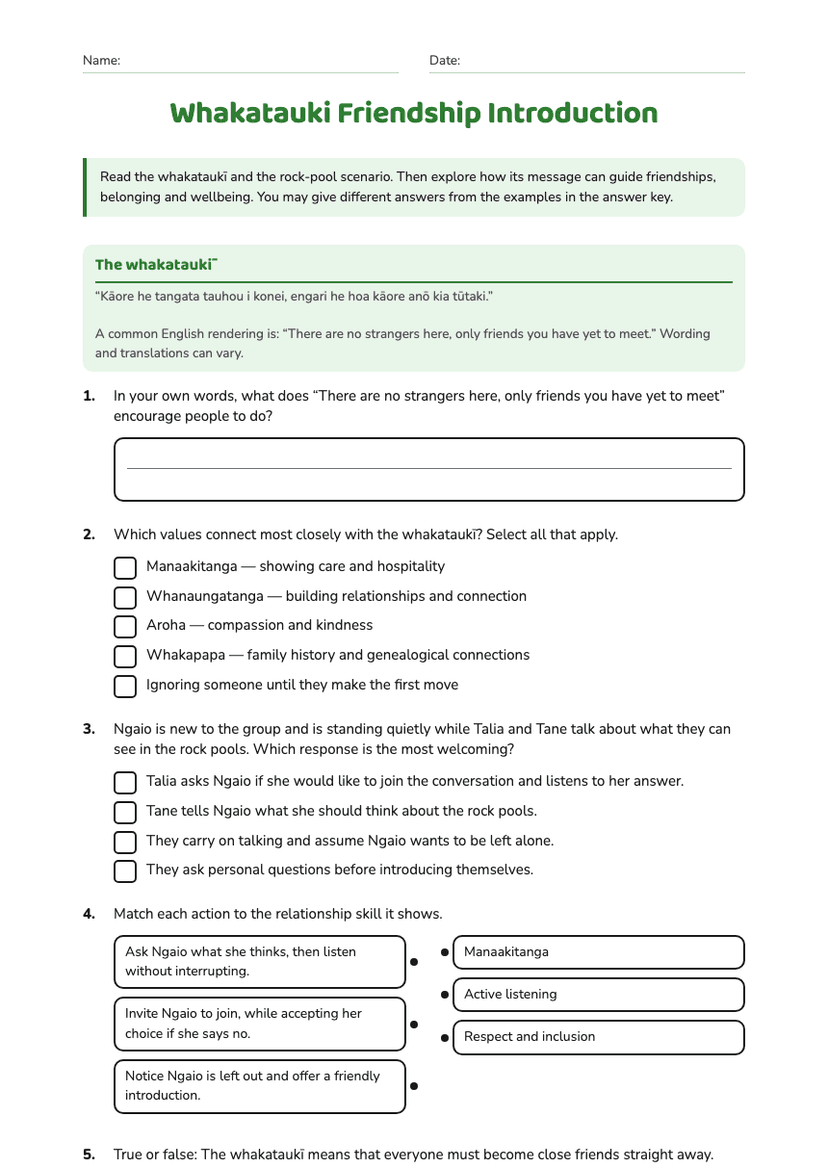
Whakatauki Friendship Introduction
Free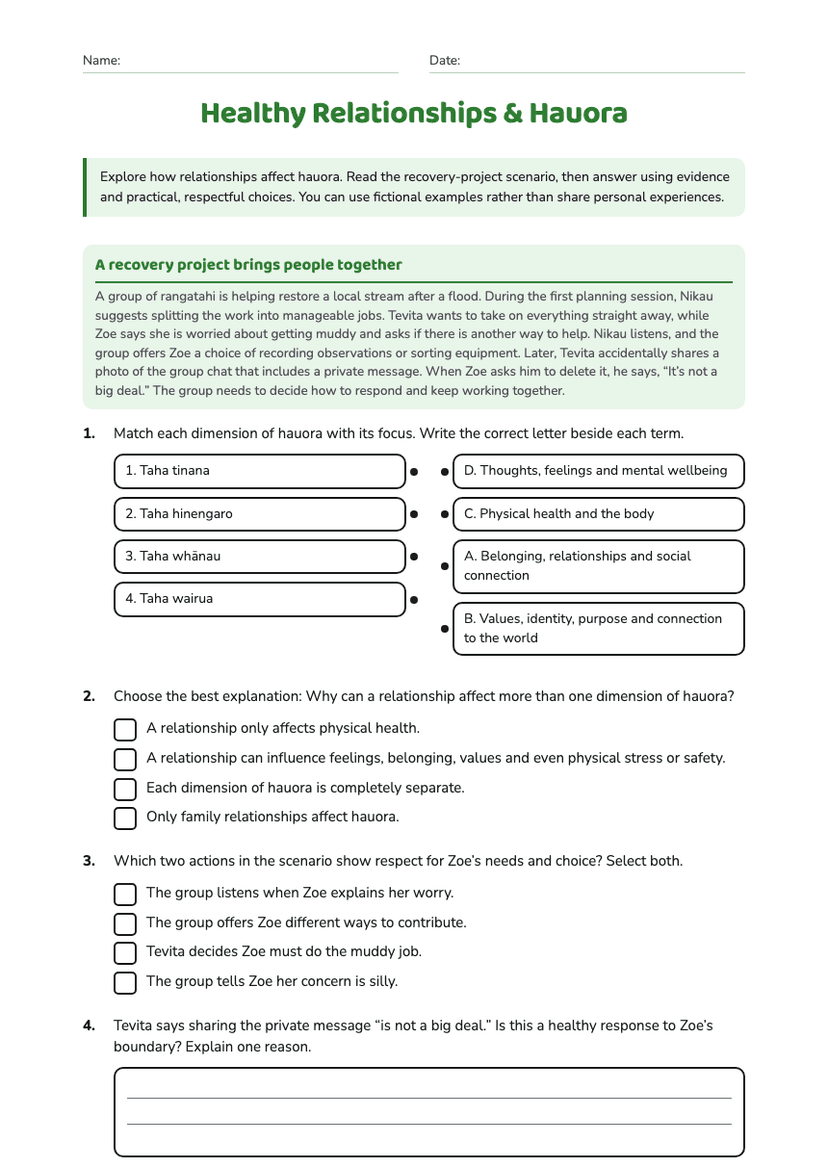
Healthy Relationships & Hauora
Free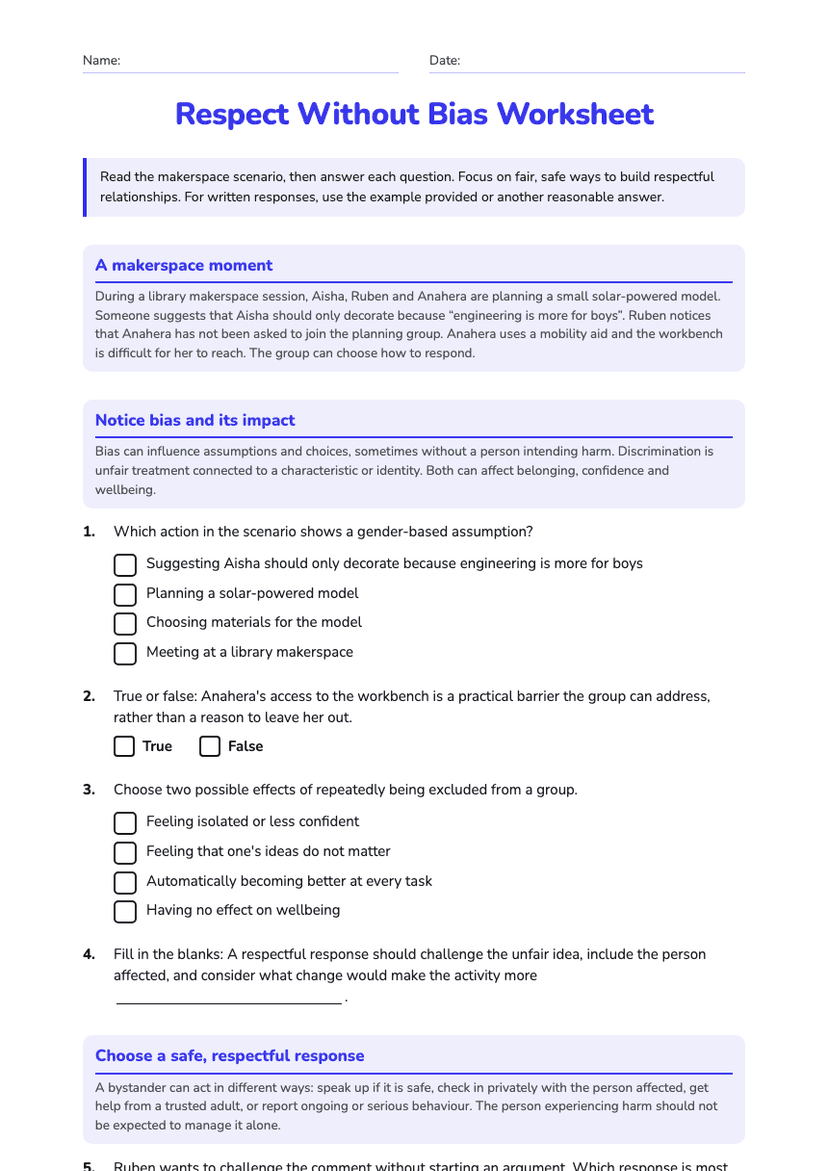
Respect Without Bias Worksheet
Free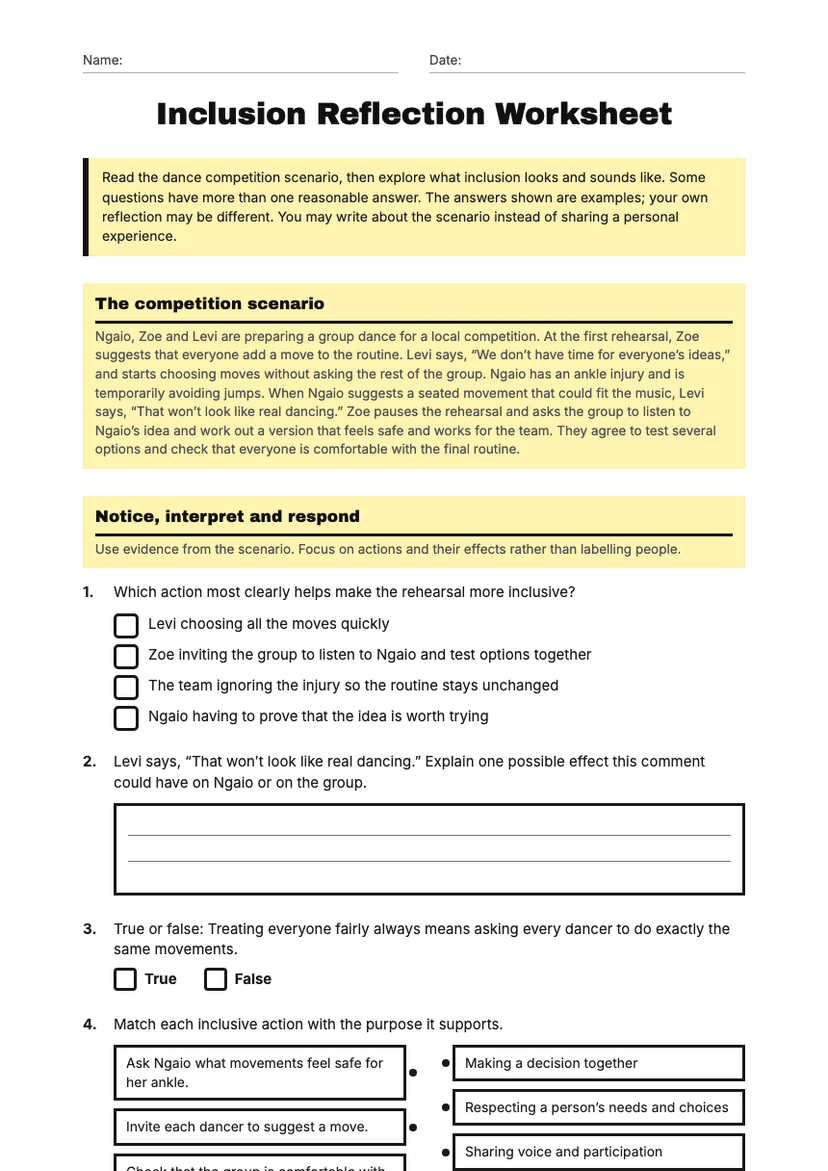
Inclusion Reflection Worksheet
Free