EnglishFreePrintable

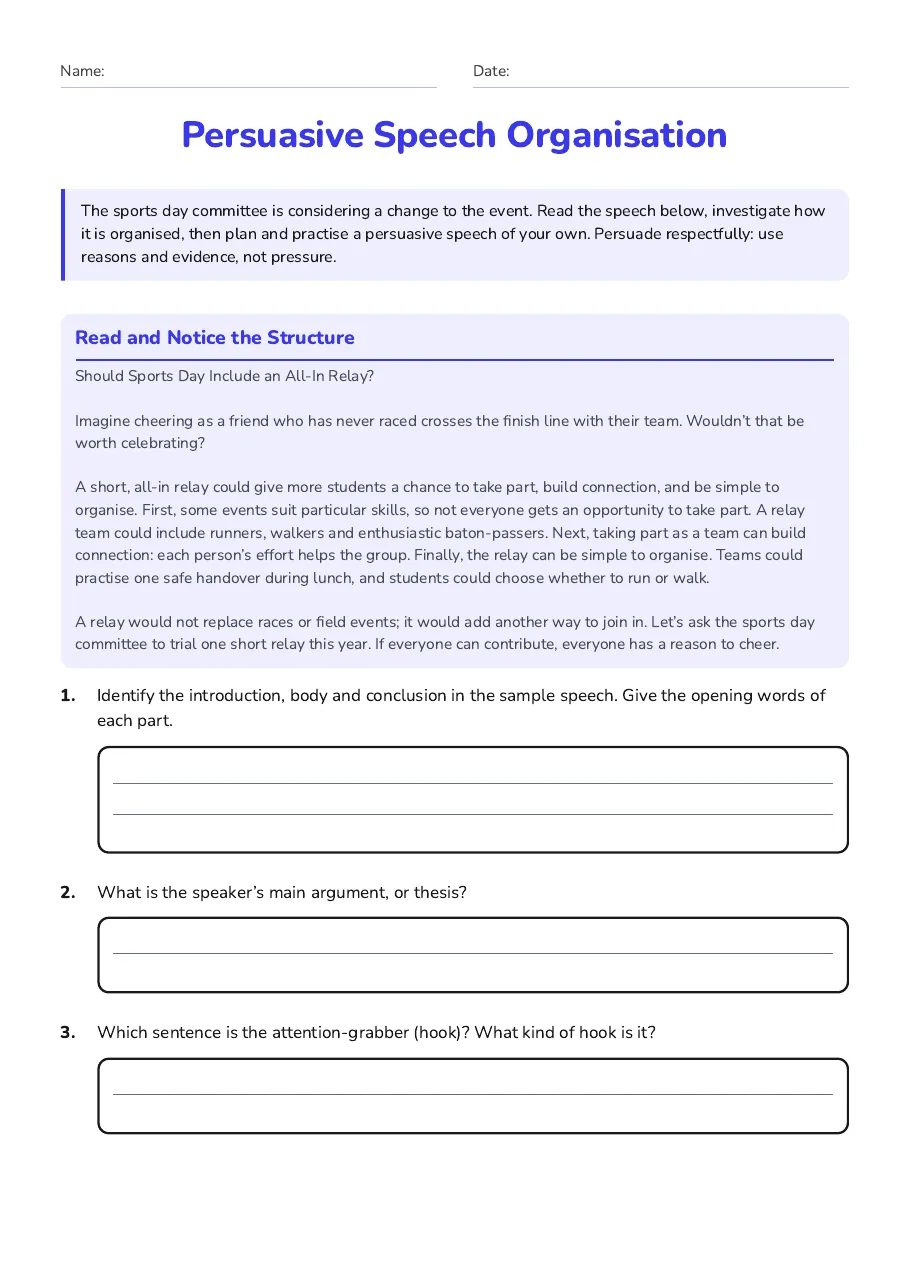
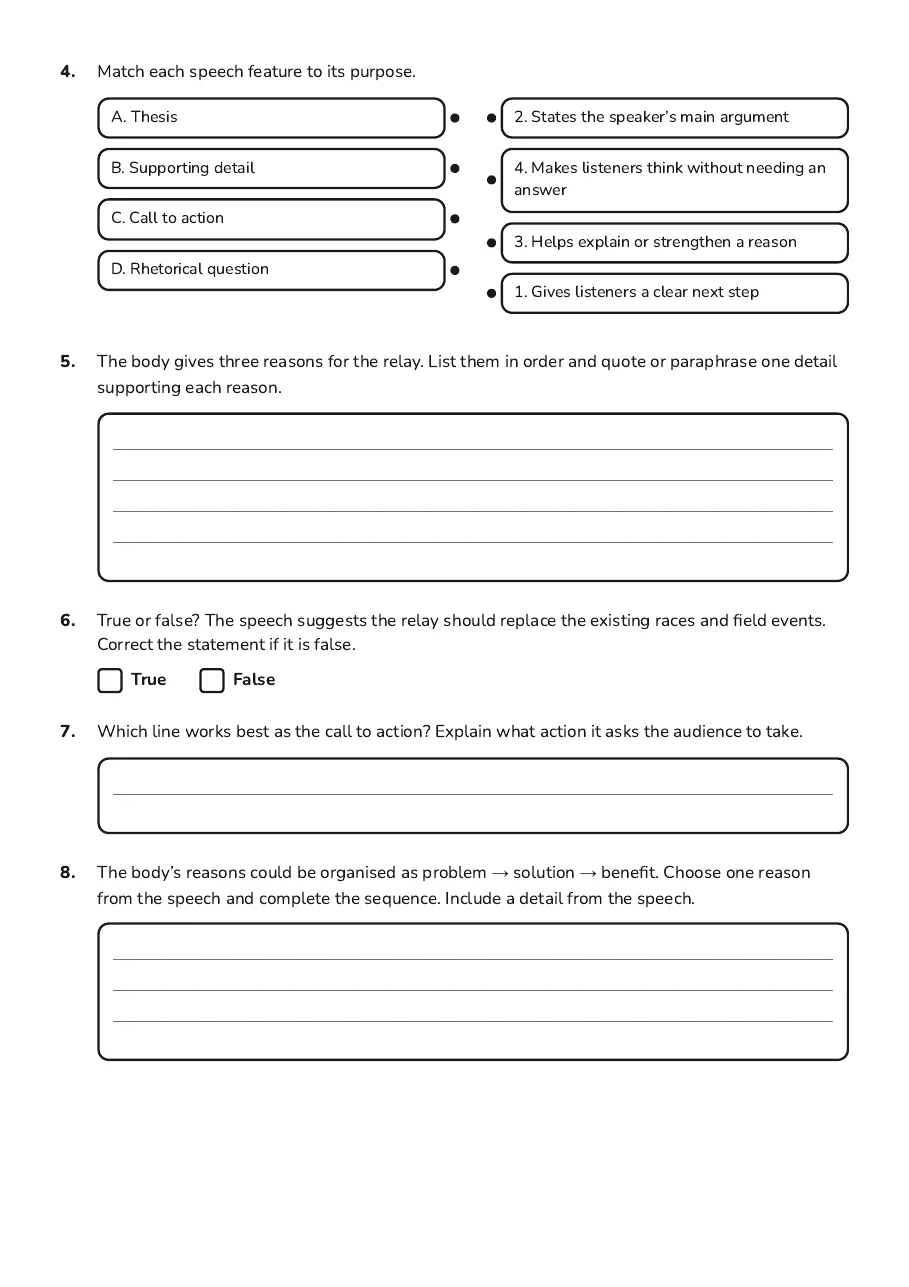
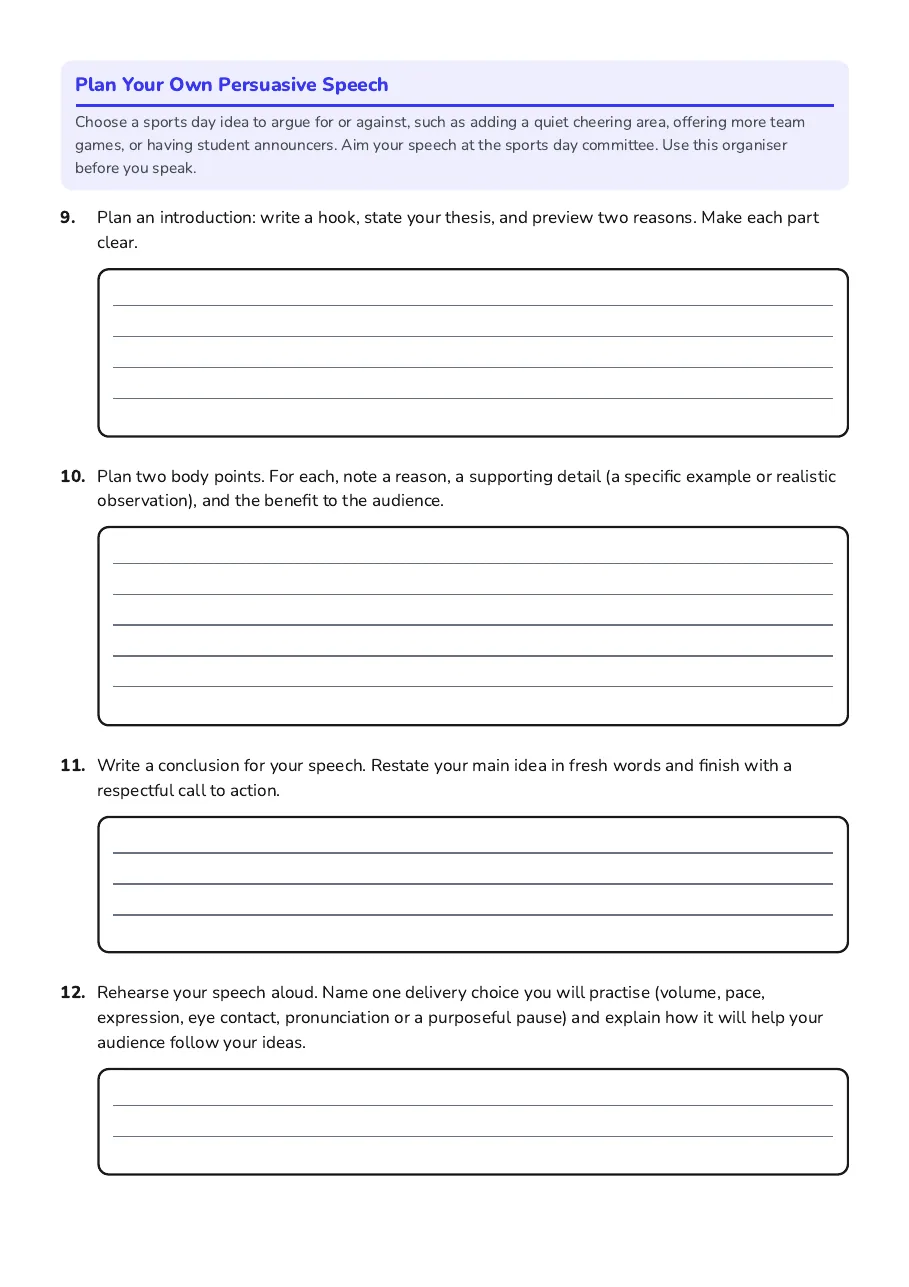
Persuasive Speech Organisation

A free english worksheet ready for your classroom. Open in Kuraplan to grab the print-ready PDF, customize it for your students, or generate a fresh version in seconds.
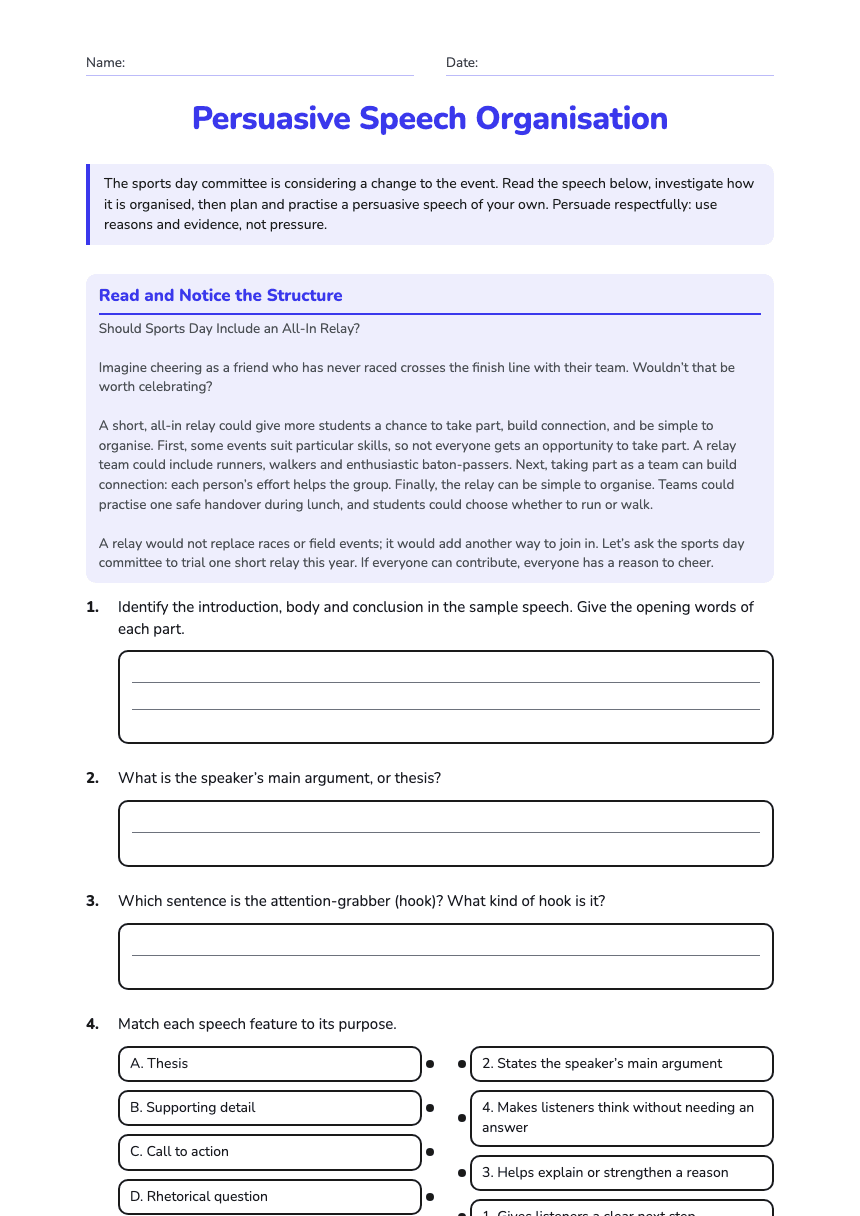
Persuasive Speech Organisation worksheet preview

Persuasive Speech Organisation

Worksheet illustration

Before You Watch: Purpose and Vocabulary

Video: How to Organize a Persuasive Speech or Presentation by Alexander Lyon Communication Coach

Length: 7:38   Link: https://www.youtube.com/watch?v=jnfoFN7TBhw

Pause or replay the video whenever you need to check an idea. Persuasion should help people think carefully, without pressuring them unfairly.

1. Predict: What three main parts do you think a persuasive speech has?
2. What might a speaker want listeners to think or do differently?
3. Match each word to its meaning. Write the correct letter beside each word.
1. persuasive _____
2. audience _____
3. attention-grabber or hook _____
4. thesis _____
5. preview _____
6. supporting detail _____
7. call to action _____
8. rhetorical question _____
A. A question asked to make people think, not usually to get an answer.
B. A person or group listening to or reading a message.
C. Information that helps prove or explain a point.
D. A clear statement of the main argument.
E. A message designed to convince people.
F. A quick opening that gains interest.
G. A brief look at the ideas that will follow.
H. A clear instruction about what listeners should do.

While You Watch: Notice the Organisation

Take brief notes. The three main parts are the introduction, body and conclusion.

4. Complete the note-taking prompts.

Introduction: An attention-grabber could be a short story, a statistic or a rhetorical question.

What is in it for the audience? ________________________________________________

Main argument or thesis: ______________________________________________________

Ideas previewed: ______________________________________________________________

Body: Each point can follow this sequence:

Problem → Solution → Benefit

Problem explained clearly: ____________________________________________________

Solution suggested: ___________________________________________________________

Benefit for people or the audience: ___________________________________________

Supporting details might include statistics, stories or quotations.

Conclusion: It signals the ending, restates the key takeaway, gives a call to action and may echo the opening hook.

Key takeaway or call to action: ________________________________________________

5. Choose the best answer.

A well-organised persuasive speech usually has:

an introduction, body and conclusion

three introductions and no conclusion

only facts, with no main argument

6. Write True or False. If false, correct the statement.

The solution should be explained before the problem. __________

Correction: _________________________________________________________________

A conclusion can include a clear call to action. __________

Correction, if needed: ______________________________________________________

7. Why are supporting details useful in a persuasive speech?

Mini-section: How to Create a Great Introduction or Hook

Choose one opening: a short story, a surprising statistic or a rhetorical question. Then explain what is in it for the audience, state your thesis and preview your ideas.

8. Topic: Should our school have more outdoor learning time? Write one hook.

Hook type: __________________________

Plan, Present and Reflect

Speech Organiser

Topic: ______________________________________________________________

Audience: __________________________________________________________

Argument or thesis: _________________________________________________

Hook: __________________________________________________________________

What is in it for the audience? ________________________________________

Body section 1

Problem: _____________________________________________________________________

Solution: ____________________________________________________________________

Benefit: _____________________________________________________________________

Supporting detail: ___________________________________________________________

Body section 2

Problem: _____________________________________________________________________

Solution: ____________________________________________________________________

Benefit: _____________________________________________________________________

Supporting detail: ___________________________________________________________

Body section 3

Problem: _____________________________________________________________________

Solution: ____________________________________________________________________

Benefit: _____________________________________________________________________

Supporting detail: ___________________________________________________________

Conclusion: Key takeaway: ____________________________________________

Call to action: ______________________________________________________

Oral Delivery Self-check

Circle one rating for each skill: 1 = not yet, 2 = sometimes, 3 = mostly, 4 = confidently.

Volume: 1   2   3   4

Pace: 1   2   3   4

Expression: 1   2   3   4

Eye contact: 1   2   3   4

Posture: 1   2   3   4

Clear pronunciation: 1   2   3   4

Purposeful pauses: 1   2   3   4

9. Higher-order thinking: Which opening would persuade a specific audience more effectively? Explain why.

Opening A: “Have you ever wished you had more time to learn outside?”

Opening B: “Last term, our class spent one afternoon measuring plants in the school garden, and everyone wanted to keep investigating.”

Audience: ____________________________   My choice: A / B

10. Exit ticket: Name one organisation strategy and one delivery strategy you will use.

Organisation strategy: _______________________________________________________

Delivery strategy: ____________________________________________________________

Teacher Answer Key

1. Accept: introduction, body and conclusion.

2. Answers will vary. Accept any reasonable purpose, such as convincing listeners to change an opinion or take an action.

3. 1-E, 2-B, 3-F, 4-D, 5-G, 6-C, 7-H, 8-A.

4. Accept accurate notes. Expected ideas include an opening hook, what the audience gains, the thesis and a preview; body points using problem–solution–benefit with supporting details; and a conclusion with a takeaway and call to action.

5. An introduction, body and conclusion.

6. False: The problem should be explained clearly before the solution. True: A conclusion can include a clear call to action.

7. Supporting details make a point clearer and help support the argument. Accept statistics, stories and quotations as examples.

8. Answers will vary. Award credit for a relevant short story, statistic or rhetorical question connected to the topic.

9. Answers will vary. Strong answers identify a particular audience and justify the choice using relevance, interest, emotion or connection to that audience.

10. Accept any accurate organisation strategy, such as using a hook, preview or problem–solution–benefit sequence, and any delivery strategy, such as changing pace, making eye contact or using purposeful pauses.

Speech organiser and self-check marking guidance: Award one point for each completed, relevant organiser element. For oral delivery, students should choose honest ratings and identify a useful improvement goal. Persuasive communication should be clear, respectful and free from unfair pressure.

About This Worksheet

Free in Kuraplan

Sign up free, grab the PDF, and customize it for your class.

Print-Ready

Formatted for standard paper. Clean layout, easy to read.

AI-Generated

Created with Kuraplan's AI, designed for real classroom use.

For Teachers & Parents

Use in classrooms, for homework, tutoring, or homeschool.

Need a custom version of this worksheet?

Kuraplan's AI generates custom worksheets in seconds — differentiated for every learner, aligned to your curriculum.

Generate Custom Worksheets — Free
No credit card Curriculum-aligned Under 60 seconds