EnglishFreePrintable

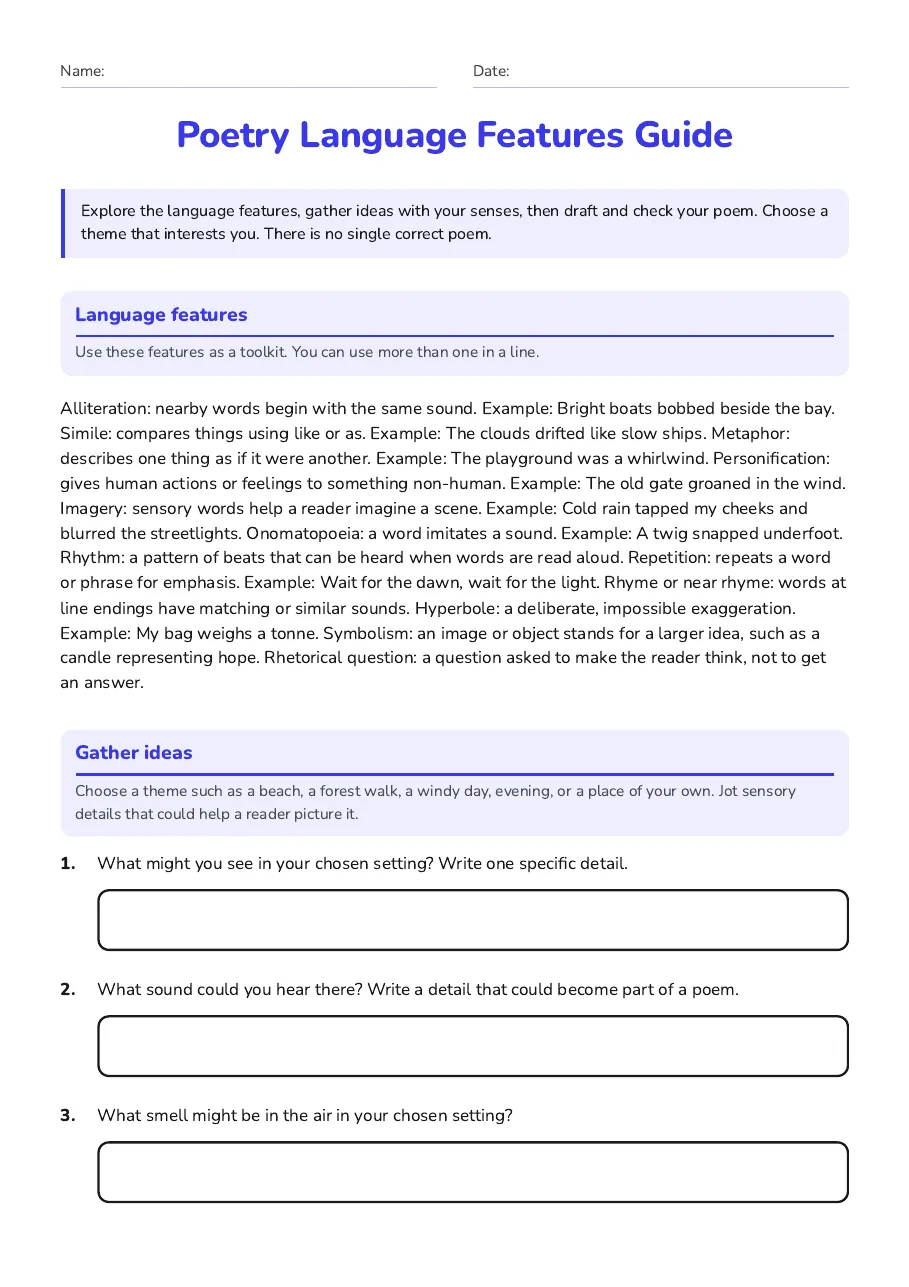
Poetry Language Features Guide

A free english worksheet ready for your classroom. Open in Kuraplan to grab the print-ready PDF, customize it for your students, or generate a fresh version in seconds.
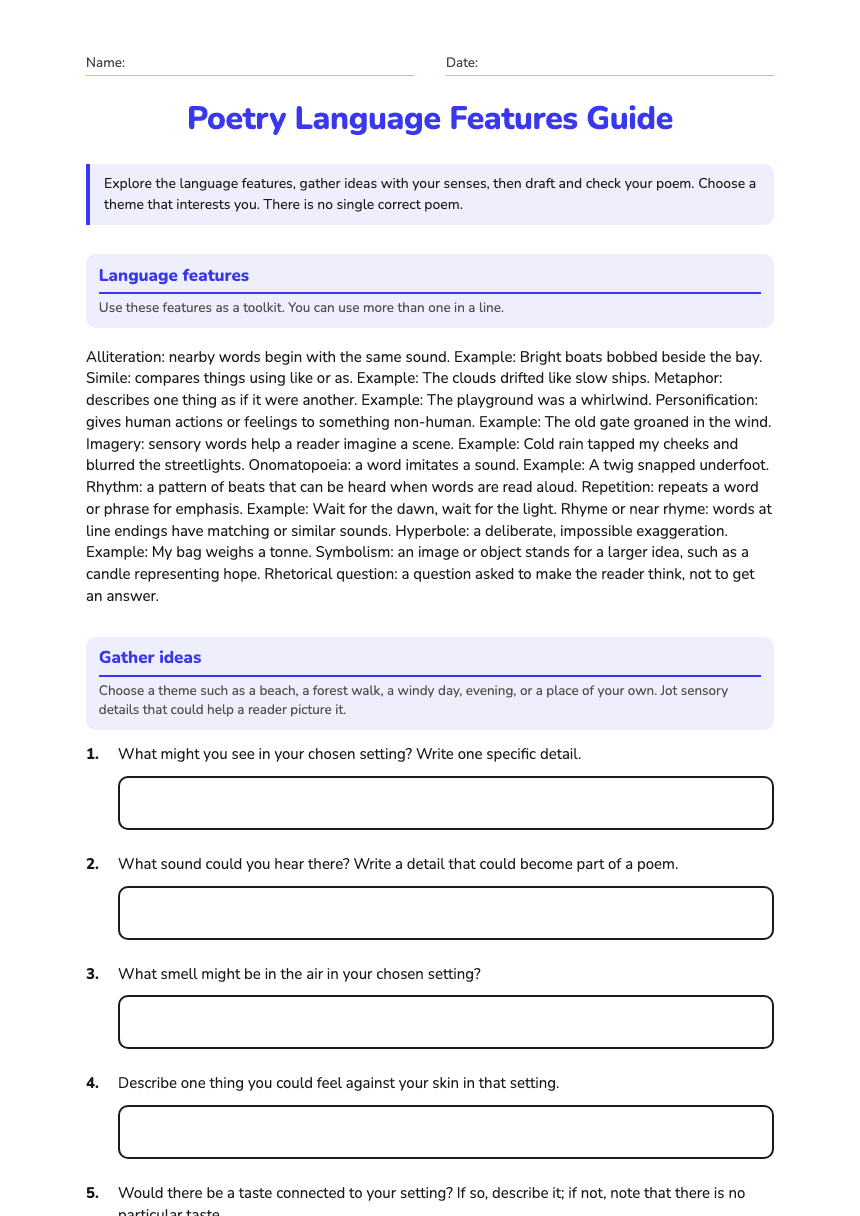
Poetry Language Features Guide worksheet preview

Poetry Language Features – WALT

Poetry worksheet illustration

🎯 WALT

We are learning to use poetry language features to create vivid and effective imagery.

📖 Feature Bank – Language Features Reference

Use this table to help you write your poem. Choose features from the list below!

Alliteration – Repeating the same starting sound in nearby words.

Example: "Slippery silver snakes slid silently."

Simile – Comparing two things using like or as.

Example: "The moon was as bright as a torch."

Metaphor – Saying one thing is something else (no like/as).

Example: "The sea is a hungry beast."

Personification – Giving human qualities to a non-human thing.

Example: "The wind whispered secrets through the trees."

Imagery – Language that paints a picture using the five senses.

Example: "The warm, golden sand squeaked beneath my feet."

Onomatopoeia – A word that sounds like what it describes.

Example: "The rain splattered and splashed on the roof."

Rhythm – A beat or pattern in the words when read aloud.

Example: "The cat sat on the mat by the flat."

Repetition – Repeating a word or phrase for effect.

Example: "Rain, rain, endless rain."

Rhyme / Near Rhyme – Words that sound the same (or similar) at the end.

Example: "I walked through the night / beneath pale moonlight."

Hyperbole – A huge exaggeration used for effect.

Example: "I've told you a million times!"

Symbolism – Using an object or image to represent a bigger idea.

Example: "A dove landed on the fence." (dove = peace)

Rhetorical Question – A question asked for effect, not for an answer.

Example: "How could anyone forget that storm?"

✏️ Planning Your Poem

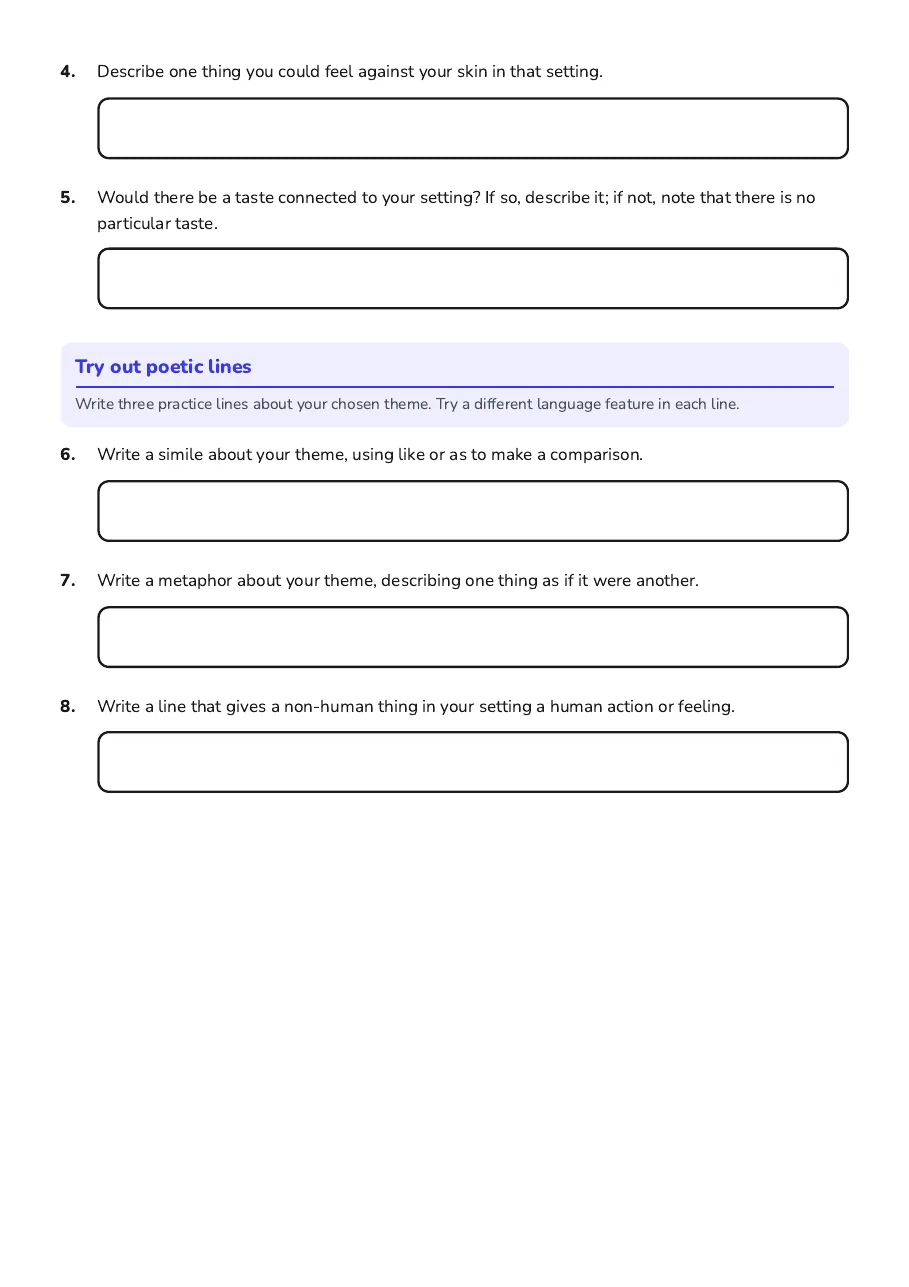
Step 1 – Choose your theme: (Circle or underline one, or write your own)

🌊 The Ocean    🌿 The Bush    ⛈️ A Storm    🌙 Night-time    🔥 Fire    My own: _______________________

Step 2 – Brainstorm 5 sensory details about your theme:

👁️ Sight – What do you see?
👂 Sound – What do you hear?
👃 Smell – What do you smell?
🤚 Touch – What does it feel like?
👅 Taste – What do you taste (if anything)?

Step 3 – Write 3 practice lines using features from the Feature Bank:

💡 Sentence starters to help you:
Simile: "It was like..."  |  Metaphor: "The ___ is a..."  |  Personification: "The ___ reached out and..."  |  Hyperbole: "I could have..."

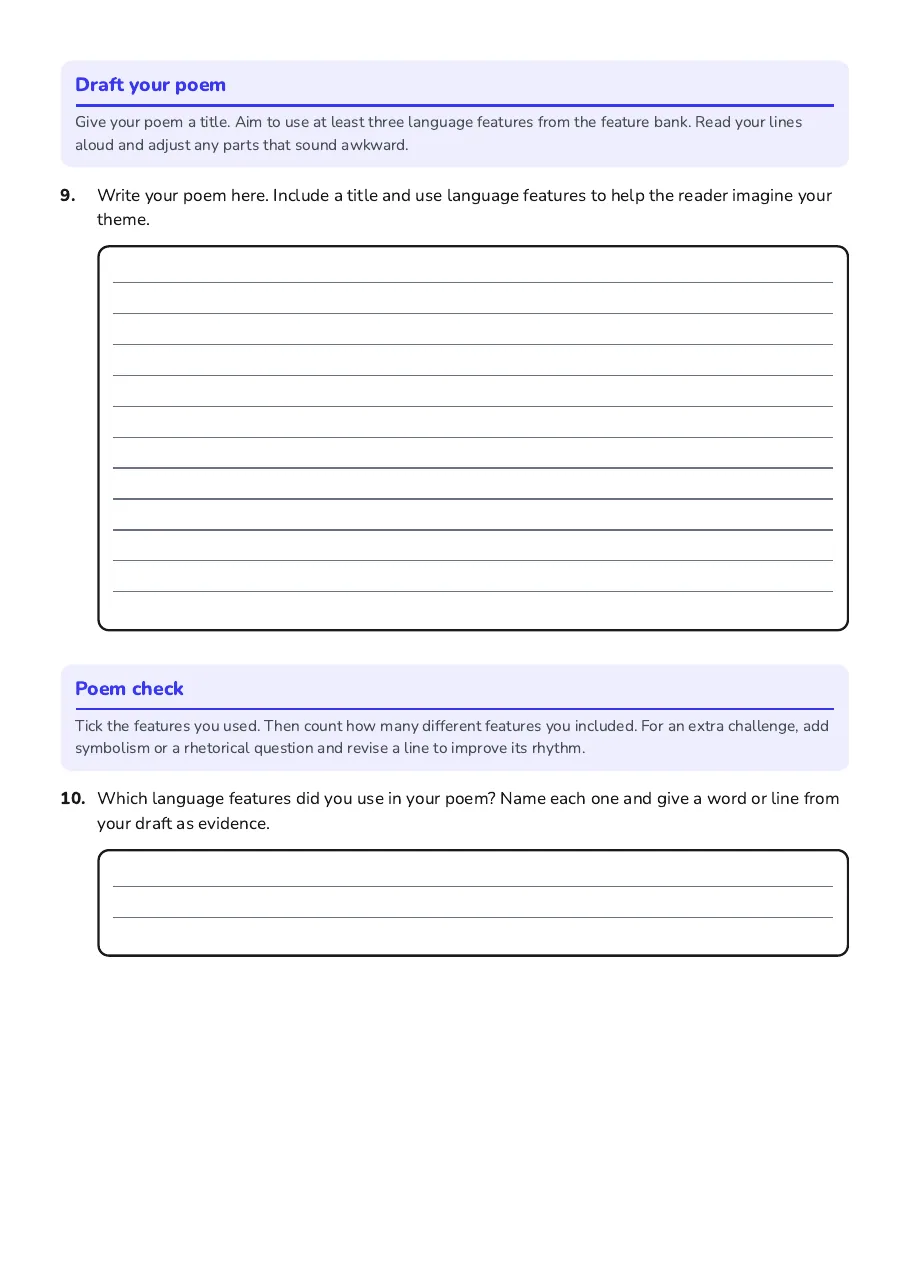
📝 Poem Draft

Title: _____________________________________________

Write your poem below. Aim to use at least 3–6 language features from your Feature Bank.

🔊 Dyslexia-friendly tip: Read your poem aloud when you finish – does it flow? Does it paint a picture?

✅ Self-Check Checklist

Tick each feature you have used in your poem draft:

Alliteration

Simile

Metaphor

Personification

Imagery (sensory detail)

Onomatopoeia

Rhythm or Rhyme

Repetition

Hyperbole

Symbolism

Rhetorical Question

Total features used: _______ / 11

🌟 Differentiation

Core: Include at least 3 features in your poem. Use the sentence starters and Feature Bank to help you.
Challenge: Include at least 5 features in your poem, and make sure one is imagery.

🚀 Extension Activity

Add one advanced feature (symbolism or rhetorical question) to your poem. Then read it aloud and revise for rhythm – do the lines flow smoothly? Adjust any lines that feel awkward.

About This Worksheet

Free in Kuraplan

Sign up free, grab the PDF, and customize it for your class.

Print-Ready

Formatted for standard paper. Clean layout, easy to read.

AI-Generated

Created with Kuraplan's AI, designed for real classroom use.

For Teachers & Parents

Use in classrooms, for homework, tutoring, or homeschool.

Need a custom version of this worksheet?

Kuraplan's AI generates custom worksheets in seconds — differentiated for every learner, aligned to your curriculum.

Generate Custom Worksheets — Free
No credit card Curriculum-aligned Under 60 seconds