EnglishFreePrintable
Setting the Scene: Narrative Openings
A free english worksheet ready for your classroom. Open in Kuraplan to grab the print-ready PDF, customize it for your students, or generate a fresh version in seconds.
Name:Date:
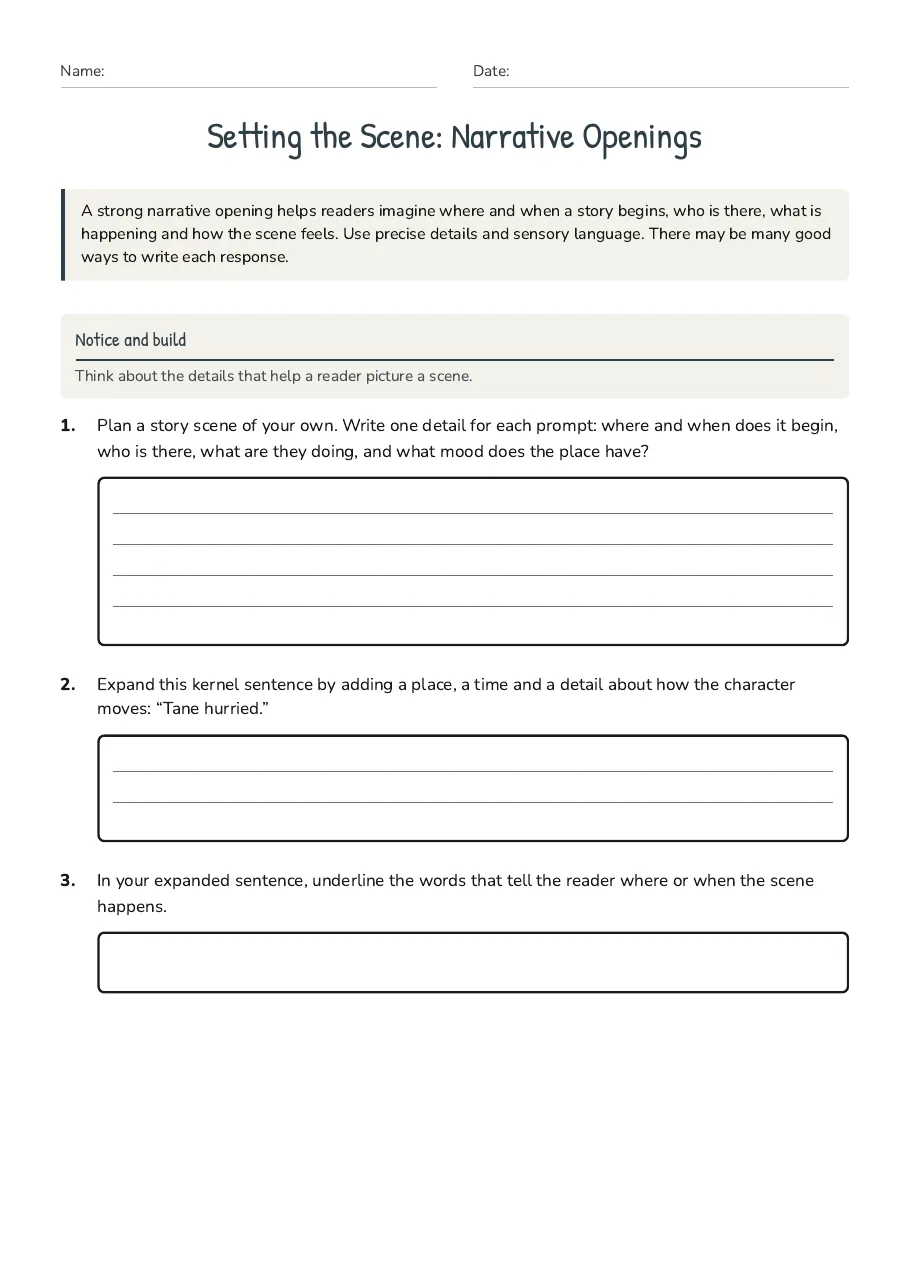
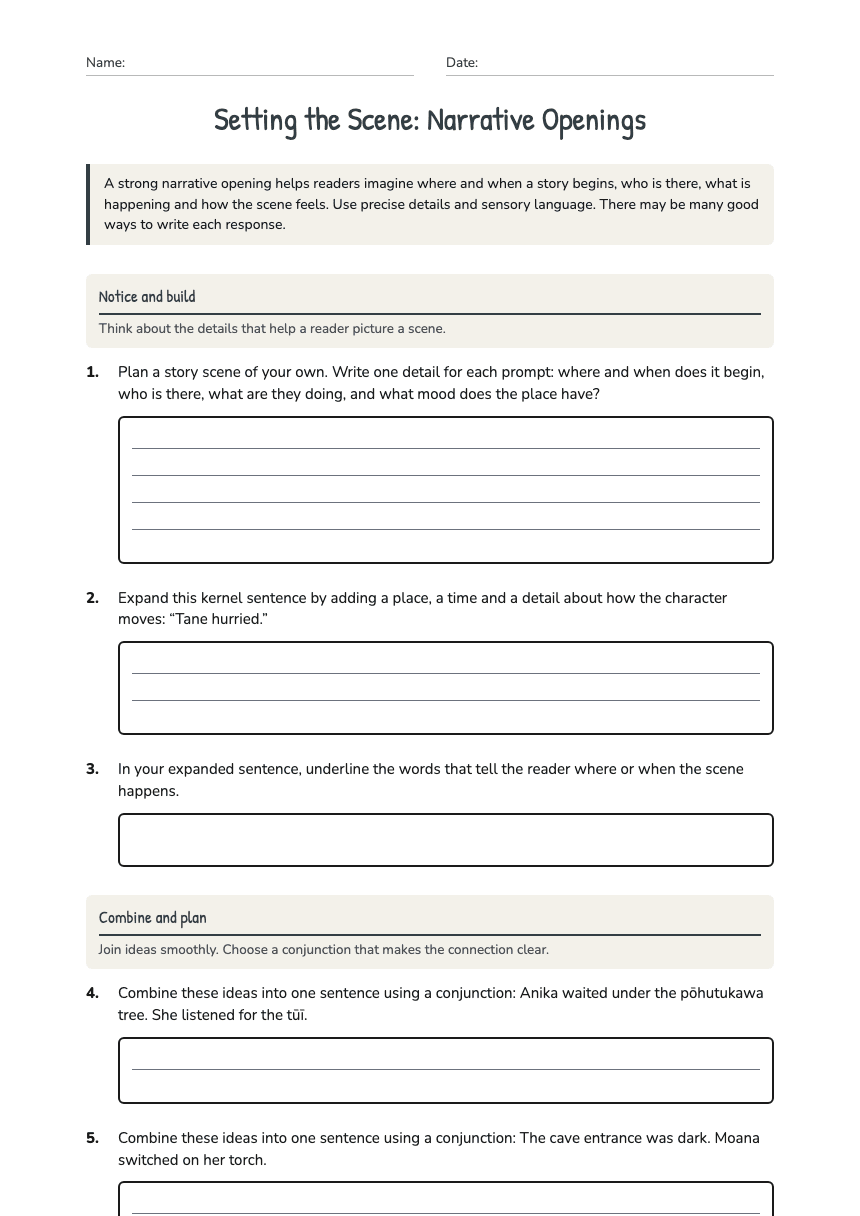
Setting the Scene: Narrative Openings
A strong narrative opening helps readers imagine where and when a story begins, who is there, what is happening and how the scene feels. Use precise details and sensory language. There may be many good ways to write each response.
Notice and build
Think about the details that help a reader picture a scene.
1.Plan a story scene of your own. Write one detail for each prompt: where and when does it begin, who is there, what are they doing, and what mood does the place have?
2.Expand this kernel sentence by adding a place, a time and a detail about how the character moves: “Tane hurried.”
3.In your expanded sentence, underline the words that tell the reader where or when the scene happens.
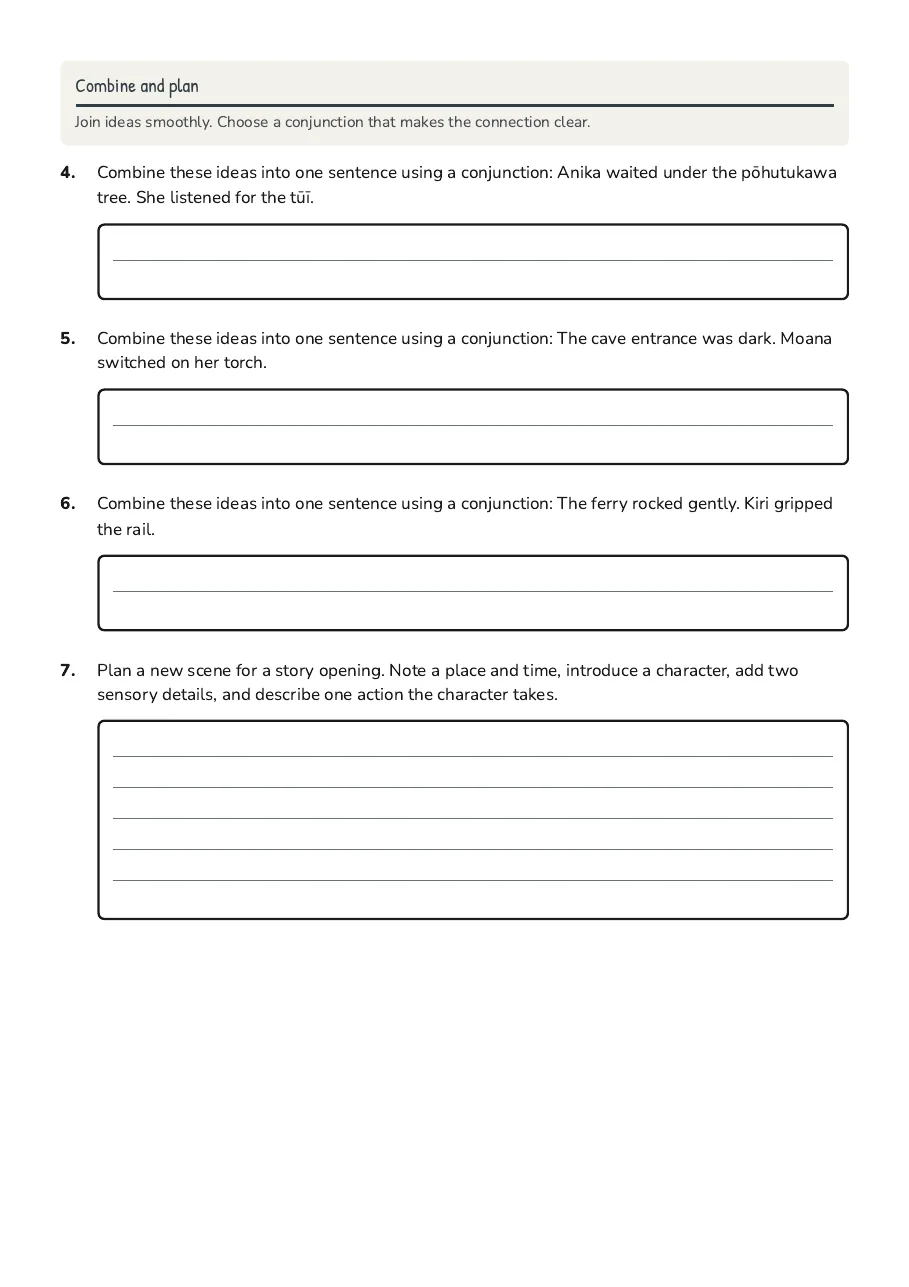
Combine and plan
Join ideas smoothly. Choose a conjunction that makes the connection clear.
4.Combine these ideas into one sentence using a conjunction: Anika waited under the pōhutukawa tree. She listened for the tūī.
5.Combine these ideas into one sentence using a conjunction: The cave entrance was dark. Moana switched on her torch.
6.Combine these ideas into one sentence using a conjunction: The ferry rocked gently. Kiri gripped the rail.
7.Plan a new scene for a story opening. Note a place and time, introduce a character, add two sensory details, and describe one action the character takes.
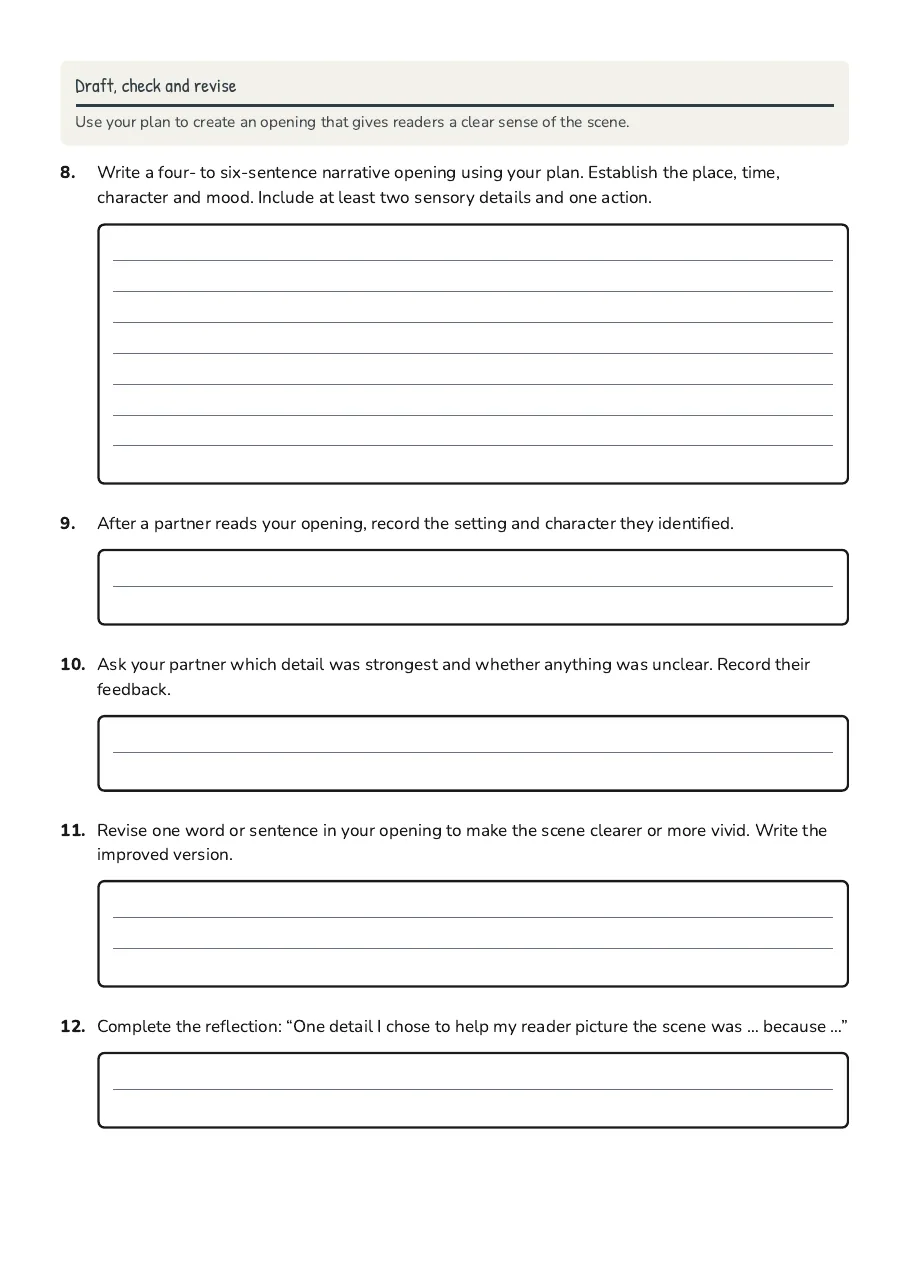
Draft, check and revise
Use your plan to create an opening that gives readers a clear sense of the scene.
8.Write a four- to six-sentence narrative opening using your plan. Establish the place, time, character and mood. Include at least two sensory details and one action.
9.After a partner reads your opening, record the setting and character they identified.
10.Ask your partner which detail was strongest and whether anything was unclear. Record their feedback.
11.Revise one word or sentence in your opening to make the scene clearer or more vivid. Write the improved version.
12.Complete the reflection: “One detail I chose to help my reader picture the scene was … because …”
About This Worksheet
Free in Kuraplan
Sign up free, grab the PDF, and customize it for your class.
Print-Ready
Formatted for standard paper. Clean layout, easy to read.
AI-Generated
Created with Kuraplan's AI, designed for real classroom use.
For Teachers & Parents
Use in classrooms, for homework, tutoring, or homeschool.
Need a custom version of this worksheet?
Kuraplan's AI generates custom worksheets in seconds — differentiated for every learner, aligned to your curriculum.
Generate Custom Worksheets — Free No credit card Curriculum-aligned Under 60 seconds
More English Worksheets

Year 5
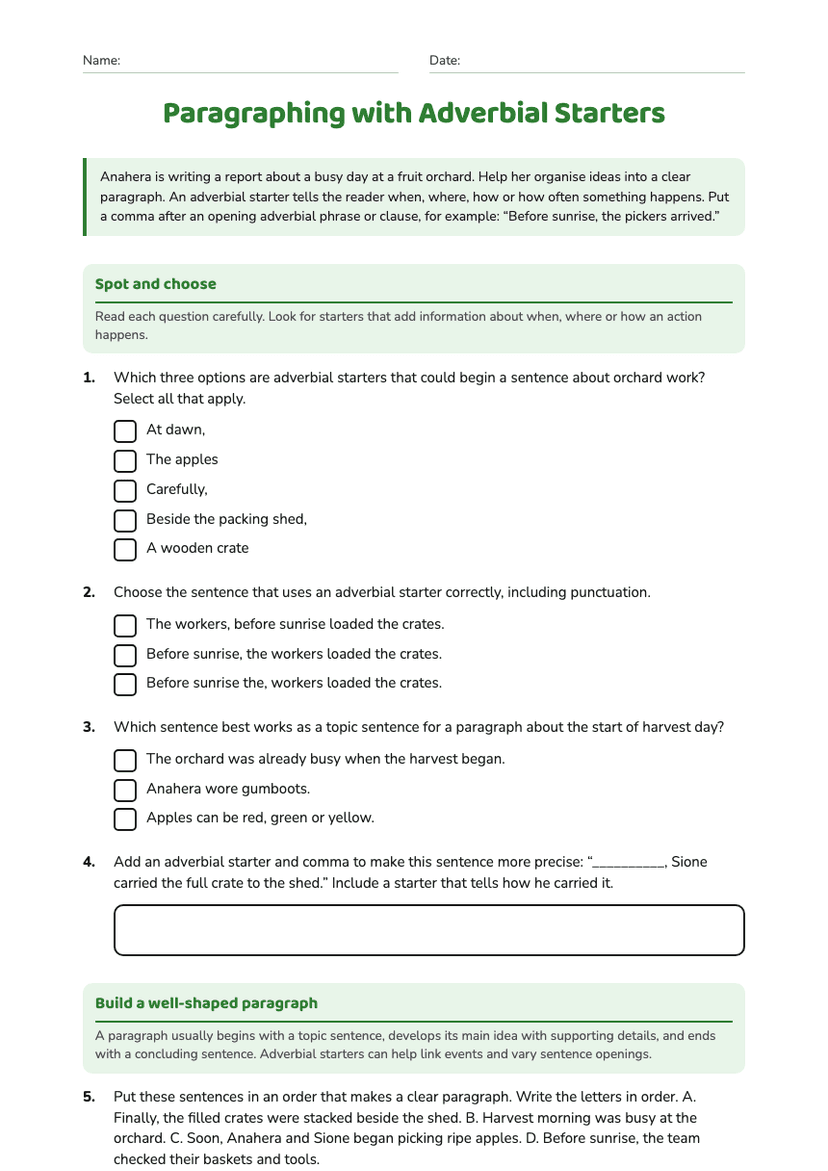
Paragraphing with Adverbial Starters
Free
SCAR Narrative Writing Guide
Free
Year 12 Writing Scaffolds
Free
Year 12
Dunkirk Essay Analysis Worksheet
Free
Year 7–8
Persuasive Writing Planning Workshop
Free
Year 9
Curious Essay Explorers Introduction
Free
Year 5–6
Special Moment Recount Writing
Free
Year 2–3