Synthesis in Life Science
A free science worksheet ready for your classroom. Open in Kuraplan to grab the print-ready PDF, customize it for your students, or generate a fresh version in seconds.
Life Science Synthesis Processes
Learning Goal: Students will understand synthesis processes in living organisms and identify where these occur in cells.
Estimated Time: 45 minutes
🔥 Part 1: Warm-up - Synthesis vs Breakdown (5 minutes)
🔬 Part 2: Cell Structure and Synthesis (10 minutes)
Instructions: Below are descriptions of plant and animal cell components. Select 8 parts relevant to synthesis processes and complete the table.
Available cell parts: Nucleus, Ribosomes, Rough ER, Smooth ER, Golgi apparatus, Mitochondria, Chloroplasts (plants only), Cell membrane, Cytoplasm, Vacuole, Cell wall
1. Cell part: _________________ Role in synthesis: _________________________________
2. Cell part: _________________ Role in synthesis: _________________________________
3. Cell part: _________________ Role in synthesis: _________________________________
4. Cell part: _________________ Role in synthesis: _________________________________
5. Cell part: _________________ Role in synthesis: _________________________________
6. Cell part: _________________ Role in synthesis: _________________________________
7. Cell part: _________________ Role in synthesis: _________________________________
8. Cell part: _________________ Role in synthesis: _________________________________
⚙️ Part 3: Synthesis Scenarios (15 minutes)
Word Bank: amino acids, glucose, fatty acids, nucleotides, ATP, water, oxygen, CO₂, light energy, enzymes, proteins, carbohydrates, lipids
Synthesis type: _________________
3 Inputs needed: _________________, _________________, _________________
2 Outputs produced: _________________, _________________
How energy is used (2-3 sentences):
Where this occurs: _________________
Synthesis type: _________________
3 Inputs needed: _________________, _________________, _________________
2 Outputs produced: _________________, _________________
How energy is used (2-3 sentences):
Where this occurs: _________________
📊 Part 4: Data Interpretation (10 minutes)
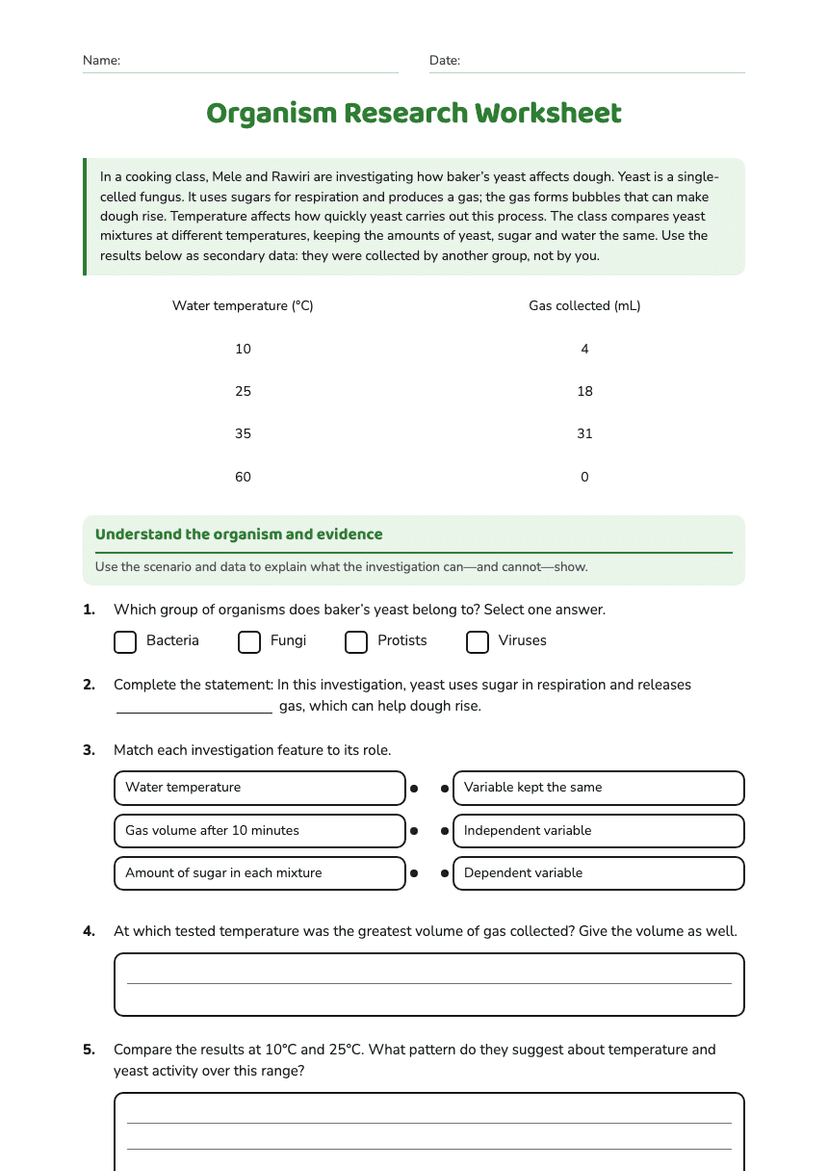
Data Table: Resource Availability vs Rate of Protein Synthesis
Resource Level (%): 0, 25, 50, 75, 100
Synthesis Rate (proteins/minute): 0, 15, 35, 48, 50
💭 Part 5: Reflection (5 minutes)
✅ Self-Assessment Checklist
I can explain the difference between synthesis and breakdown I can identify where different synthesis processes occur in cells I can analyse data about synthesis rates I completed all sections of the worksheetAbout This Worksheet
Free in Kuraplan
Sign up free, grab the PDF, and customize it for your class.
Print-Ready
Formatted for standard paper. Clean layout, easy to read.
AI-Generated
Created with Kuraplan's AI, designed for real classroom use.
For Teachers & Parents
Use in classrooms, for homework, tutoring, or homeschool.
Need a custom version of this worksheet?
Kuraplan's AI generates custom worksheets in seconds — differentiated for every learner, aligned to your curriculum.
Generate Custom Worksheets — Free