ScienceFreePrintable

Word Equations in Chemistry

A free science worksheet ready for your classroom. Open in Kuraplan to grab the print-ready PDF, customize it for your students, or generate a fresh version in seconds.
Word Equations in Chemistry worksheet preview
Name:Date:

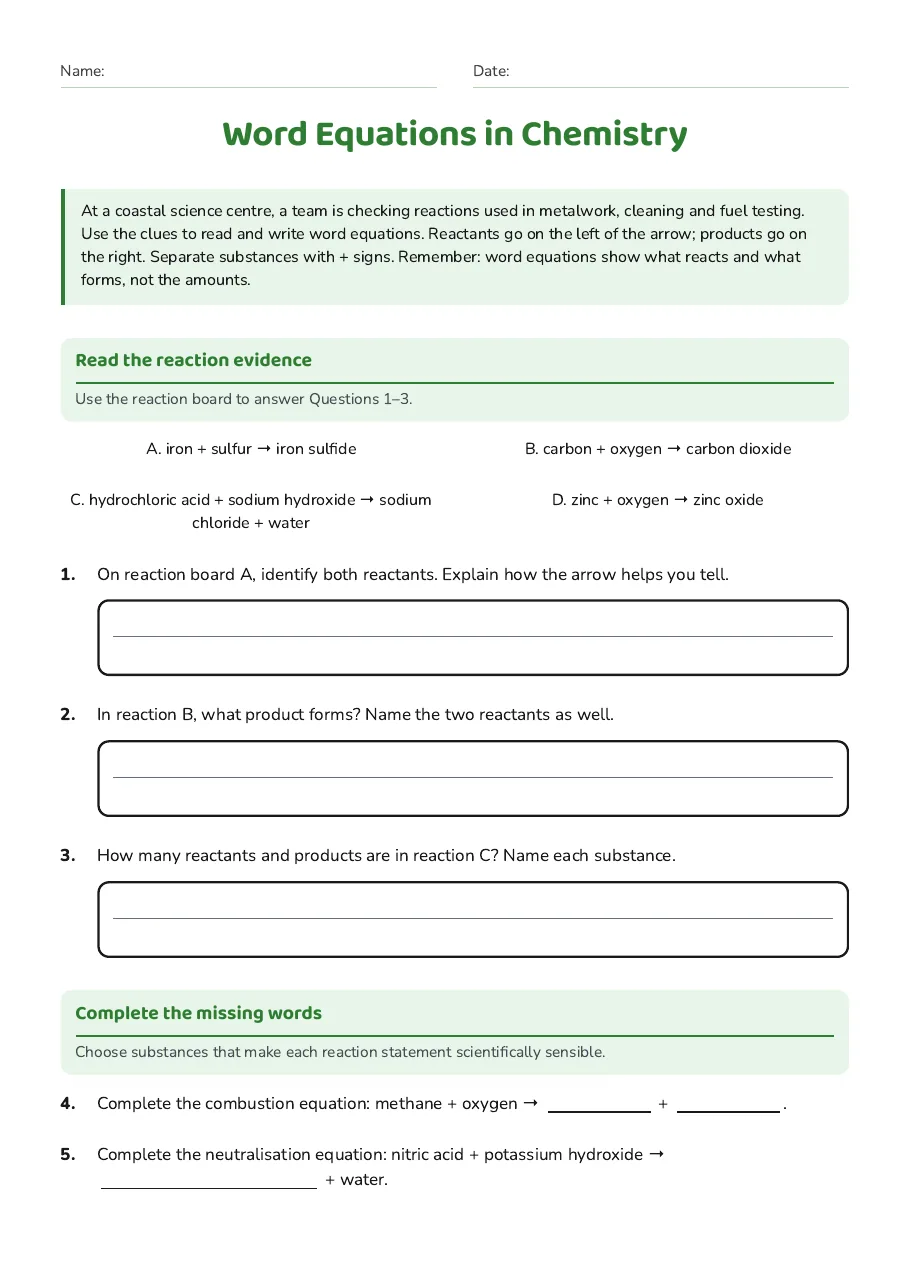
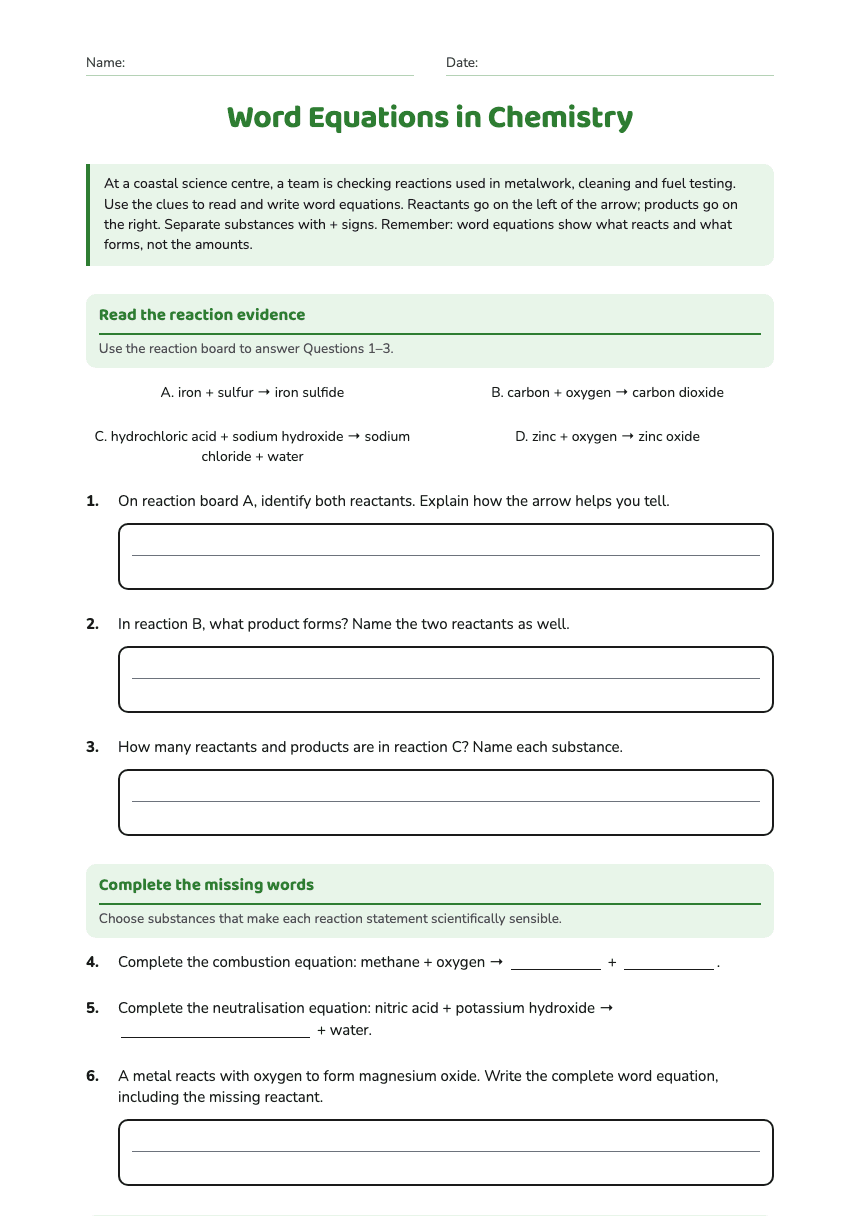
Word Equations in Chemistry

At a coastal science centre, a team is checking reactions used in metalwork, cleaning and fuel testing. Use the clues to read and write word equations. Reactants go on the left of the arrow; products go on the right. Separate substances with + signs. Remember: word equations show what reacts and what forms, not the amounts.

Read the reaction evidence

Use the reaction board to answer Questions 1–3.

A. iron + sulfur → iron sulfide

B. carbon + oxygen → carbon dioxide

C. hydrochloric acid + sodium hydroxide → sodium chloride + water

D. zinc + oxygen → zinc oxide

1.On reaction board A, identify both reactants. Explain how the arrow helps you tell.
2.In reaction B, what product forms? Name the two reactants as well.
3.How many reactants and products are in reaction C? Name each substance.

Complete the missing words

Choose substances that make each reaction statement scientifically sensible.

4.Complete the combustion equation: methane + oxygen → + .
5.Complete the neutralisation equation: nitric acid + potassium hydroxide → + water.
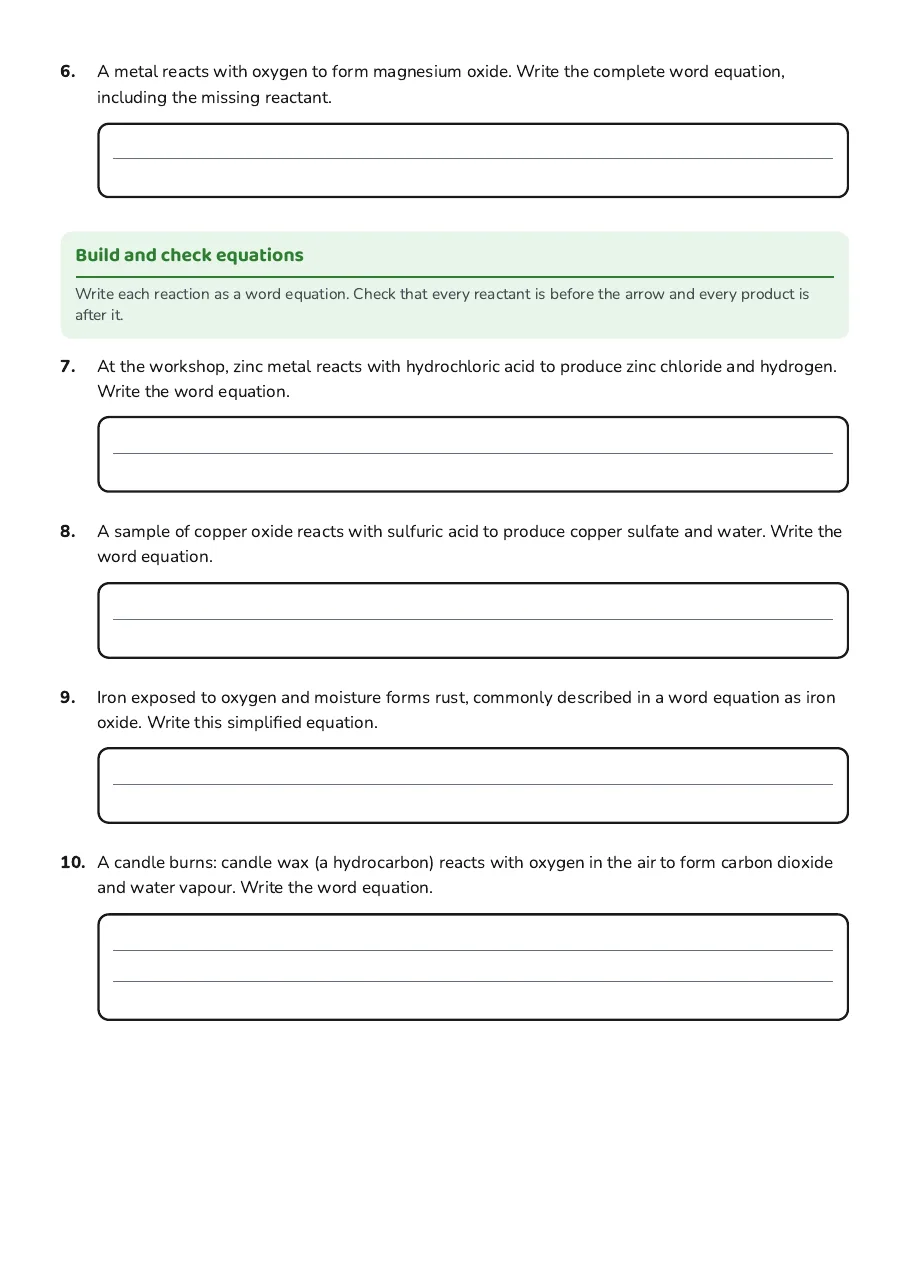
6.A metal reacts with oxygen to form magnesium oxide. Write the complete word equation, including the missing reactant.

Build and check equations

Write each reaction as a word equation. Check that every reactant is before the arrow and every product is after it.

7.At the workshop, zinc metal reacts with hydrochloric acid to produce zinc chloride and hydrogen. Write the word equation.
8.A sample of copper oxide reacts with sulfuric acid to produce copper sulfate and water. Write the word equation.
9.Iron exposed to oxygen and moisture forms rust, commonly described in a word equation as iron oxide. Write this simplified equation.
10.A candle burns: candle wax (a hydrocarbon) reacts with oxygen in the air to form carbon dioxide and water vapour. Write the word equation.
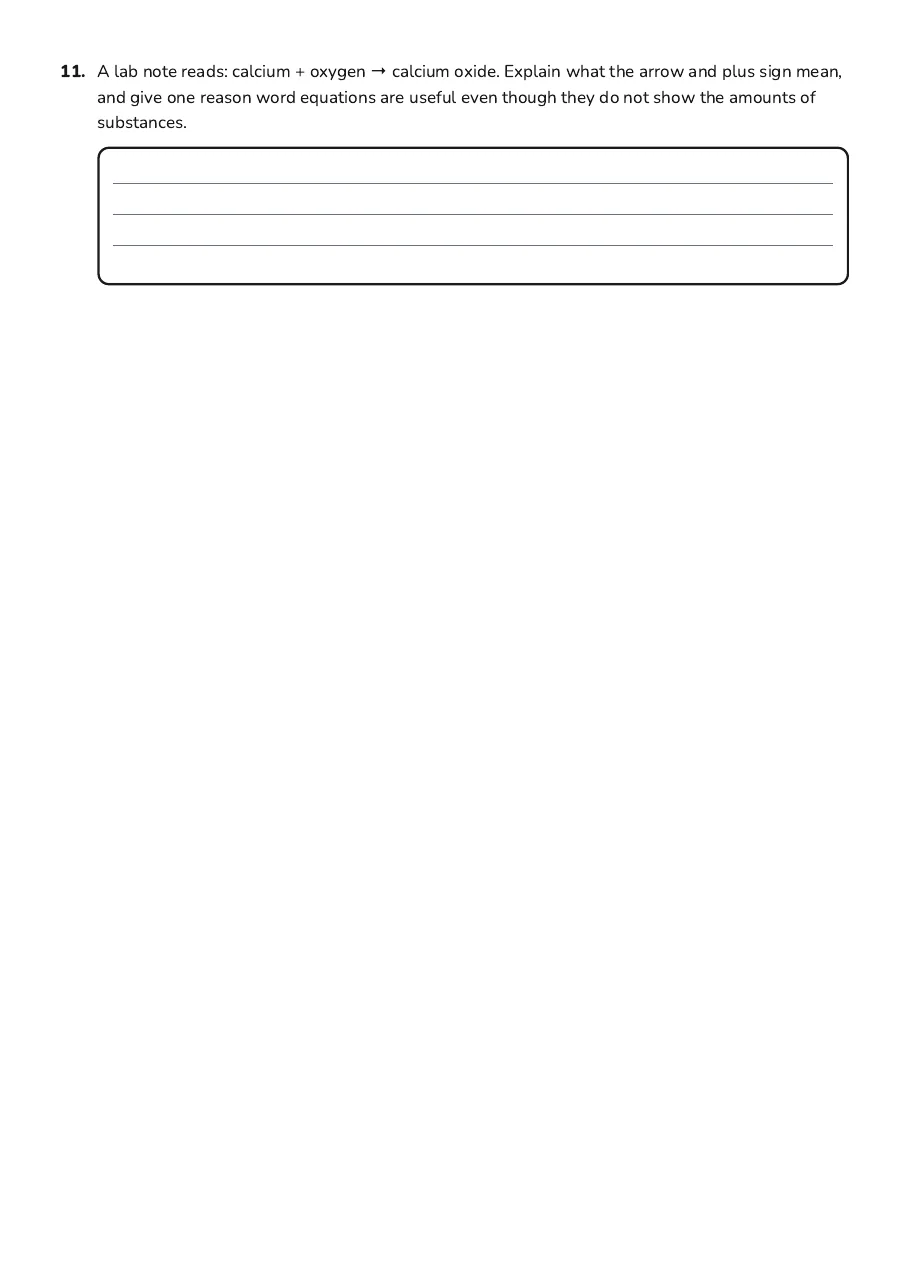
11.A lab note reads: calcium + oxygen → calcium oxide. Explain what the arrow and plus sign mean, and give one reason word equations are useful even though they do not show the amounts of substances.

3 printable pages

  • Word Equations in Chemistry, page 1 of 3: Read the reaction evidence, Complete the missing words

    Page 1

  • Word Equations in Chemistry, page 2 of 3: Build and check equations

    Page 2

  • Word Equations in Chemistry, page 3 of 3: 11. A lab note reads: calcium + oxygen → calcium oxide. Explain what the arrow and plus…

    Page 3

About This Worksheet

Free in Kuraplan

Sign up free, grab the PDF, and customize it for your class.

Print-Ready

Formatted for standard paper. Clean layout, easy to read.

AI-Generated

Created with Kuraplan's AI, designed for real classroom use.

For Teachers & Parents

Use in classrooms, for homework, tutoring, or homeschool.

Need a custom version of this worksheet?

Kuraplan's AI generates custom worksheets in seconds — differentiated for every learner, aligned to your curriculum.

Generate Custom Worksheets — Free
No credit card Curriculum-aligned Under 60 seconds