Year 5/6 Spelling Placement Test
A free english worksheet ready for your classroom. Open in Kuraplan to grab the print-ready PDF, customize it for your students, or generate a fresh version in seconds.
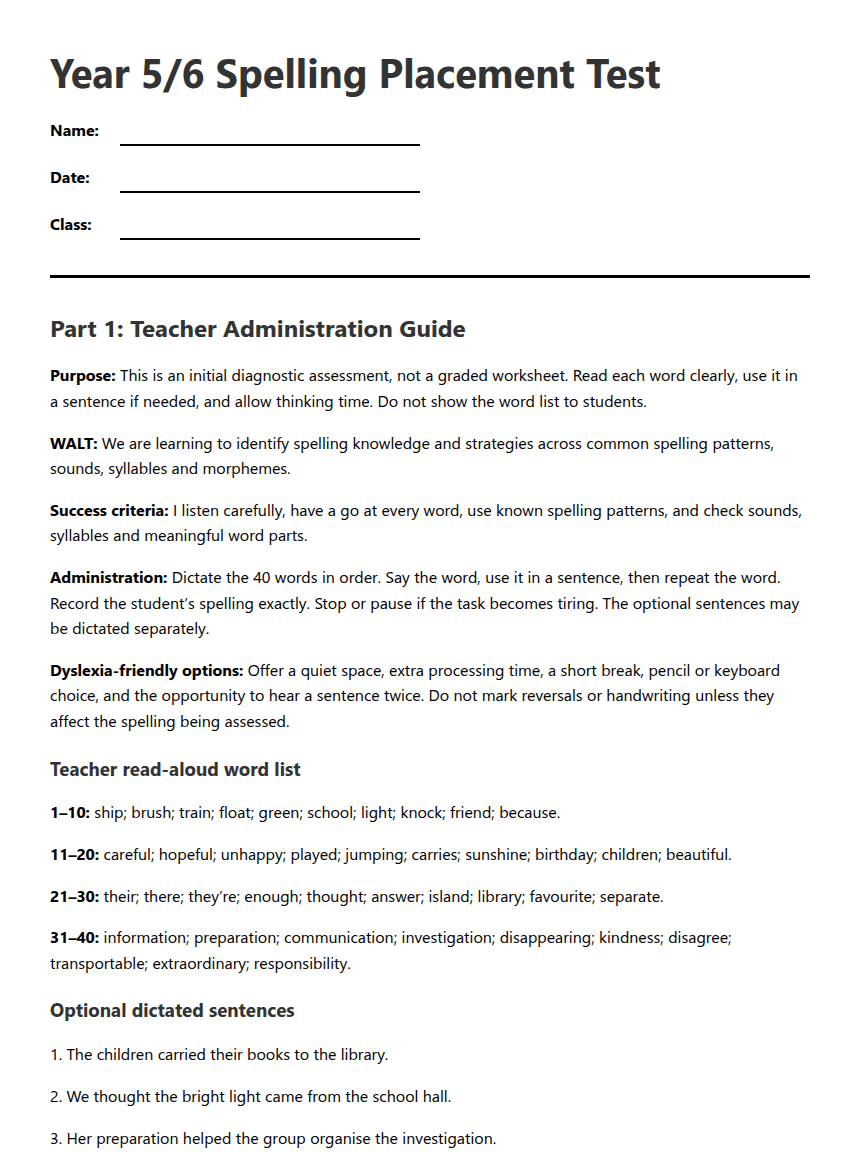
Year 5/6 Spelling Placement Test
Part 1: Teacher Administration Guide
Purpose: This is an initial diagnostic assessment, not a graded worksheet. Read each word clearly, use it in a sentence if needed, and allow thinking time. Do not show the word list to students.
WALT: We are learning to identify spelling knowledge and strategies across common spelling patterns, sounds, syllables and morphemes.
Success criteria: I listen carefully, have a go at every word, use known spelling patterns, and check sounds, syllables and meaningful word parts.
Administration: Dictate the 40 words in order. Say the word, use it in a sentence, then repeat the word. Record the student’s spelling exactly. Stop or pause if the task becomes tiring. The optional sentences may be dictated separately.
Dyslexia-friendly options: Offer a quiet space, extra processing time, a short break, pencil or keyboard choice, and the opportunity to hear a sentence twice. Do not mark reversals or handwriting unless they affect the spelling being assessed.
Teacher read-aloud word list
1–10: ship; brush; train; float; green; school; light; knock; friend; because.
11–20: careful; hopeful; unhappy; played; jumping; carries; sunshine; birthday; children; beautiful.
21–30: their; there; they’re; enough; thought; answer; island; library; favourite; separate.
31–40: information; preparation; communication; investigation; disappearing; kindness; disagree; transportable; extraordinary; responsibility.
Optional dictated sentences
1. The children carried their books to the library.
2. We thought the bright light came from the school hall.
3. Her preparation helped the group organise the investigation.
4. It is important to show kindness when someone disagrees.
5. The extraordinary discovery disappeared from the information display.
Part 2: Student Answer Lines
Listen carefully and write each word. Try every word. Use the back of the page if you need more space.
1. ____________________________________
2. ____________________________________
3. ____________________________________
4. ____________________________________
5. ____________________________________
6. ____________________________________
7. ____________________________________
8. ____________________________________
9. ____________________________________
10. ___________________________________
11. ___________________________________
12. ___________________________________
13. ___________________________________
14. ___________________________________
15. ___________________________________
16. ___________________________________
17. ___________________________________
18. ___________________________________
19. ___________________________________
20. ___________________________________
21. ___________________________________
22. ___________________________________
23. ___________________________________
24. ___________________________________
25. ___________________________________
26. ___________________________________
27. ___________________________________
28. ___________________________________
29. ___________________________________
30. ___________________________________
31. ___________________________________
32. ___________________________________
33. ___________________________________
34. ___________________________________
35. ___________________________________
36. ___________________________________
37. ___________________________________
38. ___________________________________
39. ___________________________________
40. ___________________________________
Optional sentence writing
Write the sentences as your teacher dictates them.
Part 3: Teacher Scoring and Placement
Mark each word as correct or incorrect. Record the error pattern or teaching note. Look for patterns such as vowel teams, consonant blends, silent letters, homophones, suffixes, prefixes, syllables and morphemes.
Scoring sheet: Word number | Correct/incorrect | Error pattern/notes
1–5 | ____________________ | __________________________________________
6–10 | ___________________ | __________________________________________
11–15 | __________________ | __________________________________________
16–20 | __________________ | __________________________________________
21–25 | __________________ | __________________________________________
26–30 | __________________ | __________________________________________
31–35 | __________________ | __________________________________________
36–40 | __________________ | __________________________________________
Total score: ______ / 40
Suggested placement band: Foundation/Consolidation: 0–19; Year 5-ready: 20–29; Year 6-ready: 30–36; Extension: 37–40.
Interpretation: Use the score as a starting point only. Combine it with writing samples, reading accuracy, spelling observations, confidence, and the strategies the student uses. A student may need targeted teaching even when the total score is high.
Answer key
1 ship; 2 brush; 3 train; 4 float; 5 green; 6 school; 7 light; 8 knock; 9 friend; 10 because.
11 careful; 12 hopeful; 13 unhappy; 14 played; 15 jumping; 16 carries; 17 sunshine; 18 birthday; 19 children; 20 beautiful.
21 their; 22 there; 23 they’re; 24 enough; 25 thought; 26 answer; 27 island; 28 library; 29 favourite; 30 separate.
31 information; 32 preparation; 33 communication; 34 investigation; 35 disappearing; 36 kindness; 37 disagree; 38 transportable; 39 extraordinary; 40 responsibility.
Planning notes and curriculum alignment
Differentiation and support: Group students by observed needs rather than score alone. Teach word families and groups sharing grapheme–phoneme correspondences or morphological elements. Use oral rehearsal, sound tapping, syllable clapping, word sorts, magnetic letters, colour-coded morphemes, overlearning and cumulative review.
Extension: Ask advanced learners to explain spelling choices, identify roots and affixes, generate related words, investigate exceptions, and apply new vocabulary in accurate sentences.
NZ curriculum alignment: This assessment supports NZ Te Mātaiaho English spelling guidance by identifying how learners spell through listening for phonemes, breaking words into syllables and morphemes, and learning groups of words that share grapheme–phoneme correspondences or morphological elements. References: NZ-TMA-ENGLISH-Y0-6-writing-125-DOC122 and NZ-TMA-ENGLISH-Y0-6-writing-104-DOC122.
About This Worksheet
Free in Kuraplan
Sign up free, grab the PDF, and customize it for your class.
Print-Ready
Formatted for standard paper. Clean layout, easy to read.
AI-Generated
Created with Kuraplan's AI, designed for real classroom use.
For Teachers & Parents
Use in classrooms, for homework, tutoring, or homeschool.
Need a custom version of this worksheet?
Kuraplan's AI generates custom worksheets in seconds — differentiated for every learner, aligned to your curriculum.
Generate Custom Worksheets — Free