Formative assessment isn't just another buzzword-it's the real-time compass that guides effective teaching and learning. Instead of waiting for a summative test to reveal learning gaps long after instruction has moved on, these ongoing checks provide immediate, actionable insights into what students know and where they need support. This process allows for dynamic, responsive instruction that meets learners exactly where they are, transforming the classroom into an adaptive environment.
This article breaks down 10 powerful formative assessment examples, moving beyond theory to provide practical, replicable strategies you can implement tomorrow. Forget surface-level descriptions; we are diving deep into the "how" and "why" behind each technique.
You will find a comprehensive toolkit featuring:
- Deep strategic analysis of each method.
- Actionable takeaways and classroom implementation tips.
- Grade-level and subject-specific variations to ensure relevance.
- Sample items and templates to get you started immediately.
We will explore everything from classic quick-checks like exit tickets and strategic questioning to more in-depth methods like student conferences and portfolio reviews. The goal is to equip you with a versatile set of tools to gather better data, foster a growth mindset, and ultimately, reclaim valuable instructional time. By mastering these techniques, you can make every instructional minute count and drive meaningful student progress.
1. Exit Tickets
Exit tickets are short, focused assessments given at the very end of a lesson to gauge student comprehension of the day's key concepts. Students respond to one or two questions on a slip of paper, index card, or digital form before "exiting" the classroom. This formative assessment example provides a powerful snapshot of student learning, enabling teachers to quickly identify misunderstandings and adjust the next day's instruction accordingly.
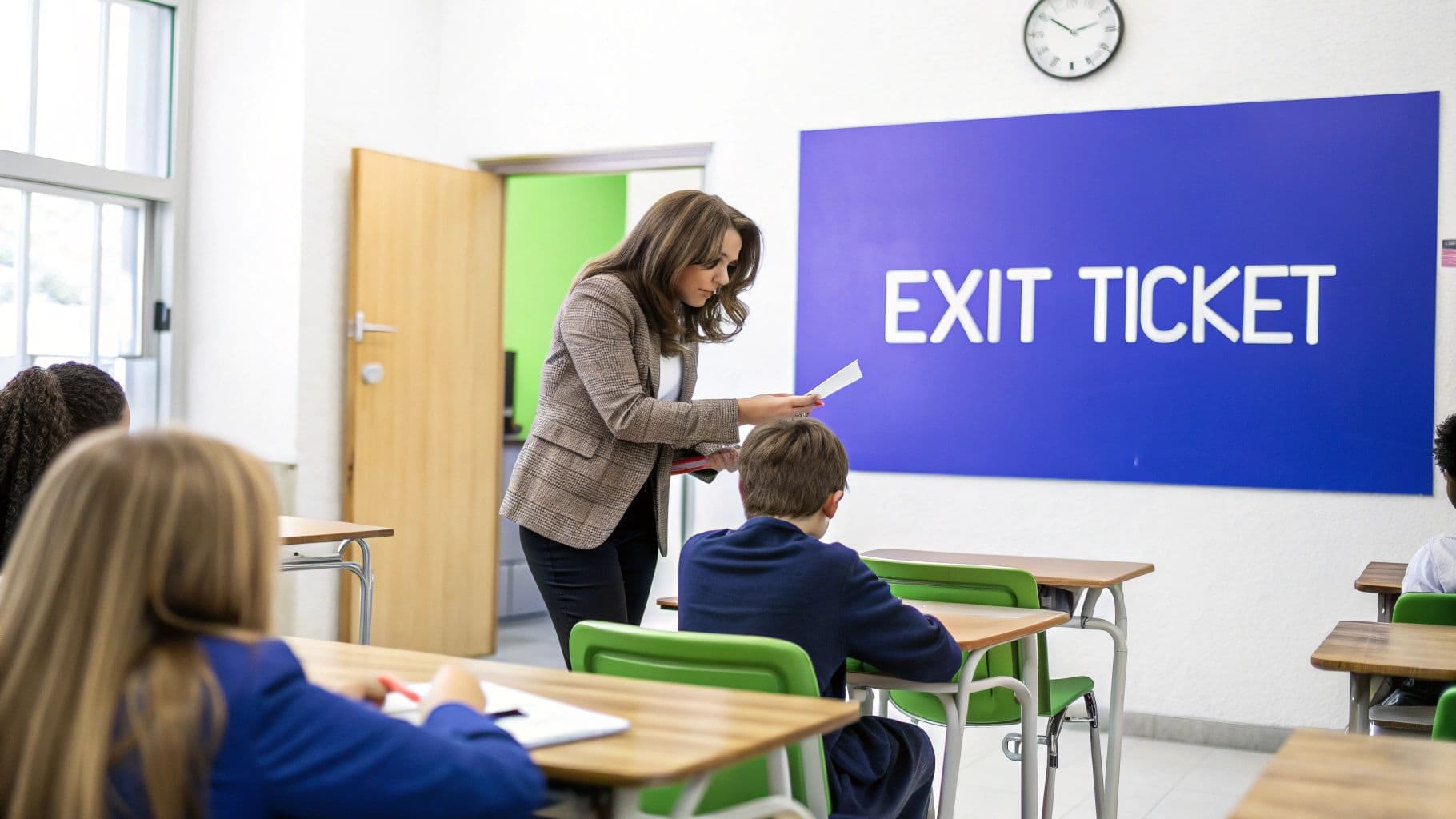
This technique captures immediate feedback while the material is still fresh, highlighting what was learned and what needs reinforcement. For more structured approaches to quick feedback, exploring various exit survey example templates can provide inspiration for your own exit tickets.
How to Implement Exit Tickets
- Craft a Focused Question: Design 1-3 questions that directly target the lesson's primary learning objective. Avoid minor details.
- Set Clear Expectations: Explain the purpose and process to students. Make it a consistent, low-stakes routine at the end of class.
- Collect and Review Promptly: Gather the responses as students leave. Review them that same day to inform your instructional plan for the next lesson.
Example Exit Ticket Questions
- Elementary Math: Draw a model to solve 3 x 4. What is one thing you still have a question about?
- Middle School ELA: Based on today's reading, what is one adjective you would use to describe the protagonist? Why?
- High School Science: Write the balanced chemical equation from today's lab experiment and explain one potential source of error.
Strategic Tips for Success
- Use Data for Grouping: Sort tickets into piles based on understanding: "Got It," "Almost There," and "Needs Reteaching." Use these piles to form flexible groups for the next day's warm-up or small-group instruction.
- Close the Feedback Loop: Start the next class by addressing a common misconception you observed on the exit tickets. This shows students you value their responses.
- Digitize for Efficiency: Use tools like Google Forms or Socrative to automate collection and analysis, making it easier to track student progress over time.
2. Observation and Anecdotal Notes
Observation and anecdotal notes involve teachers systematically watching students during classroom activities and recording specific, objective notes about their academic progress, skills, and behaviors. This formative assessment example provides rich, qualitative data that standardized tests cannot capture, offering deep insights into a student's learning process, problem-solving strategies, and collaborative skills. It allows educators to track growth over time and provide highly targeted support.
This method moves beyond right-or-wrong answers to understand the how and why behind student learning. It is particularly effective for assessing complex skills like critical thinking, communication, and perseverance. For those looking to refine their approach, understanding various data collection methods can provide a structured framework for classroom observations.
How to Implement Observation and Anecdotal Notes
- Define a Clear Focus: Decide what specific skill or standard you are observing for in a given lesson. It could be academic (e.g., using a specific math strategy) or behavioral (e.g., contributing to group discussion).
- Choose a Recording System: Use a method that works for you, such as sticky notes, a dedicated notebook with sections for each student, a clipboard with a class roster, or a digital app.
- Record Objective Evidence: Write down exactly what you see and hear, not interpretations. Instead of "struggling with fractions," write "Used incorrect denominator when adding 1/2 and 1/4."
- Review Notes Regularly: Set aside time weekly to analyze your notes, identify patterns, and use the insights to plan future lessons, form small groups, or conference with students.
Example Anecdotal Notes
- Primary Literacy: Maria blended CVC words (/c/ /a/ /t/) independently today during center time. Previously needed prompting.
- Middle School Science: During the lab, Group B did not assign roles and argued over materials. Will model collaborative roles tomorrow.
- High School History: James cited specific evidence from the primary source document to support his argument in the Socratic seminar.
Strategic Tips for Success
- Focus on a Few Students Daily: Instead of trying to observe everyone at once, focus on 5-6 students per day. This makes the process more manageable and ensures you gather meaningful data on every student over the week.
- Use Checklists and Shorthand: Create simple checklists for target behaviors or skills to make recording faster. Develop a personal shorthand (e.g., "Ind." for independent work, "w/P" for with partner) to capture notes quickly during active instruction.
- Connect Notes to Action: The power of observation is in the response. Use your notes to provide immediate feedback, adjust your lesson on the fly, or plan targeted support for the next day.
3. Think-Pair-Share
Think-Pair-Share is a structured collaborative protocol where students first think individually about a question or problem, then discuss their thinking with a partner, and finally share their ideas with the larger group. This process moves students from silent reflection to small-group discourse and then to whole-class discussion, providing multiple opportunities for teachers to check for understanding. As a formative assessment example, it reveals student thought processes in a low-stakes, engaging manner.
This technique activates prior knowledge and gives all learners, including quieter students, a chance to formulate and articulate their ideas before presenting to the class. For more inspiration on collaborative protocols, you can explore various student-centered learning activities.
How to Implement Think-Pair-Share
- Pose a Thoughtful Prompt: Ask an open-ended question that requires critical thinking, not just a simple recall of facts.
- Provide Silent Think Time: Give students at least 1-2 minutes of quiet, individual time to process the question and gather their thoughts.
- Facilitate Partner Discussion: Instruct students to turn to a predetermined partner and share their ideas. Circulate to listen in on these conversations.
- Lead a Whole-Group Share: Call on several pairs to share their combined ideas or key takeaways with the entire class, recording main points on the board.
Example Think-Pair-Share Prompts
- Elementary Math: Think about two different ways to solve 47 + 25. Turn to your partner and explain your strategies.
- Middle School Social Studies: Based on the primary sources we read, what was the most significant challenge for pioneers on the Oregon Trail? Discuss your reasoning with your partner.
- High School Science: Individually, brainstorm why plants need sunlight for photosynthesis. Pair up and refine your explanation, including the key chemical inputs and outputs.
Strategic Tips for Success
- Circulate and Listen: The "pair" phase is your primary data collection opportunity. As you walk around, listen for common misconceptions, strong arguments, and student vocabulary usage to gauge understanding.
- Use Sentence Starters: Provide scaffolds like "I think... because..." or "I agree with you, and I'd like to add..." to support academic language and guide productive partner conversations.
- Vary the "Share": Instead of having pairs report out, ask them to share one new idea they heard from their partner. This promotes active listening and validates every student's contribution.
4. Questioning and Probing Responses
Strategic questioning during instruction is a dynamic, real-time formative assessment example that uncovers student thinking on the spot. Instead of just asking for recall, teachers use open-ended, higher-order questions that require students to explain their reasoning, justify their answers, and make connections. This approach transforms a simple Q&A into a rich source of data about student comprehension and critical thinking skills.
Probing questions like, "What makes you say that?" or "Can you give me an example?" are essential follow-ups. They push students beyond surface-level answers, revealing the depth and accuracy of their understanding. This immediate feedback loop allows teachers to address misconceptions or extend learning in the moment.
How to Implement Questioning and Probing
- Plan Key Questions: Before the lesson, identify 3-5 essential, higher-order questions that align directly with your learning objectives.
- Increase Wait Time: After asking a question, pause for at least 3-5 seconds before calling on a student. This crucial pause gives all students time to process and formulate a thoughtful response.
- Probe Deeper: After a student responds, use follow-up questions to encourage elaboration. Ask them to clarify their thinking, provide evidence, or connect their idea to something else.
Example Questions
- Elementary Social Studies: Initial Question: "What was one rule the colonists disliked?" Probing Follow-up: "Why did that rule make them feel that way? What part of their lives did it affect most?"
- Middle School Science: Initial Question: "What did you observe during the experiment?" Probing Follow-up: "What evidence from your observation supports your conclusion? What might happen if we changed one variable?"
- High School Literature: Initial Question: "What is a major theme in this chapter?" Probing Follow-up: "Can you point to a specific quote that illustrates that theme? How does the author's word choice reinforce it?"
Strategic Tips for Success
- Use Question Stems: Keep a list of generic probing stems handy (e.g., "How do you know?", "What is the evidence for...?", "Can you explain that in another way?"). This helps make probing a natural part of your teaching routine.
- Track Response Patterns: Keep a brief anecdotal record of student responses. Note common misconceptions or areas where thinking is shallow to inform future whole-class or small-group instruction.
- Call on Non-Volunteers: Use a randomized system like popsicle sticks or a digital name selector to ensure all students have an opportunity to participate. This provides a more accurate picture of whole-class understanding.
5. Peer Assessment and Feedback
Peer assessment is a collaborative strategy where students evaluate each other's work based on specific success criteria. This process empowers students to become active participants in their learning, developing their ability to recognize quality, apply standards, and offer constructive criticism. As a formative assessment example, it provides the teacher with rich data on how well the entire class has internalized learning targets, while also fostering metacognitive skills in students.

This method transforms assessment from a top-down evaluation into a reciprocal learning conversation. When students analyze a peer's work, they must retrieve and apply their knowledge of the success criteria, which reinforces their own understanding and highlights any gaps they may have.
How to Implement Peer Assessment
- Establish Clear Criteria: Co-create or provide a simple, focused rubric or checklist with 2-3 specific "look-fors." Students must know exactly what quality looks like before they can identify it.
- Model the Process: Use a sample piece of work (an "exemplar" or an anonymous student example) and model how to give "kind, helpful, and specific" feedback using the rubric and sentence starters.
- Facilitate the Exchange: Structure the time for students to review work and provide feedback. Give them clear instructions on how they will share their thoughts, whether through sticky notes, a digital comment, or a structured conversation.
Example Peer Assessment Prompts
- Elementary Writing: Use a green crayon to highlight one "wow" word your partner used. Use a yellow crayon to highlight a sentence where they could add more detail.
- Middle School Math: Check your partner's work on problem #3. Did they show all their steps? Is their final answer circled? Use the checklist to mark 'yes' or 'not yet.'
- High School Social Studies: Review your peer's presentation outline. Identify their main argument and one piece of evidence that strongly supports it. Suggest one area where more evidence is needed.
Strategic Tips for Success
- Provide Sentence Starters: Equip students with phrases like, "I noticed you did a great job with..." and "I was confused when..." to guide constructive conversations and reduce anxiety.
- Focus on Strengths First: Instruct students to use a "praise sandwich" or a similar protocol where they begin by identifying something the peer did well before suggesting an area for growth.
- Close the Feedback Loop: Require the original author to review the peer feedback and write one sentence explaining how they will use it to improve their work. This ensures the feedback is acted upon.
6. Student Self-Assessment and Goal Setting
Student self-assessment involves students evaluating their own learning against clear success criteria and then setting personal learning goals. This process develops crucial metacognitive skills, helping students recognize their strengths, identify areas for growth, and plan how to improve. This formative assessment example fosters student agency, empowering them to take ownership of their learning journey and track their progress toward meaningful targets.
This technique transforms assessment from something done to students into something done with them. It shifts the focus from performance to learning, building a growth mindset. For a deeper look into structuring these objectives, exploring examples of personal wellbeing goals can offer valuable frameworks for student-centered target setting.
How to Implement Self-Assessment and Goal Setting
- Establish Clear Criteria: Co-create or share explicit learning targets and success criteria in student-friendly language. Make them visible in the classroom.
- Model the Process: Think aloud as you self-assess a sample piece of work against the criteria. Show students how to identify evidence of success and areas for improvement.
- Provide Structured Tools: Use rubrics, checklists, or simple scales (e.g., traffic light colors) to guide students' self-reflection and goal setting.
Example Self-Assessment Prompts
- Elementary ELA: After a writing piece, students complete a "Two Stars and a Wish" reflection, identifying two things they did well (stars) and one goal for next time (wish).
- Middle School Math: Students rate their confidence on a 4-point scale (Not Yet, Developing, Proficient, Advanced) for each "I can..." statement in a unit.
- High School Social Studies: Students write a reflection on their research process: What was my most effective research strategy? Where did I struggle to find information, and what goal can I set to improve next time?
Strategic Tips for Success
- Start Simple: For younger students, begin with non-verbal cues like thumbs up/sideways/down to indicate understanding before moving to more complex rubrics.
- Schedule Conferences: Hold brief, regular check-in conferences with students to discuss their self-assessments and help them set realistic, actionable goals.
- Create Visual Trackers: Use charts or graphs where students can visually track their progress toward their goals. This makes growth tangible and motivating.
- Celebrate Progress: Acknowledge and celebrate the effort and progress students make toward their goals, not just the final achievement. This reinforces a positive learning culture.
7. Concept Mapping and Graphic Organizers
Concept mapping and other graphic organizers are visual tools that help students articulate relationships between ideas and concepts. Students create diagrams like webs, Venn diagrams, or KWL charts to externalize their thinking, revealing how they organize knowledge and understand complex systems. This formative assessment example provides a clear window into a student's cognitive structure, making their understanding (or misunderstanding) visible to the teacher.
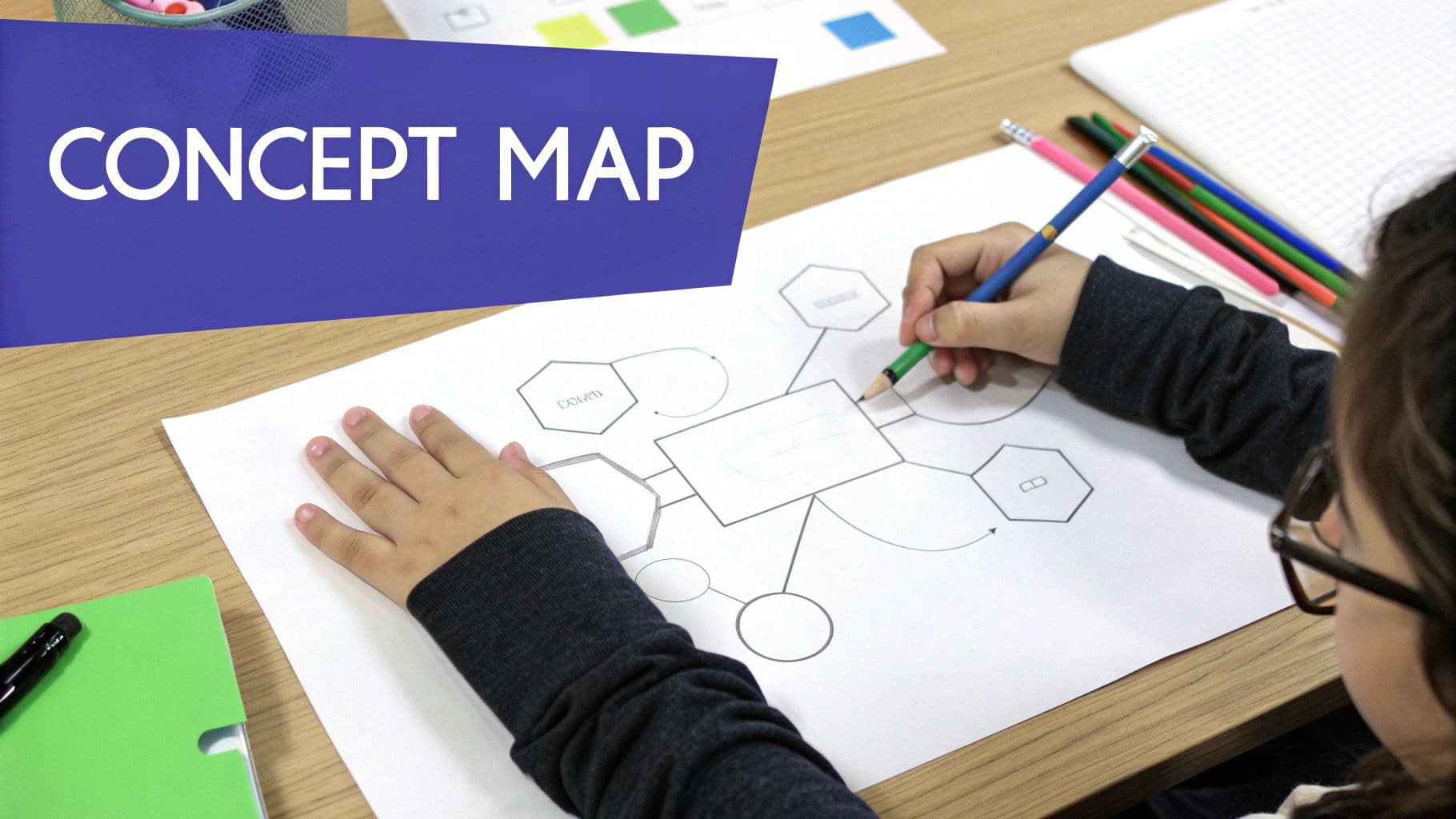
These visual artifacts function as both a learning activity and an assessment tool. By analyzing the connections students make, teachers can pinpoint where comprehension is strong and where it breaks down, guiding targeted support. For educators looking to create professional-looking templates, tools like Lucidchart offer a variety of digital graphic organizers.
How to Implement Concept Mapping
- Introduce the Format: Model how to create a specific graphic organizer. Start with a familiar topic and think aloud as you place concepts and draw connecting lines or arrows.
- Provide a Central Concept: Give students a main idea, term, or question to place at the center of their map. This provides a clear starting point.
- Encourage and Review: Let students work individually or in pairs to build their maps. Circulate to observe their process, ask probing questions, and review the final products for conceptual accuracy.
Example Graphic Organizer Prompts
- Elementary Science: Create a concept map showing the relationships between a producer, consumer, and decomposer in a forest ecosystem.
- Middle School Social Studies: Use a Venn diagram to compare and contrast the governments of Ancient Athens and Sparta.
- High School ELA: Develop a character trait web for the protagonist, using specific evidence from the text to support each trait you list.
Strategic Tips for Success
- Start Structured: Begin with highly structured organizers like KWL charts or Venn diagrams before moving to more open-ended concept maps. Provide templates to reduce cognitive load initially.
- Assess the Connections: The real data is in the links students create. Look at the connecting phrases they write on the lines between concepts. Are the relationships logical and accurate?
- Use as a Pre-Assessment: Have students create a concept map at the start of a unit to activate prior knowledge. Revisit and have them revise the same map at the end to demonstrate growth.
8. Diagnostic Quizzes and Pre-Assessments
Diagnostic quizzes, or pre-assessments, are short, low-stakes evaluations given before a new unit or lesson begins. They are designed to assess students' prior knowledge, uncover existing misconceptions, and establish a baseline of understanding. Unlike a graded test, the primary purpose of this formative assessment example is to inform instruction by revealing what students already know and where potential learning gaps exist, allowing teachers to tailor their upcoming lessons effectively.
This technique provides a clear roadmap for differentiation before instruction even starts. For a modern approach to checking understanding and identifying learning gaps, consider leveraging tools that help you efficiently create online quizzes from your existing materials.
How to Implement Diagnostic Quizzes
- Identify Prerequisite Skills: Determine the essential prior knowledge and skills required for students to succeed in the upcoming unit.
- Design Targeted Questions: Create a brief quiz with questions that directly address these prerequisite skills and potential common misconceptions.
- Administer and Analyze: Give the quiz in a low-pressure environment, explaining that it is not for a grade but to help you teach better. Analyze the results to identify patterns in student readiness and misconceptions.
Example Diagnostic Quiz Questions
- Elementary Math: Before a fractions unit, show four different shapes and ask students to circle the one that is divided into fourths.
- Middle School ELA: Before a poetry unit, ask students: What is the difference between a simile and a metaphor? Provide an example of each.
- High School Social Studies: Before a unit on the U.S. Constitution, ask: List one right protected by the First Amendment.
Strategic Tips for Success
- Use Data for Differentiation: Analyze the results to form flexible groups for targeted instruction. Students who show mastery might receive an extension activity, while others get foundational support.
- Address Misconceptions Head-On: Use the data to create anchor charts or opening activities that explicitly tackle common errors you observed on the pre-assessment.
- Show Growth Over Time: Revisit a key question from the pre-assessment at the end of the unit. This helps students see and celebrate their own learning and growth.
9. Student Conferences and Interviews
Student conferences and interviews are structured, one-on-one conversations that allow teachers to gain deep, personalized insights into a student's thinking, progress, and learning needs. This formative assessment example moves beyond written work to uncover the "why" behind a student's answer, revealing their reasoning, confidence levels, and specific misconceptions in a supportive dialogue. It provides a rich, qualitative view of student understanding that a quiz or worksheet cannot capture.
This technique is powerful because it personalizes the assessment process, fostering a stronger teacher-student relationship and empowering students to articulate their learning journey. It helps teachers understand not just what a student knows, but how they know it and where they need to go next.
How to Implement Student Conferences
- Schedule Consistently: Plan for brief, regular check-ins with a few students each day or week, rather than infrequent, long meetings. Make it a normal part of the classroom routine.
- Come with a Focus: Have a clear goal for the conference, such as checking in on a specific skill, discussing a recent assignment, or setting a new goal. Use open-ended questions to guide the conversation.
- Document Key Takeaways: Keep a concise anecdotal record for each student. Note their strengths, areas for growth, and any specific goals set during the conversation to inform future instruction.
Example Conference Questions
- Elementary Reading: Tell me about the character in your book. What problem are they trying to solve? What do you predict will happen next?
- Middle School Math: Walk me through how you solved problem #5. Why did you decide to use that strategy first? Is there another way you could have solved it?
- High School Writing: What is the main idea you want your reader to understand in this paragraph? Read it aloud and tell me if it sounds the way you intended.
Strategic Tips for Success
- Listen More, Talk Less: Aim for the student to do at least 70% of the talking. Use wait time and follow-up questions like "Can you tell me more about that?" to encourage deeper thinking.
- Start with Strengths: Begin the conversation by noticing and naming something the student is doing well. This builds trust and makes them more receptive to feedback on areas for improvement.
- Set a Collaborative Goal: End the conference by collaboratively identifying one clear, actionable next step. For example, "For your next piece of writing, let's focus on using more descriptive verbs." This gives the student a clear target for their learning.
10. Portfolio Assessment and Student Work Samples
Portfolio assessment involves a systematic, purposeful collection of student work over time that demonstrates growth, effort, and achievement. Unlike a single-point assessment, a portfolio provides a rich, multidimensional view of a student's learning journey, including drafts, final products, and self-reflections. This formative assessment example captures the process of learning, not just the final outcome, making it an invaluable tool for tracking progress toward mastery.
This method empowers students to take ownership of their learning by selecting pieces and reflecting on their progress. It provides concrete evidence of development for students, teachers, and families, fostering meaningful conversations about learning.
How to Implement Portfolio Assessment
- Define the Purpose and Criteria: Clearly establish the learning goals the portfolio will track. Decide with students what types of work samples will be included (e.g., drafts, projects, tests, reflections).
- Organize Systematically: Use a physical binder with dividers or a digital tool like Google Sites, SeeSaw, or a dedicated portfolio platform. Ensure every entry is dated and includes context.
- Schedule Regular Review and Reflection: Set aside time for students to review their portfolios, select new pieces, and write reflections on why they chose an item and what it shows about their learning.
Example Portfolio Entries
- Elementary Writing: A collection of dated writing samples from September, January, and May showing growth in sentence structure and vocabulary, each with a student's reflection on their improvements.
- Middle School Math: A series of problem-solving tasks showing how a student's approach to multi-step equations evolved, including notes on mistakes and corrected strategies.
- High School Art: Digital photos documenting the stages of a sculpture project, from initial sketches to the final piece, accompanied by an artist's statement explaining creative choices.
Strategic Tips for Success
- Balance Selections: Include a mix of student-selected "best work" pieces and teacher-selected items that demonstrate growth in a specific skill area.
- Make it a Conference Tool: Use the portfolio as the centerpiece for student-led conferences with parents. This allows students to articulate their learning journey using tangible evidence.
- Focus on Reflection: The most powerful part of the portfolio is the student's metacognition. Provide sentence starters or templates to guide students in reflecting on their work and setting future goals.
Formative Assessment: 10-Point Comparison
| Technique | Implementation Complexity 🔄 | Resource & Time Requirements ⚡ | Expected Outcomes 📊 | Ideal Use Cases 💡 | Key Advantages ⭐ |
|---|---|---|---|---|---|
| Exit Tickets | Low — simple routine to implement 🔄 | Low — 2–5 min; paper or digital; grading time required ⚡ | Quick snapshot of individual mastery; immediate gaps identified 📊 | End-of-lesson checks; reteach planning 💡 | Fast, actionable feedback; easy to scale ⭐ |
| Observation & Anecdotal Notes | Medium–High — requires observation skill and consistency 🔄 | Moderate–High — ongoing note-taking and synthesis time ⚡ | Rich qualitative data on engagement, process, and behaviors 📊 | Assessing collaboration, soft skills, early grades 💡 | Contextual insights into learning not captured by tests ⭐ |
| Think‑Pair‑Share | Low–Medium — routines and expectations needed 🔄 | Low — 5–15 min; minimal materials ⚡ | Increased engagement; reveals misconceptions via talk 📊 | Quick formative discussion; building academic language 💡 | Boosts participation and peer explanation skills ⭐ |
| Questioning & Probing Responses | High — requires pedagogical questioning skill 🔄 | Very low — no materials; needs wait time and note-taking ⚡ | Deep insight into reasoning and higher‑order thinking 📊 | Whole‑class checks; fostering critical thinking 💡 | Immediate, flexible assessment of thinking quality ⭐ |
| Peer Assessment & Feedback | Medium — needs training and clear criteria 🔄 | Moderate — time to model, practice, and use rubrics ⚡ | Diverse perspectives on work quality; develops evaluative skills 📊 | Draft reviews, writing workshops, collaborative tasks 💡 | Scales feedback and builds metacognition and ownership ⭐ |
| Student Self‑Assessment & Goal Setting | Medium — explicit instruction and routines required 🔄 | Low–Moderate — periodic reflection, trackers, conferences ⚡ | Greater student agency and metacognitive growth over time 📊 | Ongoing progress monitoring; conferences and goal reviews 💡 | Empowers learners; aligns effort to standards ⭐ |
| Concept Mapping & Graphic Organizers | Medium — modeling and scaffolding needed 🔄 | Moderate — templates/tools and creation time ⚡ | Makes conceptual relationships visible; uncovers misconceptions 📊 | Teaching complex ideas, planning, ELL supports 💡 | Externalizes thinking; aids synthesis and retention ⭐ |
| Diagnostic Quizzes & Pre‑Assessments | Low–Medium — design affects validity 🔄 | Low — 5–10 min; analysis may require extra time ⚡ | Prior‑knowledge snapshot to guide starting point and grouping 📊 | Unit starters; placement and differentiation decisions 💡 | Quickly informs instruction and targeted support ⭐ |
| Student Conferences & Interviews | High — dialogue skill and consistency required 🔄 | High — 5–20 min per student; scheduling burden ⚡ | Nuanced view of reasoning, motivation, and affective barriers 📊 | Personalized feedback, goal setting, intervention planning 💡 | Deep diagnostic insight and relationship building ⭐ |
| Portfolio Assessment & Work Samples | High — requires clear protocols and curation 🔄 | High — ongoing collection, organization, and review time ⚡ | Longitudinal evidence of growth, mastery, and reflection 📊 | Reporting growth, family conferences, capstone evidence 💡 | Comprehensive, authentic record of student progress ⭐ |
Putting It All Together: Your Next Steps for Smarter Assessment
Throughout this guide, we've explored a comprehensive toolkit of ten powerful formative assessment examples, from the quick pulse-check of an Exit Ticket to the in-depth dialogue of a Student Conference. Each strategy serves a unique purpose, but they all share a common, transformative goal: to make student learning visible, moment by moment, so you can adapt your instruction in real time. The journey from simply teaching content to responsively guiding learning begins with the intentional and consistent use of these techniques.
Moving beyond theory and into practice is the most critical step. Remember, the power of these tools isn't in their complexity, but in the insights they provide. An observation of a student's struggle with a concept map is not just a data point; it's a direct signal to reteach a key connection. A self-assessment showing a student's lack of confidence is an invitation to provide targeted support and encouragement. This is the essence of formative practice: gathering information not for a gradebook, but to inform your very next instructional move.
From Examples to an Ecosystem of Assessment
The most effective classrooms don't just use one or two of these strategies in isolation. Instead, they weave them together to create a continuous feedback loop, building a culture where assessment is seen as a supportive part of the learning process, not a final judgment.
- Start Small, Build Momentum: Don't feel pressured to implement all ten examples at once. The key is sustainable change. Select one or two strategies that resonate with your teaching style and your students' immediate needs. Perhaps start with a weekly Think-Pair-Share to boost engagement or use simple diagnostic quizzes before each new unit.
- Focus on the "Why": The purpose of every formative check is to answer a specific question about student learning. Before you hand out a graphic organizer or start an observation, ask yourself: What specific skill or concept am I trying to understand better? What will I do with this information tomorrow?
- Make it Routine: Consistency is crucial. When Exit Tickets or peer feedback become a regular part of your classroom routine, students understand their purpose and become more skilled at providing meaningful responses. This predictability reduces anxiety and maximizes the quality of the feedback you receive.
By embedding these practices, you shift the classroom dynamic. Students become active participants in their own learning journey, using tools like self-assessment and goal setting to take ownership. The classroom becomes a more responsive, agile, and ultimately more effective environment for every single learner.
The True Value of Formative Assessment
Mastering these formative assessment examples is not about becoming a data-collection expert. It's about becoming a more insightful, responsive, and impactful educator. The value lies in the conversations that a Student Conference sparks, the misconceptions that a Concept Map reveals, and the confidence a student gains through targeted, actionable feedback. These strategies empower you to move from assumption to evidence, ensuring that your instructional time is spent exactly where it's needed most.
The ultimate benefit is a classroom where no student is left behind because their struggles are identified early and addressed promptly. It's a classroom where learning is a dynamic dialogue, not a static monologue. As you begin to integrate these formative assessment examples into your daily practice, you are not just checking for understanding; you are actively building a foundation for deeper, more durable learning for all.
Ready to streamline your assessment process and reclaim your time? Kuraplan helps you instantly generate standards-aligned questions, rubrics, and templates for these formative assessment examples, so you can focus less on prep and more on responding to student needs. Explore how Kuraplan can transform your instructional planning today.