Disciplinary literacy is all about teaching students to read, write, and think like an expert in a specific field—whether that’s a scientist, a historian, or a mathematician. It goes way beyond generic reading skills, giving students the specialized tools they need to understand how knowledge is created and shared in each subject.
More Than Just Reading the Words
Ever notice how a historian and a scientist can look at the same document and see completely different things? That's because every academic discipline is its own little world, with its own language and rules.
A historian might question a primary source, digging for bias and perspective. A scientist, on the other hand, will scan a lab report for methodology and data. They aren't just reading words on a page; they're using a specific lens to make sense of the information.
Disciplinary literacy is about explicitly teaching our students these "insider" ways of thinking. It’s the difference between asking a student to simply summarize a chapter on the American Revolution and teaching them to ask, "Who wrote this, and whose voice is missing?" It's about showing them how to read a math problem not just for numbers, but for the underlying logic—just like a mathematician would.
Why This Shift Matters
This approach really took hold in the U.S. around 2010 with the adoption of the Common Core State Standards. By 2020, over 80% of U.S. states had woven disciplinary literacy into their K-12 standards. Why the big push? Because educators realized that true learning is more than just memorizing facts. You can find more details on how each discipline uses its own methods of inquiry on Wikipedia.
Ultimately, it helps students:
- Think Critically: They learn how to weigh evidence, spot bias, and build arguments that make sense within a particular subject.
- Engage Authentically: Students stop being passive sponges for information and start becoming active creators of knowledge.
- Build Deeper Understanding: They don’t just learn facts; they understand the story behind how those facts came to be.
This focus on teaching specific thinking skills is one of many powerful evidence-based teaching practices. We're not just asking students to learn the content; we're inviting them to join the academic conversation. It’s a game-changer that prepares them for the complex thinking they'll need in college and their future careers.
Content Area Literacy vs Disciplinary Literacy
As teachers, we’ve heard both terms floating around, but they’re definitely not interchangeable. Getting the difference between content area and disciplinary literacy is a total game-changer for instruction because it completely reframes what we ask students to do with a text.
Think of content area literacy as a universal toolkit. It’s full of those trusty, all-purpose strategies we know and love, like summarizing, busting out a KWL chart, or finding the main idea. These skills are super useful and work pretty well no matter the subject. A student can summarize a chapter on photosynthesis using the same basic skills they'd use for a chapter on the Civil War.
Disciplinary literacy, on the other hand, gives students a specialized, expert toolkit for each subject. It's about teaching them to use the specific tools a historian, a scientist, or a mathematician would actually use. Instead of just summarizing a text, students learn to approach it like an insider.
This is all about shifting from general comprehension to discipline-specific thinking.
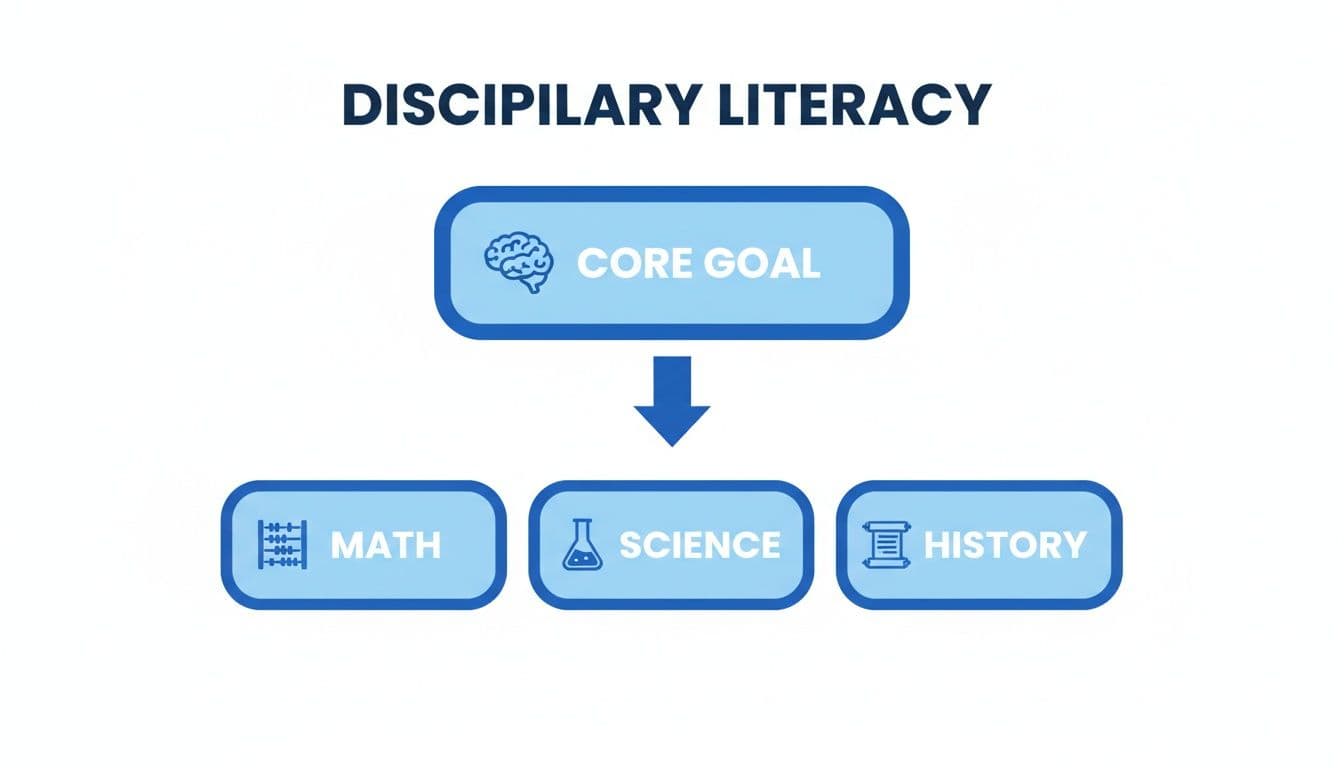
As the diagram shows, the core goal—thinking like an expert—looks very different in math than it does in science or history. Each field has its own language, rules, and ways of making sense of the world.
From General Skills to Expert Practices
While those general tools from content area literacy are a great starting point, they often don’t cut it when texts get more complex and specialized. Students need to move beyond just "getting through" the material to genuinely engaging with it. Disciplinary literacy is the bridge that gets them there.
The goal is to move students from being passive consumers of information to active participants in the discipline. They learn not just what we know, but how we know it.
This shift makes a huge difference. Research shows that disciplinary literacy instruction can improve content mastery by 25% more than generic reading strategies. It’s the difference between asking a student for a 20-word summary of the Great Wall and tasking them with debating its effectiveness as a defense strategy, using evidence just like a historian would. You can find more insights on these instructional impacts over on Savvas.com.
Of course, making this shift happen requires intentional planning. Designing lessons that teach these specialized thinking skills takes time and careful thought. This is where a tool like Kuraplan can be a massive help, allowing you to quickly build out lesson plans that embed these subject-specific skills, align them with your standards, and save you precious prep time.
How Disciplinary Literacy Looks in Your Subject
Alright, let's get into the fun part—seeing what disciplinary literacy actually looks like in the classroom. This is where theory hits the ground running.
When we say "think like an expert," what does that really mean for a tenth-grade history student or a seventh-grade math whiz?

It means equipping them with a unique lens for each subject. We're moving them beyond just finding facts to truly understanding how knowledge is built in that field. Let's break it down by discipline.
In Social Studies and History Class
Historians are basically detectives. Their job isn’t just to read a document but to interrogate it.
A social studies class buzzing with disciplinary literacy is one where students learn to source and corroborate evidence. They don’t just read a letter from a soldier; they ask critical questions:
- Who wrote this and why? What was their motivation?
- What is their bias? How does their perspective shape this account?
- How does this account compare to others? Is this the whole story?
This approach uses specific practices like the inquiry cycle—questioning, researching, analyzing, and communicating. Since 2014, Wisconsin has mandated this as part of its social studies instruction, requiring teachers to help students evaluate sourcing and bias.
A student learns to read the 1863 Gettysburg Address with a different lens than they would a modern news article because they understand how authorship and context shape what is presented as 'truth.' You can explore more about these state-level implementations and classroom resources from the Wisconsin Department of Public Instruction.
In the Science Lab
Scientists read with a healthy dose of skepticism. They aren't just looking for the conclusion of an experiment; they want to know how that conclusion was reached.
In a science classroom, this means teaching students to read a lab report or scientific article by focusing on:
- Methodology: Was the experiment designed well? Are there flaws?
- Data and Evidence: Do the numbers actually support the claim being made?
- Replication: Could someone else repeat this experiment and get the same results?
Instead of just absorbing findings, students learn to critique the process. They move from asking "What happened?" to "How do we know this happened, and can we trust it?"
For the ELA Classroom
This might seem like home base for literacy, but disciplinary literacy in ELA is about more than just comprehension. It’s about reading like a writer and a literary critic.
Students learn to analyze an author's craft and rhetorical choices. They don't just identify a metaphor; they ask why the author chose that specific metaphor and what effect it creates for the reader.
They learn to deconstruct arguments to see exactly how a writer builds a persuasive case, piece by piece. You can dive deeper into these strategies in our comprehensive guide to teaching ELA effectively.
In the World of Arts and Beyond
Disciplinary literacy isn’t just for core subjects. It works everywhere.
In an art class, "reading" a painting means understanding its composition, symbolism, and historical context. Many disciplines also use specific ways of processing information. For example, understanding how different subjects use visual learning can deepen comprehension of disciplinary texts like charts in science or maps in history.
The goal is always the same: give students the tools to engage with the subject as an insider, not just an observer.
Bringing Disciplinary Literacy into Your Classroom
So, how do we move from understanding what disciplinary literacy is to actually doing it? This is where the rubber meets the road. The good news is you don't need to overhaul your entire curriculum overnight.
Starting with a few high-impact, low-prep strategies can make a world of difference. The goal is to make expert thinking visible. We need to pull back the curtain and show students the specific mental moves that historians, scientists, and mathematicians make when they encounter a text in their field.

Modeling Expert Thinking with Think-Alouds
One of the most powerful and immediate strategies is the think-aloud. This is where you, the content expert, read a complex text aloud and narrate your internal thought process for your students.
Instead of just reading a primary source, you'd pause and say things like, "Okay, the date on this letter is 1862. That's right in the middle of the Civil War, so I'm already thinking about the author's potential biases." You're showing them how to read like a historian, not just telling them to.
Try This Tomorrow:
Choose a short, challenging paragraph from your textbook or a primary document. Read it aloud to your class, stopping at least three times to model your thinking. Point out where you get confused, what questions pop into your head, and how you use context clues to make sense of it all.
Structuring Authentic Academic Conversations
Disciplinary literacy thrives on dialogue and debate. Experts in any field don't work in a vacuum; they question, challenge, and build on each other's ideas. We can bring this into our classrooms with structured protocols.
Structured Academic Controversy (SAC): This is perfect for social studies and science. Students work in teams to argue both sides of a controversial issue, using evidence to support their claims before seeking consensus. It teaches them that complex issues rarely have simple answers.
Document-Based Questions (DBQs): A cornerstone of history instruction, DBQs require students to analyze a set of documents to build an evidence-based argument that answers a central historical question. This moves them from finding information to constructing an interpretation.
Data Analysis Protocols: In math and science, provide a graph, chart, or data set and ask students to work through a simple protocol: "What do you notice? What do you wonder?" This simple framework invites them to think like analysts, identifying patterns and formulating questions before jumping to conclusions.
These strategies shift the focus from students passively receiving information to actively constructing knowledge. They learn that answers aren't just found in a book—they are built with evidence and reasoning.
Creating materials for these deep-thinking tasks, like rubrics for a SAC or graphic organizers for a DBQ, can be time-consuming. This is a great place to use an AI assistant like Kuraplan, which can generate standards-aligned resources tailored to these tasks in minutes.
If you're looking for more ways to structure your units around these big ideas, check out our guide on backwards design lesson planning. It's a perfect complement to implementing these strategies.
Assessing Skills and Supporting Every Learner
So, how do you actually know if your students are starting to think like historians or scientists? Your go-to multiple-choice quiz probably isn’t going to cut it. That kind of assessment just doesn’t capture the deep, disciplinary thinking we’re aiming for.
This is where we need to get creative with our assessments to match our new instructional goals. Meaningful assessment in disciplinary literacy isn't about right-or-wrong answers; it's about seeing the process—how students build arguments, analyze evidence, and communicate within a specific subject.
Moving Beyond Traditional Tests
To really see these skills in action, we need to give students tasks that let them practice being the expert. Think of these performance-based assessments as windows into their thinking.
Instead of a standard test on the Civil War, you could challenge students with a more authentic task:
- Performance Task: Ask them to write a letter from the perspective of a soldier, using evidence from at least three different primary sources to support their viewpoint.
- Analytical Rubric: Create a rubric that grades not just for historical accuracy but for the quality of their source analysis and evidence-based arguments.
- Student Portfolios: Have students collect their work over a unit—like their analyses of different political cartoons—to show how their ability to identify bias and perspective has grown over time.
This approach makes assessment a genuine part of the learning journey, not just a final judgment. It values the messy, critical work of thinking like an expert.
Differentiation and Support for All Learners
Teaching students to think in entirely new ways means we also need to provide the right scaffolds to help them get there. Disciplinary literacy is for every learner, and differentiation is the key to making it accessible.
Even simple supports can make a huge impact:
- Sentence Starters: Provide helpful stems like, "The author's perspective might be biased because..." or "The data suggests that..."
- Graphic Organizers: Use templates designed for specific skills, like a sourcing tool for history or a lab report outline for science.
- Collaborative Structures: Try a think-pair-share or small group discussions to let students practice disciplinary conversations in a low-stakes setting.
The goal isn’t to lower the bar but to build a sturdy ladder so every student can reach it. By providing the right tools, we empower them to engage in complex thinking.
To effectively support all students in mastering disciplinary texts, consider exploring various forms of assistive technology for reading. These tools can be a game-changer for students who need that extra boost.
Of course, creating leveled texts, varied graphic organizers, and custom rubrics for every single student can feel like a monumental task. This is where an AI assistant like Kuraplan can be a true partner. It instantly generates differentiated lesson plans and resources that help you meet every student's needs without spending your entire weekend planning.
Got Questions About Disciplinary Literacy? Let's Unpack Them.
Anytime we're asked to shift our instruction, a healthy dose of skepticism is natural. Is this just another trend? Where does this even fit into my math class? It’s easy to feel like it’s just one more thing on an already-full plate.
Let's clear the air and tackle some of the most common questions teachers have about disciplinary literacy.
Is This Just Another Educational Fad?
Totally fair question. We've all seen buzzwords come and go.
But disciplinary literacy isn't a flash in the pan. It’s a research-backed approach that’s been baked into standards like the CCSS and NGSS for a reason: it’s about teaching students to think like experts in the field.
Think of it less as a trend and more as a fundamental shift toward authentic learning. It’s about preparing kids for the real-world thinking required in college and careers. This one’s here to stay.
I Teach Math, Not Reading. How Does This Apply to Me?
This is a big one, and not just for math teachers. The key is to reframe what "literacy" means in your classroom. It isn't about shoehorning reading lessons into your algebra block.
It’s about teaching students how to read, write, and communicate mathematically.
You’re already doing this when you ask students to:
- Decipher the precise language in a word problem.
- Logically explain the steps of a proof.
- Use symbols and diagrams to convey complex ideas.
- Critique a classmate's reasoning and find the flaw in their logic.
The only real change is being more intentional about teaching these skills as part of "doing math." You’re not a reading teacher; you’re teaching the language of your discipline.
How Can I Start Without Overwhelming Myself or My Students?
Start small. Seriously. You don't need to throw out your entire curriculum and start over. Gradual, focused implementation is the name of the game.
Pick one upcoming unit and try one new thing. Maybe you model a "think-aloud" while analyzing a primary source document in history class. Or you introduce a specific protocol for how to interpret a new graph in science.
The goal is progress, not perfection. A small, successful change in one unit is far more powerful than a massive, overwhelming overhaul that never gets off the ground.
This is also a great time to lean on modern tools. An AI lesson planner like Kuraplan can help you build a single worksheet focused on a specific disciplinary skill, saving you hours of prep time.
What’s the Difference Between This and Close Reading?
Great question—they're definitely related. The easiest way to think about it is that close reading is a foundational tool inside the larger disciplinary literacy toolbox.
Close reading teaches students to analyze a text carefully—to see what an author says and how they say it. Disciplinary literacy adds another layer by asking discipline-specific questions.
For instance:
- A historian close reading a letter also asks: Who wrote this? What was their bias? Does this corroborate other sources?
- A scientist close reading a study also asks: What was the methodology? Is the sample size large enough? Can these results be replicated?
Close reading is the magnifying glass. Disciplinary literacy is the expert holding it, knowing exactly what details to look for.
Ready to bring these powerful strategies into your classroom without adding hours to your prep time? Kuraplan is an AI-powered lesson planner that helps you instantly create standards-aligned lessons, differentiated worksheets, and custom visuals for any subject. Join over 30,000 teachers who are reclaiming their time and elevating their instruction. Start planning smarter, not harder, at https://kuraplan.com.