Bridge Building STEM Packet
A free stem worksheet ready for your classroom. Open in Kuraplan to grab the print-ready PDF, customize it for your students, or generate a fresh version in seconds.
Bridge Building STEM Packet
📖 Part 1: Bridge Engineering Through History
Learning Goals:
I can identify different types of bridges and explain how engineering has evolved over time.
I can analyze the relationship between bridge design and the materials available in different time periods.
Reading Passage: The Evolution of Bridge Engineering
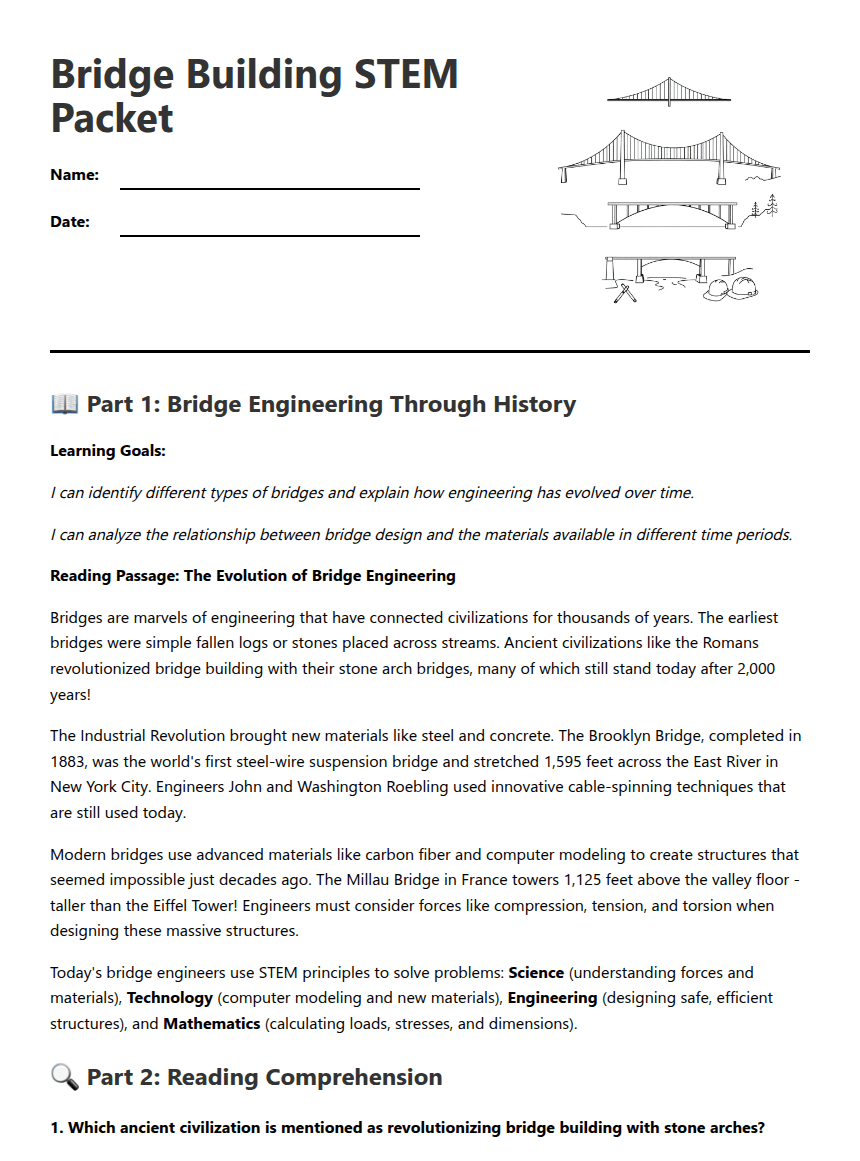
Bridges are marvels of engineering that have connected civilizations for thousands of years. The earliest bridges were simple fallen logs or stones placed across streams. Ancient civilizations like the Romans revolutionized bridge building with their stone arch bridges, many of which still stand today after 2,000 years!
The Industrial Revolution brought new materials like steel and concrete. The Brooklyn Bridge, completed in 1883, was the world's first steel-wire suspension bridge and stretched 1,595 feet across the East River in New York City. Engineers John and Washington Roebling used innovative cable-spinning techniques that are still used today.
Modern bridges use advanced materials like carbon fiber and computer modeling to create structures that seemed impossible just decades ago. The Millau Bridge in France towers 1,125 feet above the valley floor - taller than the Eiffel Tower! Engineers must consider forces like compression, tension, and torsion when designing these massive structures.
Today's bridge engineers use STEM principles to solve problems: Science (understanding forces and materials), Technology (computer modeling and new materials), Engineering (designing safe, efficient structures), and Mathematics (calculating loads, stresses, and dimensions).
🔍 Part 2: Reading Comprehension
⚙️ Part 3: STEM Analysis & Bridge Design Challenge
Success Criteria:
• I can explain how at least 3 STEM fields contribute to bridge engineering
• I can design a bridge that addresses specific engineering constraints
• I can justify my design choices using scientific reasoning
Science: ________________________________________________
Technology: ________________________________________________
Engineering: ________________________________________________
Mathematics: ________________________________________________
Explain your design choices:
About This Worksheet
Free in Kuraplan
Sign up free, grab the PDF, and customize it for your class.
Print-Ready
Formatted for standard paper. Clean layout, easy to read.
AI-Generated
Created with Kuraplan's AI, designed for real classroom use.
For Teachers & Parents
Use in classrooms, for homework, tutoring, or homeschool.
Need a custom version of this worksheet?
Kuraplan's AI generates custom worksheets in seconds — differentiated for every learner, aligned to your curriculum.
Generate Custom Worksheets — FreeMore STEM Worksheets
Building Story Structure
Free
Building Your Own Poem
Free
RACE Strategy Sentence Building
Free
Building Reading Skills Worksheet
Free
Descriptive Puzzle Building
Free
Puzzle Description Building
Free
Reading Confidence Building Mentoring
Free