Henrietta Lacks Quiz
A free english (ela) worksheet ready for your classroom. Open in Kuraplan to grab the print-ready PDF, customize it for your students, or generate a fresh version in seconds.
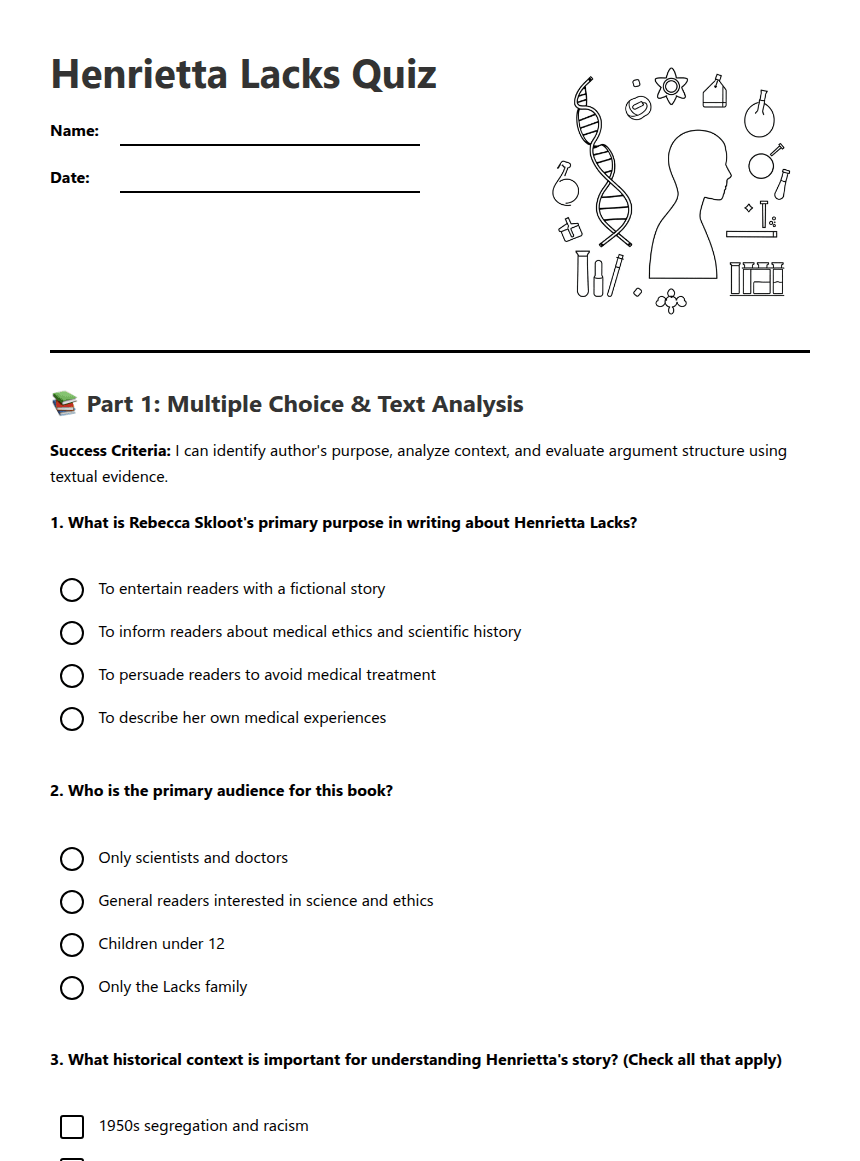
Henrietta Lacks Quiz 1

📚 Part 1: Multiple Choice & Text Analysis
Success Criteria (ELAGSE9-10RL6, ELAGSE9-10RI6): I can identify author's purpose, analyze context, evaluate argument structure using textual evidence, and determine author's tone and point of view.
🎨 Part 2: Tone Analysis & Vocabulary
Success Criteria (ELAGSE9-10RL4, ELAGSE9-10L5): I can analyze how tone vocabulary contributes to meaning and determine the impact of word choice on reader response.
Tone Vocabulary Word Bank: reverent, indignant, melancholy, empathetic, analytical, urgent, nostalgic, critical, respectful, somber
a) When Skloot describes Henrietta's childhood: ________________
b) When discussing doctors' lack of consent: ________________
c) When explaining scientific breakthroughs: ________________
d) When describing Henrietta's death: ________________
1. ________________________________
2. ________________________________
3. ________________________________
✏️ Part 3: Extended Cloze Reading & Vocabulary
Success Criteria (ELAGSE9-10L4, ELAGSE9-10RI4): I can apply vocabulary knowledge and demonstrate reading comprehension using context clues and tone analysis.
Word Bank: immortal, consent, segregated, biopsy, cervical, laboratory, multiplied, decades, ethics, poverty, reverent, indignant, analytical, empathetic, somber
Rebecca Skloot writes with a __________ tone when describing Henrietta Lacks, a young African American woman living in __________ in 1950s America. Her __________ approach to research reveals how Henrietta went to Johns Hopkins Hospital for __________ cancer, where doctors took a __________ of her tumor without her __________. Skloot's tone becomes more __________ when discussing how her cells __________ endlessly in the __________, becoming essentially __________. The author maintains a __________ tone throughout, showing deep respect for Henrietta's memory. For __________ after her death, scientists used her cells for research, and Skloot becomes __________ when discussing the medical __________ violations and how __________ hospitals treated Black patients differently during this era. Her __________ tone when describing the family's ongoing struggles contrasts sharply with her __________ tone when celebrating the scientific breakthroughs made possible by HeLa cells.
🎯 Part 4: Critical Analysis & Extended Response
Success Criteria (ELAGSE9-10RI6, ELAGSE9-10W1): I can evaluate author's techniques, analyze tone shifts, connect historical context to emotional impact, and support analysis with textual evidence.
📋 Answer Key - Henrietta Lacks Quiz
GA INSPIRE ELA Standards Alignment: ELAGSE9-10RL4, ELAGSE9-10RL6, ELAGSE9-10RI4, ELAGSE9-10RI6, ELAGSE9-10L4, ELAGSE9-10L5, ELAGSE9-10W1
1. B - To inform readers about medical ethics and scientific history
Standard: ELAGSE9-10RI6 - Skloot's purpose is primarily informational, combining scientific history with ethical analysis.
2. B - General readers interested in science and ethics
Standard: ELAGSE9-10RI6 - The book uses accessible language and explains complex concepts for a broad audience.
3. A, B, D (1950s segregation and racism; Limited medical consent practices; Poverty in rural Virginia and Baltimore)
Standard: ELAGSE9-10RI6 - These contexts directly impact Henrietta's experience and the ethical issues raised.
4. B - Doctors took her cells without her knowledge
Standard: ELAGSE9-10RI4 - This is the central factual event that drives the narrative and ethical questions.
5. B - They grew and multiplied indefinitely
Standard: ELAGSE9-10RI4 - This scientific fact explains why HeLa cells became so valuable to research.
6. B - Sympathetic
Standard: ELAGSE9-10RL4 - Skloot uses compassionate language when describing Henrietta's vulnerability and fear.
7. B - From neutral to increasingly critical
Standard: ELAGSE9-10RL6 - Skloot begins objectively but becomes more critical as ethical violations become apparent.
8. B - Compassionate
Standard: ELAGSE9-10RL4 - Skloot shows empathy for the family's struggles without judgment.
9. B - Including personal details about Henrietta's life
Standard: ELAGSE9-10RL4 - Personal details create emotional connection and humanize Henrietta.
10. A - From accepting to questioning
Standard: ELAGSE9-10RL6 - Skloot's tone evolves as she uncovers more ethical concerns throughout her research.
11. Tone Identification:
a) Nostalgic/Empathetic - Skloot uses warm, detailed descriptions of Henrietta's rural childhood
b) Indignant/Critical - Clear disapproval of lack of informed consent
c) Analytical - Objective, factual explanation of scientific processes
d) Somber/Reverent - Respectful, mournful tone when describing her death
Standard: ELAGSE9-10RL4, ELAGSE9-10L5 - Students identify how word choice creates specific tones.
12. Empathetic/Reverent
Standard: ELAGSE9-10RL6 - Skloot maintains deep respect and compassion throughout the narrative.
13. Sample Answer: Skloot's reverent tone toward Henrietta shows her as a dignified person deserving respect, while her critical tone toward doctors exposes their ethical failures. This contrast highlights the power imbalance and injustice.
Standard: ELAGSE9-10RL4 - Analysis of contrasting tones and their effects.
14. Sample Empathetic Word Choices:
1. "Poor" (describing her economic situation with sympathy)
2. "Worried" (showing her emotional state)
3. "Trusted" (emphasizing her vulnerability)
Standard: ELAGSE9-10L5 - Identifying specific diction that creates empathy.
15. Sample Answer: The analytical tone makes complex science accessible while maintaining credibility. It helps readers understand the significance of HeLa cells without overwhelming them with technical jargon.
Standard: ELAGSE9-10RL4 - Understanding how tone affects comprehension and reader response.
16. Completed Passage:
Rebecca Skloot writes with a reverent tone when describing Henrietta Lacks, a young African American woman living in poverty in 1950s America. Her analytical approach to research reveals how Henrietta went to Johns Hopkins Hospital for cervical cancer, where doctors took a biopsy of her tumor without her consent. Skloot's tone becomes more empathetic when discussing how her cells multiplied endlessly in the laboratory, becoming essentially immortal. The author maintains a respectful tone throughout, showing deep respect for Henrietta's memory. For decades after her death, scientists used her cells for research, and Skloot becomes indignant when discussing the medical ethics violations and how segregated hospitals treated Black patients differently during this era. Her somber tone when describing the family's ongoing struggles contrasts sharply with her analytical tone when celebrating the scientific breakthroughs made possible by HeLa cells.
Standards: ELAGSE9-10L4, ELAGSE9-10RI4 - Vocabulary application and context clue usage.
17. Sample Answer: Skloot's empathetic tone helps readers see Henrietta and her family as real people who suffered, not just subjects of scientific study. This emotional connection makes readers question whether scientific progress justifies human exploitation.
Standard: ELAGSE9-10RL4 - Analyzing how tone affects reader understanding and response.
18. Sample Answer: Skloot's analytical tone provides credible, factual information while her empathetic tone maintains emotional connection. This balance prevents the story from becoming either purely academic or overly sentimental.
Standard: ELAGSE9-10RL6 - Understanding how authors balance different approaches to achieve purpose.
19. Sample Response Elements:
• Reverent tone when introducing Henrietta establishes her dignity and humanity
• Analytical tone when explaining science builds credibility and understanding
• Critical tone when discussing medical ethics creates moral urgency
• Empathetic tone toward family suffering maintains emotional connection
Standards: ELAGSE9-10RI6, ELAGSE9-10W1 - Evaluating author's techniques with textual evidence.
20. Sample Response Elements:
• Yes, consent is fundamental to medical ethics and human dignity
• Skloot's critical tone toward lack of consent influences reader to support patient rights
• Historical context of racism makes consent violation more egregious
• Evidence: Specific examples of how doctors dismissed Henrietta's concerns
Standards: ELAGSE9-10RI6, ELAGSE9-10W1 - Evaluating arguments with evidence.
21. Sample Response Elements:
• Segregation created power imbalance that enabled exploitation
• Black patients had limited healthcare options, making them vulnerable
• Skloot's indignant tone helps readers understand systemic injustice
• Examples: Different treatment standards, lack of advocacy for Black patients
Standards: ELAGSE9-10RI6, ELAGSE9-10W1 - Connecting historical context to ethical analysis.
22. Sample Response Elements:
• Reverent tone honors Henrietta while building reader sympathy
• Analytical tone provides credible scientific explanation
• Critical tone exposes ethical violations without dismissing scientific value
• Empathetic tone maintains human focus amid complex issues
• Together, these tones create a balanced argument that respects all stakeholders while advocating for ethical reform
Standards: ELAGSE9-10RI6, ELAGSE9-10W1 - Comprehensive analysis of author's rhetorical strategies.
Proficient Level Indicators:
• Accurately identifies author's purpose and audience (ELAGSE9-10RI6)
• Demonstrates understanding of tone vocabulary and its effects (ELAGSE9-10RL4, L5)
• Uses context clues to determine meaning (ELAGSE9-10L4)
• Provides textual evidence to support analysis (ELAGSE9-10W1)
• Connects historical context to ethical implications (ELAGSE9-10RI6)
About This Worksheet
Free in Kuraplan
Sign up free, grab the PDF, and customize it for your class.
Print-Ready
Formatted for standard paper. Clean layout, easy to read.
AI-Generated
Created with Kuraplan's AI, designed for real classroom use.
For Teachers & Parents
Use in classrooms, for homework, tutoring, or homeschool.
Need a custom version of this worksheet?
Kuraplan's AI generates custom worksheets in seconds — differentiated for every learner, aligned to your curriculum.
Generate Custom Worksheets — FreeMore English (ELA) Worksheets
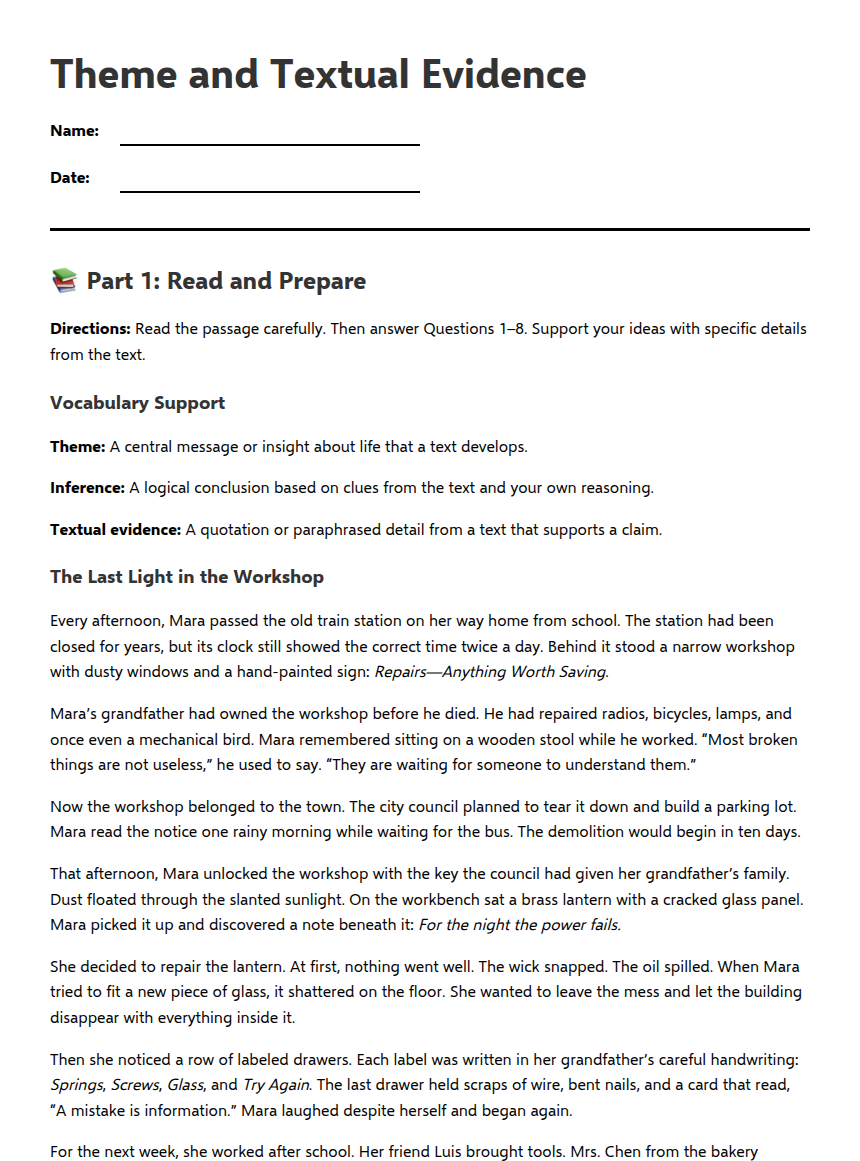
Theme and Textual Evidence
Free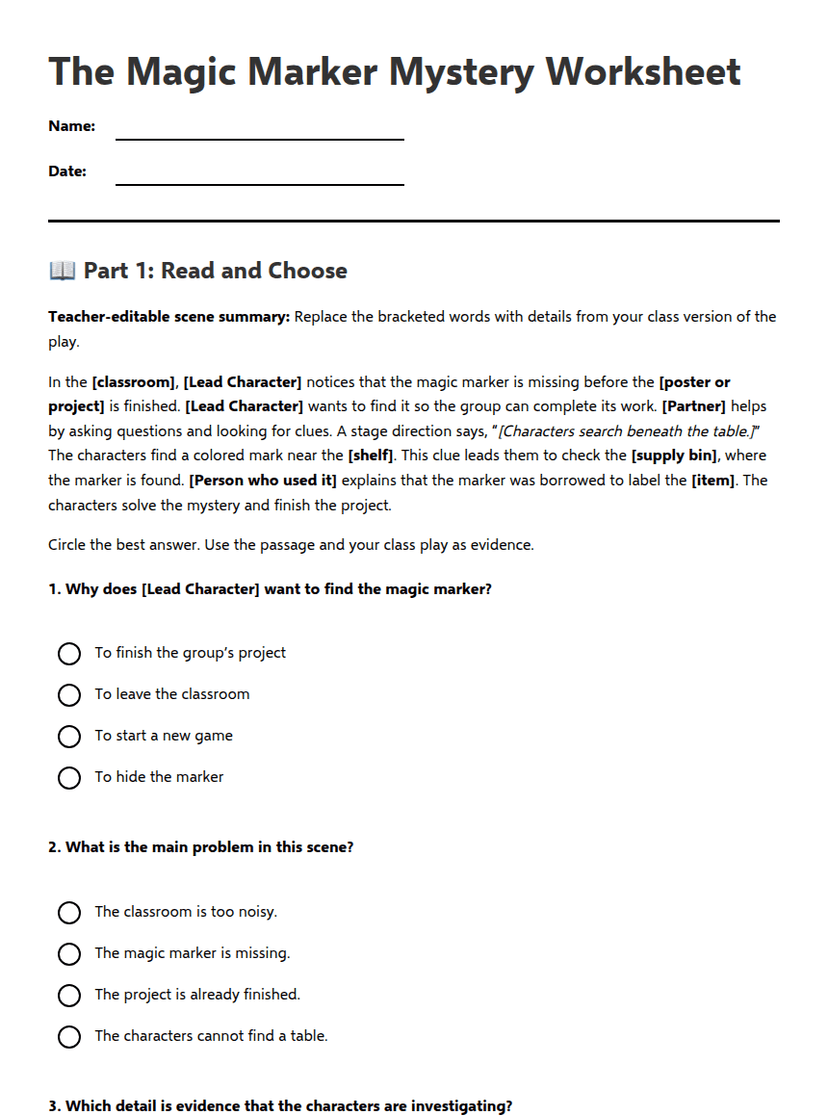
The Magic Marker Mystery Worksheet
Free
Magic Marker Mystery Quiz
Free
The Magic Marker Mystery Worksheet
Free
Text Evidence and Inference Assessment
Free
Citing Evidence and Inferences
Free
Preview, Predict, Read”】【
Free