ScienceFreePrintable

Matter & Decimals Practice

A free science worksheet ready for your classroom. Open in Kuraplan to grab the print-ready PDF, customize it for your students, or generate a fresh version in seconds.
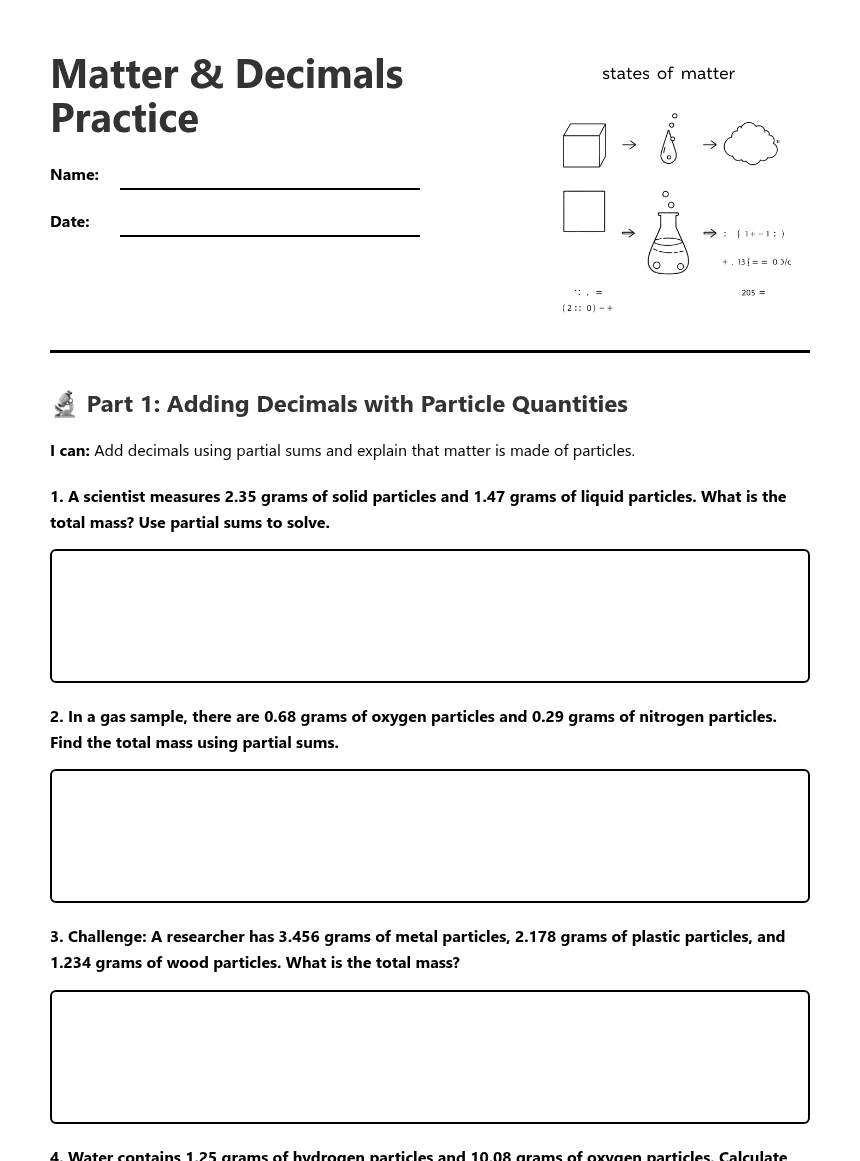
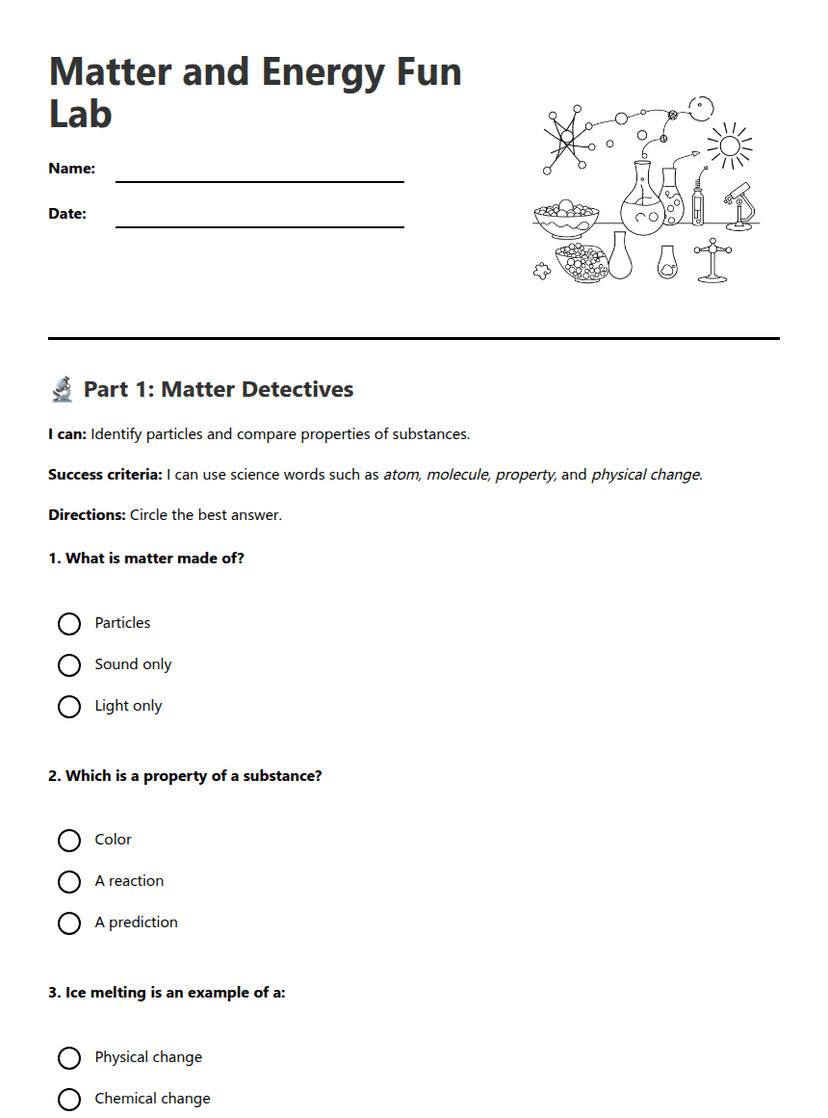
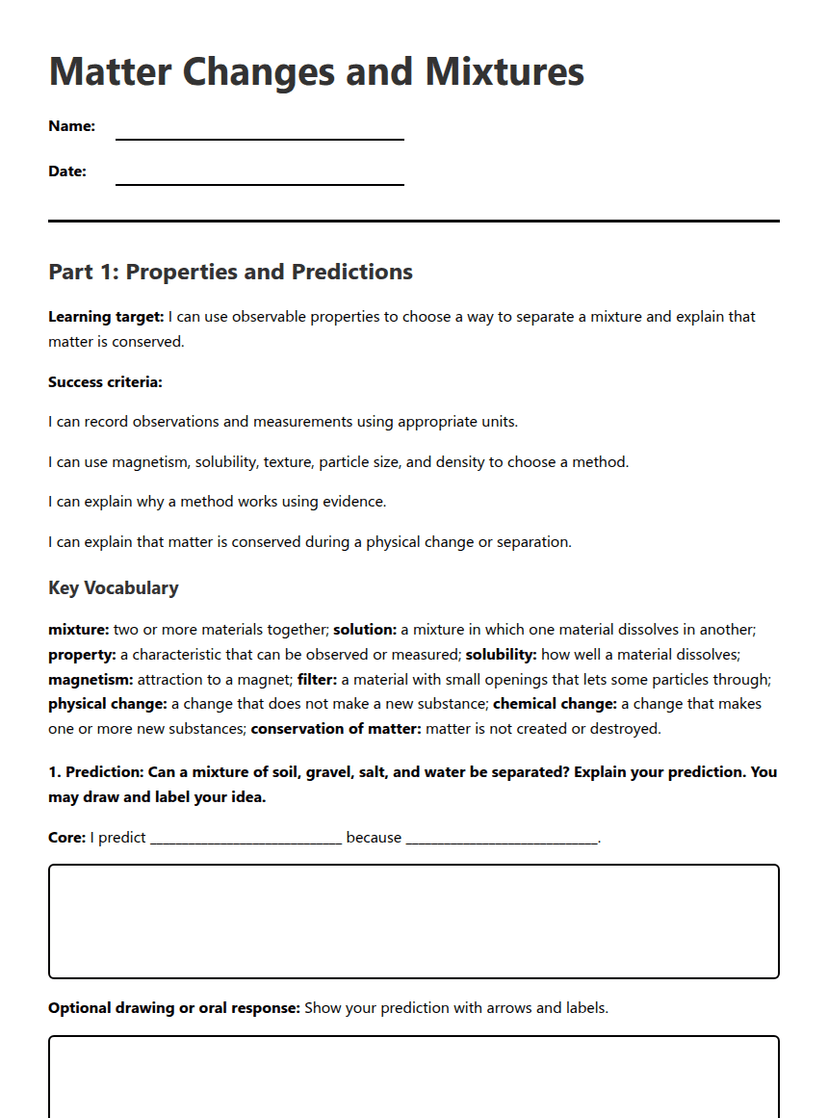
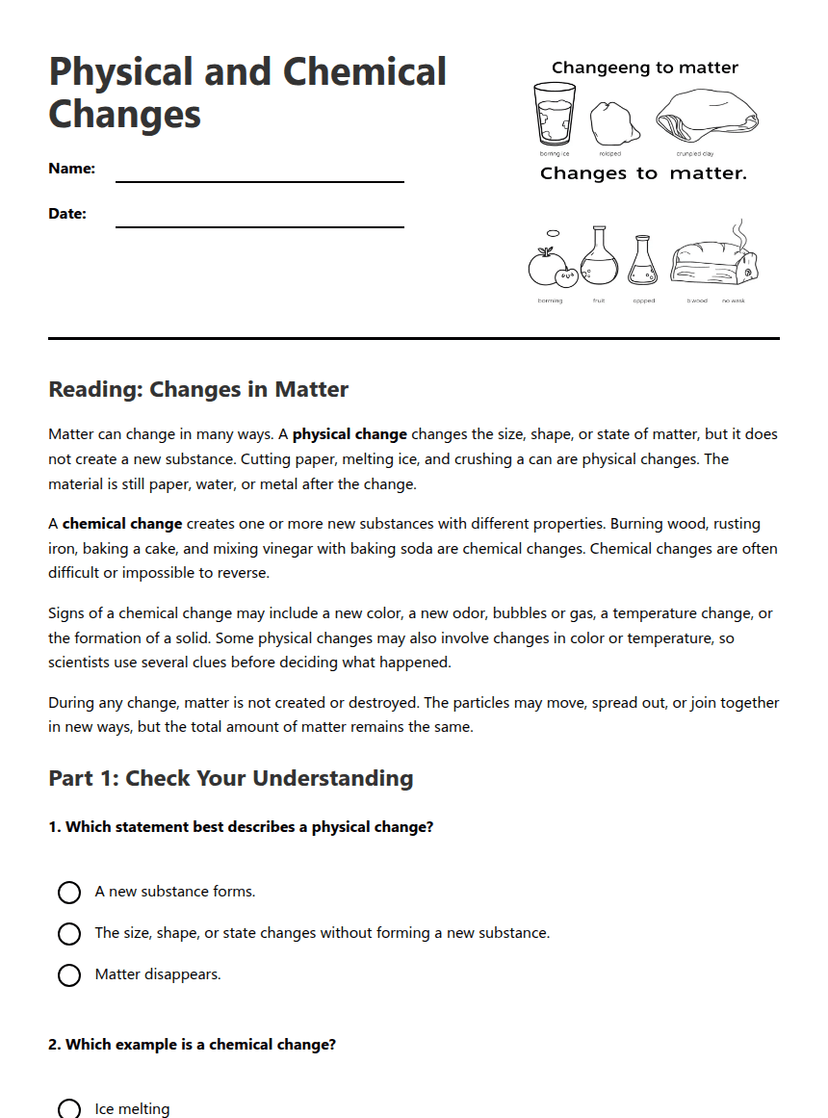
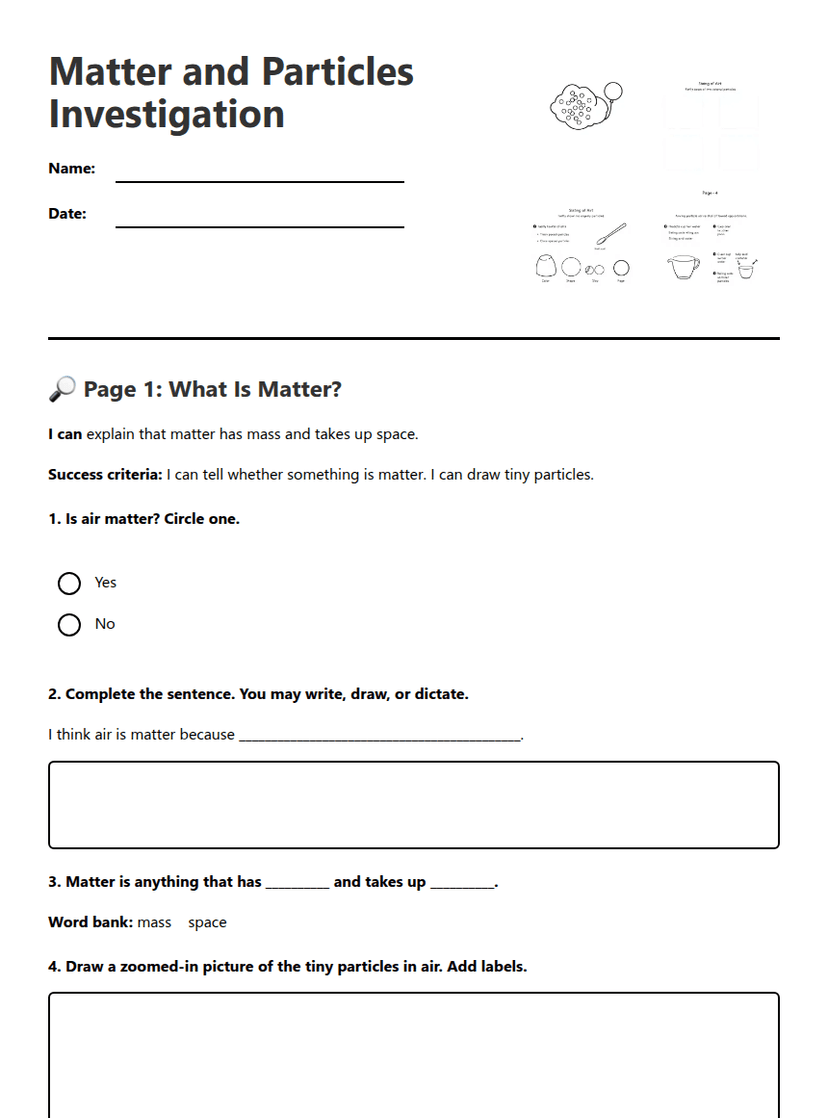
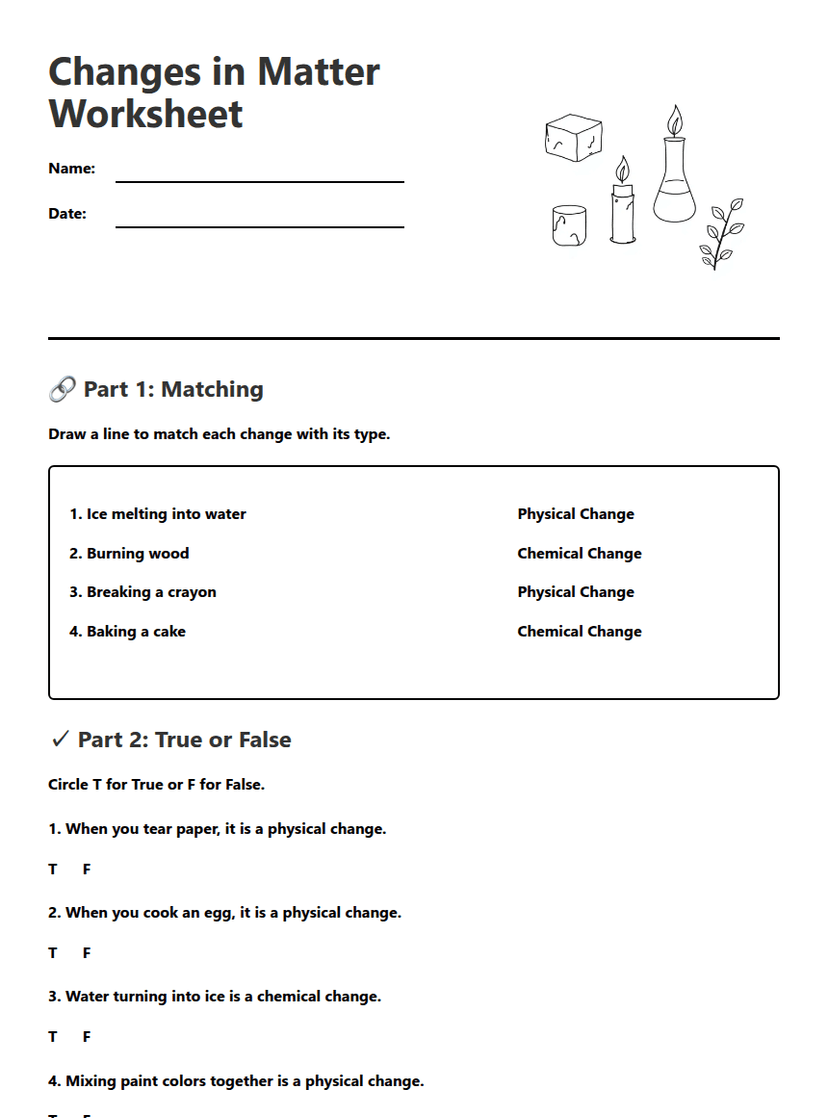
Matter & Decimals Practice worksheet preview
Matter & Decimals Practice

Particles and decimal numbers illustration

🔬 Part 1: Adding Decimals with Particle Quantities

I can: Add decimals using partial sums and explain that matter is made of particles.

1. A scientist measures 2.35 grams of solid particles and 1.47 grams of liquid particles. What is the total mass? Use partial sums to solve.
2. In a gas sample, there are 0.68 grams of oxygen particles and 0.29 grams of nitrogen particles. Find the total mass using partial sums.
3. Challenge: A researcher has 3.456 grams of metal particles, 2.178 grams of plastic particles, and 1.234 grams of wood particles. What is the total mass?
4. Water contains 1.25 grams of hydrogen particles and 10.08 grams of oxygen particles. Calculate the total particle mass.
5. A mixture has 4.7 grams of salt particles and 2.85 grams of sugar particles. What is the combined mass?

⚗️ Part 2: Subtracting Decimals with Physical & Chemical Changes

I can: Subtract decimals using the difference method and identify physical and chemical changes.

6. Ice melts from 15.6 grams to 12.8 grams due to evaporation. How much water evaporated? (Physical change)
7. A candle burns and loses mass from 25.75 grams to 18.42 grams. How much mass was lost? (Chemical change)
8. Paper dissolves in acid, changing from 8.9 grams to 3.65 grams. Calculate the mass difference. (Chemical change)
9. Challenge: Metal rusts and decreases from 12.456 grams to 9.287 grams. Find the mass lost to rusting. (Chemical change)
10. Salt dissolves in water, reducing visible salt from 6.25 grams to 1.8 grams. How much salt dissolved? (Physical change)

🧪 Part 3: Mixed Practice Word Problems

I can: Solve real-world problems combining matter concepts with decimal operations.

11. A scientist starts with 20.5 grams of a substance. After a physical change, 3.75 grams evaporate. Then 2.8 grams more are added. What is the final mass?
12. Three containers hold different states of matter: Container A has 4.62 grams of solid particles, Container B has 3.8 grams of liquid particles, and Container C has 1.95 grams of gas particles. What is the total mass of all particles?
13. Extension Challenge: During an experiment, a chemical reaction changes 15.678 grams of reactants. If 8.234 grams of product forms and 2.156 grams escape as gas, how much mass is unaccounted for? (Hint: Use multiple operations)

About This Worksheet

Free in Kuraplan

Sign up free, grab the PDF, and customize it for your class.

Print-Ready

Formatted for standard paper. Clean layout, easy to read.

AI-Generated

Created with Kuraplan's AI, designed for real classroom use.

For Teachers & Parents

Use in classrooms, for homework, tutoring, or homeschool.

Need a custom version of this worksheet?

Kuraplan's AI generates custom worksheets in seconds — differentiated for every learner, aligned to your curriculum.

Generate Custom Worksheets — Free
No credit card Curriculum-aligned Under 60 seconds