US HistoryFreePrintable

S.P.A.C.E.S. H.I.P. Exceptions

A free us history worksheet ready for your classroom. Open in Kuraplan to grab the print-ready PDF, customize it for your students, or generate a fresh version in seconds.
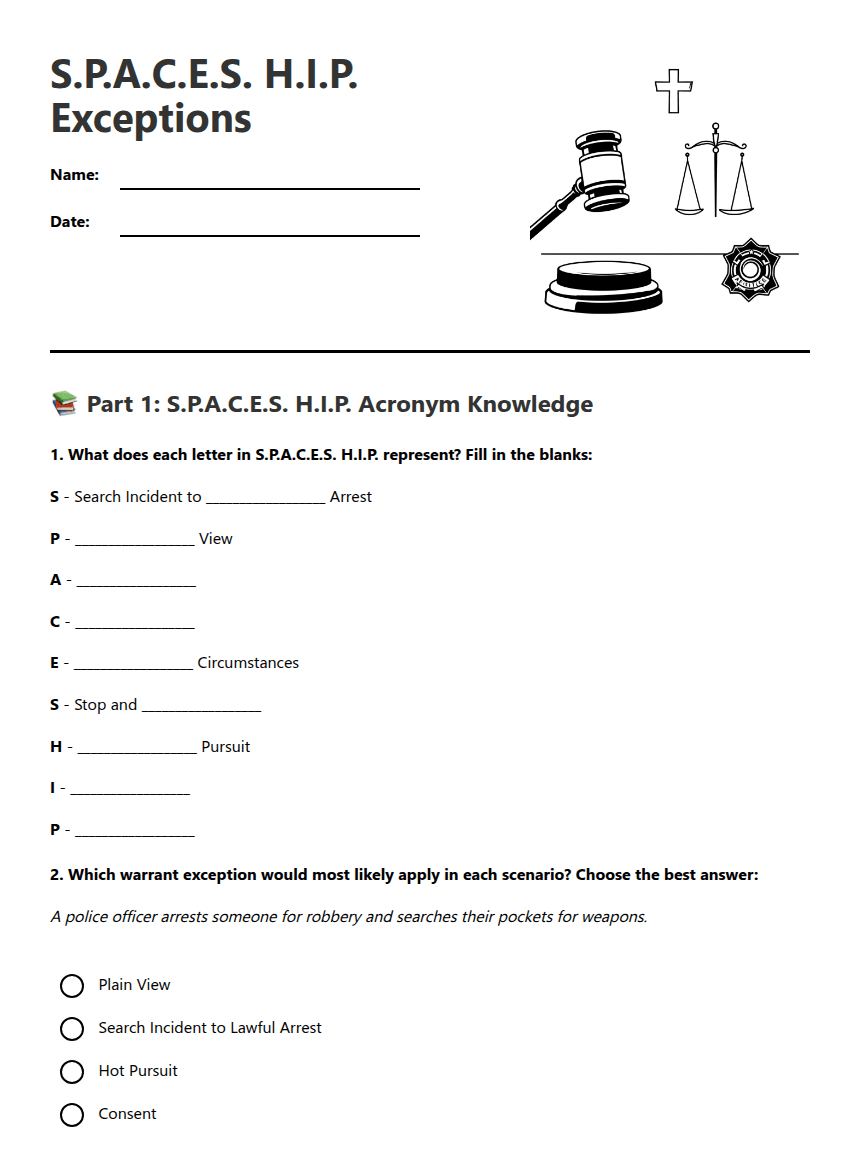
S.P.A.C.E.S. H.I.P. Exceptions worksheet preview

S.P.A.C.E.S. H.I.P. Exceptions

Fourth Amendment and police badge illustration

📚 Part 1: S.P.A.C.E.S. H.I.P. Acronym Knowledge

1. What does each letter in S.P.A.C.E.S. H.I.P. represent? Fill in the blanks:

S - Search Incident to __________________ Arrest

P - __________________ View

A - __________________

C - __________________

E - __________________ Circumstances

S - Stop and __________________

H - __________________ Pursuit

I - __________________

P - __________________

2. Which warrant exception would most likely apply in each scenario? Choose the best answer:

A police officer arrests someone for robbery and searches their pockets for weapons.

Plain View

Search Incident to Lawful Arrest

Hot Pursuit

Consent

3. A suspect voluntarily allows police to search their vehicle during a traffic stop. This is an example of:

Automobile Exception

Consent

Exigent Circumstances

Stop and Frisk

⚖️ Part 2: Case Analysis and Application

4. An officer sees illegal drugs on the dashboard while lawfully stopped at a car window. Explain why this would fall under the "Plain View" exception:
5. Police are chasing a suspect who runs into their home. The officers follow immediately without a warrant. Which exception applies and why is it justified?
6. A police officer stops someone on the street based on reasonable suspicion and pats them down for weapons. This scenario demonstrates which exception?
7. Check all situations where a warrant would typically NOT be required:

Searching a car after a valid traffic stop with probable cause

Searching someone's home while they're on vacation

Searching a person immediately after arresting them

Searching when someone gives clear permission

Searching when evidence might be destroyed immediately

🎭 Part 3: Critical Thinking and Real-World Application

8. You are a judge deciding a case. Police entered a home without a warrant because they heard screaming and believed someone was in immediate danger. They found illegal weapons. Should the evidence be admissible? Explain your reasoning using Fourth Amendment principles:
9. Which warrant exception do you think has the greatest impact on daily police work? Explain why and provide a specific example:
10. Extension Challenge: Create your own scenario where two different warrant exceptions might apply. Describe the situation and explain which exceptions could be used:

About This Worksheet

Free in Kuraplan

Sign up free, grab the PDF, and customize it for your class.

Print-Ready

Formatted for standard paper. Clean layout, easy to read.

AI-Generated

Created with Kuraplan's AI, designed for real classroom use.

For Teachers & Parents

Use in classrooms, for homework, tutoring, or homeschool.

Need a custom version of this worksheet?

Kuraplan's AI generates custom worksheets in seconds — differentiated for every learner, aligned to your curriculum.

Generate Custom Worksheets — Free
No credit card Curriculum-aligned Under 60 seconds