NZ HistoryFreePrintable

Aotearoa's Geography and Colonisation

A free nz history worksheet ready for your classroom. Open in Kuraplan to grab the print-ready PDF, customize it for your students, or generate a fresh version in seconds.
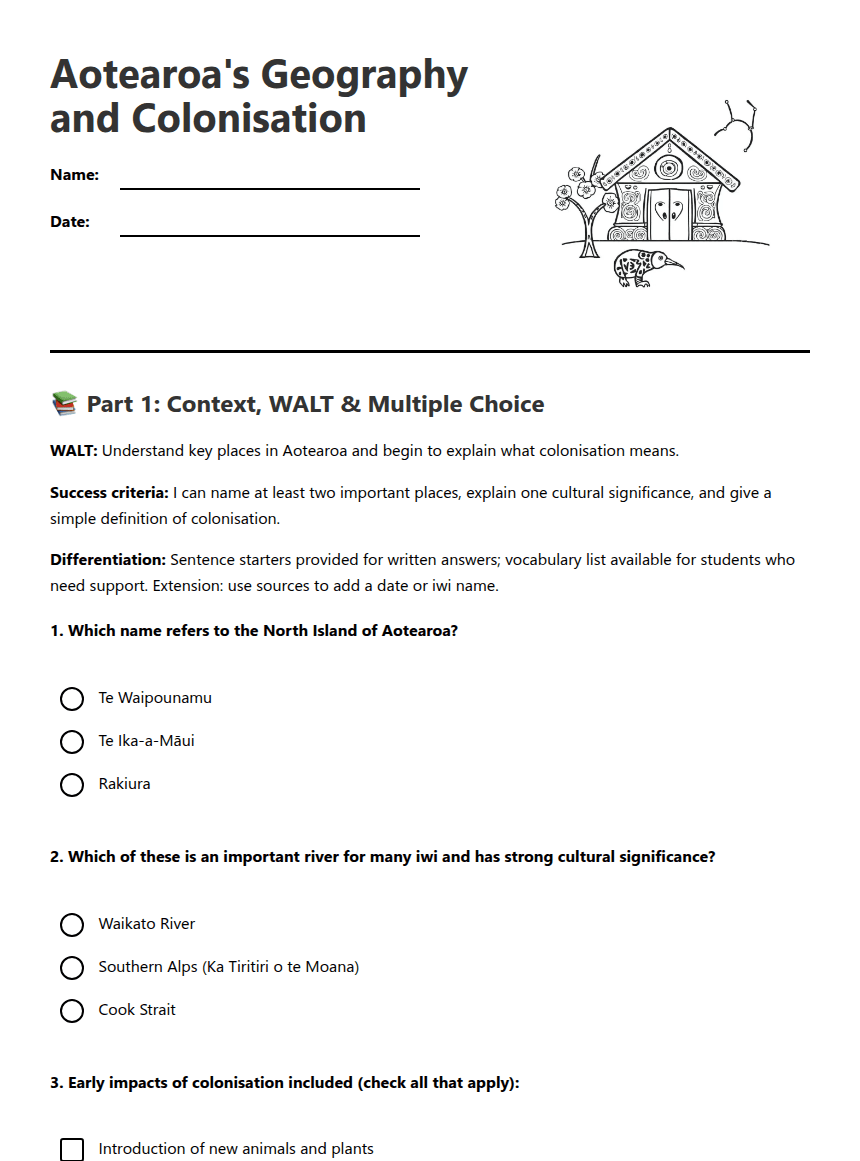
Aotearoa's Geography and Colonisation worksheet preview
Aotearoa's Geography and Colonisation

Worksheet illustration

📚 Part 1: Context, WALT & Multiple Choice

WALT: Understand key places in Aotearoa and begin to explain what colonisation means.

Success criteria: I can name at least two important places, explain one cultural significance, and give a simple definition of colonisation.

Differentiation: Sentence starters provided for written answers; vocabulary list available for students who need support. Extension: use sources to add a date or iwi name.

1. Which name refers to the North Island of Aotearoa?

Te Waipounamu

Te Ika-a-Māui

Rakiura

2. Which of these is an important river for many iwi and has strong cultural significance?

Waikato River

Southern Alps (Ka Tiritiri o te Moana)

Cook Strait

3. Early impacts of colonisation included (check all that apply):

Introduction of new animals and plants

Loss of land for many Māori

Immediate nationwide legal recognition of iwi sovereignty

New trading relationships with Europeans

4. Who are the Pākehā in New Zealand history?

Early European settlers

A tribal Māori group

A mountain range

✏️ Part 2: Short Answers & Matching

5. Match each place (left) with its cultural significance (right). Draw lines between the matching items.
1. Aoraki / Mount Cook
2. Mount Taranaki
3. Waikato River
4. Te Whanganui-a-Tara (Wellington Harbour)
A. Important river for Waikato-Tainui and central to identity
B. Sacred mountain for Ngāi Tahu; part of whakapapa
C. Sacred maunga for Taranaki iwi; stories of guardianship
D. Major harbour and place of settlement and trade
6. In one sentence, define colonisation (use simple language):
7. Why is it important to learn both Māori and Pākehā perspectives about the same event? (Use this starter: "It is important because…")
8. Translate the whakataukī: "Ko au te whenua, ko te whenua ko au" — I am the ______, and the ______ is me.

Fill blanks: I am the _________, and the _________ is me.

🎯 Part 3: Extension & Creative Activity

Extension (for advanced learners): Choose one place from this worksheet, find the name of a local iwi associated with it and one historical event linked to that place.

9. Which local iwi would you like to research next lesson, and one question you would ask them?
10. Draw a simple map detail: sketch one local geographic feature (hill, river, or harbour) and label it. Below, write one sentence about its cultural importance.

About This Worksheet

Free in Kuraplan

Sign up free, grab the PDF, and customize it for your class.

Print-Ready

Formatted for standard paper. Clean layout, easy to read.

AI-Generated

Created with Kuraplan's AI, designed for real classroom use.

For Teachers & Parents

Use in classrooms, for homework, tutoring, or homeschool.

Need a custom version of this worksheet?

Kuraplan's AI generates custom worksheets in seconds — differentiated for every learner, aligned to your curriculum.

Generate Custom Worksheets — Free
No credit card Curriculum-aligned Under 60 seconds