ScienceFreePrintable

Cell Structure Scavenger Hunt

A free, printable science worksheet ready for your classroom. Download instantly, print, and hand out to your students — no account needed.
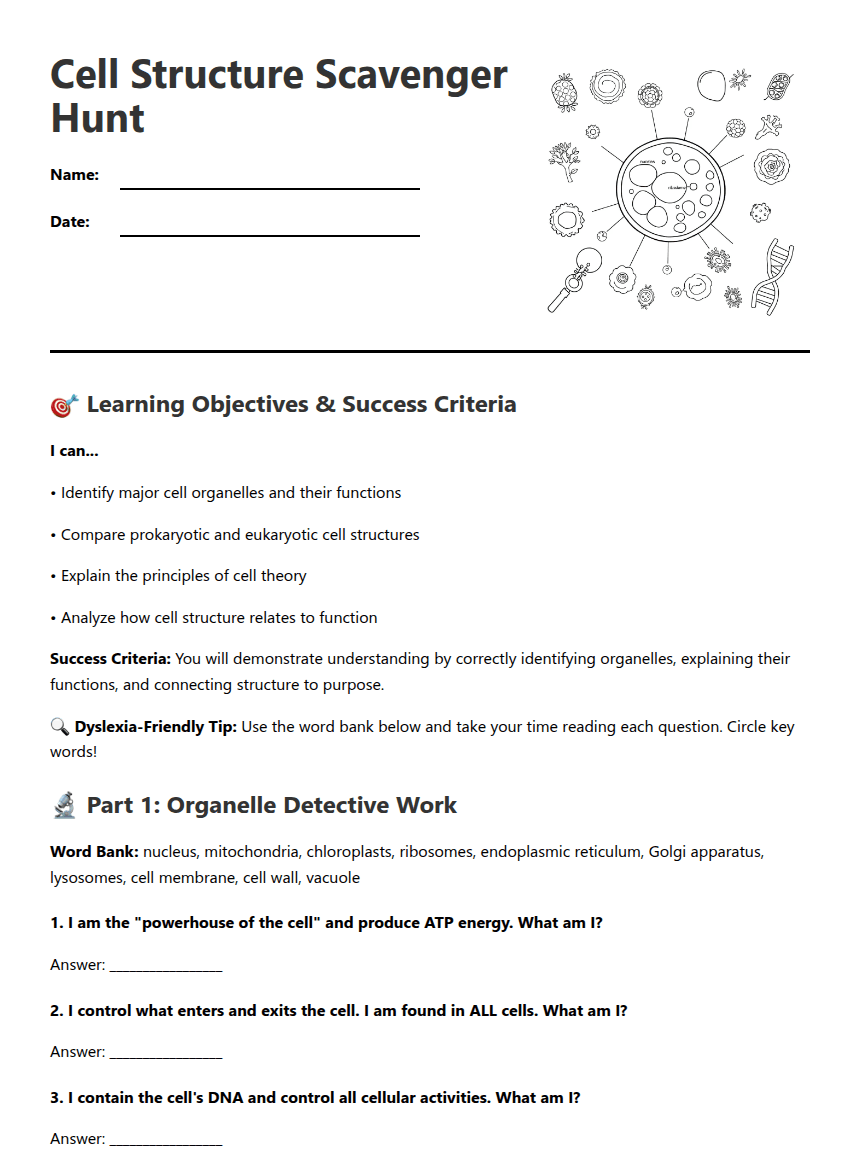
Cell Structure Scavenger Hunt worksheet preview
Cell Structure Scavenger Hunt

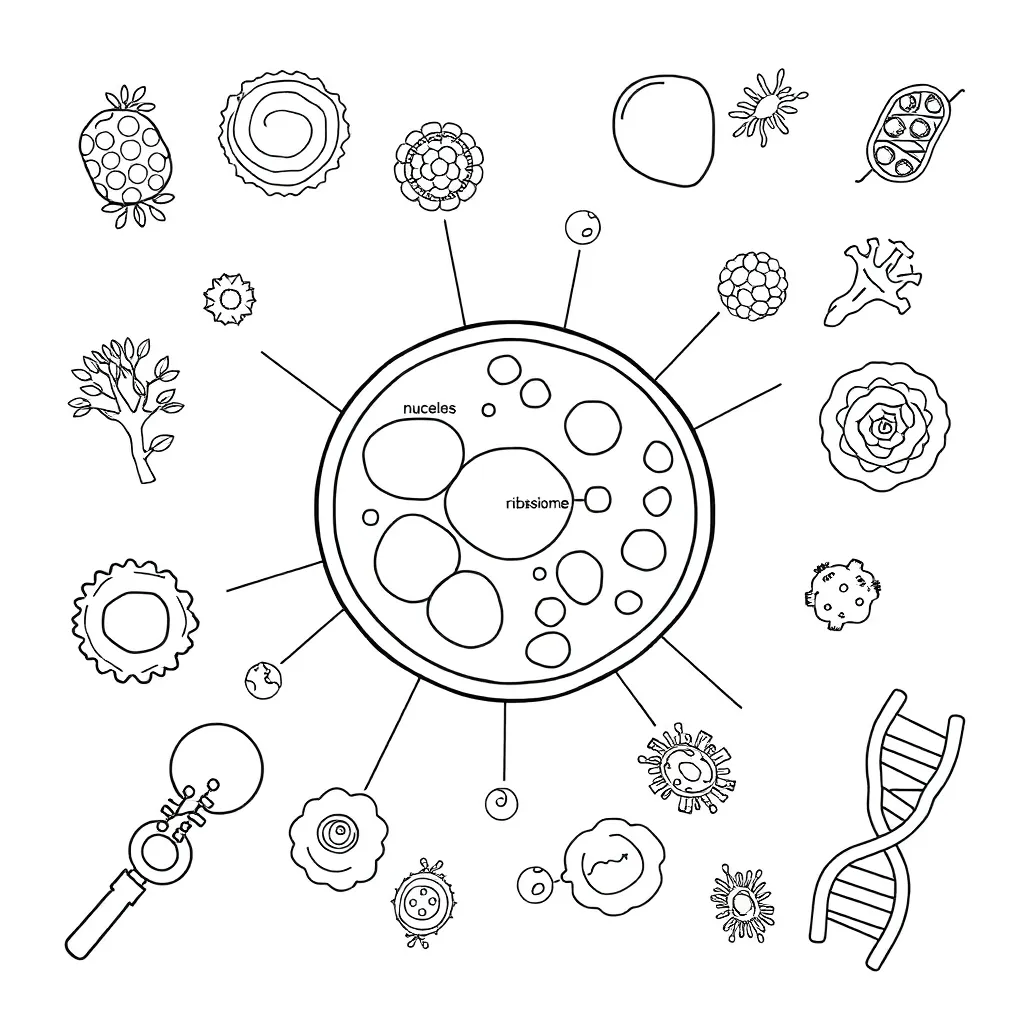
Cell structure diagram

🎯 Learning Objectives & Success Criteria

I can...

• Identify major cell organelles and their functions

• Compare prokaryotic and eukaryotic cell structures

• Explain the principles of cell theory

• Analyze how cell structure relates to function

Success Criteria: You will demonstrate understanding by correctly identifying organelles, explaining their functions, and connecting structure to purpose.

🔍 Support Tip: Use the word bank below and take your time reading each question. Circle key words!

📚 Required Reading: Cell Theory and Structure

Article Link: Introduction to Cells and Cell Theory - Khan Academy

Instructions: Read the linked article about cell theory and cellular structures. Use the information from the article to help answer the scavenger hunt questions and constructed response questions below.

🔬 Part 1: Organelle Detective Work

Word Bank: nucleus, mitochondria, chloroplasts, ribosomes, endoplasmic reticulum, Golgi apparatus, lysosomes, cell membrane, cell wall, vacuole, cytoplasm, centrioles

1. I am the "powerhouse of the cell" and produce ATP energy. What am I?

Answer: _________________

2. I control what enters and exits the cell. I am found in ALL cells. What am I?

Answer: _________________

3. I contain the cell's DNA and control all cellular activities. What am I?

Answer: _________________

4. I make proteins by reading mRNA. I can be found floating freely or attached to membranes. What am I?

Answer: _________________

5. I am only found in plant cells and capture sunlight for photosynthesis. What am I?

Answer: _________________

6. I digest waste materials and break down worn-out organelles. I'm called the "cleanup crew." What am I?

Answer: _________________

7. I modify, package, and ship proteins from the endoplasmic reticulum. What am I?

Answer: _________________

🧬 Part 2: Multiple Choice Challenge

8. Which organelle would you expect to find in large numbers in a muscle cell?

A) Lysosomes

B) Mitochondria

C) Chloroplasts

D) Vacuoles

9. Cell theory states that:

All living things are made of cells

Cells are the basic unit of life

All cells come from pre-existing cells

All cells contain a nucleus

10. Which structure is found in plant cells but NOT in animal cells?

A) Cell membrane

B) Mitochondria

C) Cell wall

D) Ribosomes

11. Prokaryotic cells differ from eukaryotic cells because prokaryotes:

A) Have no genetic material

B) Have no membrane-bound nucleus

C) Cannot reproduce

D) Are always larger

12. The rough endoplasmic reticulum appears "rough" because:

A) It has ribosomes attached to it

B) It contains DNA

C) It has a folded structure

D) It produces energy

📊 Part 3: Compare and Contrast

13. Complete the Venn diagram comparing plant and animal cells:
14. Fill in the comparison table:
Feature Prokaryotic Cells Eukaryotic Cells
Nucleus
Size
Examples

🧠 Part 4: Critical Thinking and Application

15. A scientist discovers a new single-celled organism with the following characteristics: no nucleus, circular DNA, and ribosomes. Classify this organism and explain your reasoning:
16. Why do you think red blood cells in mammals lose their nucleus as they mature? Consider their function in your answer:
17. Design Challenge: If you were designing a cell to live in extreme heat, which organelles would you modify and how? Explain your reasoning:
18. Explain the relationship between the structure of chloroplasts and their function in photosynthesis. Include details about thylakoids and stroma:
19. Medical Connection: Some genetic diseases affect mitochondrial function. Predict which types of body systems would be most affected by these diseases and explain why:

📝 Part 5: Short Answer Analysis

20. Describe how the cell membrane maintains homeostasis. Include the concept of selective permeability:
21. Explain why plant cells need both chloroplasts AND mitochondria:
22. How does the structure of the Golgi apparatus relate to its function in protein processing?
23. Real-World Application: Why might a person with a bacterial infection be treated with antibiotics that target ribosomes, and why don't these antibiotics harm human cells?
24. Predict what would happen to a plant cell if its vacuole stopped functioning properly:

🚀 Part 6: Extension Activities and Advanced Thinking

25. Research Extension: Choose one organelle and research a disease or condition that occurs when it malfunctions. Summarize your findings:
26. Creative Challenge: Design an analogy comparing a cell to a city, factory, or school. Match at least 6 organelles to parts of your chosen system and explain the comparisons:
27. Advanced Analysis: Explain how the endosymbiotic theory explains the presence of mitochondria and chloroplasts in eukaryotic cells. What evidence supports this theory?
28. Problem Solving: A cell biologist observes a cell under a microscope and notes: large central vacuole, cell wall, chloroplasts, and a nucleus. What type of cell is this? What would the scientist likely observe if this cell were placed in distilled water?

⭐ Differentiation Support & Extensions

For Additional Support:

• Focus on questions 1-7, 8-12, and 20-22 • Use word bank and diagrams freely • Work with a partner for discussion questions • Use colored pencils to highlight key terms

For Advanced Learners:

• Complete all questions including extensions • Research additional organelles not covered • Create your own cell structure quiz questions • Connect to current scientific research on cellular biology

Visual Learning Support:

• Draw diagrams to accompany written answers • Use the provided cell image as reference • Create concept maps for organelle relationships • Use graphic organizers for comparison activities

Discussion Opportunities:

• Questions 17, 19, 26, and 27 work well for peer discussions • Share analogies from question 26 with classmates • Debate the implications of cellular discoveries

About This Worksheet

Free Download

No sign-up, no email, no paywall. Just download and print.

Print-Ready

Formatted for standard paper. Clean layout, easy to read.

AI-Generated

Created with Kuraplan's AI, designed for real classroom use.

For Teachers & Parents

Use in classrooms, for homework, tutoring, or homeschool.

Need a custom version of this worksheet?

Kuraplan's AI generates custom worksheets in seconds — differentiated for every learner, aligned to your curriculum.

Generate Custom Worksheets — Free
No credit card Curriculum-aligned Under 60 seconds