Chemical Formulas and Composition
A free science worksheet ready for your classroom. Open in Kuraplan to grab the print-ready PDF, customize it for your students, or generate a fresh version in seconds.
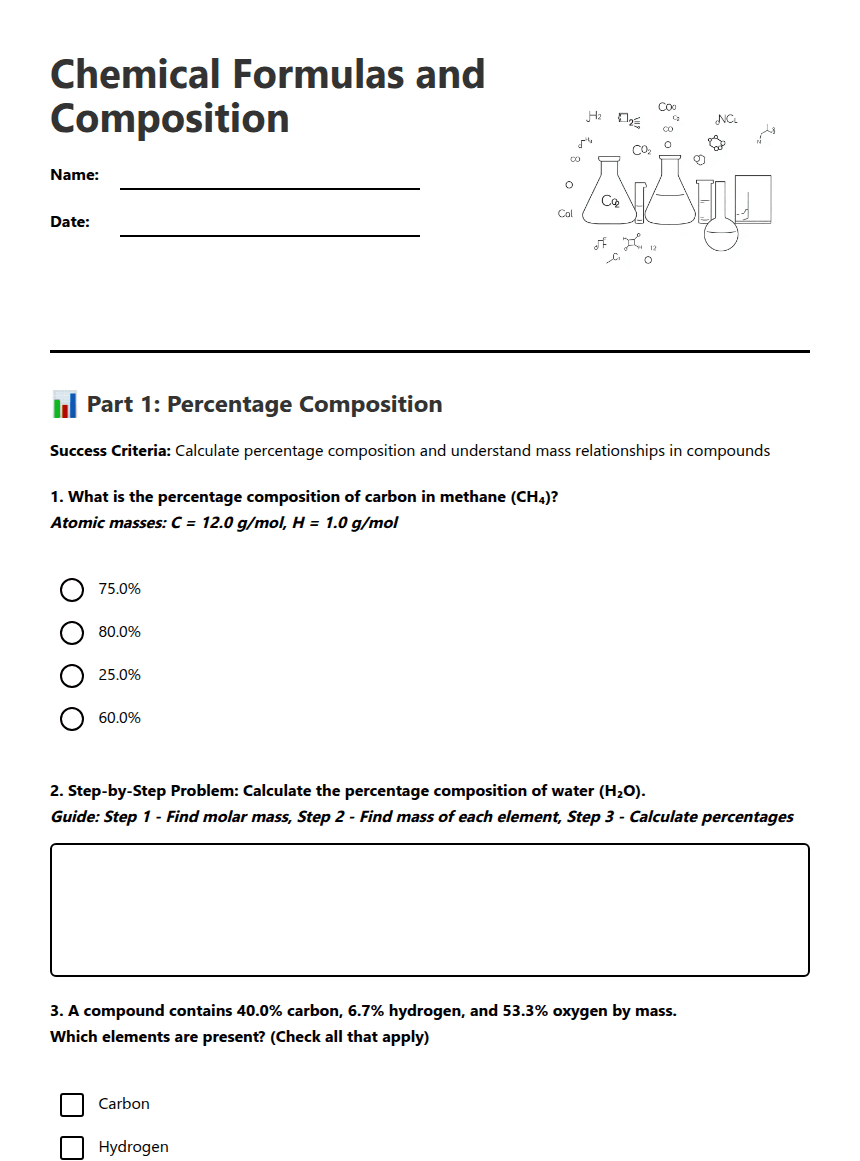
Chemical Formulas and Composition Worksheet-1

📊 Part 1: Percentage Composition
Success Criteria: Calculate percentage composition and understand mass relationships in compounds
Atomic masses: C = 12.0 g/mol, H = 1.0 g/mol
Solution: Molar mass of CH₄ = 12.0 + (4 × 1.0) = 16.0 g/mol. Percentage of C = (12.0 / 16.0) × 100 = 75.0%
Guide: Step 1 - Find molar mass, Step 2 - Find mass of each element, Step 3 - Calculate percentages
Solution: Molar mass of H₂O = (2 × 1.0) + 16.0 = 18.0 g/mol. Percentage of H = (2.0 / 18.0) × 100 = 11.1%, Percentage of O = (16.0 / 18.0) × 100 = 88.9%
Which elements are present? (Check all that apply)
Solution: The elements present are Carbon, Hydrogen, and Oxygen.
🧪 Part 2: Empirical and Molecular Formulas
Success Criteria: Derive empirical formulas from percentage data and determine molecular formulas
Step 1: Convert percentages to grams: 85.7 g C, 14.3 g H
Step 2: Convert to moles: 85.7 g C / 12.0 g/mol = 7.14 mol C, 14.3 g H / 1.0 g/mol = 14.3 mol H
Step 3: Find simplest ratio: C:H = 7.14:14.3 = 1:2
Empirical formula: CH₂
Solution: Molar mass of empirical formula (CH₂) = 12.0 + (2 × 1.0) = 14.0 g/mol. Molecular formula = (28.0 g/mol / 14.0 g/mol) × CH₂ = C₂H₄.
Solution: Convert percentages to grams: 52.2 g C, 13.0 g H, 34.8 g O. Moles: C = 52.2/12.0 = 4.35, H = 13.0/1.0 = 13.0, O = 34.8/16.0 = 2.18. Simplest ratio: C:H:O = 4.35:13.0:2.18 = 2:6:1. Empirical formula = C₂H₆O. Molar mass of empirical formula = 2(12.0) + 6(1.0) + 16.0 = 46.0 g/mol. Molecular formula = C₂H₆O.
🎯 Part 3: Problem-Solving Applications
Success Criteria: Apply formula calculation strategies to real-world scenarios
• A vitamin C tablet contains 0.18 g of ascorbic acid (C₆H₈O₆)
• Molar mass of ascorbic acid = 176.0 g/mol
• Calculate: How many moles of vitamin C are in one tablet?
Solution: Moles = mass / molar mass = 0.18 g / 176.0 g/mol = 0.00102 mol.
Show how to convert this to a whole number ratio and determine the empirical formula.
Solution: To convert to whole numbers, multiply by 4: C = 4, H = 9. Empirical formula = C₄H₉.
a) Medicine: ________________
b) Environmental science: ________________
Differentiation Support:
• Use the guided steps for structured learning
• Advanced learners: Complete extension questions 6 and 8
• Visual learners: Draw molecular structures alongside calculations
🔍 Detailed Solutions
Atomic masses: C = 12.0 g/mol, H = 1.0 g/mol
Solution: Molar mass of CH₄ = 12.0 + (4 × 1.0) = 16.0 g/mol. Percentage of C = (12.0 / 16.0) × 100 = 75.0%
Guide: Step 1 - Find molar mass, Step 2 - Find mass of each element, Step 3 - Calculate percentages
Solution: Molar mass of H₂O = (2 × 1.0) + 16.0 = 18.0 g/mol. Percentage of H = (2.0 / 18.0) × 100 = 11.1%, Percentage of O = (16.0 / 18.0) × 100 = 88.9%
Which elements are present? (Check all that apply)
Solution: The elements present are Carbon, Hydrogen, and Oxygen.
Step 1: Convert percentages to grams: 85.7 g C, 14.3 g H
Step 2: Convert to moles: 85.7 g C / 12.0 g/mol = 7.14 mol C, 14.3 g H / 1.0 g/mol = 14.3 mol H
Step 3: Find simplest ratio: C:H = 7.14:14.3 = 1:2
Empirical formula: CH₂
Solution: Molar mass of empirical formula (CH₂) = 12.0 + (2 × 1.0) = 14.0 g/mol. Molecular formula = (28.0 g/mol / 14.0 g/mol) × CH₂ = C₂H₄.
Solution: Convert percentages to grams: 52.2 g C, 13.0 g H, 34.8 g O. Moles: C = 52.2/12.0 = 4.35, H = 13.0/1.0 = 13.0, O = 34.8/16.0 = 2.18. Simplest ratio: C:H:O = 4.35:13.0:2.18 = 2:6:1. Empirical formula = C₂H₆O. Molar mass of empirical formula = 2(12.0) + 6(1.0) + 16.0 = 46.0 g/mol. Molecular formula = C₂H₆O.
• A vitamin C tablet contains 0.18 g of ascorbic acid (C₆H₈O₆)
• Molar mass of ascorbic acid = 176.0 g/mol
• Calculate: How many moles of vitamin C are in one tablet?
Solution: Moles = mass / molar mass = 0.18 g / 176.0 g/mol = 0.00102 mol.
Show how to convert this to a whole number ratio and determine the empirical formula.
Solution: To convert to whole numbers, multiply by 4: C = 4, H = 9. Empirical formula = C₄H₉.
a) Medicine: ________________
b) Environmental science: ________________
About This Worksheet
Free in Kuraplan
Sign up free, grab the PDF, and customize it for your class.
Print-Ready
Formatted for standard paper. Clean layout, easy to read.
AI-Generated
Created with Kuraplan's AI, designed for real classroom use.
For Teachers & Parents
Use in classrooms, for homework, tutoring, or homeschool.
Need a custom version of this worksheet?
Kuraplan's AI generates custom worksheets in seconds — differentiated for every learner, aligned to your curriculum.
Generate Custom Worksheets — Free