Contact Forces Spring Scale
A free science worksheet ready for your classroom. Open in Kuraplan to grab the print-ready PDF, customize it for your students, or generate a fresh version in seconds.
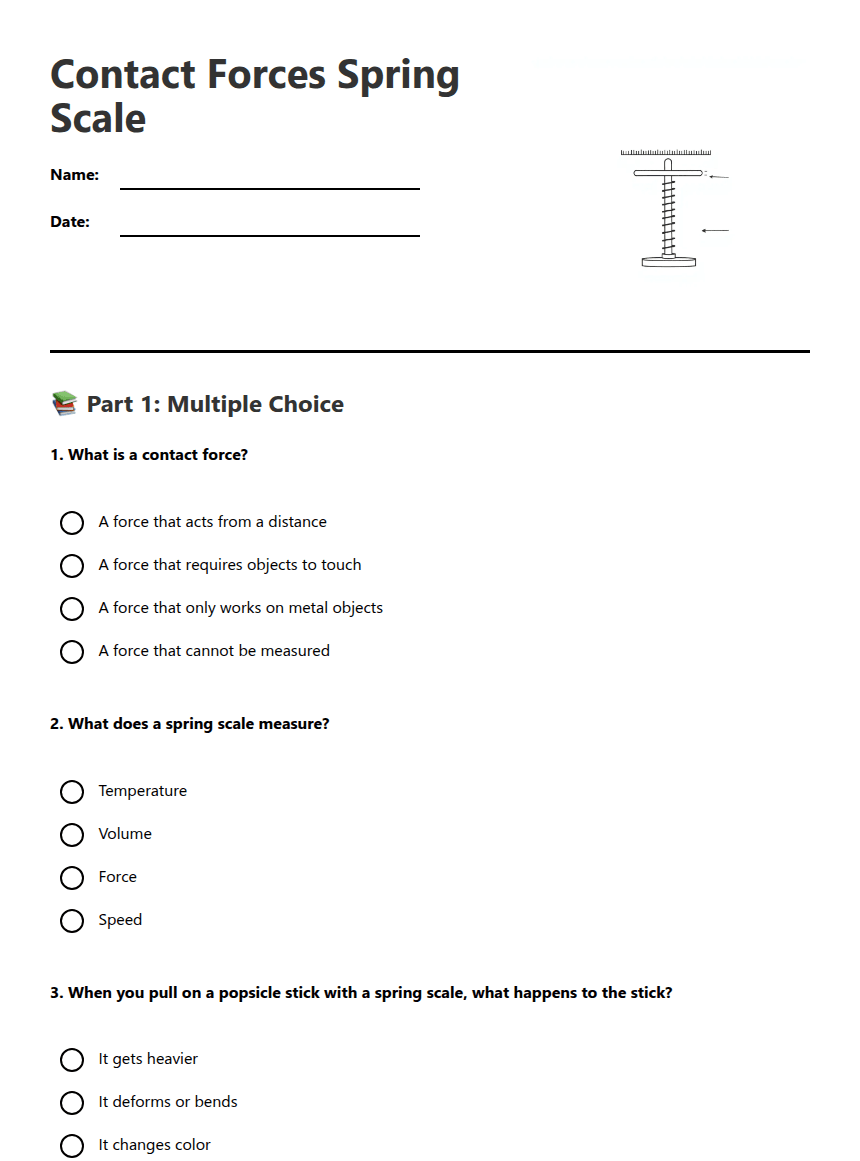
Contact Forces Spring Scale
📚 Part 1: Multiple Choice
✏️ Part 2: Short Essay Questions
📋 Answer Key
1. B - A force that requires objects to touch
2. C - Force
3. B - It deforms or bends
4. A - Pounds or Newtons
5. C - The deformation increases
6. C - Pushing a book across a table
7. B - While the force is being applied
8. A - When an object changes shape due to applied force
9. A - It will bend about 1 inch
10. B - To ensure accurate measurements
Model Answer: A contact force is a force that occurs when two objects physically touch each other. Examples include: pushing a shopping cart (your hands touch the cart), friction between shoes and the ground when walking, or kicking a soccer ball (foot touches ball).
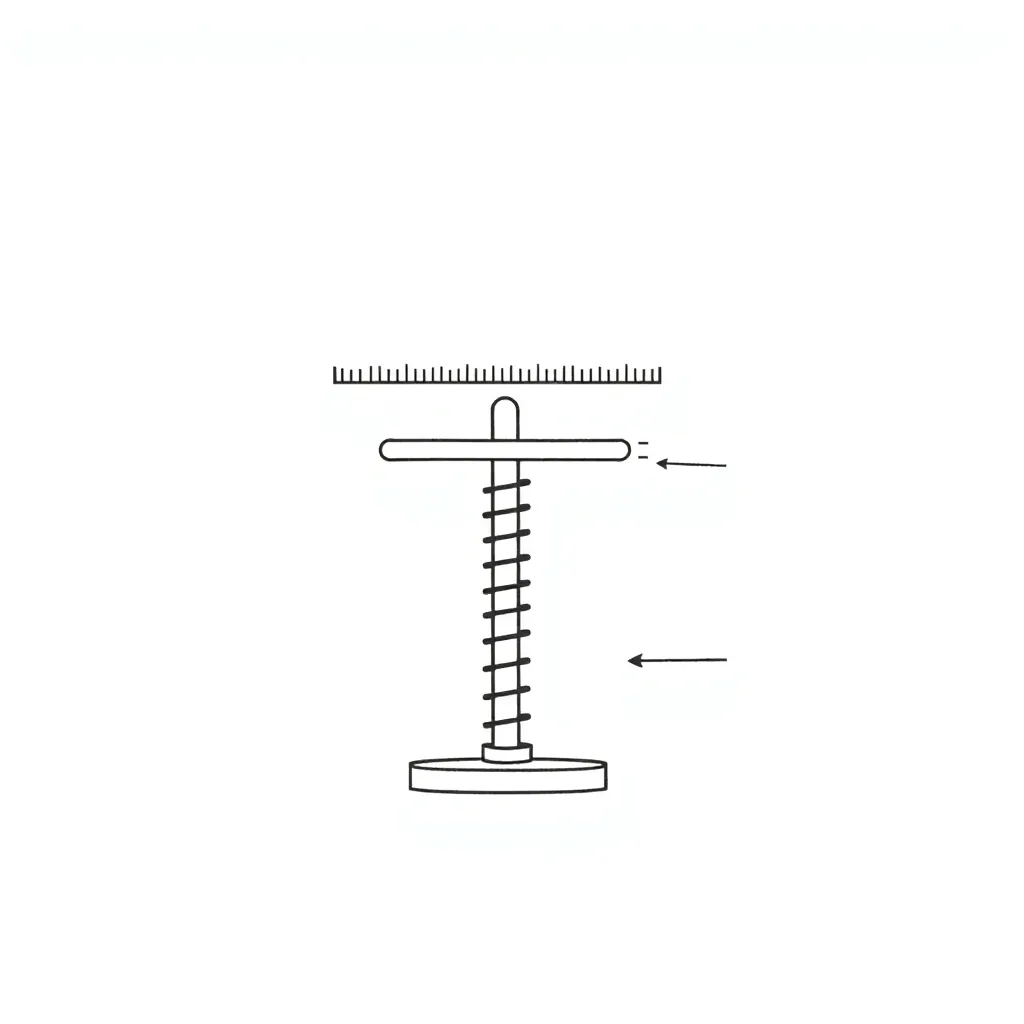
Model Answer: A spring scale works by using a spring that stretches when force is applied. The amount the spring stretches is proportional to the force applied. A scale or dial shows the measurement in force units like pounds or Newtons.
Model Answer: You would observe the popsicle stick bending as force increases, the spring scale reading changing, and possibly hearing cracking sounds as the stick approaches its breaking point. The stick returns to its original shape when small forces are removed.
Model Answer: There is a direct relationship between force and deformation. As you increase the force applied to the popsicle stick, the amount it bends (deformation) also increases. This relationship is often linear until the material reaches its breaking point.
Model Answer: A popsicle stick breaks when the applied force exceeds the material's strength limit. Every material has a maximum stress it can withstand. Beyond this point, the molecular bonds break, causing the stick to fracture or snap completely.
Model Answer: Applying force quickly may cause sudden failure or breaking, while applying force slowly allows you to observe gradual deformation and measure the relationship more accurately. Quick application gives less time to record measurements.
Model Answer: 1) Wear safety glasses to protect eyes from flying pieces, 2) Apply force gradually to avoid sudden snapping, 3) Keep fingers away from the breaking point of the stick to avoid cuts from sharp edges.
Model Answer: Create a data table with columns for force applied (in pounds or Newtons) and deformation observed (in inches or centimeters). Record multiple trials and calculate averages. Graph the results to show the relationship visually.
Model Answer: Factors include: calibration of the spring scale, consistent measurement technique, environmental conditions (temperature/humidity), quality and consistency of popsicle sticks, and human error in reading the scale.
Model Answer: Different materials would show different force-deformation relationships. A plastic ruler might bend more before breaking, requiring less force. A wooden stick might be stronger and require more force. Each material has unique properties affecting its response to applied forces.
About This Worksheet
Free in Kuraplan
Sign up free, grab the PDF, and customize it for your class.
Print-Ready
Formatted for standard paper. Clean layout, easy to read.
AI-Generated
Created with Kuraplan's AI, designed for real classroom use.
For Teachers & Parents
Use in classrooms, for homework, tutoring, or homeschool.
Need a custom version of this worksheet?
Kuraplan's AI generates custom worksheets in seconds — differentiated for every learner, aligned to your curriculum.
Generate Custom Worksheets — FreeMore Science Worksheets
Force and Motion Investigations
Free
Pushes and Pulls Investigations
Free
Forces and Friction Investigation
Free
Forces and Motion Exploration
Free
Forces and Motion Experiments
Free
Forces: Cornell Notes Example
Free
Energy and Forces Worksheet
Free