⚡ Part 1: Multiple Choice
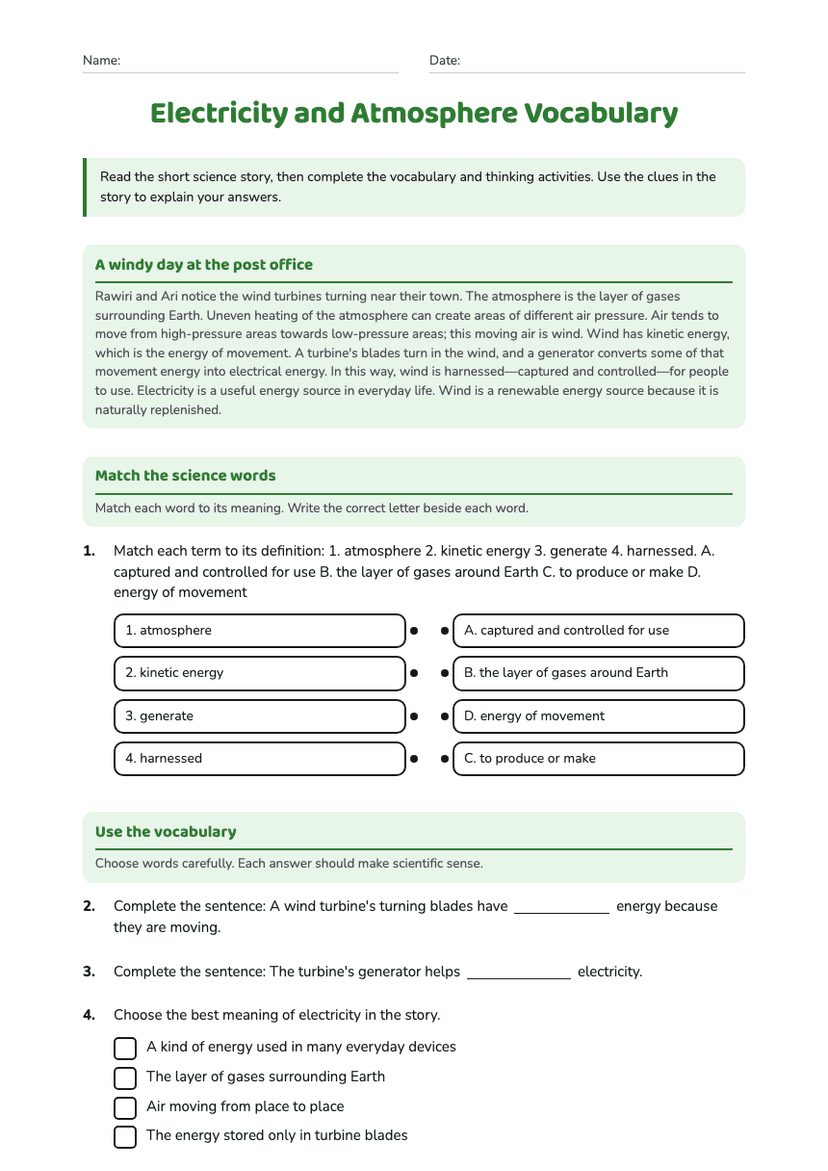
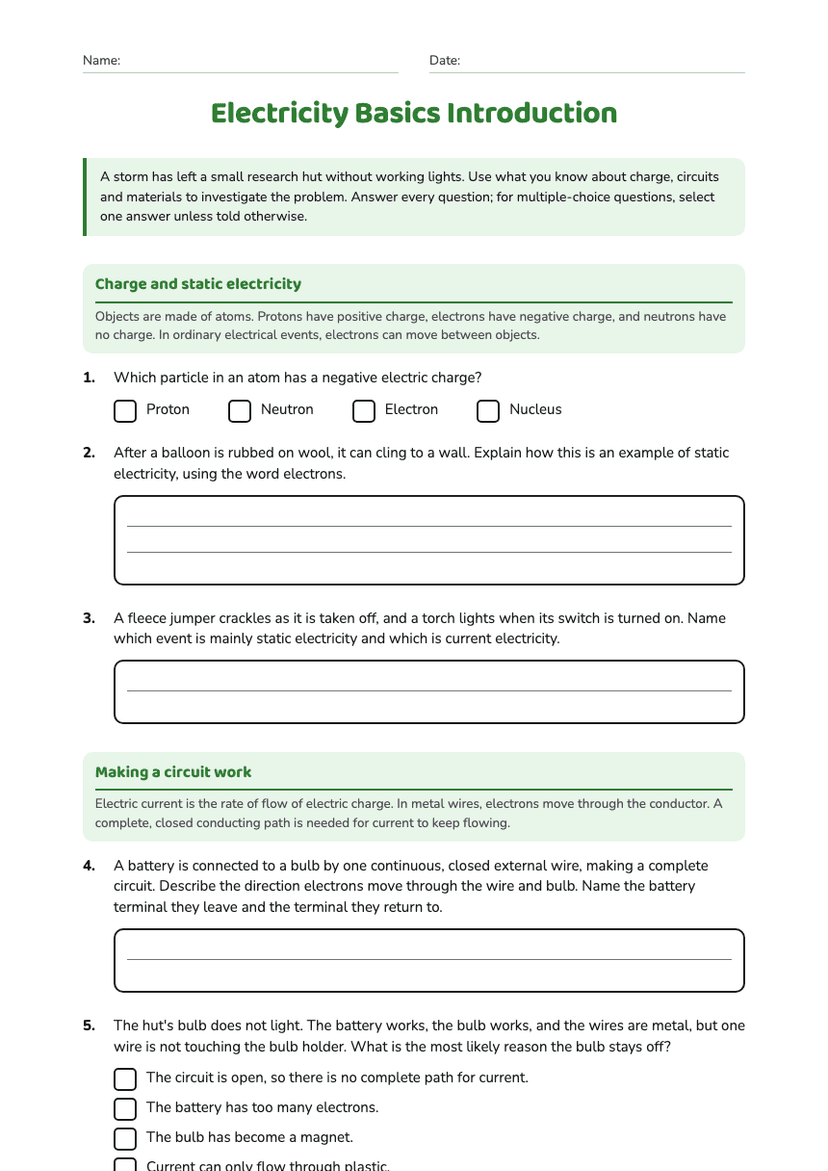
1. Which subatomic particle carries a negative electric charge?
Proton
Neutron
Electron
Nucleus
2. Which subatomic particle carries a positive electric charge?
3. An atom has 8 protons and 10 electrons. What is the overall charge of this atom?
4. Which particles are found in the nucleus of an atom?
Protons
Neutrons
Electrons
Ions
5. When an object gains electrons, it becomes:
Positively charged
Negatively charged
Neutral
Radioactive
6. A balloon rubbed on wool becomes negatively charged because:
It gains protons
It loses protons
It gains electrons
It loses electrons
7. Which statement about electric charge is correct?
Protons can move freely between atoms
Electrons are the main charge carriers in metals
Neutrons carry positive charge
All atoms have equal numbers of protons and electrons
🔬 Part 2: Problem Solving & Analysis
8. Calculate the net charge of an ion with 12 protons and 10 electrons. Show your working.
9. An atom loses 3 electrons. If it originally had 15 protons and 15 electrons, what is its new charge?
10. Complete the table:
Particle | Charge | Location in Atom
Proton | _______ | _______
Electron | _______ | _______
Neutron | _______ | _______
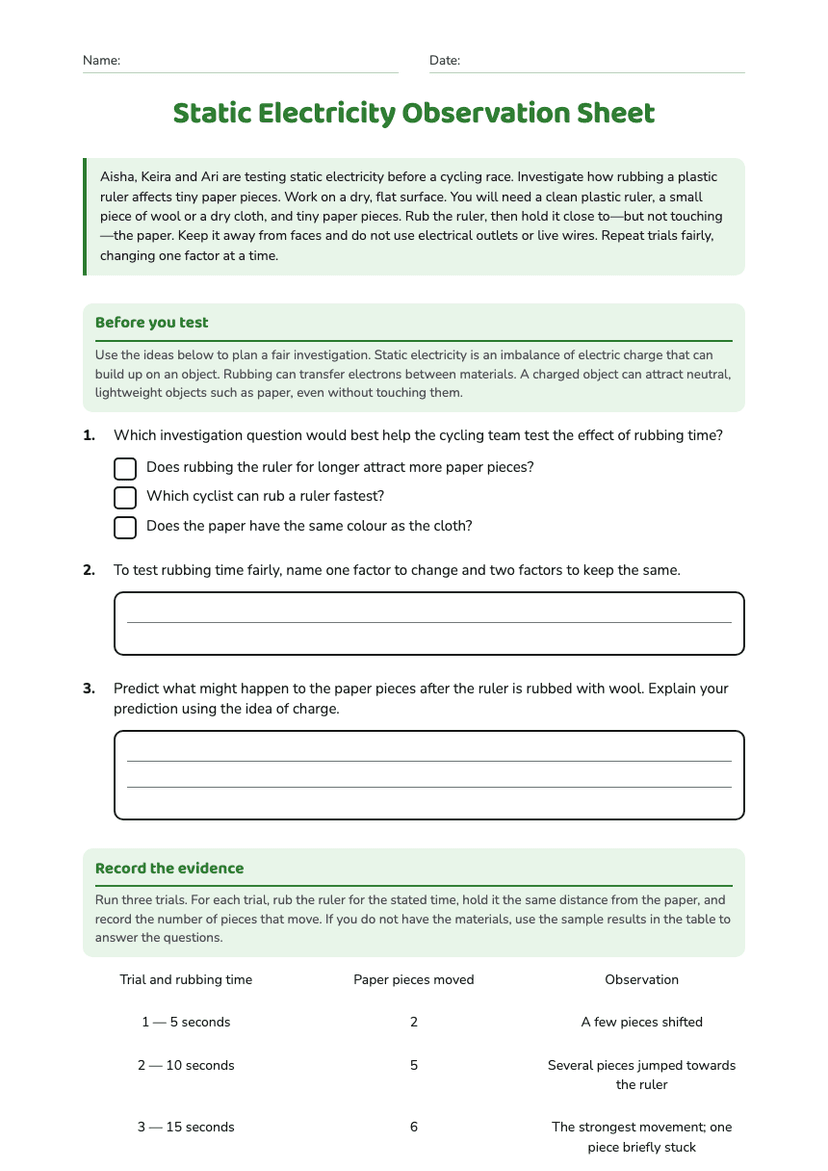
11. Explain why rubbing a plastic rod with fur causes the rod to become charged, using the terms "electrons," "protons," and "transfer."
12. A metal sphere has a charge of -6.4 × 10⁻¹⁹ coulombs. How many excess electrons does it have? (Elementary charge = 1.6 × 10⁻¹⁹ C)
13. Extension Challenge: Two identical metal spheres are charged. Sphere A has +8 units of charge, and Sphere B has -4 units of charge. If they touch and then separate, what will be the final charge on each sphere? Explain your reasoning.
📝 Part 3: Application & Critical Thinking
14. True or False: During charging by friction, both objects involved will have equal but opposite charges.
Answer: _______ Explain: ________________________________
15. List three everyday examples where electric charge carriers (electrons) are important:
16. Why can't we add or remove protons from an atom as easily as we can add or remove electrons?
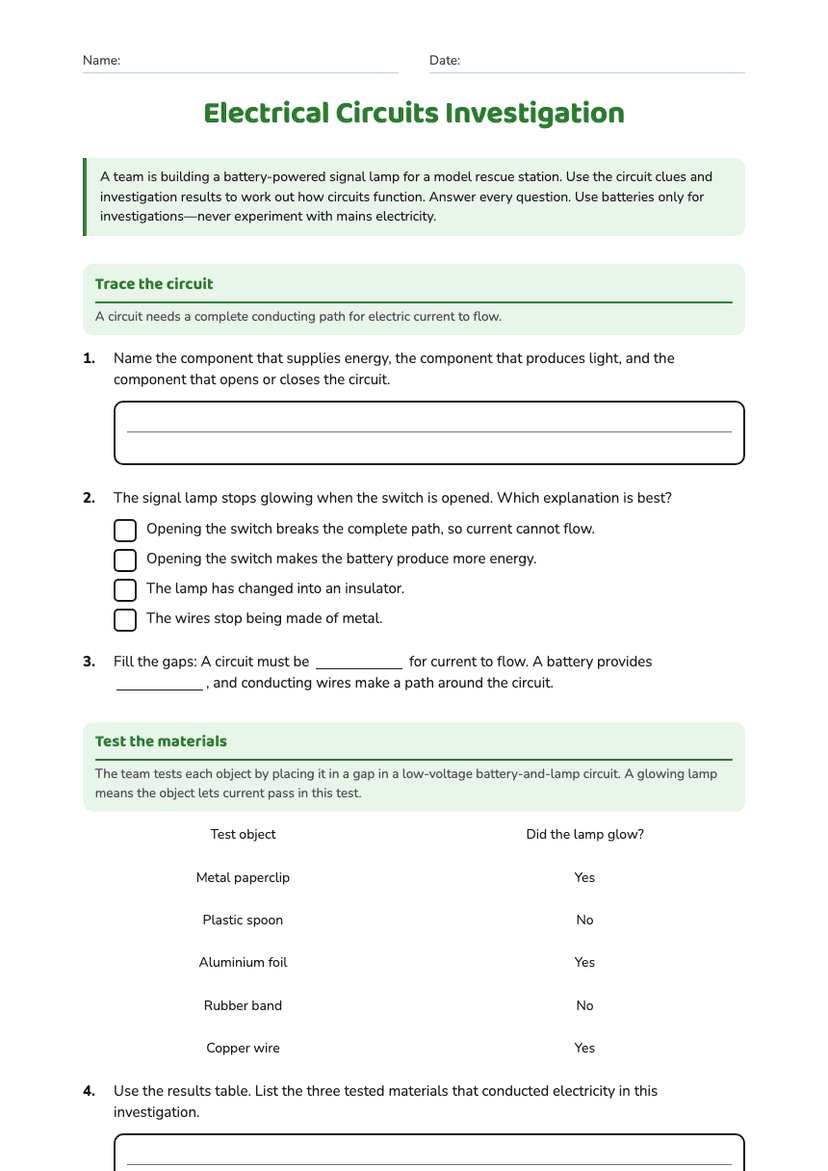
17. A student claims that "positive charges move in electric circuits." Evaluate this statement and explain what actually happens in terms of charge carriers.
18. Advanced: In a lightning bolt, approximately 15 coulombs of charge flows. How many electrons is this equivalent to? Show your calculation.
19. Design an experiment to demonstrate that electrons carry negative charge. Describe your method and expected results.
20. Research Extension: Investigate and explain how charge carriers behave differently in conductors, insulators, and semiconductors. Write a brief summary.
Success Criteria: ✓ Identify charge carriers correctly ✓ Calculate net charges ✓ Explain charging processes ✓ Apply knowledge to real situations
Differentiation Note: Questions 1-7 focus on basic concepts, 8-16 on application, and 17-20 provide extension challenges.