First World War Essentials
A free history worksheet ready for your classroom. Open in Kuraplan to grab the print-ready PDF, customize it for your students, or generate a fresh version in seconds.
First World War Essentials
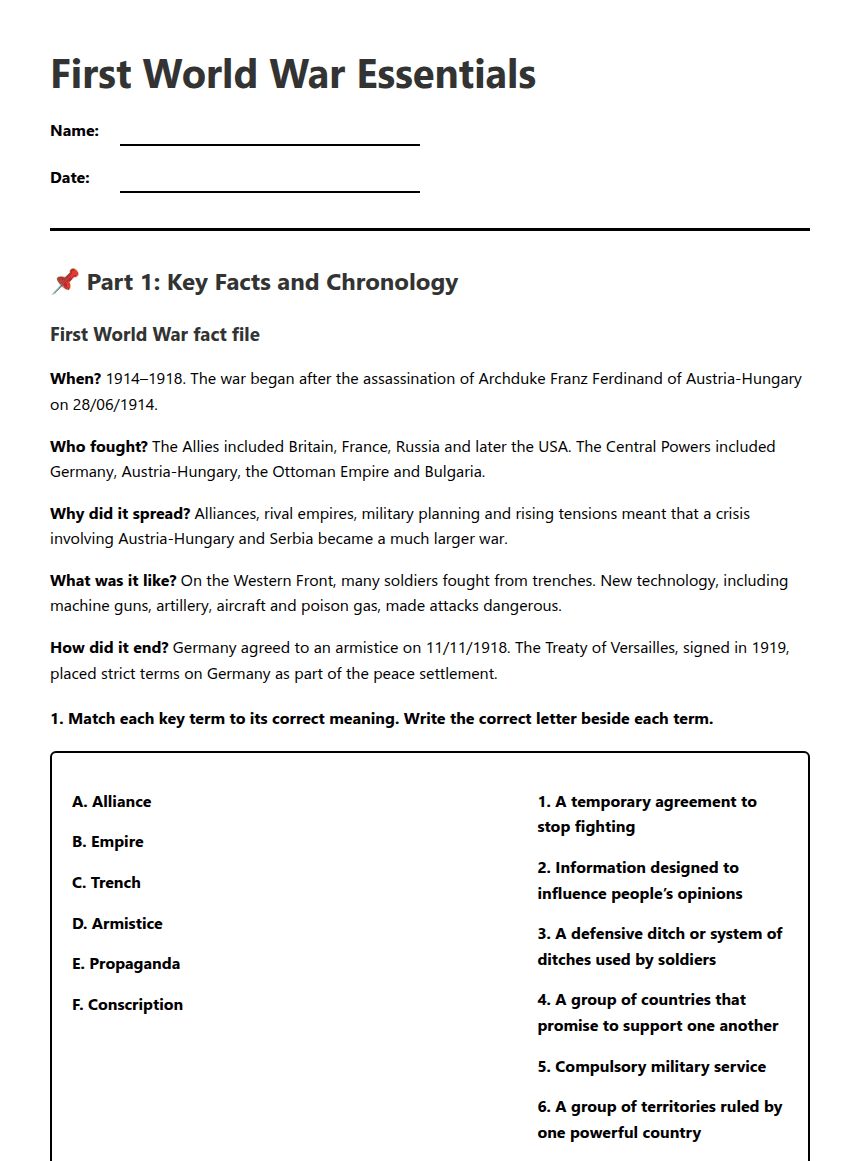
📌 Part 1: Key Facts and Chronology
First World War fact file
When? 1914–1918. The war began after the assassination of Archduke Franz Ferdinand of Austria-Hungary on 28/06/1914.
Who fought? The Allies included Britain, France, Russia and later the USA. The Central Powers included Germany, Austria-Hungary, the Ottoman Empire and Bulgaria.
Why did it spread? Alliances, rival empires, military planning and rising tensions meant that a crisis involving Austria-Hungary and Serbia became a much larger war.
What was it like? On the Western Front, many soldiers fought from trenches. New technology, including machine guns, artillery, aircraft and poison gas, made attacks dangerous.
How did it end? Germany agreed to an armistice on 11/11/1918. The Treaty of Versailles, signed in 1919, placed strict terms on Germany as part of the peace settlement.
_____ Treaty of Versailles is signed
_____ The First World War begins
_____ Battle of the Somme
_____ Armistice ends the fighting
✏️ Part 2: Check Your Understanding
a) The First World War ended with an armistice in 1918. True / False
Correction, if needed: ____________________________________________
b) Propaganda always gives a completely balanced account. True / False
Correction: ________________________________________________________
c) The Treaty of Versailles was signed before the fighting began. True / False
Correction: ________________________________________________________
Source A: Soldier’s letter, Western Front, 1916
“The rain has filled the trench with mud. We spend hours waiting for orders, and the guns never seem to stop. I am thinking of home and hoping this will soon be over.”
Source B: Recruitment poster description, Britain, 1915
“A proud soldier stands beside the words: ‘Your country needs you. Join today and protect your family and freedom.’ The image uses bold lettering and bright colours.”
What does Source A tell you about soldiers’ experiences? Use one detail from the source.
What does Source B suggest about how recruitment propaganda tried to persuade people?
Give one limitation of either source. Think about its viewpoint, purpose or what it leaves out.
✅ Teacher Answer Key
1. A–4, B–6, C–3, D–1, E–2, F–5.
2. Treaty of Versailles = 4; war begins = 1; Battle of the Somme = 2; armistice = 3.
3. The assassination of Archduke Franz Ferdinand.
4. The USA.
5. An agreement to stop fighting.
6. a) True. b) False: propaganda is selected or persuasive information, not always balanced. c) False: the Treaty of Versailles was signed in 1919, after the war had ended.
7. Source A suggests mud, constant shellfire, waiting and homesickness. Source B uses patriotism, duty, family and bold visual language to encourage enlistment. A limitation could be that the letter gives one soldier’s personal viewpoint, while the poster is designed to persuade and does not show the dangers of war.
8. Answers should explain that trench warfare and powerful weapons made attacks costly, while both sides had large armies and strong alliances. The war continued because neither side could easily defeat the other. Credit references to resources, military plans, national determination or changing circumstances such as the USA joining the Allies.
About This Worksheet
Free in Kuraplan
Sign up free, grab the PDF, and customize it for your class.
Print-Ready
Formatted for standard paper. Clean layout, easy to read.
AI-Generated
Created with Kuraplan's AI, designed for real classroom use.
For Teachers & Parents
Use in classrooms, for homework, tutoring, or homeschool.
Need a custom version of this worksheet?
Kuraplan's AI generates custom worksheets in seconds — differentiated for every learner, aligned to your curriculum.
Generate Custom Worksheets — FreeMore History Worksheets
Arkansas History Learning Packet
Free
Arkansas History Made Accessible
Free
Early Humans and Prehistory
Free
Year 7 History Worksheet
Free
History Detectives Worksheet Pack
Free
African American History
Free
Australian History Texts
Free