Forces and Motion Worksheet
A free, printable science worksheet ready for your classroom. Download instantly, print, and hand out to your students — no account needed.
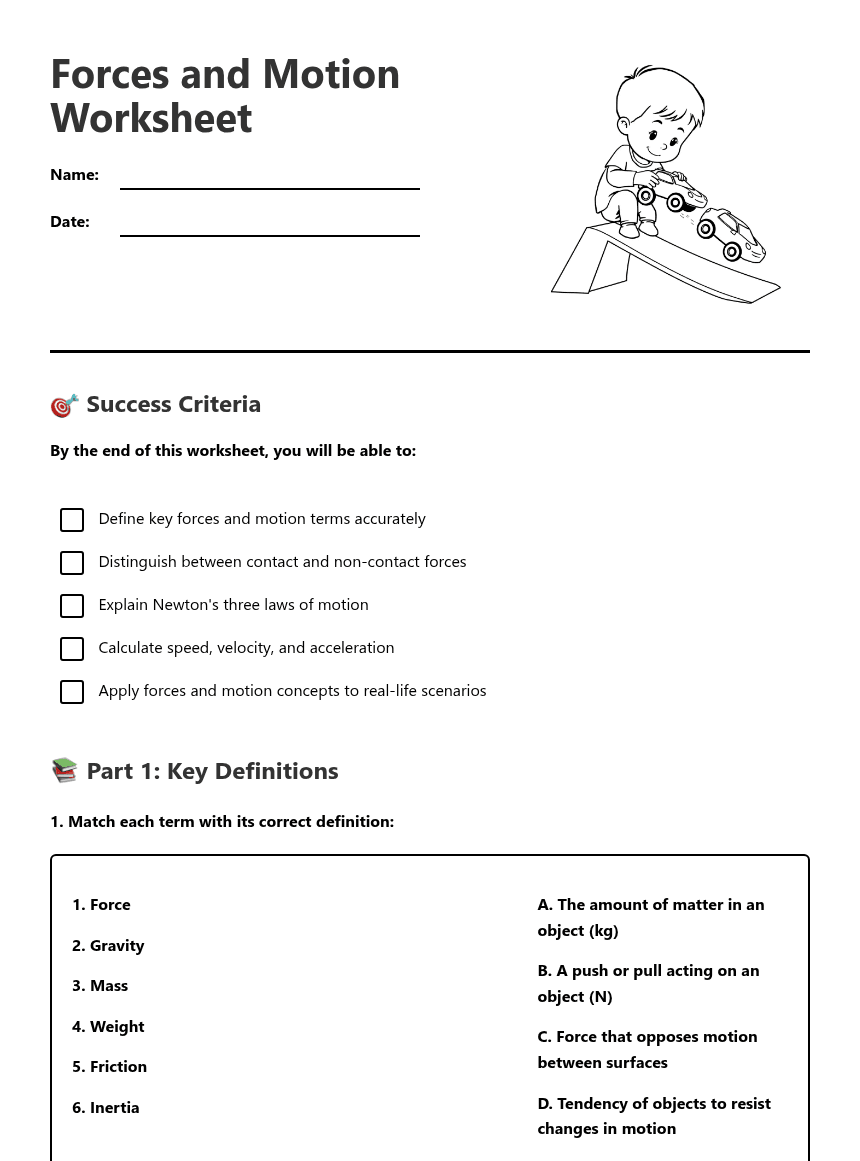
Forces and Motion Worksheet
🎯 Success Criteria
By the end of this worksheet, you will be able to:
📚 Part 1: Key Definitions
Speed:
m/s² m/s kg⋅m/sAcceleration:
m/s² m/s NMomentum:
m/s² kg kg⋅m/s✏️ Part 2: Fill in the Blanks
Box: velocity, scalar, vector, resultant, balanced, unbalanced, contact, non-contact
Speed is a __________ quantity because it only has magnitude, whilst __________ is a __________ quantity because it has both magnitude and direction.
When forces acting on an object are __________, the object remains at rest or moves at constant velocity. When forces are __________, the object will accelerate.
The __________ force is the single force that has the same effect as all the individual forces acting on an object.
Friction is an example of a __________ force, whilst gravity is an example of a __________ force.
Newton's First Law: An object at rest stays at ________, and an object in motion stays in ________ at constant ________, unless acted upon by an ________ force. This is also known as the law of ________.
Newton's Second Law: The acceleration of an object is directly proportional to the ________ force acting on it and inversely proportional to its ________. Formula: F = ________ × ________
Newton's Third Law: For every action, there is an equal and ________ reaction acting in the ________ direction.
🧮 Part 3: Calculations
a) A car travels 150 metres in 10 seconds. Calculate its speed.
b) A cyclist accelerates from 5 m/s to 15 m/s in 4 seconds. Calculate the acceleration.
c) Calculate the weight of a 60 kg person on Earth (g = 9.8 m/s²).
d) A 2 kg object moving at 8 m/s collides with a stationary 3 kg object. Calculate the initial momentum.
🔬 Part 4: Concepts and Applications
A book resting on a table:
Tension Compression Air resistanceA stretched rubber band:
Tension Compression FrictionA parachutist falling at terminal velocity:
Balanced forces Unbalanced forces No forcesWhich factors affect kinetic energy?
Mass of the object Velocity of the object Height of the object Temperature of the object🚀 Part 5: Extension Questions
🎨 Part 6: Visual Learning
• Starts from rest
• Accelerates for 3 seconds
• Travels at constant velocity for 2 seconds
• Decelerates to a stop over 1 second
💡 Differentiation Support
For students needing extra support:
For advanced learners:
Forces and their effects: _____ / 5
Newton's Laws: _____ / 5
Motion calculations: _____ / 5
Energy and motion: _____ / 5
About This Worksheet
Free Download
No sign-up, no email, no paywall. Just download and print.
Print-Ready
Formatted for standard paper. Clean layout, easy to read.
AI-Generated
Created with Kuraplan's AI, designed for real classroom use.
For Teachers & Parents
Use in classrooms, for homework, tutoring, or homeschool.
Need a custom version of this worksheet?
Kuraplan's AI generates custom worksheets in seconds — differentiated for every learner, aligned to your curriculum.
Generate Custom Worksheets — Free