ScienceFreePrintable
Living Things Classification
A free, printable science worksheet ready for your classroom. Download instantly, print, and hand out to your students — no account needed.
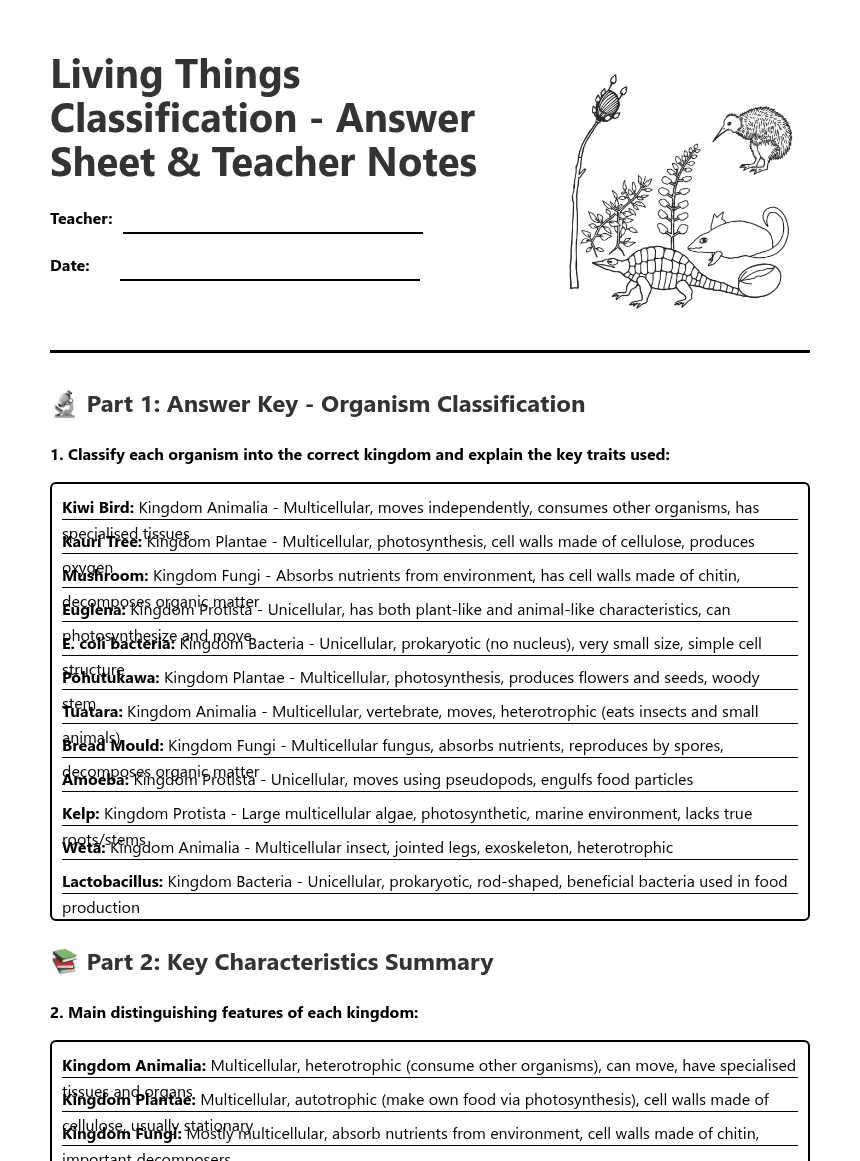
Living Things Classification - Answer Sheet & Teacher Notes
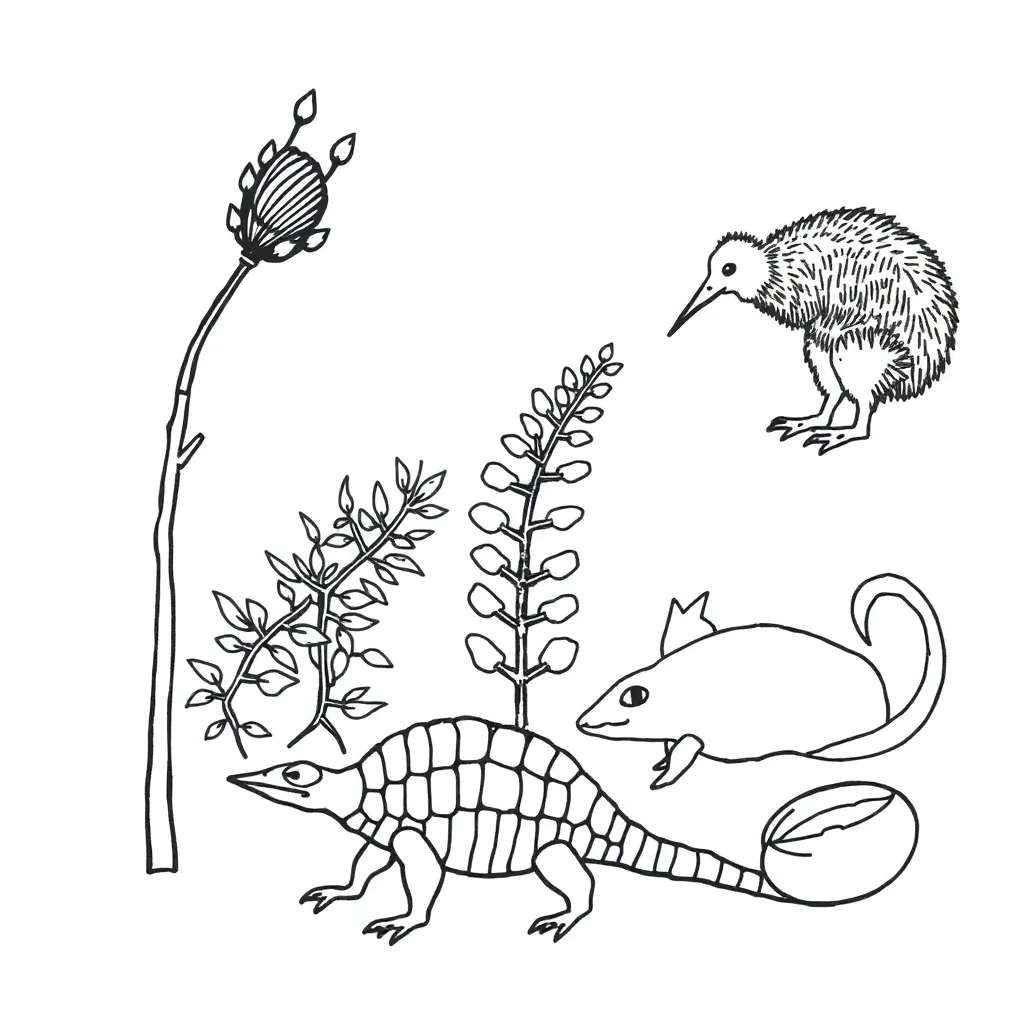
🔬 Part 1: Answer Key - Organism Classification
1. Classify each organism into the correct kingdom and explain the key traits used:
Kiwi Bird: Kingdom Animalia - Multicellular, moves independently, consumes other organisms, has specialised tissues
Kauri Tree: Kingdom Plantae - Multicellular, photosynthesis, cell walls made of cellulose, produces oxygen
Mushroom: Kingdom Fungi - Absorbs nutrients from environment, has cell walls made of chitin, decomposes organic matter
Euglena: Kingdom Protista - Unicellular, has both plant-like and animal-like characteristics, can photosynthesize and move
E. coli bacteria: Kingdom Bacteria - Unicellular, prokaryotic (no nucleus), very small size, simple cell structure
Pōhutukawa: Kingdom Plantae - Multicellular, photosynthesis, produces flowers and seeds, woody stem
Tuatara: Kingdom Animalia - Multicellular, vertebrate, moves, heterotrophic (eats insects and small animals)
Bread Mould: Kingdom Fungi - Multicellular fungus, absorbs nutrients, reproduces by spores, decomposes organic matter
Amoeba: Kingdom Protista - Unicellular, moves using pseudopods, engulfs food particles
Kelp: Kingdom Protista - Large multicellular algae, photosynthetic, marine environment, lacks true roots/stems
Wētā: Kingdom Animalia - Multicellular insect, jointed legs, exoskeleton, heterotrophic
Lactobacillus: Kingdom Bacteria - Unicellular, prokaryotic, rod-shaped, beneficial bacteria used in food production
📚 Part 2: Key Characteristics Summary
2. Main distinguishing features of each kingdom:
Kingdom Animalia: Multicellular, heterotrophic (consume other organisms), can move, have specialised tissues and organs
Kingdom Plantae: Multicellular, autotrophic (make own food via photosynthesis), cell walls made of cellulose, usually stationary
Kingdom Fungi: Mostly multicellular, absorb nutrients from environment, cell walls made of chitin, important decomposers
Kingdom Protista: Mostly unicellular, diverse group with mixed characteristics, includes algae, protozoa, and slime moulds
Kingdom Bacteria: Unicellular, prokaryotic (no membrane-bound nucleus), very small, found everywhere on Earth
🎯 Part 3: Teacher Discussion Points
3. Key discussion questions to guide student learning:
• Why might some organisms be difficult to classify? (e.g., Euglena has both plant and animal characteristics)
• How do scientists decide when to create new kingdoms or reclassify organisms?
• What tools help scientists classify very small organisms like bacteria?
• How does classification help us understand biodiversity in New Zealand?
• What role do native NZ species play in their ecosystems?
⚠️ Part 4: Common Student Misconceptions
4. Watch out for these common errors:
Misconception: All small organisms are bacteria
Correction: Many protists are also microscopic but have different cell structures
Misconception: Fungi are plants because they don't move
Correction: Fungi absorb nutrients rather than photosynthesise, and have different cell wall composition
Misconception: All algae are plants
Correction: Most algae belong to Kingdom Protista, though they photosynthesise like plants
Misconception: Classification never changes
Correction: Scientific classification evolves as we discover new evidence and better understand relationships
🌿 Part 5: New Zealand Curriculum Connections
5. Curriculum alignment and extension activities:
Level 4 Achievement Objective: Recognise common features of living things and explore diversity and classification
Key Competencies developed:
• Thinking: Analysing characteristics and making classification decisions
• Using language: Communicating scientific reasoning and terminology
• Participating and contributing: Working collaboratively in group activities
Extension activities:
• Research endemic NZ species and their classification
• Create a dichotomous key for local organisms
• Explore Māori traditional knowledge of native species classification
• Investigate how DNA analysis has changed modern classification
📝 Part 6: Assessment Rubric
6. Student performance indicators:
Excellent (A): Correctly classifies all organisms with detailed, accurate explanations of distinguishing characteristics
Good (B): Correctly classifies most organisms with generally accurate explanations, minor errors in detail
Satisfactory (C): Correctly classifies some organisms with basic explanations, shows understanding of main concepts
Needs Support (D): Limited correct classifications, requires additional support to understand basic classification principles
About This Worksheet
Free Download
No sign-up, no email, no paywall. Just download and print.
Print-Ready
Formatted for standard paper. Clean layout, easy to read.
AI-Generated
Created with Kuraplan's AI, designed for real classroom use.
For Teachers & Parents
Use in classrooms, for homework, tutoring, or homeschool.
Need a custom version of this worksheet?
Kuraplan's AI generates custom worksheets in seconds — differentiated for every learner, aligned to your curriculum.
Generate Custom Worksheets — Free No credit card Curriculum-aligned Under 60 seconds