Living Things Marking Guide
A free science worksheet ready for your classroom. Open in Kuraplan to grab the print-ready PDF, customize it for your students, or generate a fresh version in seconds.
Living Things Marking Guide
📋 General Marking Rubric - "Explain Using Evidence" Questions
3 marks: Relevant concept correctly identified + accurate evidence/data reference + clear explanation
2 marks: Concept identified + some evidence OR clear explanation with minor gaps
1 mark: Basic understanding shown but limited evidence or unclear explanation
0 marks: Incorrect concept or no relevant evidence provided
🔬 Section 1-3: Cell Structure & Organisation
Key points: Cell wall, chloroplasts, vacuole (plant only). Award 1 mark per correct difference with accurate description.
Accept: Nucleus, cytoplasm, cell membrane, mitochondria, cell wall, chloroplasts. 1 mark per correct label in appropriate location.
Correct sequence: Cell → Tissue → Organ → Organ System → Organism. Common misconception: confusing tissue/organ order.
Red blood cells: Carry oxygen, no nucleus, biconcave shape (2 marks)
Root hair cells: Absorb water/nutrients, large surface area, thin walls (2 marks)
Nerve cells: Transmit electrical signals, long extensions, insulation (2 marks)
🌱 Section 4-6: Life Processes & Classification
Accept: Movement, Respiration, Sensitivity, Growth, Reproduction, Excretion, Nutrition. 1 mark each.
6CO₂ + 6H₂O → C₆H₁₂O₆ + 6O₂ Award marks: reactants (2), products (2). Accept word equation for partial credit.
Kingdom → Phylum → Class → Order → Family → Genus → Species. Award 1 mark per correct level in sequence.
Genus + species, italicised/underlined, genus capitalised. Common error: both words capitalised.
📊 Section 7-8: Ecosystems & Data Analysis
Arrows show energy flow direction (2), correct trophic levels (2), appropriate NZ species (2).
Expected interpretations: Identify peak population year, calculate percentage change, describe trend pattern. Award marks for accurate data reading + correct calculations.
Students should: Compare species diversity between sites, link to environmental factors, suggest reasons for differences. Look for evidence-based reasoning using provided dataset.
🧬 Section 9-10: Adaptation & Evolution
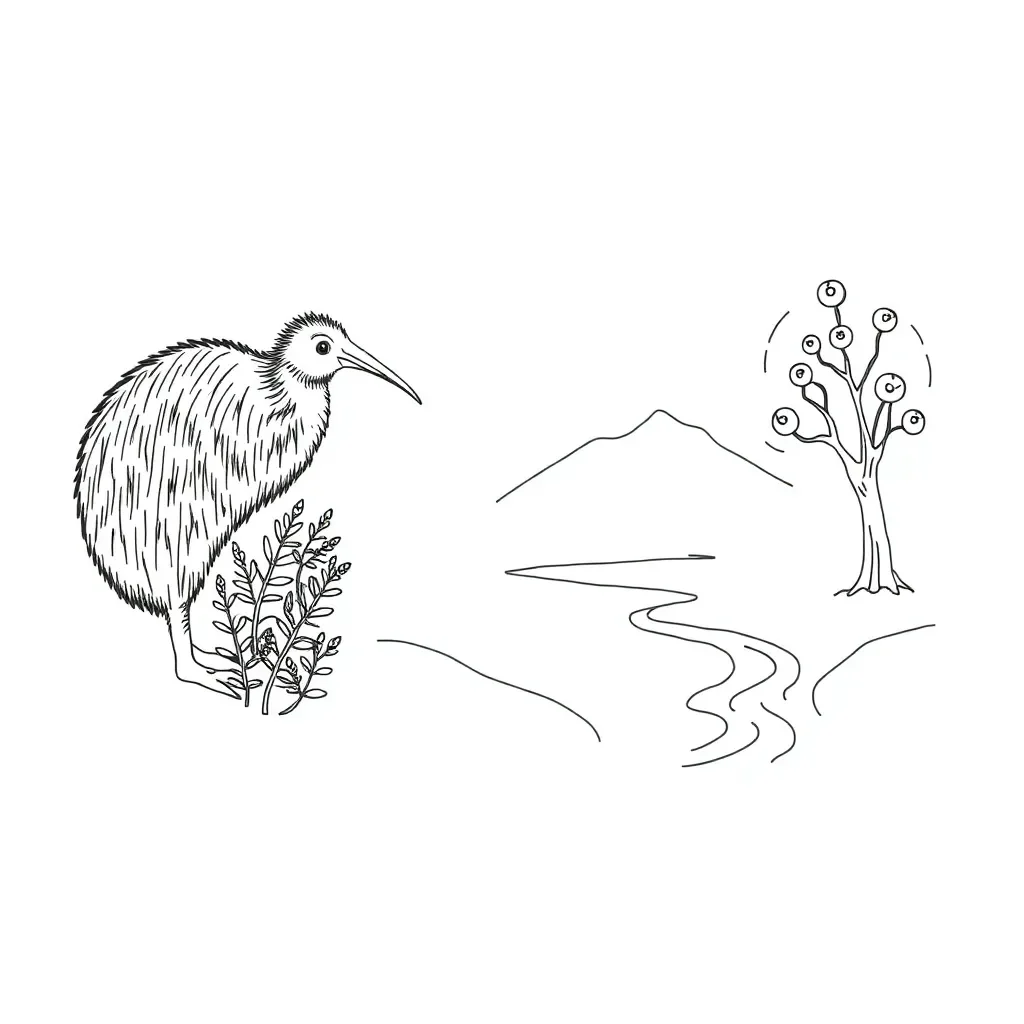
Kiwi: Flightless, strong legs, long beak for ground feeding (3 marks)
Kauri: Thick bark, buttress roots, waxy leaves (3 marks)
Key concepts: Variation (2), inheritance (2), selection pressure (2), survival advantage (2)
Common misconception: "Need creates adaptation" - emphasise random variation first.
Accept: Fossil record, comparative anatomy, DNA similarities, biogeography. 1 mark per valid example with explanation.
Total Marks: _____ / 73
About This Worksheet
Free in Kuraplan
Sign up free, grab the PDF, and customize it for your class.
Print-Ready
Formatted for standard paper. Clean layout, easy to read.
AI-Generated
Created with Kuraplan's AI, designed for real classroom use.
For Teachers & Parents
Use in classrooms, for homework, tutoring, or homeschool.
Need a custom version of this worksheet?
Kuraplan's AI generates custom worksheets in seconds — differentiated for every learner, aligned to your curriculum.
Generate Custom Worksheets — FreeMore Science Worksheets
Danforth: Authority and Conscience
Free
Natural Resources Science
Free
Natural Resources Science
Free
Vitamins, Minerals, and Protein Science
Free
Exploring Science Materials
Free
Waka Buoyancy Science Worksheet
Free
Science Skills Made Simple
Free