Natural Hazards Quiz Worksheet
A free, printable science worksheet ready for your classroom. Download instantly, print, and hand out to your students — no account needed.
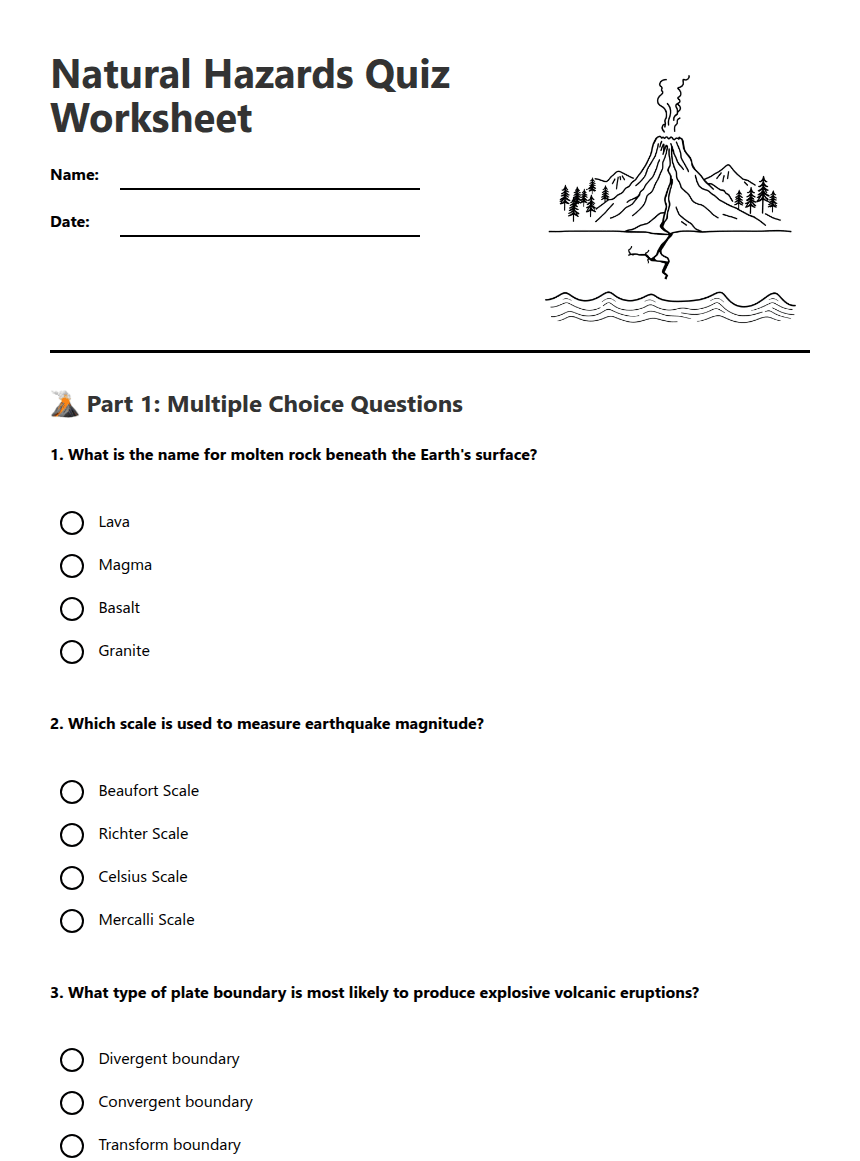
Natural Hazards Quiz Worksheet
🌋 Part 1: Multiple Choice Questions
📝 Part 2: Short Answer Questions
🗺️ Part 3: Applied Knowledge
📋 ANSWER SHEET
Part 1: Multiple Choice Answers
1. Magma - Molten rock beneath Earth's surface is called magma
2. Richter Scale - The Richter Scale measures earthquake magnitude
3. Convergent boundary - Where plates collide, creating explosive eruptions
4. Earthquakes, Volcanic eruptions, Tsunamis - All are natural hazards (car accidents are human-caused)
5. Epicentre - The surface point directly above the earthquake focus
Part 2: Short Answer Responses
6. Magma is molten rock beneath the Earth's surface, while lava is magma that has reached the surface during a volcanic eruption.
7. Three volcanic hazards:
• Pyroclastic flows - fast-moving hot gas and rock debris
• Lava flows - streams of molten rock that destroy everything in their path
• Volcanic ash - fine particles that can damage lungs and disrupt transport
8. The focus (or hypocentre) is the underground point where an earthquake begins, while the epicentre is the point on the surface directly above it.
9. Two earthquake preparation methods:
• Secure heavy furniture and objects that could fall
• Create an emergency kit with water, food, and first aid supplies
Part 3: Applied Knowledge Responses
10. New Zealand sits on the boundary between the Pacific and Australian tectonic plates, making it part of the "Ring of Fire." This location causes frequent plate movement, resulting in earthquakes and volcanic activity.
11. A pyroclastic flow is a fast-moving current of hot gas, ash, and volcanic rock that flows down volcano slopes. It's dangerous because it moves extremely fast (up to 700 km/h), reaches temperatures of 1000°C, and destroys everything in its path.
12. Three immediate earthquake safety actions:
• Drop to hands and knees
• Take cover under a desk or table
• Hold on to your shelter and protect your head and neck
About This Worksheet
Free Download
No sign-up, no email, no paywall. Just download and print.
Print-Ready
Formatted for standard paper. Clean layout, easy to read.
AI-Generated
Created with Kuraplan's AI, designed for real classroom use.
For Teachers & Parents
Use in classrooms, for homework, tutoring, or homeschool.
Need a custom version of this worksheet?
Kuraplan's AI generates custom worksheets in seconds — differentiated for every learner, aligned to your curriculum.
Generate Custom Worksheets — Free