FreePrintable

Nervous System Reaction Time

A free, printable general worksheet ready for your classroom. Download instantly, print, and hand out to your students — no account needed.
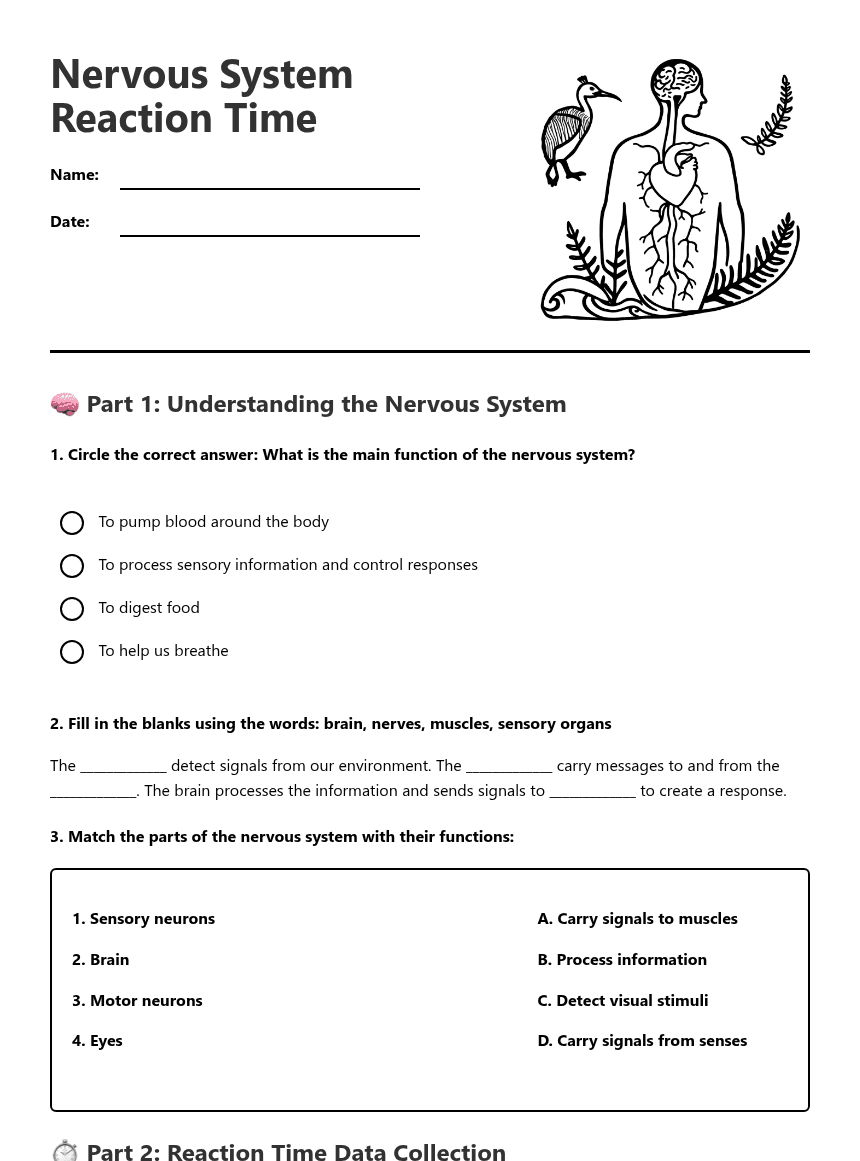
Nervous System Reaction Time worksheet preview
Nervous System Reaction Time

Nervous System Reaction Time

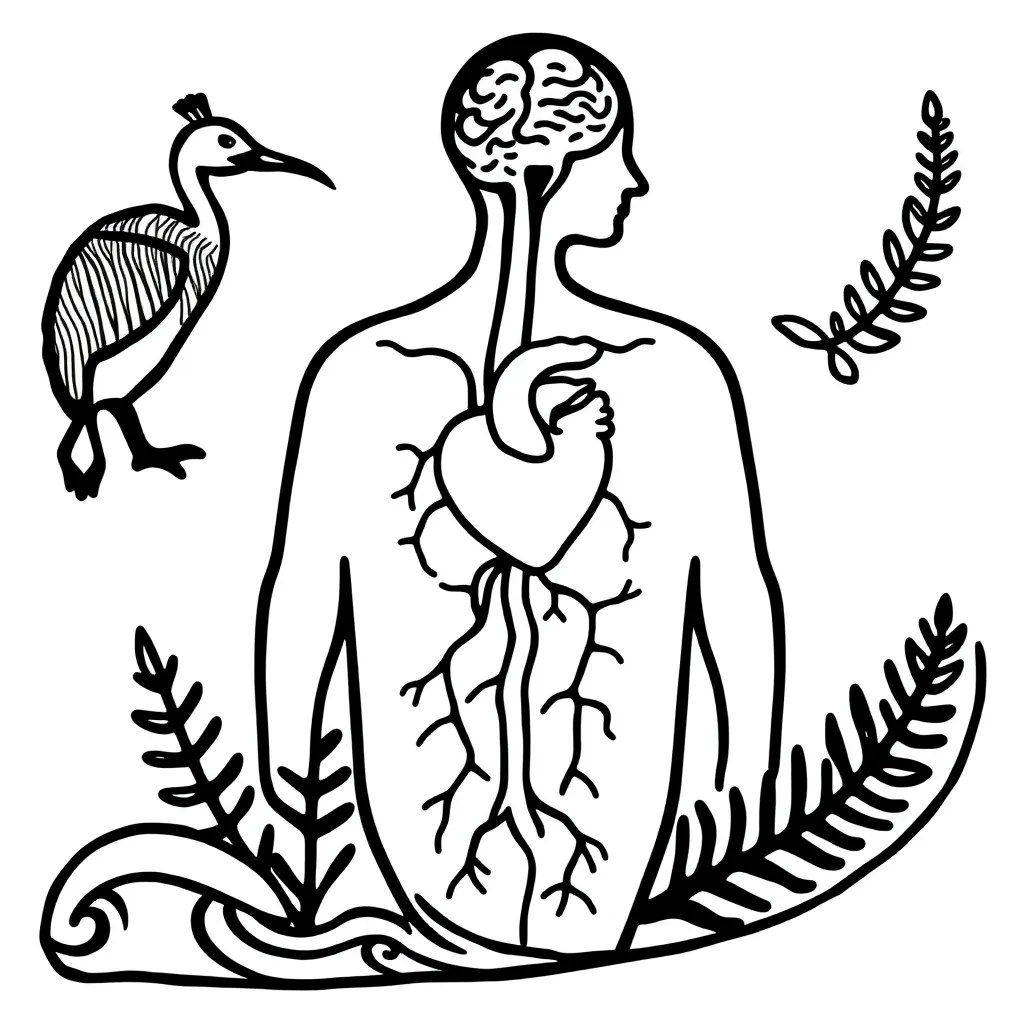
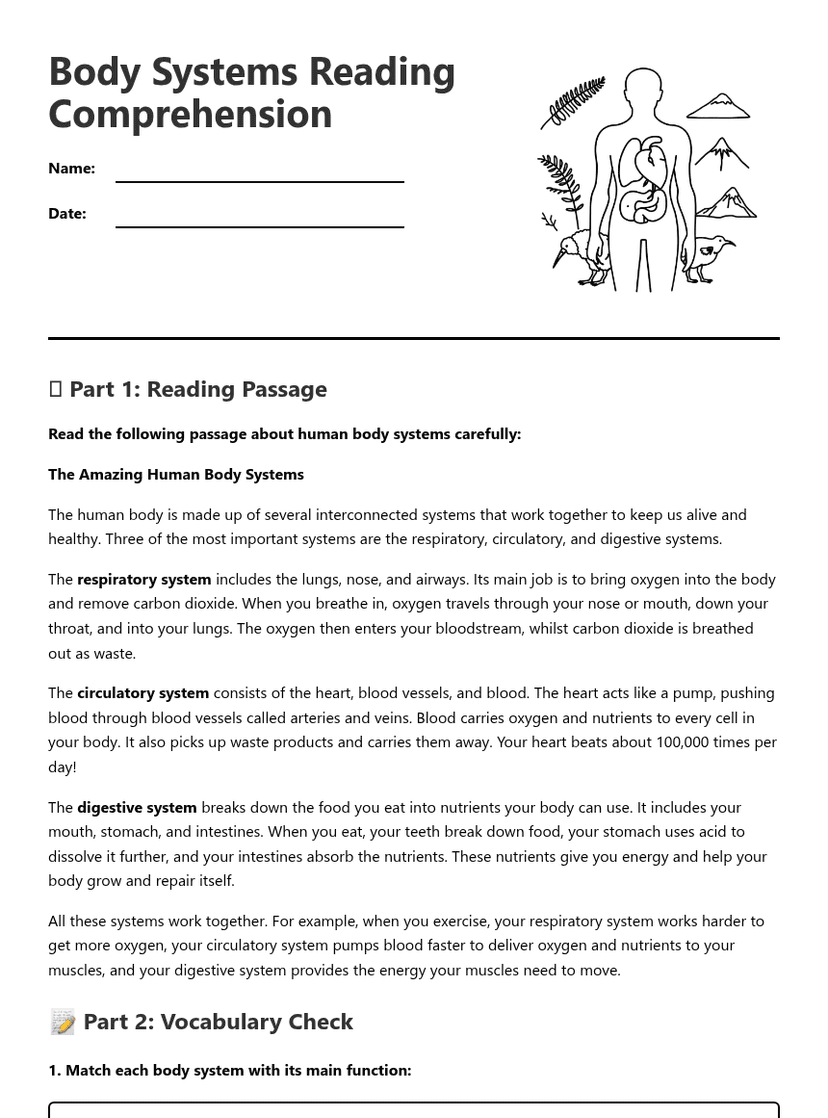
Brain and nervous system illustration

🧠 Part 1: Understanding the Nervous System

1. Circle the correct answer: What is the main function of the nervous system?

To pump blood around the body

To process sensory information and control responses

To digest food

To help us breathe

2. Fill in the blanks using the words: brain, nerves, muscles, sensory organs

The _____________ detect signals from our environment. The _____________ carry messages to and from the _____________. The brain processes the information and sends signals to _____________ to create a response.

3. Match the parts of the nervous system with their functions:
1. Sensory neurons
2. Brain
3. Motor neurons
4. Eyes
A. Carry signals to muscles
B. Process information
C. Detect visual stimuli
D. Carry signals from senses

⏱️ Part 2: Reaction Time Data Collection

4. Record your reaction time results in the table below. Work with your partner to complete 5 trials for each type of stimulus.

Visual Stimulus Reaction Times (seconds)

Trial 1: _______ seconds     Trial 2: _______ seconds     Trial 3: _______ seconds

Trial 4: _______ seconds     Trial 5: _______ seconds

Average visual reaction time: _______ seconds

Auditory Stimulus Reaction Times (seconds)

Trial 1: _______ seconds     Trial 2: _______ seconds     Trial 3: _______ seconds

Trial 4: _______ seconds     Trial 5: _______ seconds

Average auditory reaction time: _______ seconds

5. Calculate the difference between your average visual and auditory reaction times:

📊 Part 3: Data Analysis

6. Circle the correct answer: Which type of stimulus generally produces faster reaction times?

Visual stimuli

Auditory stimuli

They are exactly the same

It varies from person to person

7. Compare your results with a classmate. Record their average reaction times:

Classmate's name: _________________

Their average visual reaction time: _______ seconds

Their average auditory reaction time: _______ seconds

8. Explain why there might be differences in reaction times between different people:

🔬 Part 4: Neural Pathways

9. Draw and label the pathway of a nerve signal from stimulus to response. Include: sensory organ, sensory neuron, brain, motor neuron, muscle.
10. Check all the factors that could affect reaction time:

Age

Tiredness

Practice

Distractions

Type of stimulus

Time of day

11. Explain what happens in your nervous system during the reaction time test, from the moment you see or hear the signal until you respond:

🤔 Part 5: Reflection and Extension

12. What surprised you most about reaction times during this activity?
13. Why is having a fast reaction time important in everyday life? Give two examples:

Example 1: ________________________________________________

Example 2: ________________________________________________

14. Circle the correct answer: A reflex action (like pulling your hand away from something hot) is:

Slower than normal reaction time because it goes through the brain

Faster than normal reaction time because it bypasses the brain

The same speed as normal reaction time

Only possible when you're awake

15. Extension: Research and write one interesting fact about animal reaction times compared to humans:

About This Worksheet

Free Download

No sign-up, no email, no paywall. Just download and print.

Print-Ready

Formatted for standard paper. Clean layout, easy to read.

AI-Generated

Created with Kuraplan's AI, designed for real classroom use.

For Teachers & Parents

Use in classrooms, for homework, tutoring, or homeschool.

Need a custom version of this worksheet?

Kuraplan's AI generates custom worksheets in seconds — differentiated for every learner, aligned to your curriculum.

Generate Custom Worksheets — Free
No credit card Curriculum-aligned Under 60 seconds