Periodic Table Properties Worksheet
A free, printable science worksheet ready for your classroom. Download instantly, print, and hand out to your students — no account needed.
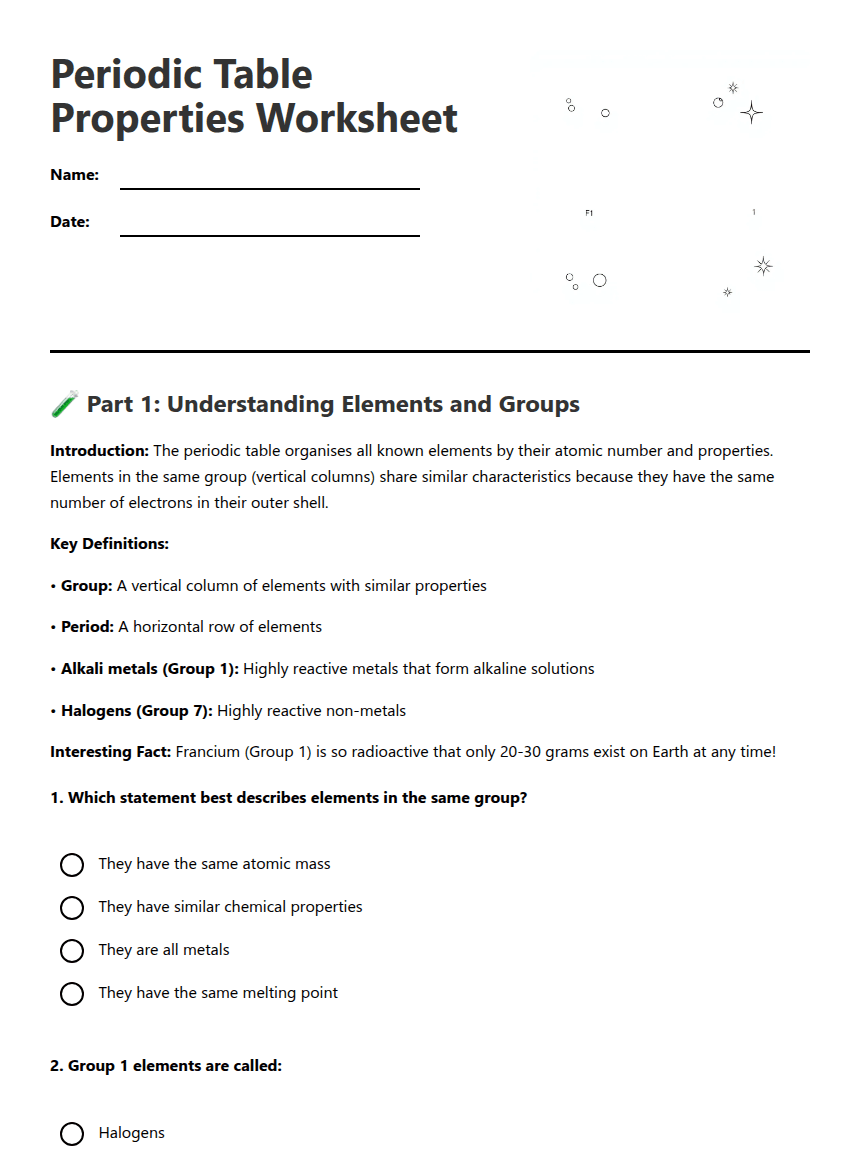
Periodic Table Properties Worksheet

🧪 Part 1: Understanding Elements and Groups
Introduction: The periodic table organises all known elements by their atomic number and properties. Elements in the same group (vertical columns) share similar characteristics because they have the same number of electrons in their outer shell.
Key Definitions:
• Group: A vertical column of elements with similar properties
• Period: A horizontal row of elements
• Alkali metals (Group 1): Highly reactive metals that form alkaline solutions
• Halogens (Group 7): Highly reactive non-metals
Interesting Fact: Francium (Group 1) is so radioactive that only 20-30 grams exist on Earth at any time!
⚗️ Part 2: Comparing Group 1 and Group 7 Properties
Group 1 (Alkali Metals) Properties:
• Soft metals that can be cut with a knife • React vigorously with water • Form ionic compounds • Low density (lithium floats on water!)
Group 7 (Halogens) Properties:
• Exist as diatomic molecules (F₂, Cl₂, etc.) • Reactivity decreases down the group • Form salts when combined with metals • Toxic and corrosive
🎯 Part 3: Application and Analysis
About This Worksheet
Free Download
No sign-up, no email, no paywall. Just download and print.
Print-Ready
Formatted for standard paper. Clean layout, easy to read.
AI-Generated
Created with Kuraplan's AI, designed for real classroom use.
For Teachers & Parents
Use in classrooms, for homework, tutoring, or homeschool.
Need a custom version of this worksheet?
Kuraplan's AI generates custom worksheets in seconds — differentiated for every learner, aligned to your curriculum.
Generate Custom Worksheets — Free