Plant Transpiration and Respiration
A free science worksheet ready for your classroom. Open in Kuraplan to grab the print-ready PDF, customize it for your students, or generate a fresh version in seconds.
Plant Transpiration and Respiration
🎯 WALT (We Are Learning To)
Understand the processes of transpiration and respiration in plants
Success Criteria:
• Explain what transpiration is and why it happens
• Describe how plants respire and why they need to
• Identify the differences between transpiration and respiration
• Use scientific vocabulary correctly
📖 Reading Passage: How Plants Move Water and Breathe
What is Transpiration?
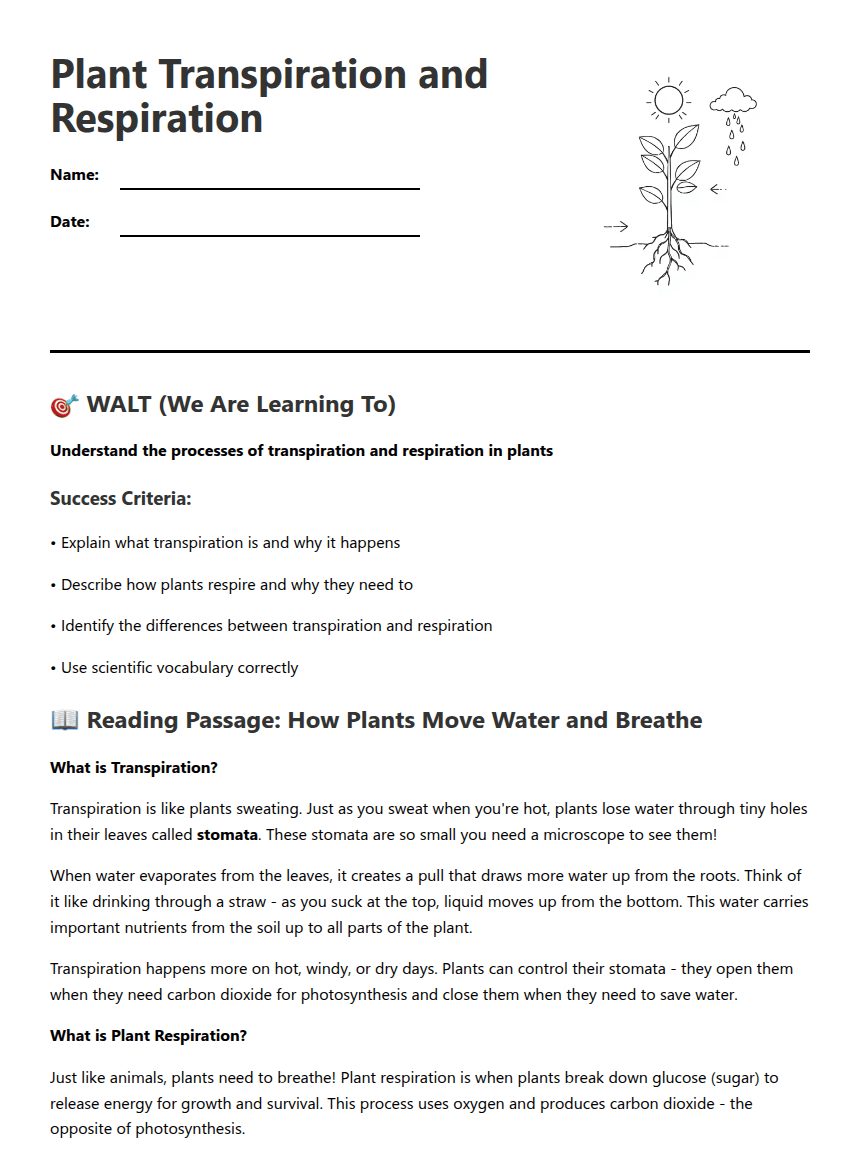
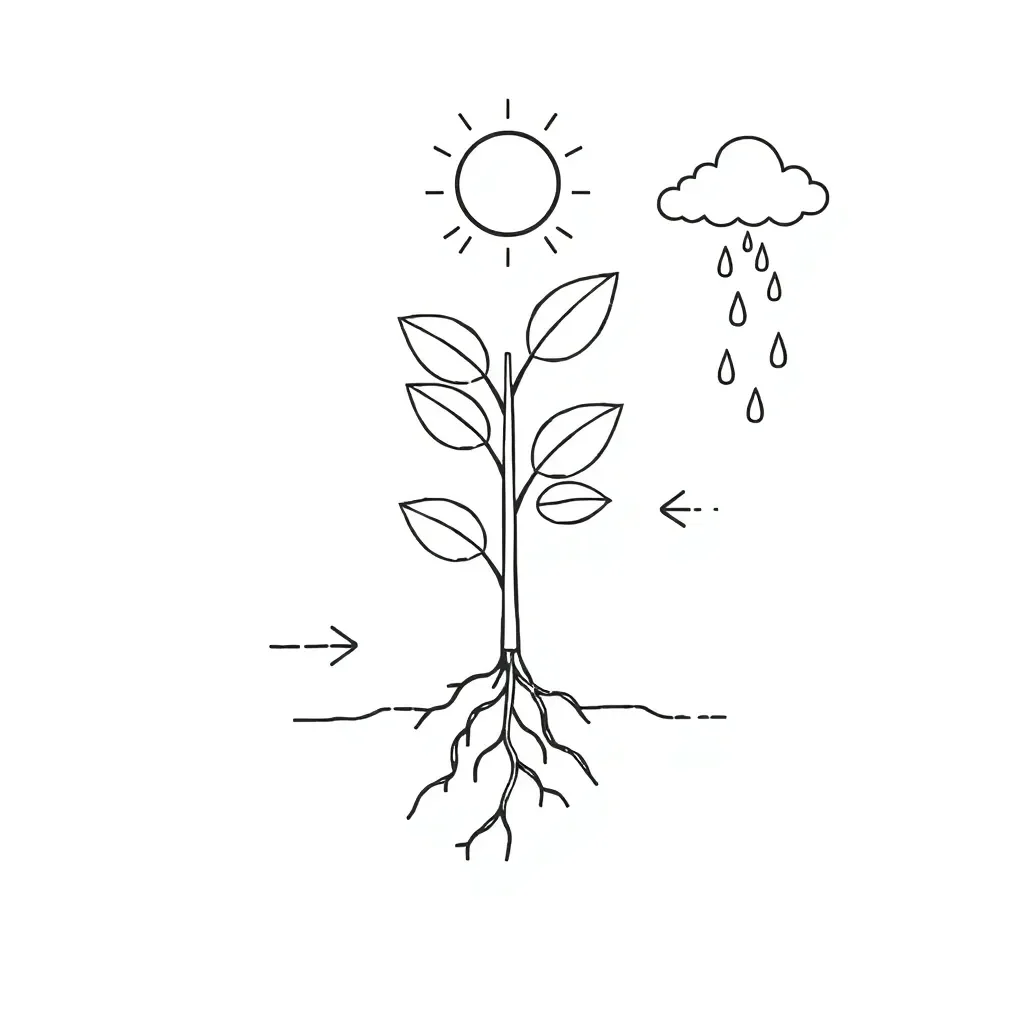
Transpiration is like plants sweating. Just as you sweat when you're hot, plants lose water through tiny holes in their leaves called stomata. These stomata are so small you need a microscope to see them!
When water evaporates from the leaves, it creates a pull that draws more water up from the roots through special tubes called xylem. The xylem carries water and nutrients from the soil to all parts of the plant. Think of it like drinking through a straw - as you suck at the top, liquid moves up from the bottom. This water carries important nutrients from the soil up to all parts of the plant.
Minerals and nutrients from the soil are also transported to the leaves through the xylem. These minerals are essential for the plant's growth and health. Without them, plants cannot perform vital functions like photosynthesis. The xylem structure in the roots is designed to absorb water and minerals, while in the stems, it helps transport these resources to the leaves where they are needed most.
Transpiration happens more on hot, windy, or dry days. Plants can control their stomata - they open them when they need carbon dioxide for photosynthesis and close them when they need to save water. Water leaving the leaves through the stomata pulls more water through the xylem continuously throughout the day, ensuring that the plant remains hydrated and healthy.
What is Plant Respiration?
Just like animals, plants need to breathe! Plant respiration is when plants break down glucose (sugar) to release energy for growth and survival. The word equation for this process is: glucose + oxygen → carbon dioxide + water + energy. This energy is used for vital functions such as growth, repair, and maintaining health.
Respiration happens in all living parts of the plant, including roots, stems, and leaves. It occurs 24 hours a day, even when the plant is not photosynthesising. During the day, plants both photosynthesise and respire. At night, they only respire because there's no sunlight for photosynthesis. Respiration can be thought of as the 'reverse' of photosynthesis, where the sunlight energy that was converted into chemical energy is now used as energy for the plant.
Oxygen plays a crucial role in respiration as it is used to break down glucose. If plants cannot perform respiration, they risk not being able to grow, move towards light or water, and may face dehydration or starvation. This shows how important both transpiration and respiration are for a plant's survival.
Key Differences:
• Transpiration moves water and nutrients around the plant
• Respiration releases energy for the plant to use
• Transpiration happens mainly through leaves
• Respiration happens in all living plant parts
📝 Comprehension Questions
🌟 Extension Activities for Advanced Learners
About This Worksheet
Free in Kuraplan
Sign up free, grab the PDF, and customize it for your class.
Print-Ready
Formatted for standard paper. Clean layout, easy to read.
AI-Generated
Created with Kuraplan's AI, designed for real classroom use.
For Teachers & Parents
Use in classrooms, for homework, tutoring, or homeschool.
Need a custom version of this worksheet?
Kuraplan's AI generates custom worksheets in seconds — differentiated for every learner, aligned to your curriculum.
Generate Custom Worksheets — FreeMore Science Worksheets
Danforth: Authority and Conscience
Free
Natural Resources Science
Free
Natural Resources Science
Free
Vitamins, Minerals, and Protein Science
Free
Exploring Science Materials
Free
Waka Buoyancy Science Worksheet
Free
Science Skills Made Simple
Free