Social SciencesFreePrintable
Population Patterns Introduction
A free, printable social sciences worksheet ready for your classroom. Download instantly, print, and hand out to your students — no account needed.
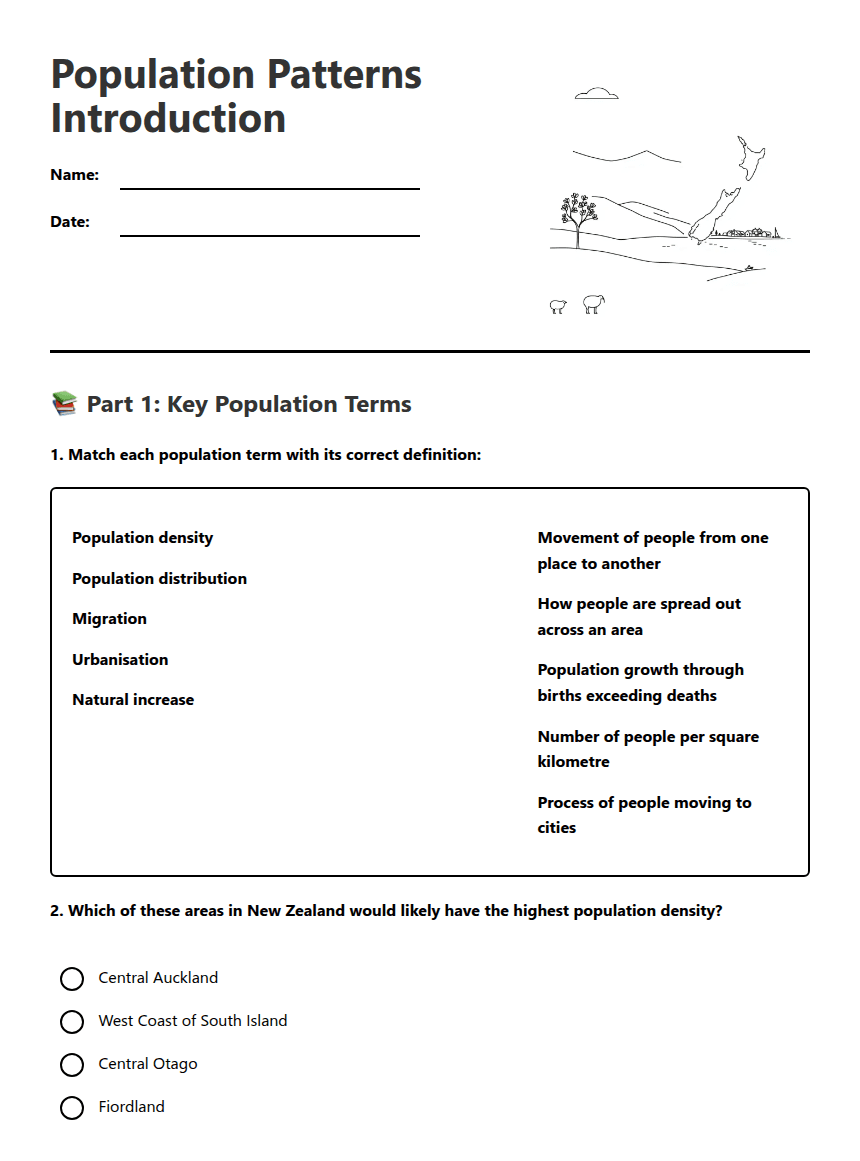
Introduction to Population Studies
📚 Part 1: Key Population Terms
1. Match each population term with its correct definition:
Population density
Population distribution
Migration
Urbanisation
Natural increase
Movement of people from one place to another
How people are spread out across an area
Population growth through births exceeding deaths
Number of people per square kilometre
Process of people moving to cities
2. Which of these areas in New Zealand would likely have the highest population density?
Central AucklandWest Coast of South IslandCentral OtagoFiordland
3. Australia's population growth rate is approximately 1.3% per year. What does this tell us?
Australia's population is decreasingAustralia's population is staying the sameAustralia's population is increasingAustralia has no migration
🗺️ Part 2: Population Patterns Analysis
4. Look at a map of Australia and New Zealand. List three factors that might explain why most of Australia's population lives along the coast:
5. Complete the following comparison:
New Zealand's total land area is approximately _____________ square kilometres, while Australia's is approximately _____________ square kilometres. This means Australia is about _____ times larger than New Zealand.
6. Explain why population studies are important for government planning. Give two specific examples:
7. Which factors influence population distribution? (Select all that apply)
ClimateEconomic opportunitiesNatural resourcesTransportation networksTerrain and geography
🧠 Part 3: Critical Thinking
8. Both New Zealand and Australia experience internal migration (people moving within the country). Predict where people are most likely to move TO and FROM in each country, and explain your reasoning:
9. How might Māori perspectives on population and land use differ from European approaches? Consider iwi and hapū distribution:
10. If you were a city planner in Auckland (NZ's fastest-growing city), what population data would you need to plan for the next 10 years? List four types of information:
About This Worksheet
Free Download
No sign-up, no email, no paywall. Just download and print.
Print-Ready
Formatted for standard paper. Clean layout, easy to read.
AI-Generated
Created with Kuraplan's AI, designed for real classroom use.
For Teachers & Parents
Use in classrooms, for homework, tutoring, or homeschool.
Need a custom version of this worksheet?
Kuraplan's AI generates custom worksheets in seconds — differentiated for every learner, aligned to your curriculum.
Generate Custom Worksheets — Free No credit card Curriculum-aligned Under 60 seconds