Scientific Notation Test Rubric
A free, printable maths worksheet ready for your classroom. Download instantly, print, and hand out to your students — no account needed.
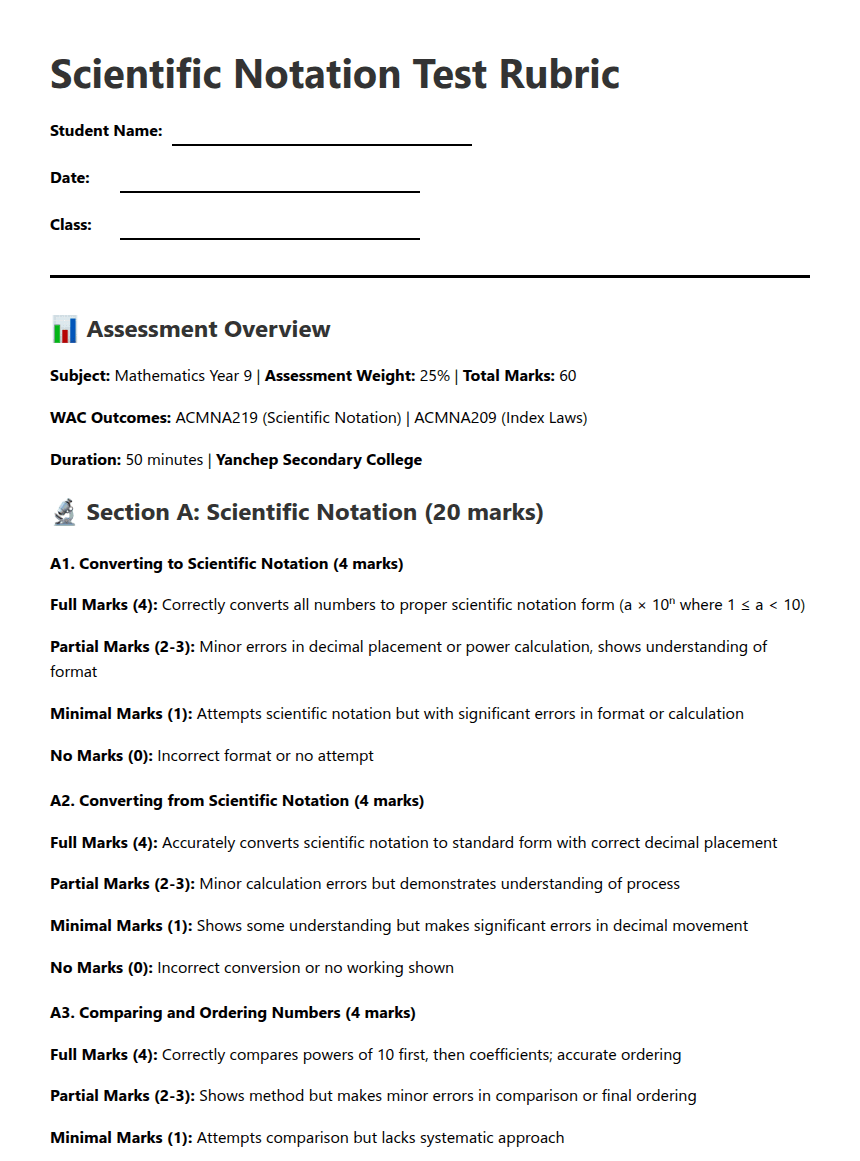
Scientific Notation Test Rubric
📊 Assessment Overview
Subject: Mathematics Year 9 | Assessment Weight: 25% | Total Marks: 60
WAC Outcomes: ACMNA219 (Scientific Notation) | ACMNA209 (Index Laws)
Duration: 50 minutes | Yanchep Secondary College
🔬 Section A: Scientific Notation (20 marks)
Full Marks (4): Correctly converts all numbers to proper scientific notation form (a × 10ⁿ where 1 ≤ a < 10)
Partial Marks (2-3): Minor errors in decimal placement or power calculation, shows understanding of format
Minimal Marks (1): Attempts scientific notation but with significant errors in format or calculation
No Marks (0): Incorrect format or no attempt
Full Marks (4): Accurately converts scientific notation to standard form with correct decimal placement
Partial Marks (2-3): Minor calculation errors but demonstrates understanding of process
Minimal Marks (1): Shows some understanding but makes significant errors in decimal movement
No Marks (0): Incorrect conversion or no working shown
Full Marks (4): Correctly compares powers of 10 first, then coefficients; accurate ordering
Partial Marks (2-3): Shows method but makes minor errors in comparison or final ordering
Minimal Marks (1): Attempts comparison but lacks systematic approach
No Marks (0): Random ordering or no clear method
Full Marks (7-8): Correctly performs multiplication/division, adjusts coefficients and combines powers
Partial Marks (4-6): Shows understanding of process with minor computational errors
Minimal Marks (2-3): Attempts operations but makes errors in index laws or coefficient handling
Limited Marks (1): Shows some working but significant errors throughout
No Marks (0): No working or completely incorrect method
⚡ Section B: Index Laws (20 marks)
Full Marks (5): Correctly applies product law, adds indices with same base, shows all working
Partial Marks (3-4): Shows understanding but minor errors in addition or simplification
Minimal Marks (1-2): Attempts to use law but makes significant errors
No Marks (0): Incorrect application or no working shown
Full Marks (5): Correctly applies quotient law, subtracts indices accurately
Partial Marks (3-4): Shows method but minor computational errors
Minimal Marks (1-2): Attempts quotient law with significant errors
No Marks (0): Incorrect method or no attempt
Full Marks (5): Correctly multiplies indices when raising power to a power
Partial Marks (3-4): Shows understanding with minor calculation errors
Minimal Marks (1-2): Attempts power law but significant errors in multiplication
No Marks (0): Incorrect application or no working
Full Marks (5): Correctly identifies a⁰ = 1 and applies negative power rules (a⁻ⁿ = 1/aⁿ)
Partial Marks (3-4): Shows understanding but minor errors in application
Minimal Marks (1-2): Attempts rules but significant conceptual errors
No Marks (0): Incorrect understanding or no attempt
🧠 Section C: Problem Solving & Applications (20 marks)
Full Marks (7-8): Clear problem-solving strategy, accurate calculations, correct final answer in scientific notation
Partial Marks (5-6): Good approach with minor errors, shows logical reasoning
Minimal Marks (3-4): Attempts multi-step process but makes calculation or reasoning errors
Limited Marks (1-2): Some correct elements but lacks coherent approach
No Marks (0): No clear method or completely incorrect
Full Marks (6): Correctly interprets context, applies scientific notation appropriately, explains reasoning clearly
Partial Marks (4-5): Good interpretation with minor errors in application or explanation
Minimal Marks (2-3): Shows some understanding but lacks clear reasoning or makes significant errors
Limited Marks (1): Minimal attempt with little understanding shown
No Marks (0): No attempt or completely incorrect
Full Marks (6): Clear explanation of advantages (handling very large/small numbers, easier calculations, precision)
Partial Marks (4-5): Good explanation covering most key points with minor gaps
Minimal Marks (2-3): Basic understanding but lacks depth or contains errors
Limited Marks (1): Minimal explanation with little understanding
No Marks (0): No explanation or completely incorrect reasoning
Working and Communication Requirements:
• Clear Working: All calculations must show step-by-step process
• Mathematical Language: Correct use of terminology and notation
• Logical Reasoning: Explanations must be coherent and mathematically sound
About This Worksheet
Free Download
No sign-up, no email, no paywall. Just download and print.
Print-Ready
Formatted for standard paper. Clean layout, easy to read.
AI-Generated
Created with Kuraplan's AI, designed for real classroom use.
For Teachers & Parents
Use in classrooms, for homework, tutoring, or homeschool.
Need a custom version of this worksheet?
Kuraplan's AI generates custom worksheets in seconds — differentiated for every learner, aligned to your curriculum.
Generate Custom Worksheets — Free