Water Cycle Processes
A free, printable science worksheet ready for your classroom. Download instantly, print, and hand out to your students — no account needed.
Water Cycle Processes
🌊 Understanding the Water Cycle
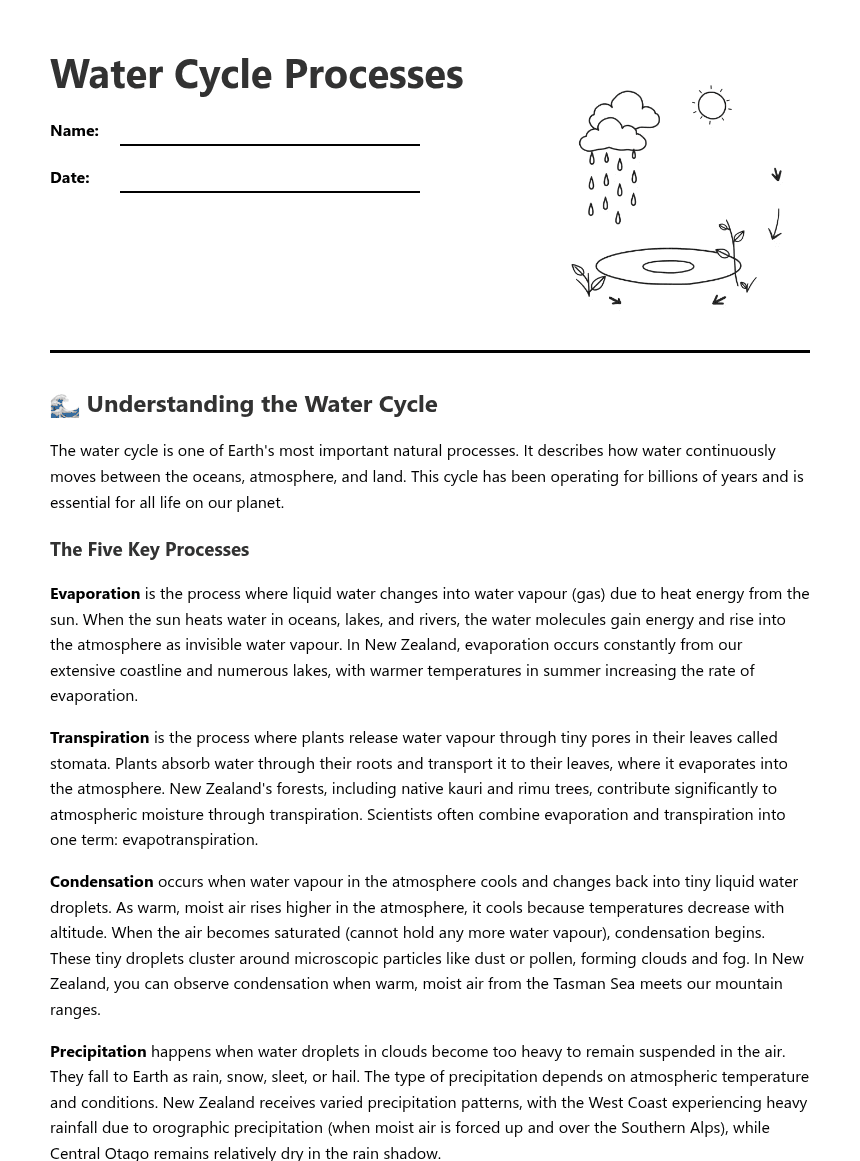
The water cycle is one of Earth's most important natural processes. It describes how water continuously moves between the oceans, atmosphere, and land. This cycle has been operating for billions of years and is essential for all life on our planet.
The Five Key Processes
Evaporation is the process where liquid water changes into water vapour (gas) due to heat energy from the sun. When the sun heats water in oceans, lakes, and rivers, the water molecules gain energy and rise into the atmosphere as invisible water vapour. In New Zealand, evaporation occurs constantly from our extensive coastline and numerous lakes, with warmer temperatures in summer increasing the rate of evaporation.
Transpiration is the process where plants release water vapour through tiny pores in their leaves called stomata. Plants absorb water through their roots and transport it to their leaves, where it evaporates into the atmosphere. New Zealand's forests, including native kauri and rimu trees, contribute significantly to atmospheric moisture through transpiration. Scientists often combine evaporation and transpiration into one term: evapotranspiration.
Condensation occurs when water vapour in the atmosphere cools and changes back into tiny liquid water droplets. As warm, moist air rises higher in the atmosphere, it cools because temperatures decrease with altitude. When the air becomes saturated (cannot hold any more water vapour), condensation begins. These tiny droplets cluster around microscopic particles like dust or pollen, forming clouds and fog. In New Zealand, you can observe condensation when warm, moist air from the Tasman Sea meets our mountain ranges.
Precipitation happens when water droplets in clouds become too heavy to remain suspended in the air. They fall to Earth as rain, snow, sleet, or hail. The type of precipitation depends on atmospheric temperature and conditions. New Zealand receives varied precipitation patterns, with the West Coast experiencing heavy rainfall due to orographic precipitation (when moist air is forced up and over the Southern Alps), while Central Otago remains relatively dry in the rain shadow.
Collection is the process where precipitated water gathers in various locations on Earth's surface. Water flows into streams, rivers, lakes, and eventually returns to the oceans. Some water soaks into the ground, becoming groundwater that slowly moves through soil and rock. In New Zealand, our major rivers like the Waikato and Clutha collect water from precipitation and transport it back to the sea, completing the cycle.
The Continuous Cycle
The water cycle operates continuously, driven by energy from the sun and gravity. Water molecules may spend different amounts of time in various parts of the cycle – some may remain in the ocean for thousands of years, while others might cycle through the atmosphere in just days. Climate change is affecting the water cycle globally, with some regions experiencing more intense precipitation events while others face increased drought conditions.
Understanding the water cycle helps us appreciate how interconnected our environment is and why protecting our waterways and atmosphere is crucial for maintaining this essential natural process.
📚 Key Vocabulary
Atmosphere: The layer of gases surrounding Earth
Condensation: The process of water vapour changing into liquid water
Evaporation: The process of liquid water changing into water vapour
Evapotranspiration: The combined process of evaporation and transpiration
Groundwater: Water that soaks into the ground and moves through soil and rock
Orographic precipitation: Rainfall caused when moist air is forced up and over mountains
Precipitation: Water falling from clouds as rain, snow, sleet, or hail
Saturated: When air contains the maximum amount of water vapour it can hold
Stomata: Tiny pores in plant leaves through which water vapour escapes
Transpiration: The process where plants release water vapour through their leaves
Water vapour: Water in its gaseous form
🤔 Comprehension Questions
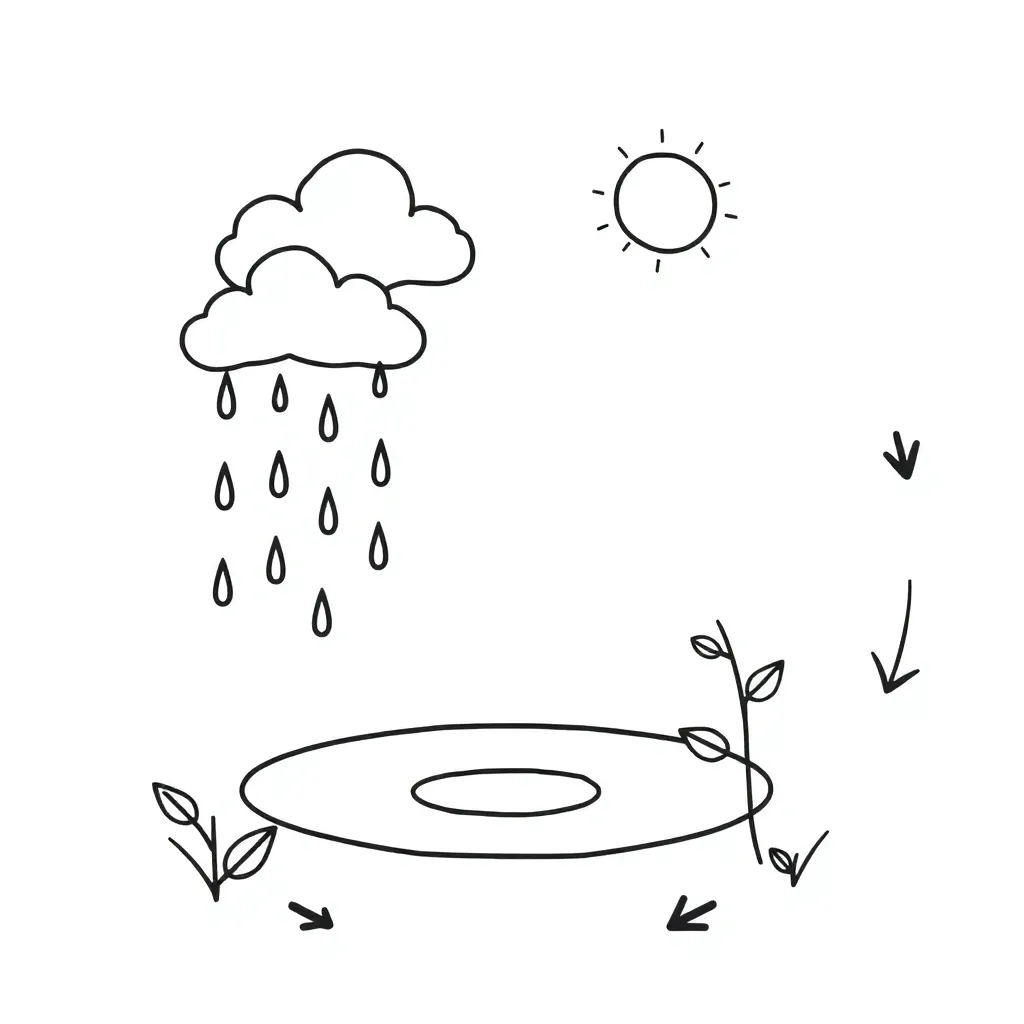
🎨 Water Cycle Diagram
About This Worksheet
Free Download
No sign-up, no email, no paywall. Just download and print.
Print-Ready
Formatted for standard paper. Clean layout, easy to read.
AI-Generated
Created with Kuraplan's AI, designed for real classroom use.
For Teachers & Parents
Use in classrooms, for homework, tutoring, or homeschool.
Need a custom version of this worksheet?
Kuraplan's AI generates custom worksheets in seconds — differentiated for every learner, aligned to your curriculum.
Generate Custom Worksheets — Free