💧 Part 1: Water Cycle Knowledge!
1. What is the process called when water changes from liquid to gas??!
Condensation
Evaporation
Precipitation
Collection
2. When water vapour cools and forms clouds, this is called:
Evaporation
Condensation
Transpiration
Infiltration
3. Which of these are forms of precipitation? (Check all that apply)
4. The main source of energy that drives the water cycle is:
The moon
The sun
Wind
Gravity
✏️ Part 2: Fill in the Blanks
5. Complete the sentences about the water cycle:
a) Water from oceans, lakes, and rivers heats up and changes into water vapour through _______________.
b) Plants release water vapour through their leaves in a process called _______________.
c) When water vapour rises and cools, it forms tiny droplets that create _______________.
d) Water falls back to Earth as _______________ in the form of rain, snow, or hail.
6. Explain why the water cycle is important for life on Earth:
🎨 Part 3: Draw and Label
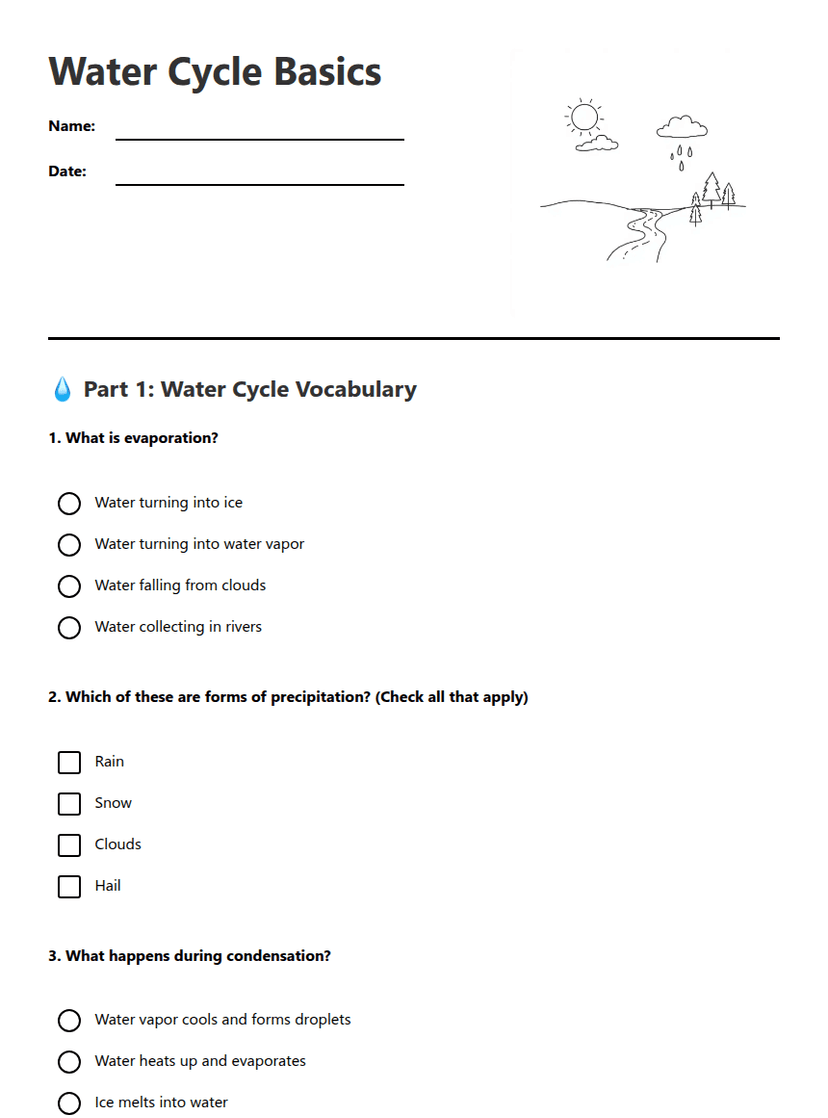
7. In the box below, draw a simple diagram of the water cycle and label the four main processes: evaporation, condensation, precipitation, and collection.
8. Name two ways humans can affect the water cycle:
🧠 Part 4: Advanced Water Cycle Concepts
9. Explain in detail the process of infiltration and how it contributes to the water cycle:
10. Describe the process of transpiration and explain how it differs from evaporation:
11. What role does groundwater play in the water cycle? Explain how it is recharged and how it returns to surface water bodies:
12. How is climate change affecting the water cycle? Provide at least three specific examples:
🤔 Part 5: Critical Thinking & Data Analysis
13. Critical Thinking: A city is experiencing water shortages despite normal rainfall patterns. The city has grown rapidly in the past 20 years with increased concrete surfaces, fewer green spaces, and higher population density. Analyze how these changes might be affecting the local water cycle and propose three solutions that could help restore natural water processes:
14. Data Interpretation: The table below shows rainfall data for two cities over 5 years:
City A: 2019: 45cm, 2020: 52cm, 2021: 38cm, 2022: 41cm, 2023: 35cm
City B: 2019: 48cm, 2020: 47cm, 2021: 49cm, 2022: 46cm, 2023: 50cm
a) Calculate the average annual rainfall for each city.
b) Which city shows more variable rainfall patterns and what might this indicate about climate stability?
c) How might these different patterns affect each city's water management strategies?
15. Research Extension: Choose one human activity (such as deforestation, urbanization, agriculture, or dam construction) and research its impact on the water cycle. Write a short report explaining the activity's effects on at least three components of the water cycle: