ScienceFreePrintable

Year 9 Chemistry Assessment

A free, printable science worksheet ready for your classroom. Download instantly, print, and hand out to your students — no account needed.
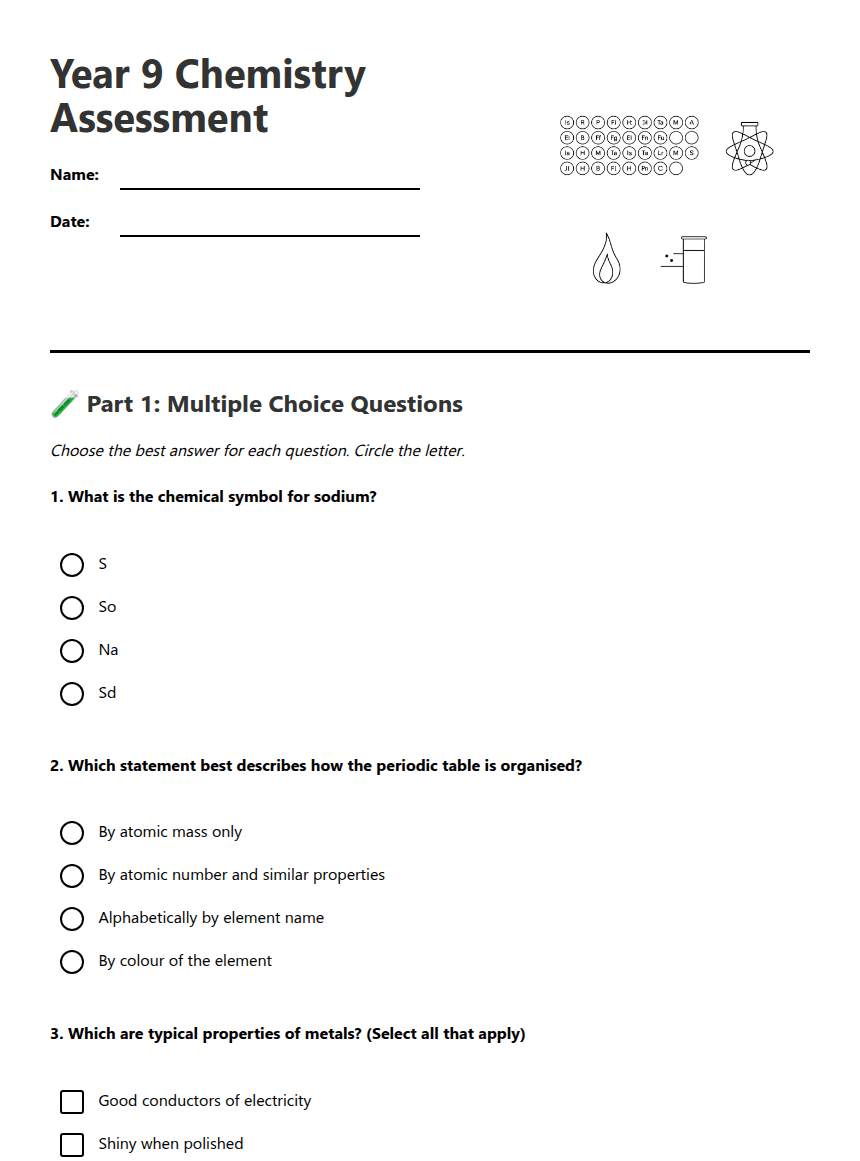
Year 9 Chemistry Assessment worksheet preview

Year 9 Chemistry Assessment Answer Key
Chemistry laboratory equipment illustration

🧪 Part 1: Multiple Choice Questions - Answer Key

Correct answers are indicated with explanations.

1. What is the chemical symbol for sodium?
Answer: Na - Sodium's chemical symbol is derived from its Latin name 'Natrium'.
2. Which statement best describes how the periodic table is organised?
Answer: By atomic number and similar properties - The periodic table is arranged by increasing atomic number and groups elements with similar chemical properties.
3. Which are typical properties of metals? (Select all that apply)
Answer: Good conductors of electricity, Shiny when polished, Malleable (can be hammered into shapes) - Metals are known for these properties. Brittle when solid is not typical for metals.
4. What happens during a neutralisation reaction?
Answer: An acid reacts with a base to form salt and water - This is the definition of a neutralisation reaction.
5. What is the chemical symbol for potassium?
Answer: K - Potassium's symbol is derived from its Latin name 'Kalium'.
6. Which of the following is a property of non-metals?
Answer: Dull and brittle - Non-metals typically lack the luster of metals and are often brittle in solid form.
7. Which of the following elements is a noble gas?
Answer: Argon - Argon is a noble gas, known for its lack of reactivity.
8. What is the pH of a neutral solution?
Answer: 7 - A pH of 7 indicates a neutral solution, where the concentration of hydrogen ions equals that of hydroxide ions.
9. Which of the following indicates a chemical reaction has occurred?
Answer: All of the above - Changes in colour, temperature, and the formation of a gas are all indicators of a chemical reaction.
10. What is the word equation for the reaction of hydrochloric acid with sodium hydroxide?
Answer: Hydrochloric acid + Sodium hydroxide → Sodium chloride + Water - This represents the neutralisation reaction between an acid and a base.

✏️ Part 2: Short Answer Questions - Answer Key

Sample answers are provided for guidance.

5. Define the following terms:

Element: A pure substance that cannot be broken down into simpler substances by chemical means.

Compound: A substance formed when two or more elements are chemically bonded together.

Mixture: A combination of two or more substances that are not chemically bonded and can be separated by physical means.

6. List three signs that indicate a chemical reaction is taking place:
Sample Answers: Change in colour, formation of a gas, change in temperature.
7. Write a word equation for the combustion of methane gas:

Answer: Methane + Oxygen → Carbon dioxide + Water

8. Explain the difference between complete and incomplete combustion:
Complete combustion occurs when there is enough oxygen, producing carbon dioxide and water.
Incomplete combustion occurs when there is insufficient oxygen, producing carbon monoxide and/or soot.

🔬 Part 3: Applied Knowledge - Answer Key

9. Look at the following information about an element from the periodic table:

Atomic Number: 6

Element Symbol: C

Atomic Mass: 12

Answer: a) 6 protons, b) 6 electrons, c) Carbon

10. Look at the following information about another element from the periodic table:

Atomic Number: 8

Element Symbol: O

Atomic Mass: 16

Answer: a) 8 protons, b) 8 electrons, c) Oxygen

11. Look at the following information about another element from the periodic table:

Atomic Number: 11

Element Symbol: Na

Atomic Mass: 23

Answer: a) 11 protons, b) 11 electrons, c) Sodium

12. During a practical lesson, you observe a reaction between hydrochloric acid and sodium hydroxide. The pH changes from 1 to 7. Explain what this tells you about the reaction:

In your explanation, consider the following points:

  • Neutralisation occurs when an acid reacts with a base to form a neutral solution.
  • The pH scale represents the acidity or alkalinity of a solution.
  • The increase in pH from 1 to 7 indicates that the acid is being neutralised by the base.
The reaction is a neutralisation reaction.
The pH scale indicates the solution's acidity.
The pH change shows the acid is neutralised.
13. Give two examples of how the physical properties of metals make them useful in everyday life:
Sample Answers: Metals are good conductors of electricity (used in wiring) and are malleable (used in making various shapes and tools).

📋 Success Criteria & Support

To be successful in this assessment, students should be able to:

✓ Recall symbols for the first 20 elements

✓ Distinguish between elements, compounds, and mixtures

✓ Explain periodic table organisation and atomic structure

✓ Identify properties of metals and non-metals

✓ Recognise signs of chemical reactions

✓ Write simple word equations

✓ Understand acid-base reactions and pH changes

Differentiation Support:

🔤 For dyslexia-friendly reading: Use a ruler under each line, take breaks between sections

📚 Extra support: Refer to your periodic table and notes if needed

Extension: Explain your reasoning for multiple choice answers on the back

About This Worksheet

Free Download

No sign-up, no email, no paywall. Just download and print.

Print-Ready

Formatted for standard paper. Clean layout, easy to read.

AI-Generated

Created with Kuraplan's AI, designed for real classroom use.

For Teachers & Parents

Use in classrooms, for homework, tutoring, or homeschool.

Need a custom version of this worksheet?

Kuraplan's AI generates custom worksheets in seconds — differentiated for every learner, aligned to your curriculum.

Generate Custom Worksheets — Free
No credit card Curriculum-aligned Under 60 seconds