Monday morning, you're looking at a stack of standards, a half-finished unit, and a class with reading levels that seem to span several grades. You can write tomorrow's lesson, but the larger question is harder: how do you turn a dense Common Core standard into a coherent sequence that works for every learner?
That difficulty isn't a personal failure. Standards are written to describe expected learning clearly, not to tell you exactly what Tuesday at 9:15 a.m. should look like. Common Core spread rapidly after its 2010 release. By 2012, 45 states had adopted the mathematics standards and 46 states had adopted the English language arts and literacy standards, making the framework a shared planning language across major education markets (Harvard's Common Core implementation study).
The practical answer is a repeatable workflow: unpack, align, sequence, differentiate, and accelerate. Once those stages become visible, you can plan the whole unit instead of decorating isolated daily lessons. Tools such as Kuraplan can also handle repetitive drafting, leaving you more time to make the professional judgments that no template can make for you.
Why Common Core Lesson Planning Feels So Hard
At 3:30, you may have tomorrow's activity ready and still feel uneasy about the unit. Students can identify an author's claim, yet the path from first reading to independent evidence-based writing remains unclear. In math, you may know the standard but wonder which conceptual experience should precede the algorithm and what evidence shows students are ready to continue.
A single lesson can hide those gaps. A full unit exposes them.
Common Core planning feels difficult because the standard, curriculum, and classroom describe different layers of the work. The standard names a performance. The textbook supplies a page-by-page sequence. Students arrive with different background knowledge, language resources, reading stamina, and learning needs. Your planning task is to connect those layers without turning the standard code into decoration at the top of a lesson plan.
Practical rule: If changing the standard code would not change the task or assessment, the lesson probably is not aligned.
Implementation research examined planning as collaborative professional work. Teacher teams analyzed student work, planned Common Core aligned units, and adjusted lessons and classroom assessments together (district implementation findings). That practice matters because alignment is a decision you revisit. Student work may show that the task is too easy, the objective is unclear, or the assessment is collecting the wrong evidence.
Time adds pressure. In a large district sample, elementary teachers averaged about 47 minutes of daily planning time, while secondary teachers averaged about 51 minutes, roughly 10% of the scheduled workday (National Council on Teacher Quality planning-time analysis). That window leaves little room to invent a coherent plan from a blank page each day.
The workflow that holds up
Begin with the standard, then trace the learning across the unit. Identify the thinking students must do, write an observable objective, design the evidence, and sequence instruction so each lesson prepares students for the next performance. Kuraplan can help organize and draft the repeatable parts, while you decide what students need to understand first and where misconceptions are likely to appear.
The key shift is from lesson completion to unit coherence. Each lesson should develop a skill, concept, or habit required by the culminating task. Differentiation can change access, scaffolding, materials, and pacing, but it should preserve the grade-level target. That balance protects both student support and rigor.
Unpacking the Standard the Right Way
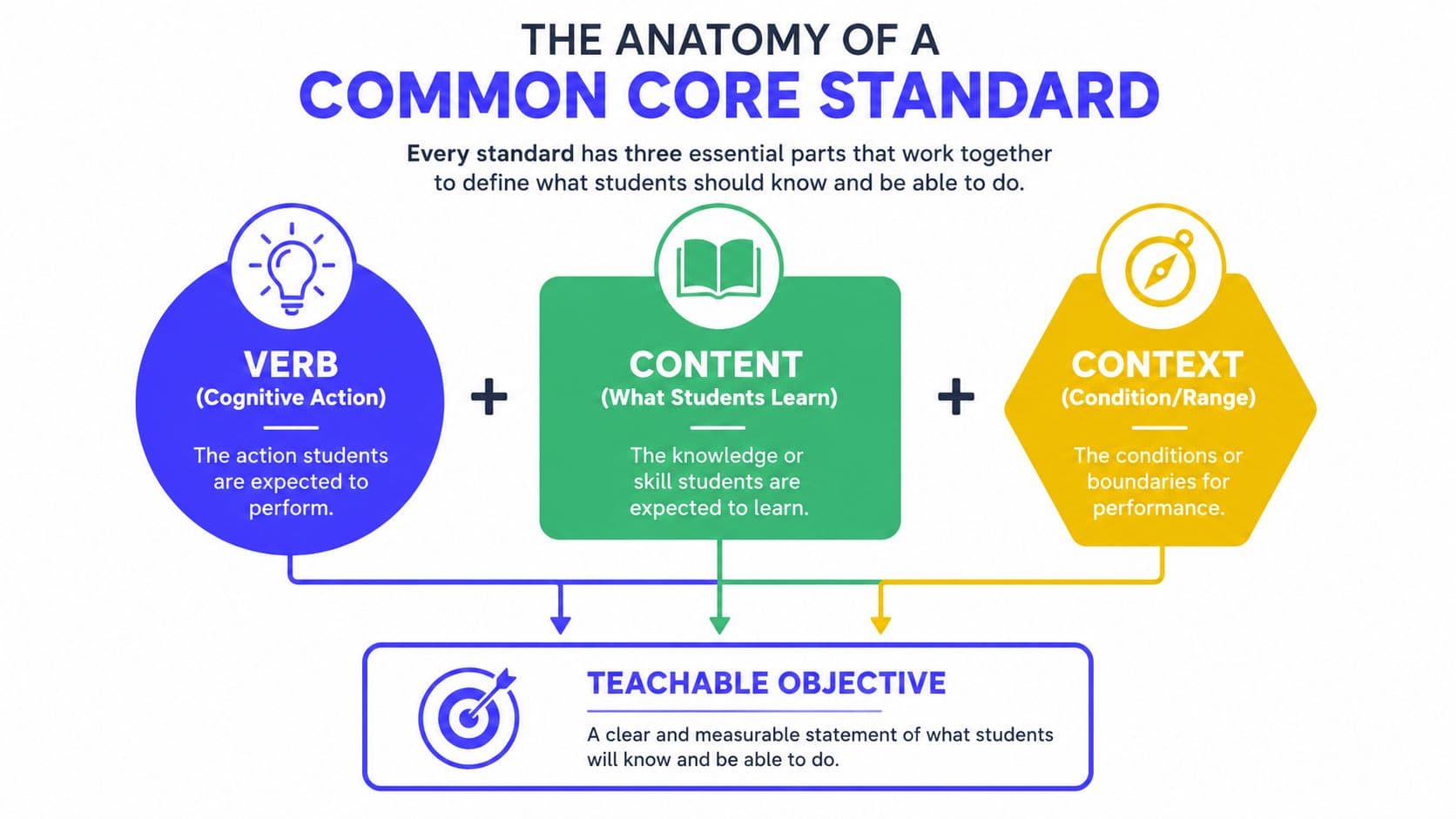
Standards often contain three parts that teachers need to separate before planning:
- The verb, or the cognitive action students must perform.
- The content, or the ideas, texts, quantities, or relationships they'll work with.
- The context, or the conditions that define the expected setting and limits.
The verb usually predicts the lesson structure more than the topic does. Analyze calls for examination of parts and relationships. Compare requires students to identify similarities and differences using a meaningful basis. Cite textual evidence demands a return to the text, not a general opinion about it.
Consider RI.5.6, which asks fifth-grade students to analyze multiple accounts of the same event or topic, noting important similarities and differences in the points of view they represent. Don't copy that sentence into your objective and call the work done. Break it down:
- Verb: analyze, note similarities and differences.
- Content: multiple accounts of one event or topic.
- Context: informational texts that represent different points of view.
- Evidence: a comparison supported by details from the accounts.
In teacher language, the standard becomes: students will examine how different authors present the same subject, identify where their perspectives overlap or diverge, and support that comparison with textual details.
A useful sentence frame is:
Students will [verb] by [skill] using [content] so that [transfer goal].
For RI.5.6, that might read: “Students will analyze two accounts of the same event by comparing each author's point of view and citing relevant details so that they can explain how perspective shapes an informational text.”
What usually goes wrong
The first trap is copying the standard verbatim. The second is replacing a demanding verb with a softer one. “Students will understand point of view” doesn't tell you what students will do, and it can't guide the design of a task.
The third is ignoring supporting standards. A priority reading standard may travel with writing, speaking and listening, or language expectations. Those companions aren't decorations. They can determine whether students discuss evidence, write an explanation, or use discipline-specific vocabulary.
Before moving on, ask: What exact student performance would convince me that the verb has been met? If you can't answer with a visible product, response, explanation, or demonstration, keep unpacking.
Writing Objectives and Assessments That Actually Match
Alignment drifts when the objective names one kind of thinking and the assessment measures another. A lesson may promise analysis, then ask students to define vocabulary. A teacher may write “evaluate an author's argument,” then grade a worksheet that only asks students to locate the claim.
The fix is backward design. Begin with the assessment task, write the objective that task would prove, and then check whether the standard supports both. This reverses the familiar habit of choosing an engaging activity first and trying to attach a standard afterward.
Use the ABCD test
The ABCD format gives an objective enough precision to plan from:
- Audience: Who is doing the work?
- Behavior: What observable action will students perform?
- Condition: What materials, tools, or circumstances will be provided?
- Degree: What level of accuracy, quality, or completeness counts?
Avoid verbs such as understand and know unless you translate them into an observable behavior. Students can explain, solve, compare, construct, justify, or revise. Those actions produce evidence.
Take a fourth-grade multiplication objective. “Students will understand multi-digit multiplication” sounds appropriate, but it doesn't identify a performance or a success criterion. An aligned version is: “Given two two-digit numbers, students will solve a multiplication problem using the standard algorithm with 80% accuracy.”
That objective supports an assessment containing multiplication problems that require the named algorithm. It wouldn't support an exit ticket asking students to define multiplication, and it wouldn't fully capture conceptual explanation unless the objective included that demand.
Alignment check: Can a student demonstrate mastery of the objective using only the assessment you built?
If the answer is no, revise one of the three pieces. The objective may be too broad, the task may be too easy, or the assessment may be testing a different skill.
A strong plan also includes formative evidence during instruction, not just an end-of-lesson score. A brief response, worked example, annotation, discussion turn, or exit ticket should help you decide whether to continue, regroup, or reteach. For practical formats you can adapt, use these formative assessment examples, then rewrite each one so it asks students to perform the exact target behavior.
Sequencing a Full Unit, Not Just a Single Lesson
Daily templates can make a plan look complete while leaving the unit's logic unresolved. A coherent unit answers four questions: What matters most? What will mastery look like? What evidence will show progress? What should happen when students aren't ready?
Begin by ranking the standards. Identify the priority standards that carry the unit's central ideas and appear in the summative performance. Supporting standards can strengthen the work, but they shouldn't crowd out the learning students most need to retain.
Build the destination first
Create a proficiency scale before writing daily lessons. A simple 2.0, 3.0, 4.0 scale can distinguish developing knowledge, grade-level mastery, and more advanced transfer. The exact descriptors should match your standard, not a generic district form.
For an informational reading unit, a scale might distinguish between identifying a claim, explaining how evidence supports it, and comparing how evidence functions across texts. Then design the summative task. If students must write an evidence-based comparison, the daily lessons need to prepare them to read closely, identify relevant evidence, discuss reasoning, and organize a response.
A workable unit sequence might look like this:
| Unit stage | Planning question | Evidence to collect |
|---|---|---|
| Entry event | What do students already know or misunderstand? | Diagnostic response |
| Guided lessons | Which skills build toward the priority standard? | Annotations, discussion, practice |
| Mid-unit check | What has become secure, and what remains fragile? | Short aligned task |
| Reteach or extend | Which students need another route to the target? | Revised practice |
| Cumulative task | Can students transfer the learning independently? | Summative performance |
Avoid front-loading vocabulary for days before students encounter meaningful comprehension work. Teach essential words in context, revisit them during reading and discussion, and watch whether language is blocking access to the text.
Pacing by page count creates another problem. A class may finish the assigned pages while still missing the standard. Use student evidence to decide whether the next lesson should introduce new content, provide guided practice, or revisit a misconception.
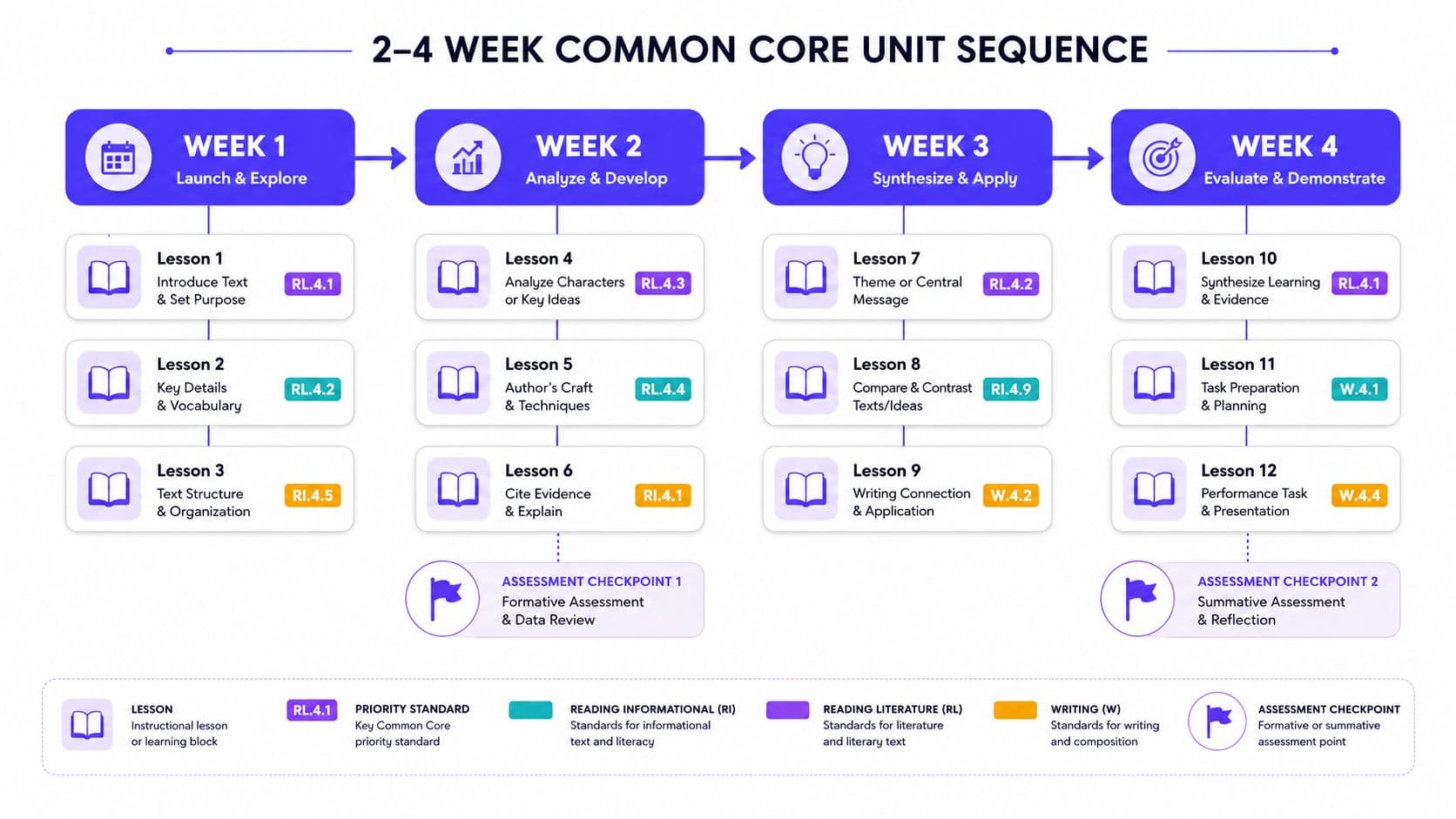
A one-page unit map can list the week, daily lesson, priority or supporting standard, check for understanding, and planned response to likely errors. For online or blended settings, this online teaching guide for educators offers useful planning context around routines, participation, and accessible lesson delivery. A digital workspace such as Kuraplan unit plans can keep the sequence, resources, and assessment checkpoints together rather than scattered across separate documents.
Differentiation That Protects Alignment and Rigor
Differentiation fails when support becomes replacement. A student who struggles with reading may receive a simpler question that no longer asks for analysis. A student with an IEP may complete a reduced task that measures recall instead of the grade-level skill. The work feels kinder in the moment, but the evidence no longer tells you whether the learner can approach the standard.
Keep the standard and make the route flexible. You can adjust the text access, task complexity, pacing, grouping, response mode, and amount of support while preserving the central verb.
Match the scaffold to the barrier
If the barrier is language, provide sentence frames, a bilingual glossary, visual vocabulary, or a structured discussion routine. The student can still compare perspectives or cite evidence, but the language load is made visible and manageable.
If the barrier is organization, use a graphic organizer that separates claim, evidence, and reasoning. If the barrier is stamina, chunk directions and text, then build toward independent completion. For IEP and 504 accommodations, audio versions, extended time, graphic organizers, and chunked directions can improve access without replacing the learning target.
Tiered tasks can also preserve rigor. One group might compare two explicit points of view. Another might compare a clear point of view with a less direct one. An advanced group might explain how the authors' choices influence the reader. All groups still work on analysis and evidence, but the complexity and independence vary.
The scaffold should remove an obstacle, not remove the thinking.
Strategic grouping helps when students can rehearse ideas with peers at different proficiency levels. Don't isolate multilingual learners or students receiving special education services as a permanent “low group.” Change groups according to the evidence and the purpose of the task.
Avoid pre-teaching the exit ticket so thoroughly that the result only measures compliance with your prompts. Scaffold the skill during instruction, but leave enough independence at the check for understanding to reveal the actual gap.
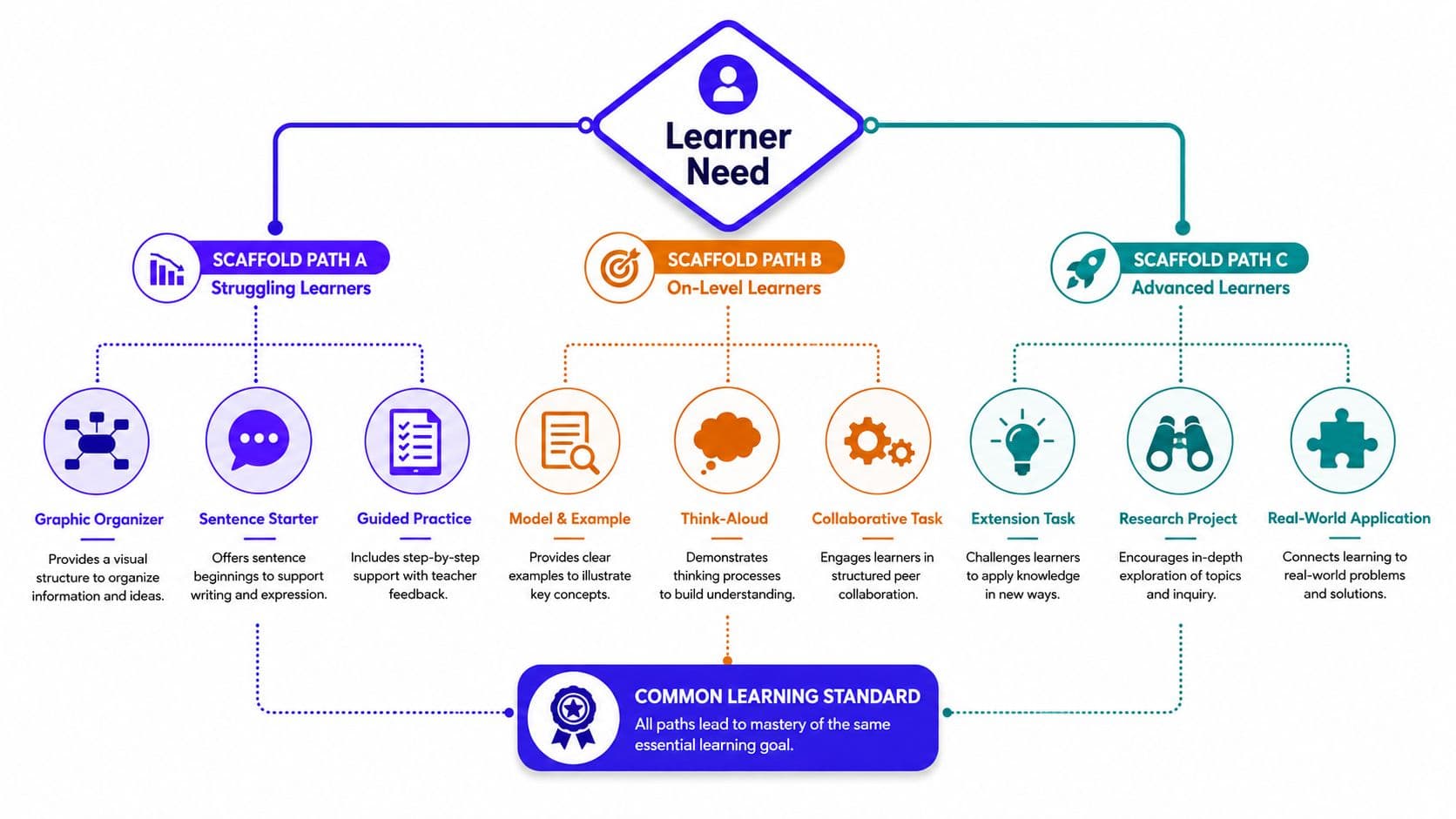
A quick decision tree works mid-lesson:
- Can the student access the content? Add audio, visuals, vocabulary, or a model.
- Can the student explain the thinking? Add a sentence frame, partner rehearsal, or organizer.
- Can the student perform independently? Remove one scaffold and check again.
- Is the student already secure? Increase transfer, complexity, or independence.
For another practical treatment of scaffolding, grouping, and task design, consult the TestPrepGenius.com differentiation guide.
Using Kuraplan to Speed Up the Whole Workflow
Mia teaches fifth-grade reading and is planning a three-week unit around informational texts. Her first move isn't to ask a tool for a finished week of instruction. She enters the Common Core strands, priority standards, text demands, and the final performance she wants students to complete.
Kuraplan gives her an editable starting point with draft objectives, lesson activities, assessment ideas, and differentiation prompts. She changes the language to match her district's expectations, removes an activity that doesn't fit the anchor text, and adds the discussion routine her students already know. The value is in editing a structured draft instead of facing a blank document.
Where the shortcut helps
Mia keeps the summative task in a shared planning document, then maps backward to guided reading, evidence collection, and writing practice. After a mid-unit check shows that students can locate details but struggle to explain how those details support a claim, she adds another reasoning lesson and shifts the cumulative task.
She also asks for distinct access supports for three multilingual students and one student with an IEP. She reviews every suggestion against their actual accommodations, replacing generic prompts with a visual evidence organizer and planned oral rehearsal.
Kuraplan can generate standards-aligned lesson and unit plans, worksheets, visuals, and assessment rubrics, including printable or shareable classroom resources. Its lesson plan generation feature is most useful here as a drafting aid for objectives, activities, and checks for understanding.
Mia estimates that the process saves roughly three hours per unit, but that estimate is her planning experience, not a universal outcome. The tool can't decide whether a class needs another day with the text, whether a student is ready to lose a scaffold, or how a particular classroom relationship affects participation.
That judgment stays with the teacher. The platform removes repetitive formatting and first-draft work, while Mia keeps control of pacing, task quality, accommodations, and the final instructional decision.
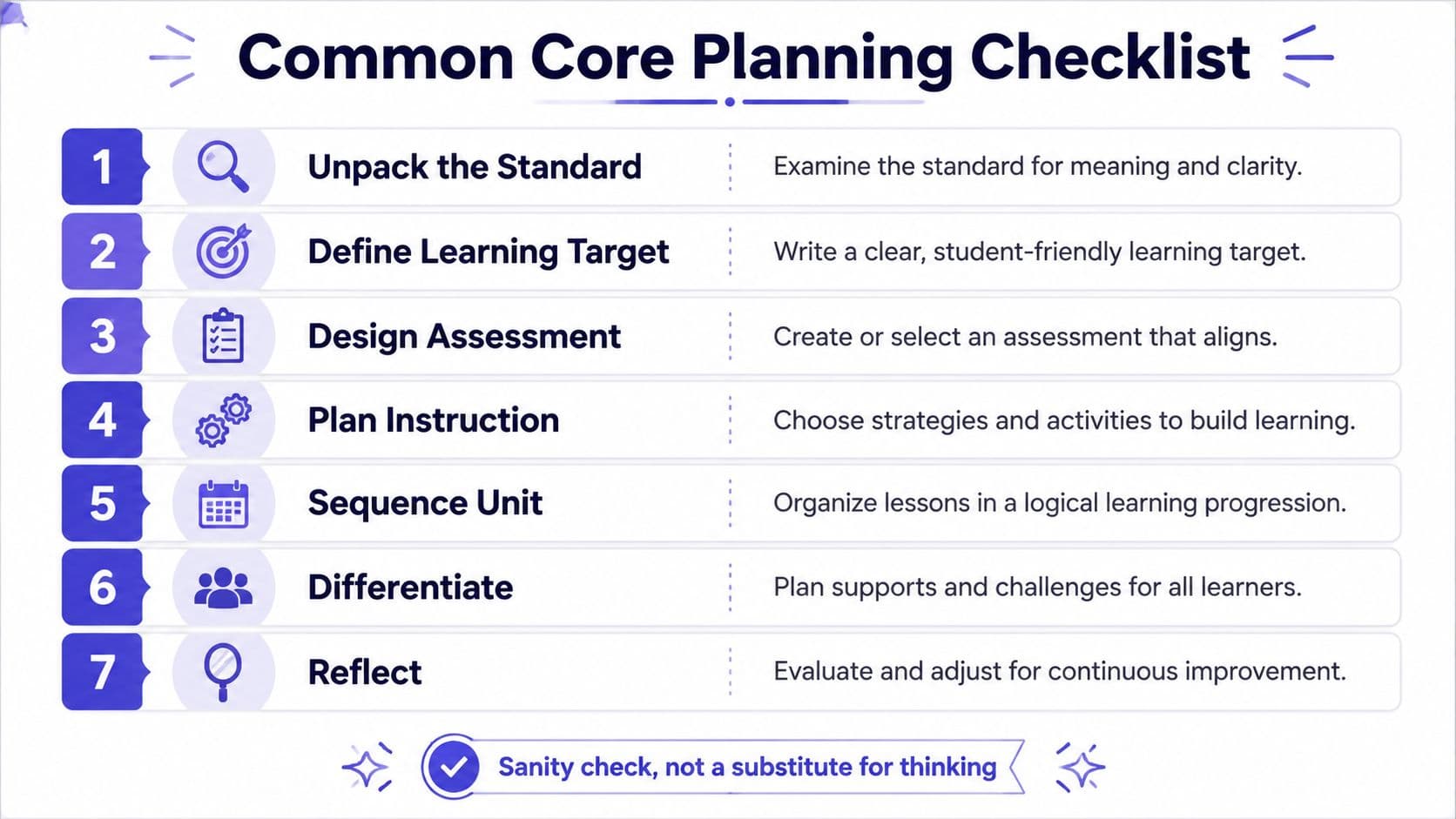
Your Common Core Planning Checklist
A checklist won't replace professional judgment. It should function as a sanity check, especially when the clock is moving and tomorrow's materials still aren't ready.
Use this sequence beside your planner:
- Unpack the standard. Isolate the verb, content, and context. Write down the performance students must demonstrate.
- Define the learning target. Turn the unpacked standard into a measurable, student-facing objective. “I can” language works well when it names the actual behavior.
- Design the assessment. Build the task or response that would prove the objective. Make the evidence visible before selecting practice activities.
- Plan instruction. Choose modeling, guided practice, independent work, questions, materials, and checks that ask for the same kind of thinking as the standard.
- Sequence the unit. Rank priority standards, describe proficiency levels, and place lessons in an order that builds toward the cumulative task.
- Differentiate without lowering the target. Choose supports based on the barrier. Adjust access, pacing, grouping, or response mode while preserving the standard's cognitive demand.
- Reflect after teaching. Sort the evidence. Record what students can do, where alignment drifted, and which lesson needs revision.
Independent Common Core planning templates commonly include objectives, exact standards, procedures, materials, assessment, differentiation, and reflection (lesson plan template guidance). A structured rubric for standards-based lesson plans has also used seven elements, each scored on a three-point scale, where 0 represents poor, vague, or nonexistent work, 1 represents somewhat lacking but acceptable work, and 2 represents clear, concise, measurable, or complete work (standards-based lesson plan rubric).
At the end of the week, ask yourself two plain questions: What tripped students up? Which step will I tighten next? If the assessment didn't reveal enough, redesign it. If the unit stalled, revisit the sequence. If differentiation lowered the demand, change the scaffold rather than the standard.
Kuraplan can help you draft Common Core aligned lesson and unit plans, worksheets, visuals, and assessment rubrics so you can spend less time formatting and more time reviewing the decisions that matter. Visit Kuraplan to build an editable planning draft around your standards, sequence, and students' needs.