
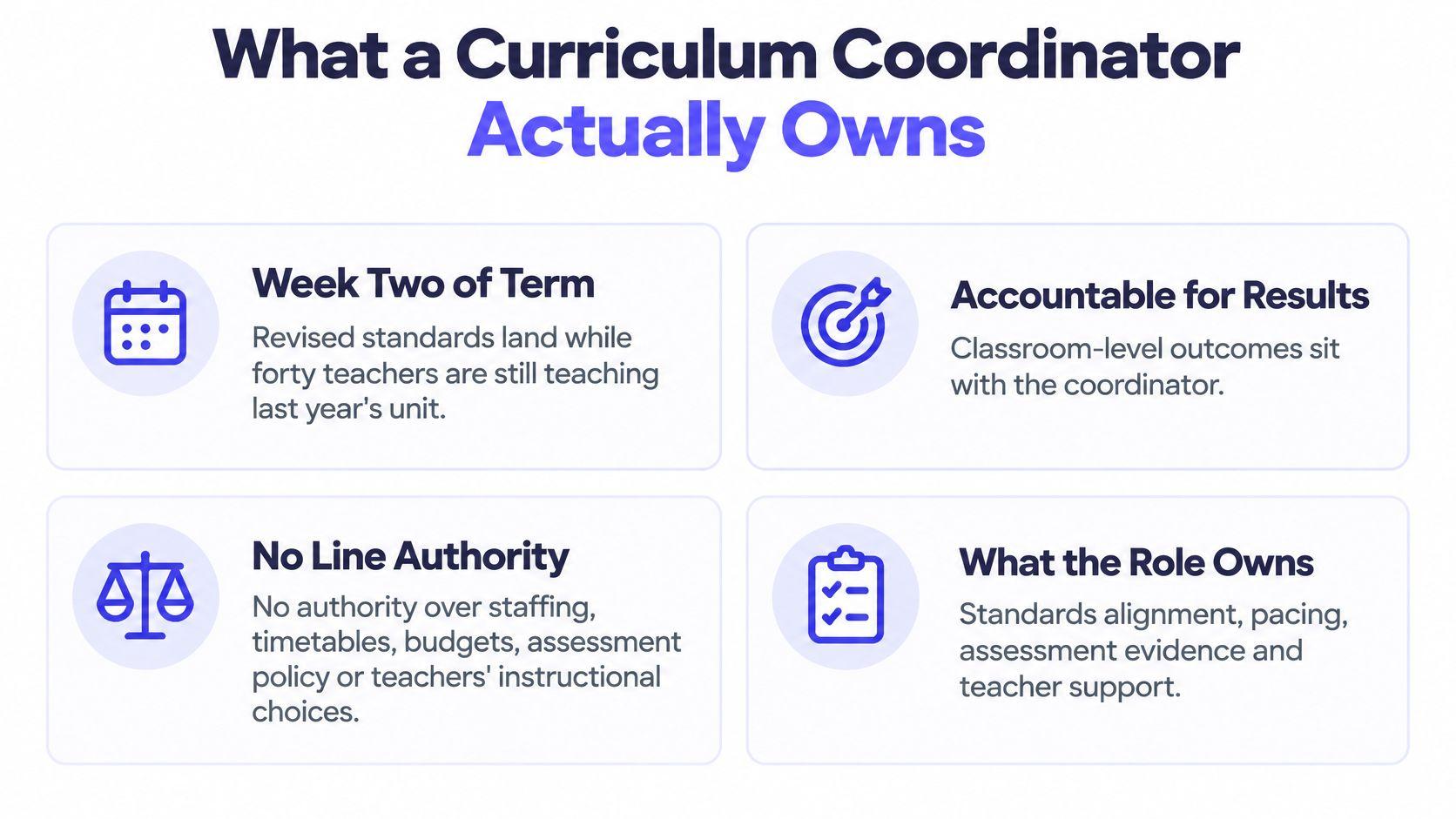
It's week two of term. Say revised standards have just landed, forty teachers are still teaching last year's unit, and your principal wants to know when the new curriculum will be embedded. You can revise the map before lunch. Getting teachers the time, materials and support to use it is another matter.
That's the awkward centre of curriculum coordinator responsibilities: you're expected to connect planning with classroom results, often without control over the timetable or budget. In 2026, there's another resource to check too, the AI-generated unit waiting in your inbox.
What a Curriculum Coordinator Actually Owns
The immediate problem isn't the outdated document. It's the mismatch between the revised expectation, the lesson teachers have prepared and the task students will eventually complete. Sending a new scope and sequence won't resolve that mismatch on its own.
In the United States, the occupation is classified as instructional coordinator, not curriculum writer. The U.S. Bureau of Labor Statistics occupational definition includes developing instructional materials, coordinating educational content, incorporating technology and setting curriculum-development guidelines. The wider role includes observing teaching, evaluating programmes, recommending improvements and organising access to materials.
This is an established institutional function. The Bureau of Labor Statistics occupational figures put employment at approximately 174,900 jobs in 2020, with a $70,160 mean annual wage, and about 248,700 jobs in 2025, with employment projected at roughly 252,800 by 2035. Those are different reporting periods, not a current salary promise or a clean like-for-like growth measure.
For workload context, Canada's Job Bank reports 35 to 40 hours weekly for comparable education-programme roles. That describes Canadian roles, not a guaranteed working week for a U.S. coordinator.
A curriculum coordinator connects what students are meant to learn, what teachers can deliver and the evidence that shows whether learning happened.
The outcomes behind the paperwork
In practical terms, protect three outcomes:
- Alignment: The intended curriculum, classroom instruction and assessment agree.
- Teacher capability: Staff have the subject knowledge, examples and planning support to teach the design.
- Evidence: Someone checks implementation and student learning, then acts on the findings.
The operational pressure is easy to recognise:
A polished curriculum folder isn't evidence of any of those outcomes. In the revised-standards scenario, your first useful move is to identify the affected units, establish what teachers need to change and agree how students will demonstrate the new expectation. The responsibility table turns those outcomes into visible weekly work.
Eight Responsibilities That Fill a Coordinator's Week
Horizontal alignment connects objectives, teaching, resources and assessment within a course or grade. Vertical alignment checks how knowledge and skills develop across grades. Compliance alignment connects the programme to applicable state, national, accreditation and district requirements.
The San Felipe Del Rio curriculum-coordinator job description makes this connection explicit: standards, implementation, teaching practices, instructional support, resources and assessment belong together. Treat them as connected checks, not separate folders maintained for different visitors.
Core responsibilities, weekly work and useful evidence
| Responsibility | What it looks like in a normal week | Evidence it is working |
|---|---|---|
| Curriculum mapping and alignment | Rebuilding scope-and-sequence documents each term and checking units against the standards map | Every standard traces to at least one unit and one assessment |
| Standards translation | Turning revised standards into usable unit outlines, success criteria and pacing guidance | Teachers can name the outcome a lesson serves without opening a document |
| Materials review and adoption | Auditing textbooks, digital subscriptions and teacher-made resources against a shared rubric | Adopted resources match the map, without duplicated or orphaned units |
| Assessment design and item review | Checking benchmark and end-of-course items before release | Items measure taught content at the intended cognitive level |
| Data analysis and progress monitoring | Running meetings after benchmark windows and tracking cohorts against outcomes | Every meeting ends with a named change, an owner and a re-check date |
| Professional learning and coaching | Planning sessions, modelling lessons, conducting walkthroughs and giving feedback | Observation notes show the new practice appearing in lessons |
| Compliance and accreditation | Maintaining documentation for state, district and accreditation reviews | Reviews don't require last-minute evidence gathering |
| AI and edtech vetting | Reviewing tools and AI-generated materials before classroom use | Reviews are documented and teachers know what they may adapt |
Don't give every duty equal space
A job description can contain a dozen duties. Your calendar can't accommodate a major initiative in every row simultaneously.
I would protect mapping, assessment design and analysis of student evidence first when a curriculum change is underway. Queue lower-priority resource requests, consolidate routine updates and tell your principal which work will move later. Otherwise, the urgent request for a replacement worksheet can displace the assessment review that would have exposed a unit-wide problem.
The table prevents two expensive mistakes: coverage without mastery, and assessments that measure material nobody taught. Neither becomes visible through a checklist showing that teachers reached the final page.
Use the evidence column at performance-review time. Bring the revised map, reviewed assessment, coaching notes and decision log, rather than describing how busy you've been. That gives your principal something concrete to evaluate.
The AI-vetting row is the newest addition and the one most likely to be absent from an older job description. Don't let its absence turn it into unallocated work.
How the Curriculum Cycle Runs From Standards to Evidence
The Bureau of Labor Statistics occupational handbook places curriculum development, teacher training, test-data analysis, resource review and implementation procedures within the same role. That combination matters: writing the curriculum and checking its use shouldn't become separate projects.
Work through the whole cycle
Unpack the standard. Name the content, cognitive demand and evidence a student would produce. If the standard requires an explanation, a lesson built entirely around identifying vocabulary won't meet it.
Update the traceability matrix. Use a shared spreadsheet linking each standard to an objective, adopted resource, assessment item and intervention option. Add enrichment where appropriate, so the map supports students who are ready to move further as well as those who need another route.
Sequence the unit. Check prerequisites against the grade below before deciding the starting point. A missing prerequisite needs planned teaching, not a note saying students should already know it.
Write the assessment blueprint before locking lessons. Specify the outcomes, task types and expected reasoning, then compare the blueprint with the teaching sequence. Don't demand a formal test for every worthwhile classroom activity, but don't leave required learning unexamined or assess untaught content.
Equip teachers to teach it. Provide exemplars, a shared planning template and a planning session, not just slides introducing the change. Clear learning intentions and success criteria help teachers distinguish the learning from the activity used to teach it.
Collect implementation evidence. Use walkthroughs, observation notes and student work samples to check what students encountered. Record whether the planned support was available before attributing weak results to the curriculum itself.
Review and record revisions. Combine assessment findings with teacher feedback, identify the change and log its date and owner. Keep previous versions accessible so teams can explain why a resource or sequence changed.
The cycle should remain connected rather than ending at resource production:
Give drafting tools a bounded job
Kuraplan can serve as the build tool: its standards-aligned unit plans connect lessons, assessments and learning progressions, giving the coordinator a draft to review and adapt rather than a blank document to format.
The time saved belongs in the checks, not in skipping them. Verify the local standard, the prerequisite assumptions and the level of demand.
I would schedule the complete cycle across a term. If a mid-year standards change leaves only a few weeks, protect assessment review, teacher preparation, implementation checks and revision time rather than pretending the rewritten plan completes the job.
Coaching Teachers Without Line Authority
You can be accountable for classroom results without authority over staffing, timetables, budgets, assessment policy or teachers' instructional choices. Responsibility without matching authority isn't a communication problem you can solve by sending clearer emails.
A study of grade-level coordinators describes a hybrid role with a persistent gap between curricular responsibility and authority. Time, bureaucracy, workload, resources and limited access to decisions constrain what coordinators can accomplish.
Coaching needs to happen close to the actual teaching:

Agree what's fixed and what teachers can change
Split each implementation into two categories:
- Non-negotiable: The learning outcome, evidence students must produce and agreed assessment window.
- Negotiable: Texts, examples, teaching methods, scaffolds, pacing within the unit and culturally responsive adaptations.
Teacher discretion supports adaptation to students. Uniform lessons aren't the target, and identical slide decks don't prove consistent opportunity to learn.
Say a Year 4 team resists a new writing block because the prescribed texts don't fit their students. Don't defend every page of the package. Establish the required writing outcome and agreed evidence, then ask the team to propose alternative texts and teaching routes that meet them.
That changes the conversation from compliance with a resource to responsibility for learning. If the team's alternative changes the assessment expectation, seek agreement before teaching begins.
Make feedback specific enough to use
I would observe twice before giving substantial feedback on a new practice. Bring student work to the planning conversation, model the difficult part of the lesson yourself and record the action agreed.
Write down what you'll each do. A teacher may need to adjust the scaffold; you may need to supply a better exemplar or negotiate planning time. Coaching shouldn't produce obligations only for the teacher.
Use a shared discussion prompt before choosing a coaching approach:
Practical rule: When implementation requires a timetable, staffing or budget decision, take the constraint to the person who can change it. Don't repackage it as teacher resistance.
Where Your Authority Ends and a Principal's Begins
Treat decision rights as a written agreement, not an assumption attached to your title. The following is a starting model to negotiate against your district's actual delegation and policies.
Decision rights for a curriculum coordinator
| Decision | Coordinator owns | Needs principal or district approval |
|---|---|---|
| Scope and sequence revisions | Draft, review cycle and revision log | Formal adoption and any required board notification |
| Core programme and textbook adoption | Shortlist, pilot design and evaluation rubric | Final selection, purchase and contract |
| Common assessment calendar | Proposed schedule and item review | Changes to grading policy, weighting or reporting |
| An individual teacher's methods and scaffolds | Guidance, exemplars and coaching | No routine approval, this remains teacher discretion within applicable policy |
| Professional learning budget and providers | Needs assessment, content design and facilitation | Spending approval and vendor selection |
| AI and edtech adoption | Review checklist, trial and recommended approval conditions | Data-privacy sign-off and licensing |
| Intervention grouping and staffing | Evidence of which students need which support | Timetable, class allocation and staffing |
| Board and community reporting | Draft narrative and evidence pack | Sign-off and presentation |
The operating rule is simple: the coordinator drafts, evidences and recommends; the principal or district adopts, funds and signs. A written delegation can allocate particular decisions differently, but everyone should know when that applies.
Turn ambiguity into a process
I would negotiate this list during the first month in post. It's a cheap document to produce and a costly one to operate without.
For a stalled decision, send a short written recommendation with the supporting evidence attached, a named decision-maker and a requested decision date. State the consequence of delay plainly, such as postponing training or continuing the existing resource. Don't proceed and hope approval follows.
The agreement protects teachers too. Their professional discretion shouldn't be renegotiated every time a new unit appears.
Two tempting overreaches are choosing a core programme before formal adoption and changing grading policy through an assessment guide. In both cases, doing the preparatory work doesn't confer final authority.
The opposite mistake is staying quiet when a tool presents a privacy risk or student evidence contradicts the pacing guide. You may not own the final decision, but you do own making the concern visible and recommending a response.
If you can't name who signed off on your last three consequential decisions, the decision-rights agreement is overdue.
Assessment Duties That Close the Loop
Assessment is where you find out whether a curriculum change helped students or merely changed the planning documents. The St. Lucie Public Schools coordinator job description includes progress-monitoring systems, interpretation of instructional data, collaboration with teacher leaders on revisions and review of benchmark and end-of-course assessments.
That places assessment design inside curriculum oversight, not in a separate administrative box.
Use evidence for the decision it can support
| Evidence | Decision it should inform | Misuse to avoid |
|---|---|---|
| Formative | What to explain, practise or scaffold next | Turning every learning check into a reported grade |
| Benchmark | Whether the programme's sequence, resources or supports need adjustment | Comparing classes without checking what was taught |
| Summative | What achievement to report against the intended outcomes | Treating the final result as a diagnosis of every earlier difficulty |
Design review starts before an item goes live. Check alignment, cognitive demand, accessibility and bias, then ask what a correct response would prove. An item requiring recall can't verify a unit outcome requiring analysis, however neatly it fits the topic.
That's the purpose of the assessment blueprint in step 4 of the curriculum cycle. Review the task and rubric together, because an appropriate task can still have scoring criteria that reward the wrong thing.
Progress monitoring requires more than a cohort average. Examine results by outcome and student group, alongside opportunity to learn, so a strong overall result doesn't conceal students who haven't benefited.
The implementation evidence collected in step 6 helps interpret those results. For immediate teaching adjustments, use manageable formative assessment examples, such as an explanation prompt or worked-example critique, rather than waiting for the next benchmark.
End with a decision, not a commentary
Data meetings should produce the revision work in step 7. Use the data-meeting row in the responsibility table as the standard: a named change, an owner and a re-check date.
If the decision is to continue, state the evidence that justifies it and what you'll monitor. An unexplained keep going isn't analysis.
Don't force one assessment to serve teaching, programme evaluation and reporting equally. Those purposes require different levels of detail and different response times.
Quality-Checking AI Materials in 2026
A teacher submits an AI-generated unit on Friday afternoon for Monday's lessons. Someone has to decide whether it's ready for students, and in most schools that someone is the coordinator.
Classroom adoption is already ahead of policy. In the European Commission's April 2026 school-education survey, 52% of respondents identified time savings on pedagogical tasks and 49% identified customised resource creation as major AI benefits, while 87% anticipated upskilling or continuous training and 79% expected increased stress from new responsibilities. Teachers will keep generating materials with or without a review process, so the question is who checks what reaches students and against what standard.
Eight checks before classroom use
Work through these in order. A unit that fails alignment or accuracy does not improve because it happens to be accessible.
| Check | Question to ask | Red flag |
|---|---|---|
| Standards alignment | Which standard does the task assess, and at what cognitive level? | Activities without matching objectives, or objectives without tasks |
| Factual accuracy | Has a subject specialist checked claims, dates, figures and sources? | Confident detail without a source or suspiciously rounded figures |
| Developmental appropriateness | Are reading, images and task demands appropriate for this group? | Material pitched well above or below students' needs |
| Accessibility | Can students access it with screen readers and suitable font size and contrast? | Image-only instructions or dense, text-heavy slides |
| Cultural responsiveness | Whose perspectives appear, and who is missing? | A single default perspective or stereotypes presented as facts |
| Assessment bias | Does success require unrelated vocabulary or background knowledge? | Reading demands that obscure the subject being assessed |
| Student data privacy | Does the tool store, train on or transmit student data? | Missing privacy terms or prompts containing student names |
| Documentation of human review | Who checked it, when, and what changed? | No record, or the AI itself offered as the quality check |
Give staff a usable permission sheet
- Adapt independently: Examples, wording and scaffolds within approved resources, provided the learning demand remains intact.
- Seek coordinator review: New units, assessment items and substantial changes to objectives or content.
- Seek district sign-off: Tools requiring licensing, accounts or student-data processing.
- Record human review: Reviewer, version, date, changes and any conditions before use.
A practical guide to AI in schools can support staff discussion. Your local permissions still need to be explicit, including the line between permitted teacher assistance and generating work students are expected to produce themselves.
Student verification needs teaching as well. AI Video Detector's resource on assessing student verification skills offers a relevant starting point for considering how students check media and justify trust.
AI reduces production time while increasing review work. Without an agreed protocol, the coordinator inherits that extra work informally, with neither a clear queue nor a defensible approval record. Put the Friday submission into a defined queue with the checklist attached, or accept that Monday morning decides it for you.
Audit Your Own Role This Term
List your last twenty tasks. Sort each into alignment, capability, evidence or compliance, then look for the empty category. If you've been rewriting units and running training without checking student work, evidence is where to start.
Don't count tasks as if they require equal effort. Beside each, record whether it led to a decision, supported teaching or satisfied a requirement. A crowded calendar can still leave the essential work unfinished.
Make three commitments
- Write the decision-rights agreement. Take it to your principal within a fortnight. Resolve who approves resources, who controls spending and who handles stalled decisions before the next urgent adoption.
- Trial the AI review protocol. Use a single team and real classroom materials. Remove checks that duplicate existing processes, clarify the confusing ones and test whether teachers can record review without creating another paperwork burden.
- Complete a worked curriculum cycle. Choose one unit in one grade and follow it from standards to reviewed student evidence. Keep the original plan, implementation notes, findings and revision together.
That worked example gives you something useful in a budget conversation. You can show the support teachers needed, the obstacle you couldn't resolve alone and the change justified by student work.
Keep the scope small enough to finish. A completed review of a manageable unit tells you more than an ambitious district-wide redesign that never reaches evaluation.
Book the review meeting when you choose the unit, not after teaching ends. Put a named colleague beside each commitment so the audit produces shared action rather than another private to-do list.
The job is the loop, not the documents.
Visit Kuraplan to build an editable, standards-aligned unit with connected lessons, assessments and learning progressions. Use its differentiated lesson plans and assessment rubrics as drafts for a team review, then spend the planning conversation checking fit, teaching demands and the evidence you'll collect.