
It's Thursday, your decimal lesson is at 8:40 tomorrow, and students still mix up the 3 in 4.37 with the 3 in 4.73. You need a decimal place value worksheet that tackles that confusion, not another page students can finish by counting columns without understanding them.
The sources below are sorted by the mistake they help you address: reading a digit's place, confusing tenths and hundredths, comparing decimals, or checking work against an answer key. Each has a different use. A generator is handy for fresh practice, but a chart or worked example is often the better starting point.
Start with our free library if you need a quick option. It holds more than 1,000 printable worksheets across math, reading, science, and more. Before printing, check the actual student page, not just the resource title. A sheet labeled place value might ask students to name a position, state a digit's value, or calculate with decimals. Those aren't interchangeable tasks.
1. Decimal Place Value Chart, Free Printable Worksheet for Mathematics
Best for students who can read a decimal but put its digits in the wrong columns.
The Decimal Place Value Chart connects digit positions with their values, covering tens through ten-thousandths. Students identify positions, record decimals in a chart, and apply place value during decimal addition. It's free, printable, and customizable for classroom practice or take-home review.
That combination makes it a useful starting point. Instead of assigning isolated digit-labeling questions, have students place a decimal in the chart, identify a digit's value, and explain why it belongs there. Then use the addition practice to check whether they can keep equivalent places aligned.
What to check before printing
- Range: Cover or remove unfamiliar columns when your lesson focuses on tenths and hundredths.
- Addition demands: Check whether the calculation requires regrouping your group hasn't learned.
- Answer key: Availability isn't stated on the resource details, so prepare your own checked copy.
- Alignment: The page doesn't specify a target grade or standards alignment.
The place-value teaching guide is useful for planning the explanation around the sheet rather than treating the chart as the lesson itself.
The important idea is the relationship between columns. The New Jersey mathematics standards specify that a digit represents 10 times as much as it does in the place immediately to its right. Ask students to explain that relationship, not merely recite the headings.
2. MathWorksheets4Kids
A student who names decimal places correctly may still struggle when the same skill appears in a word problem. MathWorksheets4Kids is useful for changing the question format without immediately changing the underlying concept.
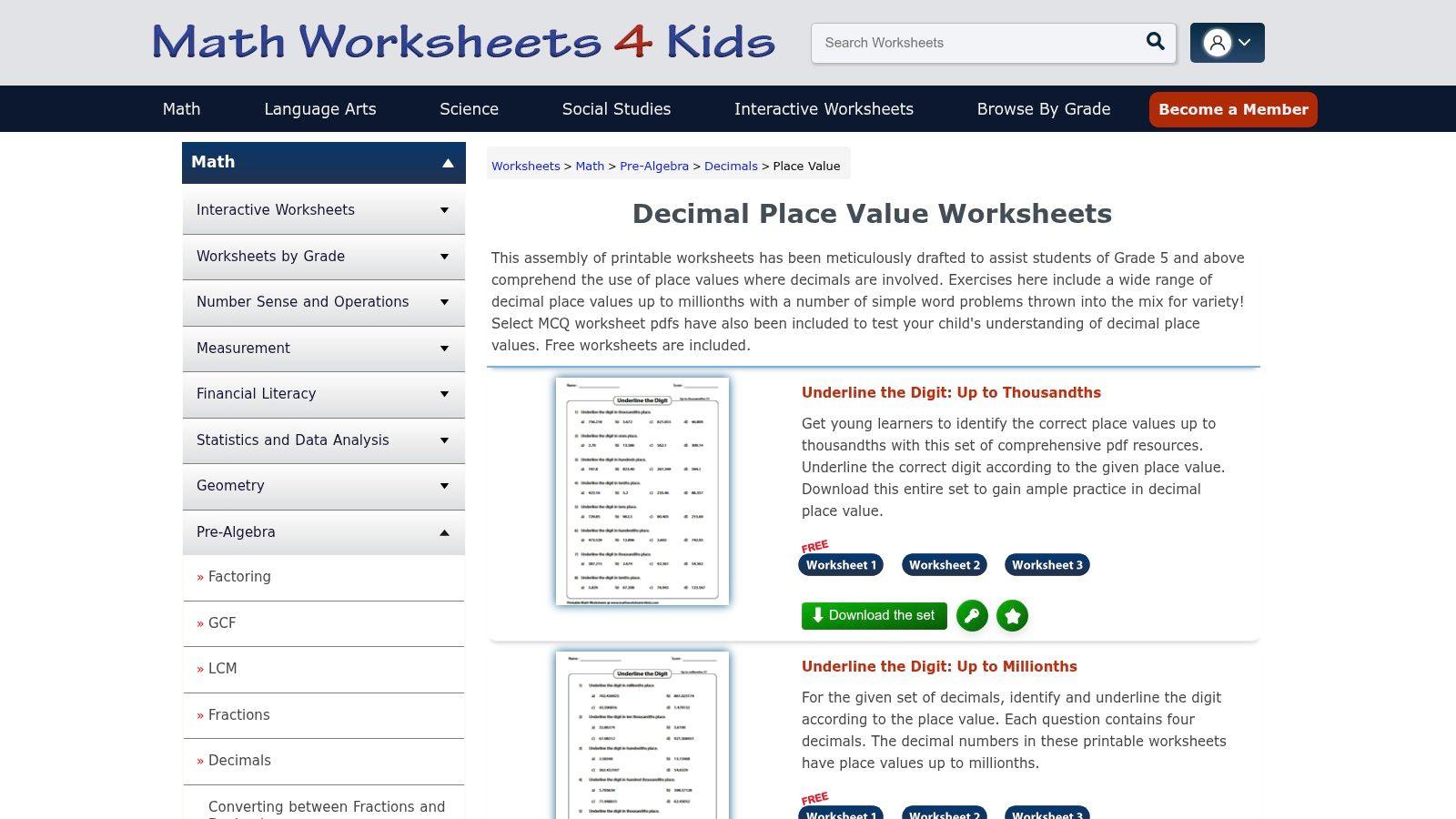
The MathWorksheets4Kids decimal-place-value collection includes underlined-digit questions, digit values through millionths, multiple-choice practice, word problems, and money contexts. Related pages cover number names and standard and expanded forms. Some materials are free; some downloads or answer keys may require membership.
I'd choose it when students need varied practice after an explanation, rather than another identical question set. Start with a familiar format, then assign a contextual question that requires students to interpret the value.
Practical rule: A money problem can make a decimal meaningful, but it doesn't automatically explain every decimal place.
In a controlled study of decimal addition and subtraction, students initially answered 6% of symbolic items correctly, compared with 31% in money contexts. That supports including context, not replacing all other representations with currency.
Before printing: Check the selected sheet's decimal range and answer-key access. The collection is broad enough that browsing can take longer than expected, especially when you only need introductory practice.
3. Math-Aids.com
Choose Math-Aids.com when students need another attempt with different numbers, not a different lesson. Its generator is more useful for repeatable practice than for building a complete conceptual sequence.
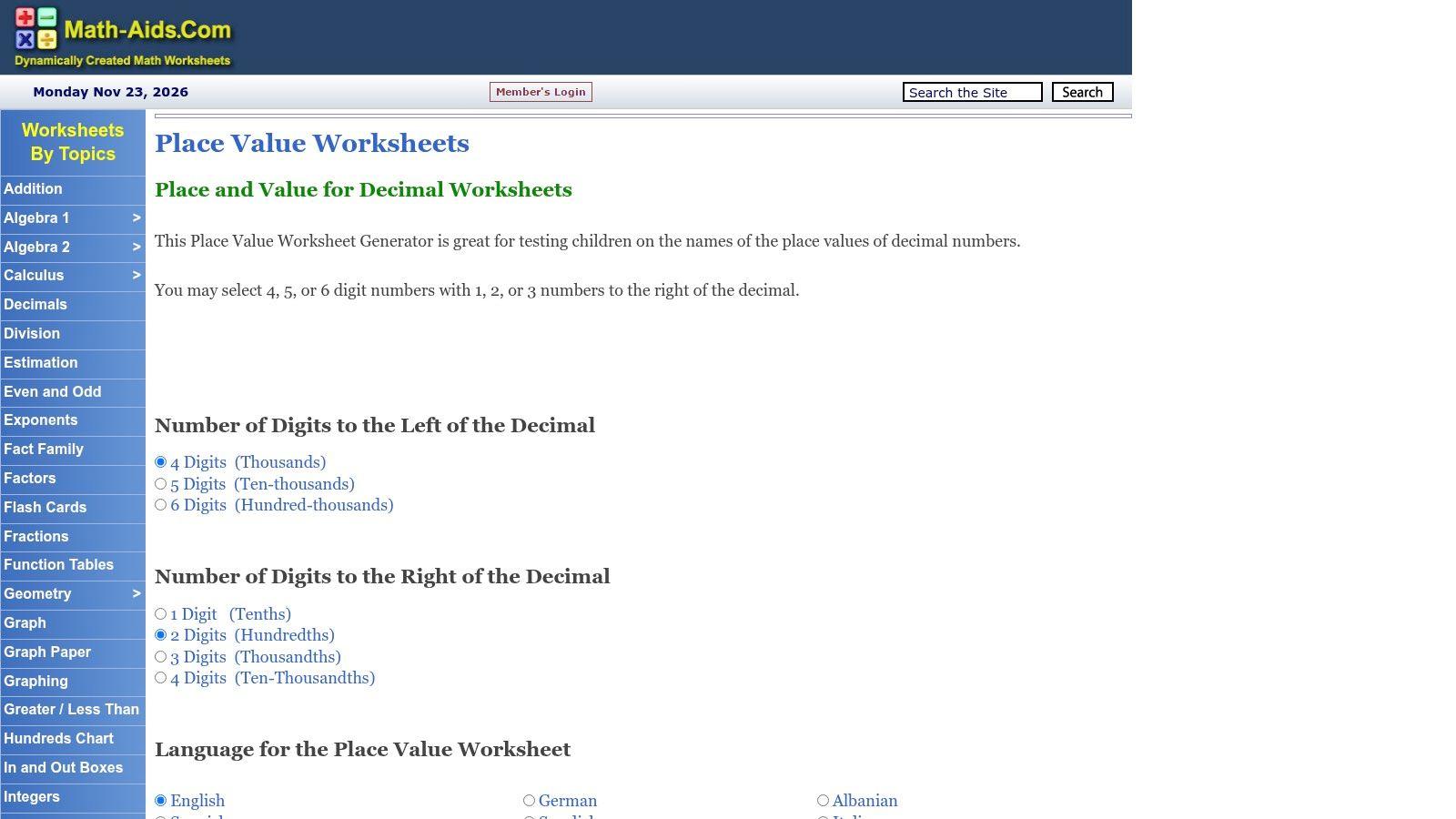
The free Math-Aids.com decimal place-and-value generator lets teachers select 4–6 whole-number digits and up to 4 decimal places, enter a custom instruction line, and generate a matching answer page. Language settings include English and Spanish.
That control helps when a group needs fresh examples of the same skill. The drawback is the number length: a student who's just beginning to distinguish tenths from hundredths may find the whole-number portion unnecessarily distracting.
Make the instruction line do some teaching
Use the custom memo to clarify the response you expect. Tell students whether to write a place name, a digit's value, or both. Otherwise, a correct answer to the wrong interpretation can look like misunderstanding.
- Good fit: Naming positions and identifying values during independent practice.
- Weak fit: Diagnosing why students compare decimals incorrectly.
- Review first: Confirm that the generated answer page matches the selected task and number range.
For a different practice format, the decimal worksheet collection offers another starting point. Don't assign extra repetition when the student needs a visual explanation instead.
4. Common Core Sheets
When students identify decimal places correctly but still order decimals incorrectly, Common Core Sheets offers a practical next step. You can select related skills without assuming that success on digit naming means students understand magnitude.
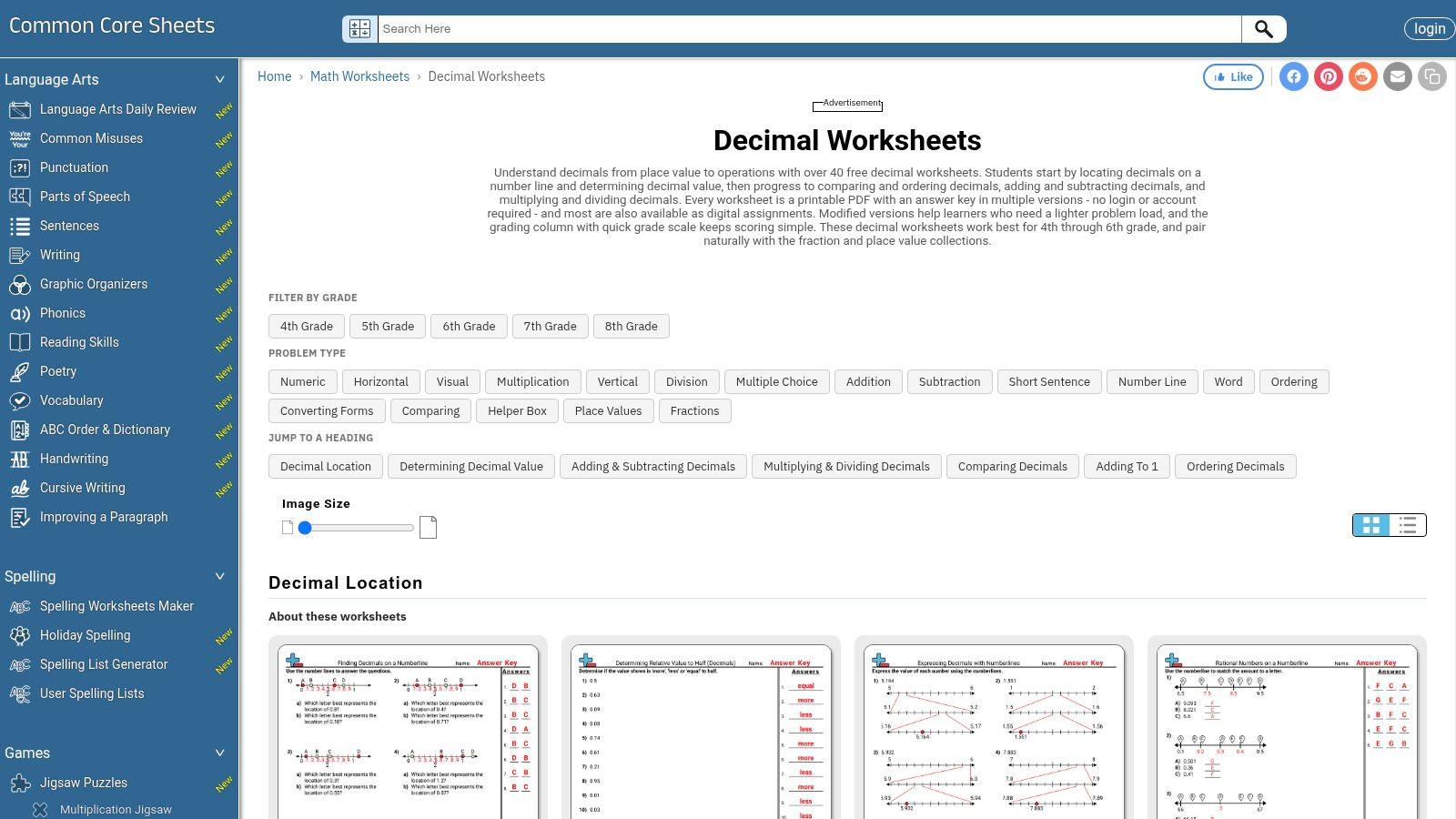
The Common Core Sheets decimal collection covers Grades 4–8 and includes digit values, comparison, ordering, and operations. Free printable PDFs are available without an account, with answer keys, multiple versions, and digital assignment options on most worksheets.
Multiple versions are the useful feature here. They let you check the same skill again without asking students to reproduce answers they remember from the original page.
- For reteaching: Select a tightly focused skill rather than a mixed decimal review.
- For reassessment: Use another version after instruction, then compare the reasoning as well as the score.
- For planning: Check the actual task against your curriculum; a Common Core grade label won't necessarily match local pacing.
For comparison practice, add a short explanation prompt. The University of Melbourne decimal-misconception resource describes distinct patterns, including treating longer decimals as larger and shorter decimals as larger. Those students need different explanations, even when both receive the same incorrect mark.
5. Super Teacher Worksheets
Some students need to move, match, and say decimal values before another written drill makes sense. Super Teacher Worksheets offers more options for that kind of guided practice.
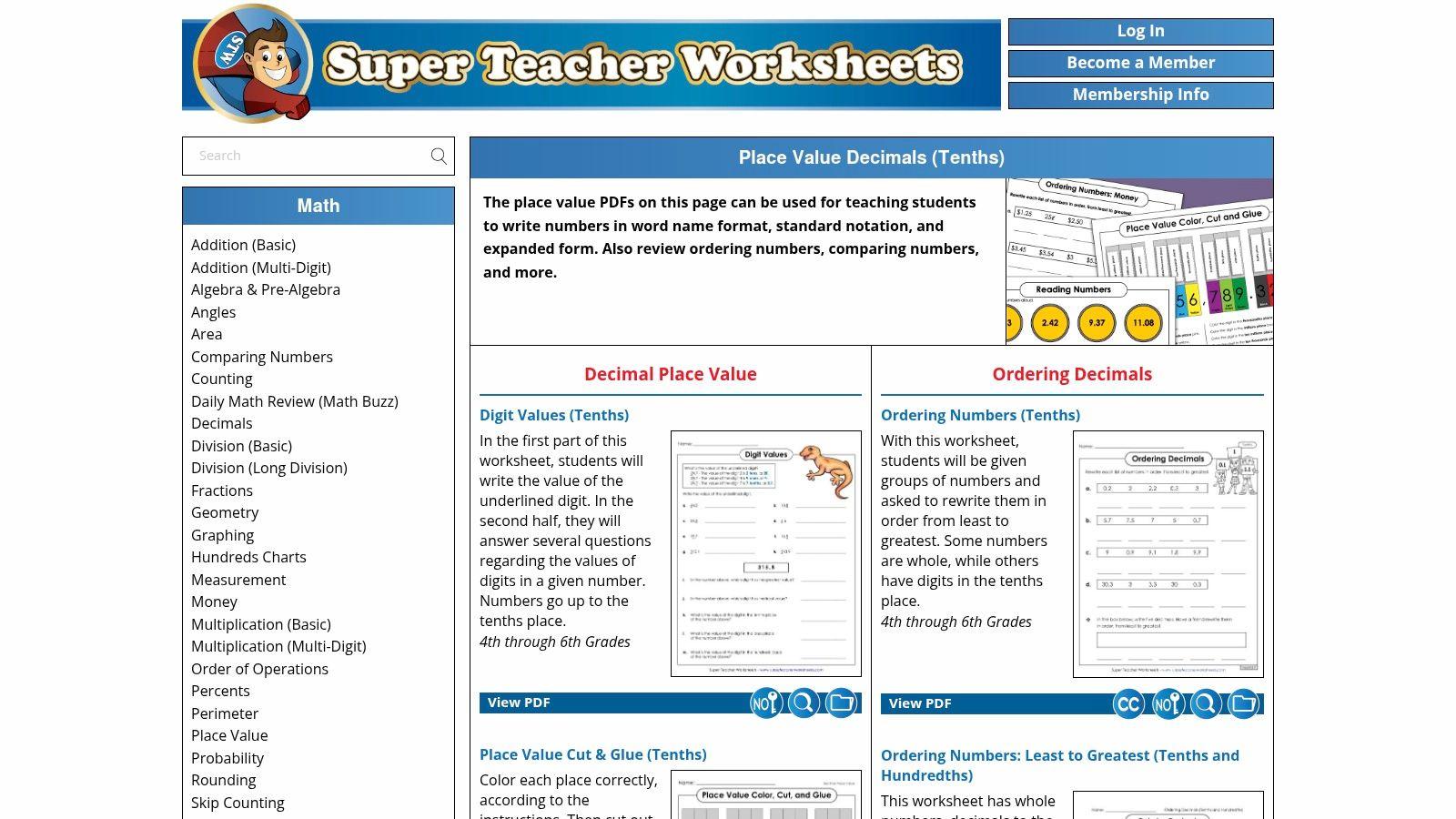
The Super Teacher Worksheets decimal-place-value collection combines conventional worksheets with anchor charts, cut-and-glue activities, reading decimals aloud, and comparing or ordering tasks. Related sections separate tenths, hundredths, and thousandths, while suggested grade labels help narrow the selection.
Use the activity variety deliberately. A matching task can help students connect a numeral, a place name, and a value, but cutting and gluing alone won't tell you whether they understand the relationship.
Ask students to explain a match before they glue it down. The explanation is more useful than a neatly finished page.
Watch the vocabulary demand
The decimal-vocabulary intervention described by EBSCO supports explicitly teaching mathematical language alongside decimal work. Let students rehearse terms aloud and point to a visual before writing an explanation.
Before printing: Check subscription access and whether the selected activity targets place value. For another format, browse the place-value worksheets, then choose by the response students need to practice, not by the worksheet's appearance.
6. K5 Learning
K5 Learning is a strong choice when students can name a place but can't translate that position into value. Expanded notation makes that gap easier to see.
The K5 Learning place-value and rounding collection includes grade-organized materials for composing and decomposing decimals, writing expanded forms, and converting them back to standard notation. Decimal work extends through thousandths, with related rounding and broader decimal practice.
A student might correctly label a digit as hundredths yet omit its fractional value when expanding the number. That's a more useful diagnostic than another correctly completed column-labeling exercise.
Use both directions
- Standard to expanded: Check whether students preserve each digit's value.
- Expanded to standard: Look for missing placeholder zeros and misplaced digits.
- Explain the connection: Ask students to point from each expanded term to its position in the numeral.
The trade-off is scope. Some pages ask for more than straightforward place-name identification, so don't assign them as introductory practice unless students understand the notation.
Access also needs checking. K5 Learning combines free worksheets with membership content, and requirements vary by resource. Open the specific printable before planning homework around it.
I'd use these sheets after chart work, then keep the chart available for students who still need to reconstruct a number. Removing the support too soon can turn a useful notation task into guessing.
7. Education.com
Education.com makes most sense when you want a printable plus another way to practice, rather than a large stack of similar pages.
The Education.com decimal-place-value collection sits within its broader Pre-K–8 library and offers printable and interactive activities filtered by grade and skill. Related resources address comparison, ordering, expanded form, and thousandths. Basic membership is limited to three content downloads per month, while unlimited access requires paid Premium membership.
The filters help, but a grade label is only a starting point. Open the resource and check whether students are naming positions, interpreting values, or applying place value in another task.
- Best use: Pair a focused worksheet with a different representation of the same concept.
- Main trade-off: Download limits make trial-and-error selection less convenient.
- Teacher review: Confirm the resource format, access conditions, and answer-key availability before assigning it.
The mixed formats can support differentiation without giving everyone unrelated objectives. One group might complete a printable while another uses an interactive activity addressing the same misunderstanding.
Don't switch formats just to keep students occupied. After either activity, ask students to explain a decimal comparison or identify a digit's value without the interface's cues. That short transfer check tells you more than completion alone.
8. Math Picnic
Math Picnic is the straightforward option for a short practice page and a separately printed answer key. It's especially useful when you know the precise skill you need to check.
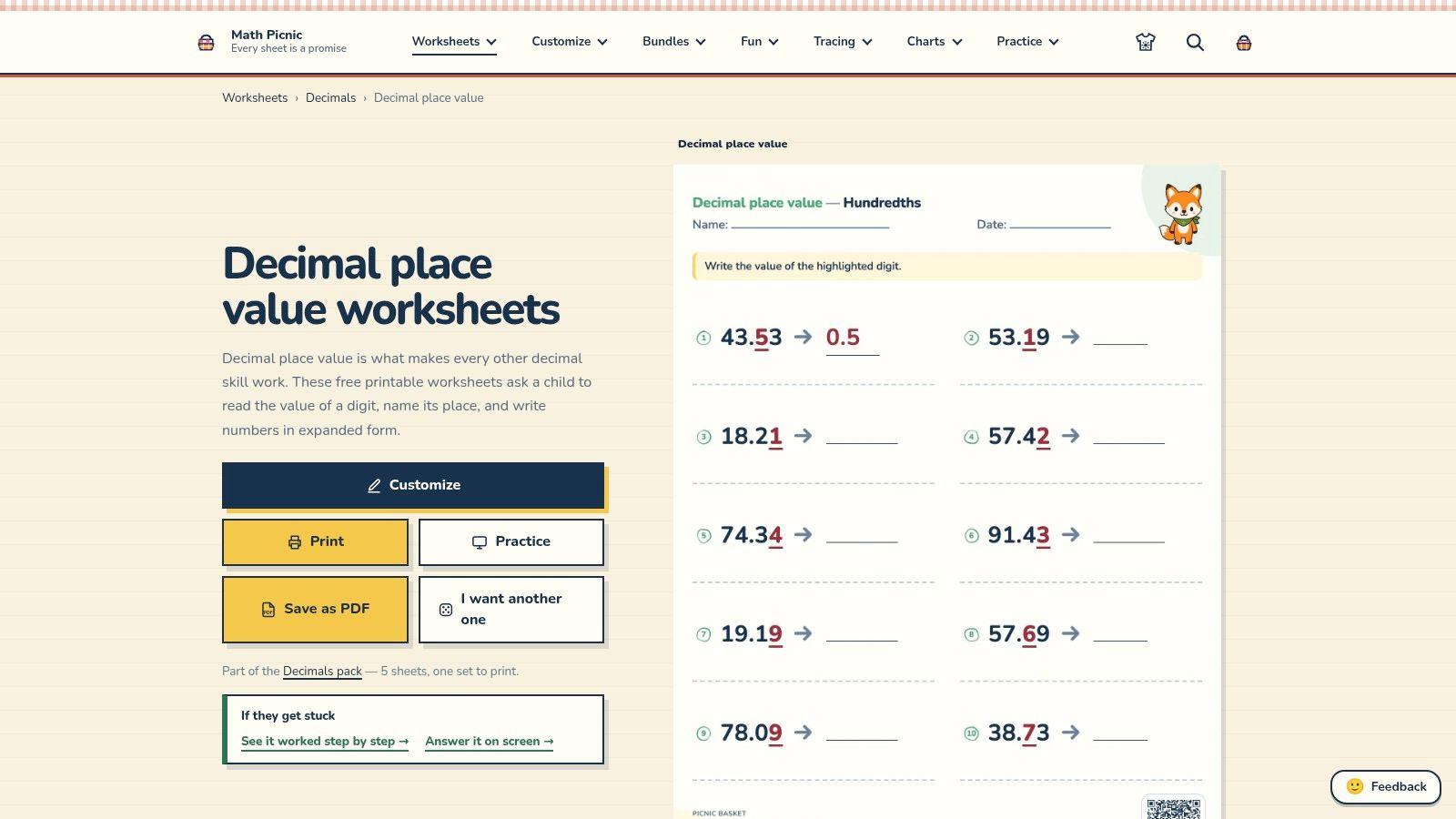
The Math Picnic decimal-place-value page focuses on identifying digit values, with levels for tenths, hundredths, and thousandths. Related activities address decimal place names and expanded form, and the page includes a worked teaching approach.
The separate answer key is convenient for handing out student copies without accidentally including solutions. Still, distinguish place name from value when modeling the directions. Students shouldn't have to guess which response you'll accept.
Checking advice: Use the key to verify the answer, then use the student's explanation to decide what to reteach.
Where the smaller collection helps
A compact collection reduces browsing when you need a focused exit check. It also means fewer alternate activity formats if students don't understand the first explanation.
I'd use Math Picnic after guided practice, then sort responses by error type. A wrong place name calls for a different follow-up from a correct place name paired with an incorrect value.
Before printing: Confirm the selected level, inspect the worked example, and make sure the answer page stays out of the student-copy print range.
9. Math Center
When students still confuse tenths and hundredths, extending the worksheet to smaller decimal places can add difficulty without addressing the problem. Math Center's introductory focus is useful here.
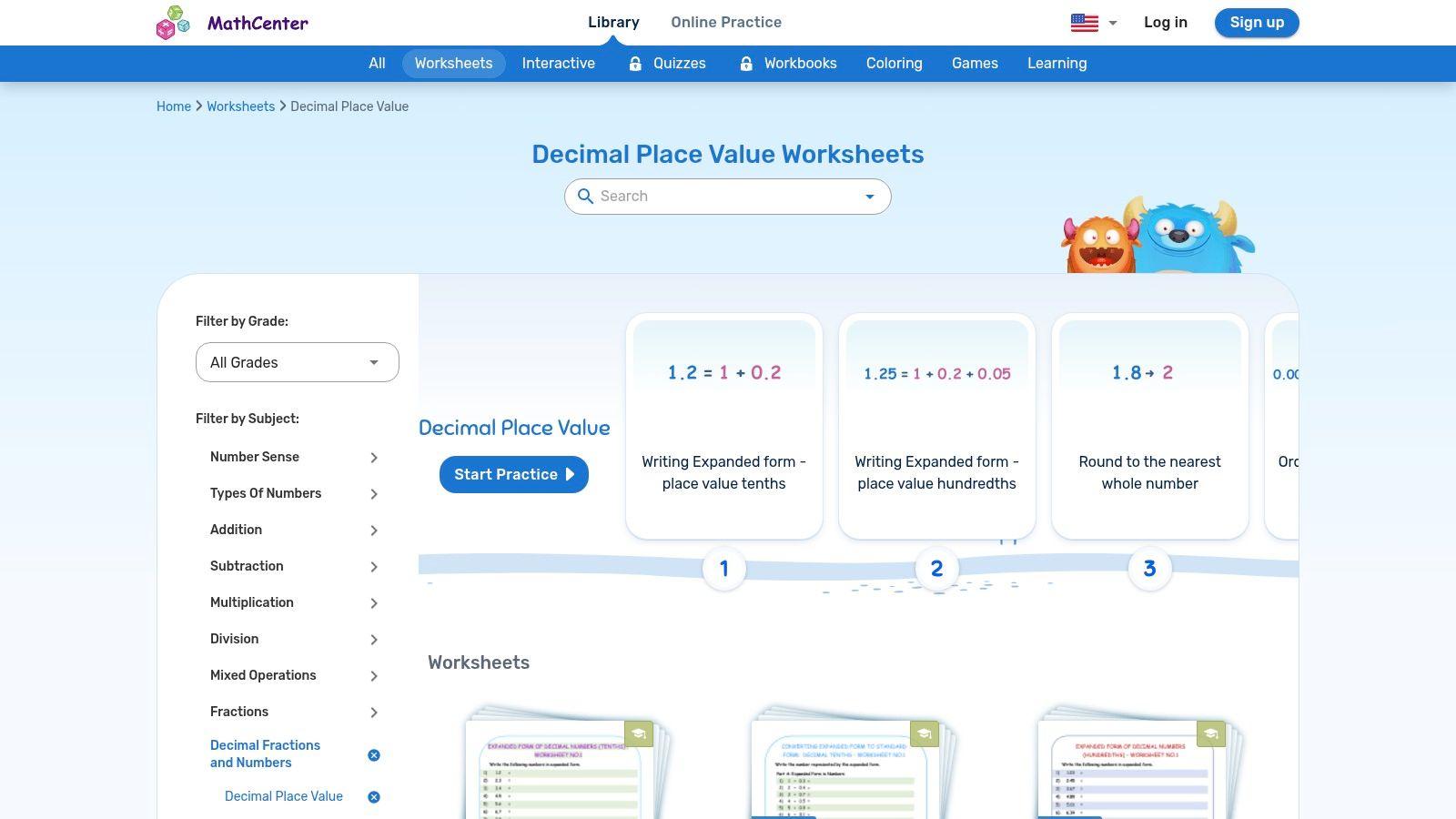
The Math Center decimal-place-value collection combines printable worksheets with interactive learning pages, primarily around tenths and hundredths. Activities include place-value charts, expanded forms, reading and writing decimals, and related comparison or ordering practice.
That narrower range can be an advantage. Keep the quantities familiar while students move between a chart, written notation, and a spoken explanation.
- Start with representation: Have students show where each digit belongs.
- Connect to notation: Ask them to write the value represented in each column.
- Check transfer: Return to a plain numeral without the chart.
The limitation is equally clear: this isn't the first stop for a class ready to work extensively with thousandths or beyond. Choose it for its introductory focus, not for breadth.
Teacher review is still necessary. Individual activities may address different objectives, and the collection description doesn't establish answer-key availability for every sheet. Check the selected printable and any interactive instructions before students begin, especially if you're moving between paper and screen during a small-group lesson.
10. Math Worksheet Studio
Math Worksheet Studio is useful when the practice settings matter more than browsing a library. Choose the decimal range and question type, then inspect the generated output.
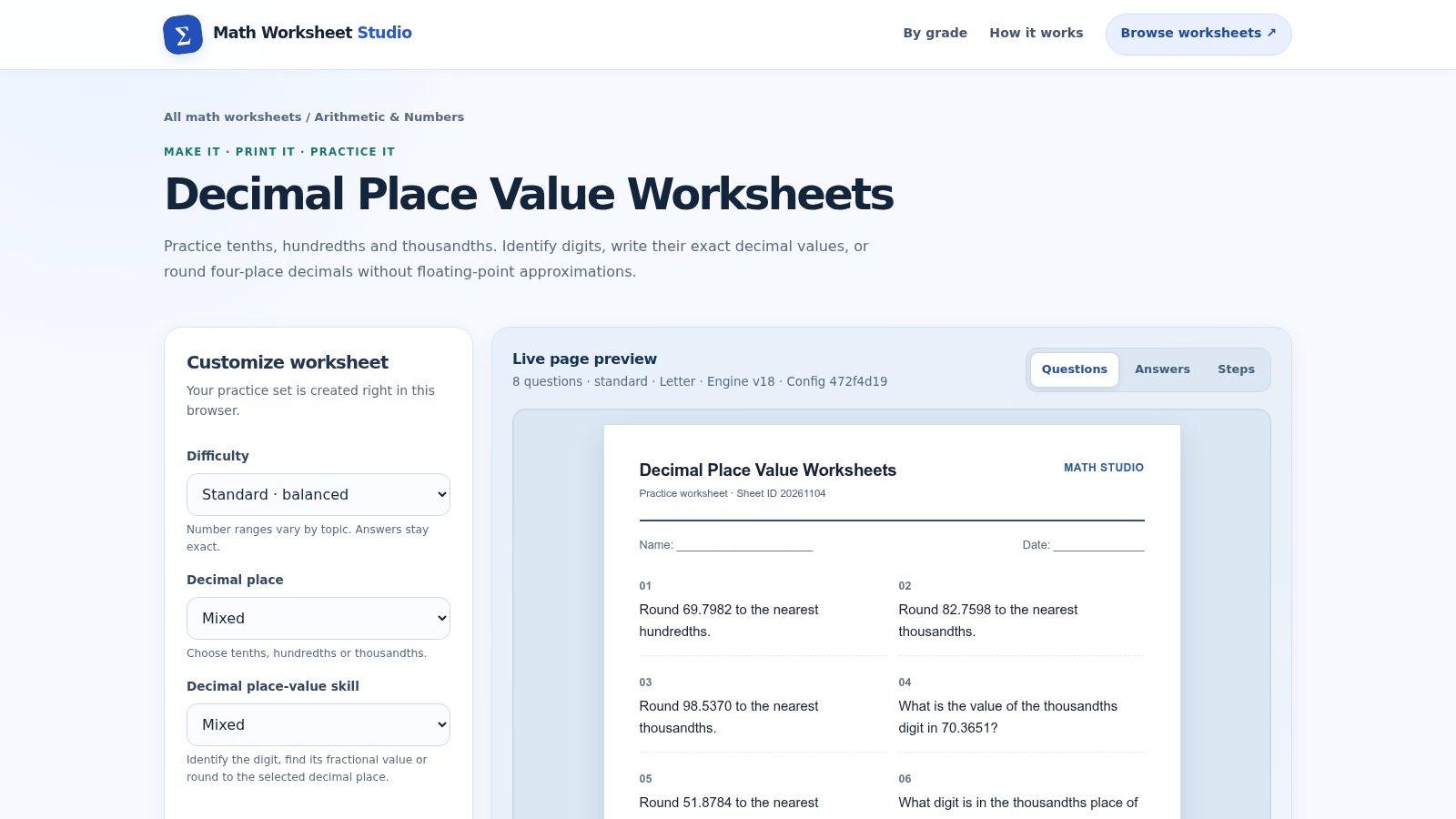
The Math Worksheet Studio generator offers tenths, hundredths, and thousandths practice, with mixed questions, digit identification, digit values, and rounding. It provides separate student, answer-key, and worked-steps PDFs, supports US Letter and A4 paper, and describes the generator as free with no account required.
Worked steps need a teaching check
Worked solutions can support reteaching, but only if they explain the idea students missed. The scaffolded-worksheet study available through ERIC found benefits from combining worked examples with self-explanation prompts rather than relying on independent problem solving alone.
Add a prompt asking students why a digit has its stated value. Don't assume reading the worked steps is enough.
- Best feature: Configurable practice with matching checking materials.
- Main limitation: It's a practice generator, not a complete lesson sequence.
- Before printing: Solve a generated question, inspect the key, and check that worked steps explain rather than merely announce the answer.
Be especially careful when selecting mixed practice. Rounding introduces another decision process, so leave it out when your immediate goal is distinguishing a digit's place from its value.
How the ten sources compare on levels, answer keys and access
| Item | Levels covered | Answer keys | Access | Best for |
|---|---|---|---|---|
| Decimal Place Value Chart, Free Printable Worksheet for Mathematics | Tens to ten-thousandths; grade level not specified | Not stated | Free, printable, customizable | Place-value charting and decimal addition practice |
| MathWorksheets4Kids | Roughly Grade 5 and up; tenths to millionths | Available for some materials | Some free; membership may be required for downloads or keys | Varied practice, review, and assessment |
| Math-Aids.com | 4–6 whole-number digits and up to 4 decimal places | Matching answer page generated | Free worksheet generator | Custom digit-place naming practice |
| Common Core Sheets | Grades 4–8; place value and related decimal skills | Included | Free printable PDFs; no account required | Standards-aligned practice with multiple worksheet versions |
| Super Teacher Worksheets | Suggested grade ranges; tenths, hundredths, and thousandths | Not stated | Some downloads require a subscription | Varied classroom activities and guided instruction |
| K5 Learning | Grade-organized; includes decimals to thousandths | Not stated | Mix of free worksheets and membership content | Standard and expanded form practice |
| Education.com | Pre-K–8 library; grade- and skill-labeled resources | Not stated | Three downloads per month with basic membership; paid Premium for unlimited access | Finding varied printable and interactive activities |
| Math Picnic | Tenths, hundredths, and thousandths | Separate printable answer key | Printables available; access details not specified | Focused practice or a quick exit check |
| Math Center | Primarily tenths and hundredths | Not stated | Printable and interactive activities; access details not specified | Introductory practice using multiple representations |
| Math Worksheet Studio | Tenths, hundredths, and thousandths | Separate answer key and worked steps | Free generator; no account required | Customizable, targeted practice with checking support |
Print One Sheet, Check the Key, Then Reteach
Pick the source that matches the mistake you saw in yesterday's exit ticket. Use a chart when students misplace digits, expanded notation when they confuse position with value, and comparison tasks when they treat decimal digits like whole numbers. A mixed review page is better saved for students who can already explain those connections.
Print a single page first, and work a problem against the answer key before copying a class set. Check the directions, writing space, decimal range, and whether the key expects a place name or a numerical value. If no key is available, prepare a checked teacher copy rather than improvising during marking.
Make the next teaching move specific
- Wrong column: Return to a labeled chart and ask students to place and read the numeral.
- Wrong value: Connect the digit to expanded notation and a visual representation.
- Wrong comparison: Use equivalent decimal forms and a number line, then ask for justification.
- Correct answer without an explanation: Change the representation before deciding the student has mastered the concept.
Keep calculation errors separate from conceptual ones. A student who understands decimal magnitude but misaligns an addition problem needs different feedback from a student who thinks more decimal digits always mean a larger amount.
For lessons involving multiplication and division, avoid teaching only that the decimal point moves. The New Mexico place-value standards guidance connects powers of ten with digit shifts and asks students to explain the pattern through place value. Your worksheet should leave room for that explanation.
If you want the worksheet to match your lesson rather than a generic skill, Kuraplan can generate one from any lesson plan with a click. The output can be downloaded as a PDF, and every plan and worksheet stays editable, so you can change number ranges or swap a question before it reaches students.
The aim isn't to finish a sheet tomorrow. It's to find out whether students understand what each digit represents, then choose the next explanation accordingly. Print less, inspect the thinking more closely, and make the follow-up count.
Kuraplan helps you turn a decimal lesson into an editable worksheet that's ready to print or share. Visit Kuraplan to create practice around the place-value mistake your students need to fix, then adjust the questions before printing your class set.